This site is supported by our readers. We may earn a commission, at no cost to you, if you purchase through links.
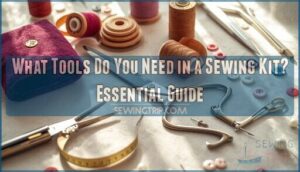
You can’t fix a popped button with wishful thinking, and you won’t get far in sewing without the right tools at your fingertips. The difference between a beginner’s struggle and a confident seamstress often comes down to having quality tools that work with you, not against you. From sharp scissors that glide through fabric to needles matched to your material, each tool fulfills a specific purpose that makes your work cleaner, faster, and more professional.
A well-stocked sewing kit transforms frustrating wardrobe malfunctions into quick fixes and opens the door to creative projects you’ll be proud to show off. Building your kit doesn’t mean buying everything at once—it means knowing which essentials belong in your collection and why they matter.
Table Of Contents
Key Takeaways
- Your sewing kit needs five core essentials—fabric scissors, hand-sewing needles, machine needles, a seam ripper, and measuring tape—that handle most common tasks and repairs.
- Sharp, fabric-specific scissors with high-carbon steel blades maintain precision through multiple projects, while using them on paper destroys their edge and ruins their effectiveness.
- Match needle types and sizes to your fabric weight for clean stitching: universal needles suit most wovens, ballpoint prevents runs in knits, and denim needles pierce thick materials.
- Organization transforms your kit from chaotic to functional—use compartmentalized storage with adjustable dividers and clear labeling to keep tools protected and instantly accessible.
Essential Tools Every Sewing Kit Needs
You can’t sew without the right tools at your fingertips. A well-stocked sewing kit starts with five core items that handle the most common tasks you’ll face at your machine or working by hand.
Before you stock up, check out this sewing project budget planning guide to prioritize essentials without overspending on extras you won’t use right away.
Let’s walk through each one so you know exactly what belongs in your kit.
Fabric Scissors
Sharp blades are the heart of your sewing kit. Fabric scissors feature high-carbon steel blades that keep their edge through project after project. You’ll want ergonomic grips to prevent hand fatigue during long cutting sessions. Look for 6-to-8-inch blades for dressmaking or longer for heavy-duty tasks. Reserve your sewing scissors exclusively for fabric—cutting paper destroys edge retention and ruins precision.
For a clear comparison of, it’s helpful to understand why fabric-specific tools are recommended for every sewing kit.
Hand-Sewing Needles
You’ll keep several hand sewing needles in sizes 7 through 10 for delicate fabrics and general mending. Sharps work well for most hand stitching, while betweens give you control in tight spaces.
Check the eye shape—round eyes fit standard thread, while long eyes handle multiple strands. Match needle sizes to your fabric weight for clean penetration without visible holes.
For more details on choosing the right needle, see this guide to types of hand sewing needles.
Sewing Machine Needles
Your machine requires different needles than hand sewing. Stock universal needles in sizes NM 70–90 for general fabrics, plus ballpoint needles for knits and denim needles for heavy materials. Needle sizes match fabric weight—smaller numbers suit lightweight fabrics, larger sizes handle thick layers and heavier thread types.
Replace needles every 8–12 hours of sewing to maintain stitching quality and machine compatibility.
- Universal needles fit most woven fabrics
- Ballpoint needles prevent runs in knits
- Denim needles pierce thick canvas
- Microtex needles suit delicate materials
Seam Ripper
Even careful stitching goes wrong sometimes—that’s where a seam ripper steps in. This small forked tool has a sharp blade at the base of its prongs, designed to slip under stitches and sever thread without damaging fabric. You’ll use it to fix sewing mistakes, remove basting, and correct stitch errors with precision.
Replace dull blades to maintain clean stitch correction and prevent fabric snags.
| Feature | Standard Design | Heavy-Duty Option |
|---|---|---|
| Blade Width | 4–6 mm | 6+ mm |
| Handle Material | Plastic or ergonomic grip | Metal or reinforced plastic |
| Best For | Delicate fabrics and light thread removal | Thick seams and denim fabric repair |
| Point Type | Sharp tapered tip | Wider reinforced tip |
| Replacement | Fixed blade | Replaceable blade available |
Measuring Tape
A flexible measuring tape belongs in every sewing kit for taking body measurements and checking fabric dimensions. Most sewing tapes extend 60 inches and display both imperial and metric markings for quick conversions.
Pair your measuring tape with high-quality fabric scissors that slice cleanly through multiple layers without fraying edges.
Look for one with a metal or fiberglass construction—these resist stretching over time. You’ll use it constantly, so choose a design with clear, easy-to-read numbers and a durable case.
Cutting and Measuring Tools for Accuracy
Cutting fabric accurately and measuring precisely can make or break your project. You need tools that help you cut clean lines and maintain consistent measurements from start to finish.
Let’s look at the cutting and measuring essentials that belong in your sewing kit.
Rotary Cutter and Cutting Mat
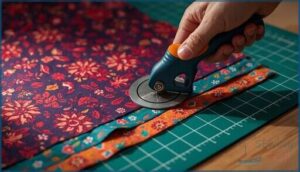
A rotary cutter uses a circular blade to slice fabric with precision you won’t get from scissors alone. Pair it with a self-healing cutting mat—12×18 inches suits most projects—and you’ll protect your table while achieving straighter cuts.
Replace your 45mm blade after cutting 6 to 8 yards to prevent jagged edges. Always retract the blade when you’re finished to avoid accidents.
Sewing Gauge and Rulers
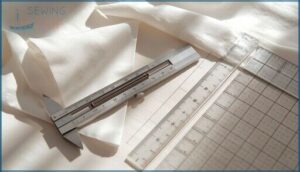
A sewing gauge is a compact metal ruler—usually six inches—with a sliding marker that locks your chosen measurement in place. You’ll rely on it for hems, seam allowances, and buttonhole spacing. Pair it with rotary rulers for angles and edge guides for alignment:
- Use the sliding bead to transfer distances quickly across multiple pieces.
- Mark pleats or tucks with angle guides built into some measurement tools.
- Trace circles with gauges that include compass-style arcs or circle markers.
These sewing tools keep your work consistent.
Pinking Shears
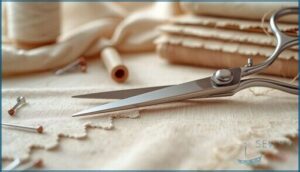
Pinking shears are sewing scissors with zigzag blade teeth that cut a serrated edge to reduce fraying on woven fabrics. These shear variants work best on straight grain for clean edge finishes.
You’ll preserve blade maintenance by avoiding thick seams and dense denim. While they’re handy fabric scissors for seam allowances, they don’t replace proper craft scissors or serve as sewing kit essentials for high-stress areas.
Always match fabric selection to cutting techniques.
Thread Snips
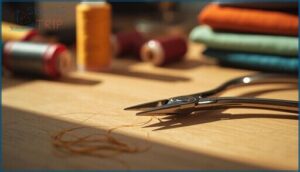
Thread snips are spring-loaded mini scissors that trim loose threads with millimeter-precise cutting techniques right next to your fabric. These compact sewing tools feature sharp blade materials like stainless steel and ergonomic grips that reduce hand fatigue during thread maintenance.
Unlike full-size sewing scissors, a quality thread snipper fits easily in any sewing kit. The pointed tips and snip designs make them essential sewing essentials for clean finishes.
Pinning, Marking, and Holding Supplies
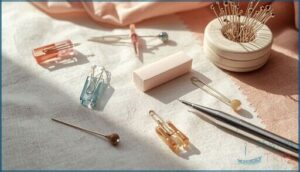
You can’t sew accurately without the right tools to hold fabric in place and mark your lines. Pins, clips, and marking tools keep everything aligned while you work, preventing shifts that lead to crooked seams.
Here are the essential supplies that give you control over every step of your project.
Straight Pins and Pin Cushion
Pins are the backbone of accurate fabric alignment. You’ll want straight pins in lengths from 1 to 1.5 inches, with stainless steel or nickel-plated shafts for rust resistance. Glass or pearl heads make them easy to spot.
Store your pins in a pincushion filled with wool or kapok—it holds them securely and keeps them within reach while you work.
Sewing Clips
When pins might snag delicate fabric or leave visible holes, sewing clips offer a smart alternative. These durable plastic or metal tools grip leather, vinyl, knit, and slippery materials without piercing them.
Their flat bottoms often display seam allowance markings for quick alignment. You’ll appreciate how they hold multiple layers securely under your presser foot, boosting your sewing efficiency without damaging fine textiles.
Fabric Marking Tools (chalk, Pens, Pencils)
Before you cut or stitch, you need to mark darts, seam lines, and pattern placements. Chalk markers, fabric pens, and pencil types each suit different fabrics and tasks. Here are your marking tips:
- Tailors chalk washes out easily on most woven fabrics
- Erasable ink pens create precise lines on dark materials
- Fabric marking pencils resist smudging during handling
Choose tools that disappear when you’re done.
Magnetic Pin Holder
A magnetic pin holder keeps your pins close while you work. The magnetic plate—usually 5.5 cm by 4 cm—grips standard pins with enough magnetic strength to prevent spills. Some designs loop around your wrist for comfort, while others sit on your table.
This pin organization tool beats a traditional pins and pincushion when you want fast access. Include one in your sewing kit for quicker assembly.
Useful Accessories for a Complete Kit
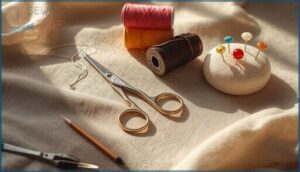
You’ve covered the basics, but a few small accessories can make your sewing projects smoother and less frustrating.
These tools aren’t required for every stitch, but they solve common problems you’ll face as you work. From guiding thread through tiny needle eyes to protecting your fingers, these helpers build confidence in your skills.
Needle Threader
Threading a needle can feel like threading the eye of a storm when your vision blurs or the light fades. A sewing needle threader solves that frustration with a thin wire loop that passes through the needle eye and grabs your thread.
Most threader designs use stainless steel wire loop materials, fitting common needle eye sizes. This small sewing aid belongs in every sewing kit alongside your other sewing tools and equipment.
Thimble
A thimble protects your fingertip when you push needles through fabric, preventing painful pricks during hand-sewing projects. This essential piece from your sewing notions and supplies fits over your finger like a cap.
Choose from these thimble types and materials:
- Metal thimbles offer durability for heavy projects
- Plastic versions suit beginners learning sewing aids and accessories
- Leather thimbles provide flexible comfort
- Open-top designs allow better tactile feedback
- Adjustable styles accommodate different thimble sizing needs
Proper thimble care includes cleaning with mild soap and thorough drying to prevent rust. Store your thimble with other sewing tools and equipment to keep the textured surface protected between projects.
Bodkin and Safety Pins
A bodkin is a blunt sewing tool that feeds elastic, ribbons, and cords through casings without fabric snags. Metal bodkin types resist bending during elastic feeding, while head and binding styles handle different material widths.
Threading tools like these outperform safety pins for waistband projects. Keep both sewing notions in your kit—safety pins work when bodkins aren’t handy, and together these sewing aids simplify tricky tasks.
Pressing Tools (iron, Press Cloth, Sleeve Roll)
An iron with adjustable steam settings is essential for crisp seam pressing and professional sewing finishes. You need variable heat controls to match delicate fabrics and avoid scorching.
A press cloth protects sensitive materials during fabric protection steps, while a sleeve roll aids curved areas without unwanted creases.
Regular iron maintenance keeps your soleplate smooth for consistent results. These pressing techniques transform your work from homemade to polished.
Storage and Organization for Your Sewing Kit
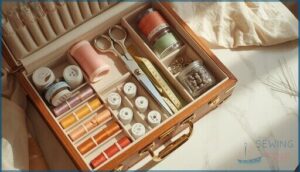
A well-organized sewing kit saves you time and keeps your tools in good condition. You’ll need a storage system that protects sharp items, prevents tangled threads, and makes everything easy to find.
Let’s look at the best ways to organize your sewing supplies at home and on the go.
Sewing Box or Organizer
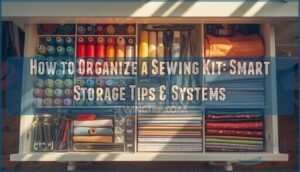
A sturdy sewing box keeps your sewing tools protected and ready for action. Look for custom storage with at least three sewing compartments—a main area 3 inches deep holds scissors and spools, while built-in trays organize needles and notions. Choose an organizer layout with adjustable dividers, transparent sections, and reinforced corners.
A quality sewing organizer turns chaos into a functional sewing station you’ll actually use.
- Main compartment at least 3 inches deep for bulk items
- Three-level trays for small sewing supplies and notions
- Adjustable dividers to fit varying tool sizes
- Clear sections for quick visibility without opening
- Reinforced construction with smooth-gliding drawers
Portable Sewing Kit Options
A compact travel sewing kit slips into your purse or backpack for quick fixes anywhere. Choose between mini repair kits at 3-4 inches for emergency repairs, basic beginner kits with varied threads and buttons, or specialized craft versions with embroidery tools.
Look for secure zipper closures, organized compartments with elastic loops, and lightweight materials that keep your portable sewing essentials protected without adding bulk.
Labeling and Sorting Supplies
Clear label systems transform your sewing kit from chaos into an efficient workspace. Color-coded tags help you spot needle types instantly, while printed category headers cut search time by 40 percent.
- Sort measuring tape, sewing pins, and small tools by type in shallow trays
- Use vinyl labels that resist water and fading in humid rooms
- Track inventory with monthly checklists to maintain your pincushion and tape measure supply
This smart organization keeps essential tools accessible when you need them.
Travel-Friendly Storage Solutions
When you’re stitching on the go, lightweight modular storage keeps your sewing kit accessible without weighing down your bag. A 12-inch zipper pouch holds sewing scissors, portable organizers, and essential sewing tools while fitting under airplane seats.
Compact cases with foam inserts protect fragile sewing accessories, and folding mats roll to six inches for easy packing—giving you functional sewing supplies wherever your projects take you.
Frequently Asked Questions (FAQs)
What 10 tools should be included in a sewing kit?
Your sewing kit essentials include fabric scissors, hand-sewing needles, a seam ripper, measuring tape, pins with a cushion, thread, needle threader, thimble, safety pins, and sewing machine needles for different fabrics.
What do I need in a sewing kit?
Your beginner sewing kit should include fabric scissors, hand-sewing needles, a seam ripper, measuring tape, straight pins with a cushion, and thread.
These essential sewing tools cover basic Fabric Preparation and Thread Management tasks.
What basic tools do I need for sewing?
Every beginner needs fabric scissors, a seam ripper, measuring tape, hand-sewing needles, pins, and thread to master sewing basics.
These sewing tools cover fabric preparation, thread management, and essential sewing notions for any project.
What thread types work best for different fabrics?
Match your thread to your fabric for best results. Cotton thread works well on natural fibers, while polyester offers strength for synthetics.
Thread weight should correspond to fabric thickness for smooth stitching.
How often should you replace sewing machine needles?
Sharp thinking keeps your stitches smooth. Replace sewing machine needles every 8 hours of sewing frequency or when you notice skipped stitches, thread breaks, or needle damage. Fresh needles maintain stitch quality and prevent fabric puckering.
Can you use household scissors for sewing projects?
You shouldn’t use household scissors for fabric. They dull quickly on textiles, leave frayed edges, and snag when cutting multiple layers.
Fabric scissors maintain blade sharpness and cutting accuracy, protecting against fabric damage.
Whats the difference between cotton and polyester thread?
Cotton thread offers a natural matte finish and works beautifully with cotton fabric.
Polyester thread provides exceptional fiber strength and sewing durability across fabric blends, making it ideal for high-stress seams.
How do you maintain and sharpen fabric scissors?
Dull blades turn your sewing kit into a museum piece.
Wipe them clean after each use, sharpen only the bevelled edge with a fine-grit stone, and hone regularly to keep your fabric scissors slicing smoothly.
Conclusion
Picture your sewing kit laid out before you—sharp scissors resting beside a full pin cushion, measuring tape coiled neatly, seam ripper ready for quick fixes. These aren’t just random supplies; they’re the foundation of every successful project.
Now that you know what tools you need in a sewing kit, you can build a collection that matches your ambitions. Start with the essentials, add what aids your work best, and watch simple repairs become confident creations.