This site is supported by our readers. We may earn a commission, at no cost to you, if you purchase through links.
You’re rushing out the door for a meeting when you notice a button dangling by a single thread, or your kid comes home with a ripped knee in their favorite jeans—again. These aren’t catastrophes, but they’re annoying enough to derail your day if you’re not prepared. A sewing kit is one of those unsexy essentials that sits forgotten in a drawer until you desperately need it, and then you’re either a hero or scrambling to find a safety pin.
Beyond the obvious wardrobe malfunctions, you’d be surprised how often a needle and thread become genuine problem-solvers: torn backpack straps on a trail, a split seam during travel, even emergency gear repairs when you’re miles from civilization. The trick is knowing which situations call for basic hand-stitching versus when you actually need specific tools, and making sure your kit’s ready before disaster strikes.
Table Of Contents
Key Takeaways
- A sewing kit handles everyday emergencies like popped buttons, torn seams, and fallen hems in minutes—saving you from wardrobe disasters right before important moments and eliminating last-minute trips to tailors.
- Travel and outdoor adventures demand compact sewing kits because torn gear, ripped backpack straps, or split tent seams can derail your entire trip when you’re miles from civilization with no repair shops available.
- Emergency preparedness bags need sewing supplies since needle and thread become survival tools for fixing torn shelters, repairing water-resistant gear, and maintaining clothing when disasters cut you off from professional help.
- Quality scissors make the difference between quick fixes and frustrating messes—invest in fabric shears for clean cuts, thread snips for precision work, and pinking shears to stop fabric edges from fraying.
Everyday Situations Requiring a Sewing Kit
You don’t need to be a seamstress to benefit from having a sewing kit at home. Life throws those little wardrobe disasters at you when you least expect them—usually right before you’re heading out the door.
A well-stocked sewing kit for home use can save you from a popped button or split seam turning into a full-blown crisis.
Here are the most common everyday situations where a basic sewing kit becomes your best friend.
Quick Clothing Repairs at Home
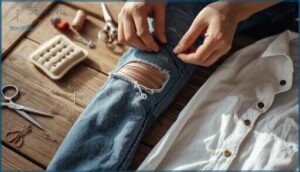
Your favorite jeans just ripped at the knee, or maybe your shirt’s seam gave out mid-laundry. That’s when you need basic sewing tools at your fingertips.
A simple sewing kit with fabric scissors, thread, and sewing needles lets you tackle fabric tears, seam repair, and hem fixing without running to a tailor. Keep one handy for quick stitch removal and button replacement emergencies.
Fixing Loose Buttons and Popped Seams
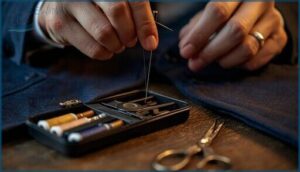
Buttons fall off at the worst times—right before your big meeting or on date night. A few tight cross-stitches with matching thread and a sharp sewing needle will lock that button back on for good.
Popped seams? Run a backstitch along the original line to close gaps fast. Your sewing kit saves the day when fabric fraying threatens, and smart thread selection means repairs that actually last.
Hemming Pants, Skirts, or Sleeves
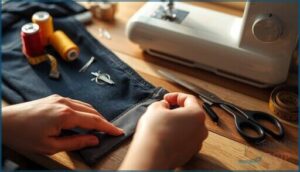
You’ve rescued your shirt—now what about those too-long pants dragging on the floor? Folded hem techniques work great here, or try blind hemming if you want stitches that vanish. Your sewing kit (sewing scissors, thread, pins) takes care of most jobs, though rolled edges on delicate skirts need extra care. A sewing machine speeds things up, but serger machines give pro-level polish. Press before you stitch—it’s everything.
For more on the steps of, check out this guide.
- Measure twice, cut once—mark your hem with pins first
- Use matching thread weight for invisible repairs
- Press the fold flat before any stitching
- Test your stitch on scrap fabric
- Trim bulk at seams to avoid lumpy hems
Mending Children’s Clothes and School Uniforms
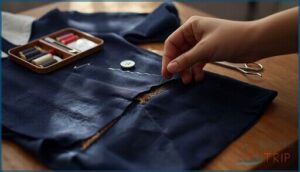
Kids wear through school uniforms faster than you’d think—buttons pop off mid-recess, knees tear during soccer, hems drop on active school days.
Your sewing kit takes care of fabric repair fast: reattach buttons with cross-stitch durability, patch holes with iron-on interfacing, re-stitch loose seams using backstitch. Uniform alterations save money when you fix issues within 24 hours.
These mending techniques work whether you’re sewing for beginners or pros—just match thread color and press afterwards. To further prolong the lifespan of uniforms, consider following proper care and maintenance tips to reduce wear and tear.
DIY Home Décor Fixes (curtains, Cushions)

Your living room curtains droop when the hem falls, or cushions look shabby with torn seams—grab your sewing kit for quick upholstery fixes. Curtain repair needs hem alterations (fold fabric 1.5 to 2 inches), cushion refurb requires invisible zippers, and fabric patching covers small tears.
These sewing techniques use basic sewing tools and sewing notions to restore home décor fast.
You can also use your sewing tools in unexpected ways to tackle quick fixes around the house.
Travel and On-the-Go Emergencies
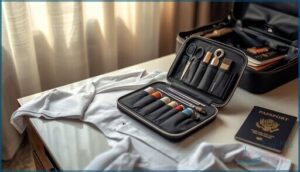
Nothing throws off your trip faster than a wardrobe emergency when you’re miles from home. Whether you’re sitting in a hotel room staring at a fallen hem or standing at a trailhead with torn gear, a compact sewing kit can save your plans—and your sanity.
A wardrobe emergency miles from home can derail your entire trip, but a compact sewing kit saves both your plans and your sanity
Here’s when you absolutely need one tucked in your bag.
Packing a Sewing Kit for Vacations
You’ll want a compact travel sewing kit that fits inside a 4 by 6 inch pouch—think mini tools instead of your full-sized home stash.
Pack essentials like a needle threader, five needle sizes, four thread spools plus clear nylon, and 12 to 20 assorted buttons. Add blunt-tip scissors under 4 inches, a seam ripper with cap, and organized compartments for quick vacation repairs.
Business Trips and Wardrobe Malfunctions
A loose button on your dress shirt or a ripped blazer seam can derail your entire presentation—that’s why business travelers carry a compact sewing kit with neutral thread, fine needles, and tiny scissors.
You can fix wardrobe malfunctions right in your hotel room using basic sewing supplies and fabric repair tools, keeping your corporate style sharp and professional without hunting for a tailor in an unfamiliar city.
Backpacking, Hiking, and Outdoor Repairs
A torn tent fly or ripped backpack strap can turn a great hike into a survival challenge—that’s why serious outdoor adventurers pack a compact sewing kit for trail gear repair and wilderness survival.
Your kit should include bonded nylon thread, a size 9-11 universal needle, and small scissors under 3 inches for emergency preparedness and outdoor fabric fixes on camping equipment and outdoor gear.
Keeping a Sewing Kit in Your Car or Office
A button falls off your blazer five minutes before a client meeting—that’s when you realize a desk drawer sewing kit isn’t just smart, it’s essential for emergency repairs and office sewing readiness.
Your portable sewing kit should include:
- Car storage tips: Tuck a compact pouch under your seat with color-coordinated thread for travel essentials
- Desk organization: Keep a needle threader, mini scissors, and safety pins for quick emergency preparedness
- Sewing kit essentials: Pack a thimble and small measuring tape for sewing organization and storage
- Emergency repairs: Store fabric glue for temporary holds until you can properly stitch
Emergency and Survival Scenarios
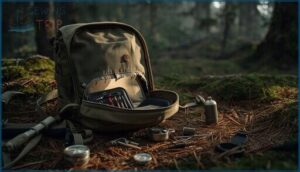
You probably don’t think about a sewing kit when you’re packing an emergency bag, but it’s one of those small, practical tools that can make a huge difference when everything goes sideways.
Whether you’re stuck outdoors with torn gear, facing a natural disaster, or just trying to be self-sufficient in uncertain situations, a needle and thread can solve problems you didn’t see coming.
Here’s when a sewing kit becomes more than just a convenience—it becomes a survival tool.
Adding a Sewing Kit to an Emergency Bag
Emergency preparedness starts with the basics, and a compact sewing kit deserves a spot in your survival bag. Pack at least 6 yards of polyester thread in white, black, and gray, plus stainless steel needles in sizes 7, 9, and 12 for diverse fabric types.
Store everything in a waterproof resealable pouch to protect from moisture—those portable repairs could save your torn emergency clothing when replacements aren’t available.
Outdoor Survival—repairing Gear or Clothing
When you’re miles from civilization, wilderness fixes become your lifeline. Heavy-duty nylon thread tackles gear repair on backpack straps and tent patches—it resists moisture and abrasion better than cotton. Keep assorted needle sizes (7, 9, and 12) in your survival kit for both thick canvas and fine nylon fabrics.
Outdoor Stitching Essentials:
- Resew popped seams along the seam allowance to restore load-bearing capacity
- Apply nylon patches with seam sealant for emergency mending on torn rainwear
- Use bar tacking at stress points like pocket corners to prevent ripping
- Realign zipper teeth and stitch a new stop for survival sewing repairs
- Reinforce worn elbows on fleece jackets with fabric patches for outdoor survival tips
First Aid Uses for Sewing Kits
Beyond patching torn gear, your sewing kit doubles as a first aid tool in a survival situation. Clean needles can close minor cuts using medical stitching techniques—sanitize the needle with flame or alcohol first.
Apply butterfly closures for wound closure, then dress with clean fabric. A basic sewing kit gives you emergency control when professional help isn’t available.
Disaster Preparedness and Self-sufficiency
When disaster strikes—think hurricanes, power outages, or extended isolation—you won’t find a tailor. Stocking your emergency preparedness strategies with a survival kit that includes thread, needles, and scissors gives you real self-sufficiency.
You can fix torn shelters, repair water-resistant gear, or reinforce critical seams on clothing. This bushcraft essential transforms crisis management from helpless waiting into proactive survival skills and disaster relief on your own terms.
Top Sewing Tools for Your Kit
You don’t need fancy equipment to build a sewing kit that actually works when you need it.
The right scissors make all the difference—seriously, dull blades turn a two-minute fix into a frustrating mess. Here are five cutting tools that’ll cover everything from emergency repairs to precise fabric work, whether you’re at home or on the road.
1. Fiskars Orange Handled Scissors
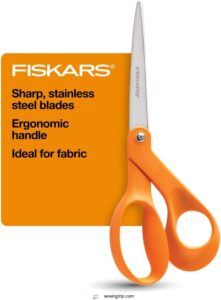
You’ve probably seen those bright orange scissors at every craft store—there’s a reason they’ve sold over a billion units since 1967! Fiskars Original Orange Handled Scissors are the workhorse of any sewing kit.
At 8 inches long, they cut fabric, paper, and thread with precision-ground stainless steel blades that stay sharp project after project. The bent handle design keeps your material flat while you cut (no more bunching!), and the ergonomic grip won’t tire your hand during longer repairs.
| Best For | Crafters, quilters, and anyone who needs reliable scissors for cutting fabric, paper, and everyday materials around the house or office. |
|---|---|
| Blade Material | Stainless Steel |
| Primary Use | Fabric cutting |
| Handle Design | Ergonomic sculpted |
| Length | 8.41 inches |
| Best For | Quilting and crafts |
| Durability | Lifetime warranty |
| Additional Features |
|
- Precision-ground stainless steel blades stay sharp through tons of projects
- Bent handle design keeps fabric flat while you cut, so no bunching or uneven edges
- Ergonomic grip is comfortable even during long cutting sessions, plus there’s a lifetime warranty
- Blades can dull over time with heavy use and need careful handling to maintain sharpness
- No protective blade cover included, so you’ll need to store them carefully
- Manufactured in China, which some users feel may affect long-term durability
2. Fiskars Razor Edge Fabric Shears
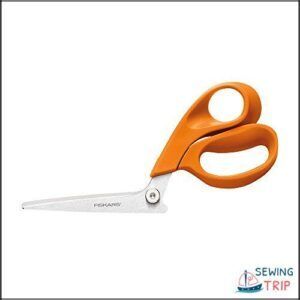
When you’re cutting long strips for binding or hemming a dress, you need Fabric Shears that glide through fabric without lifting it off the table. Fiskars RazorEdge Fabric Shears feature a bent handle that keeps material flat while premium stainless steel blades slice cleanly through multiple layers.
The sculpted finger loops make those marathon cutting sessions way more comfortable, and the included sheath protects the ultra-sharp edge between projects. At 8 inches, they handle everything from lightweight cotton to midweight denim with professional results.
| Best For | Sewers and quilters who need precise, comfortable fabric cutting for long projects—especially those working with multiple layers or who have limited hand mobility. |
|---|---|
| Blade Material | Stainless Steel |
| Primary Use | Fabric cutting |
| Handle Design | Sculpted loops |
| Length | 8 inches |
| Best For | Sewing and quilting |
| Durability | Premium grade blades |
| Additional Features |
|
- Ultra-sharp stainless steel blades cut cleanly through multiple fabric layers without fraying
- Bent handle design keeps fabric flat on the table for more accurate cuts
- Sculpted finger loops reduce hand fatigue during extended cutting sessions
- Scissors may stiffen up over time and need regular use to stay loose
- Best kept separate from household scissors to maintain sharpness for fabric only
- Limited to flat tabletop cutting, not ideal for other cutting angles or tasks
3. Fiskars Thread Snip Scissors
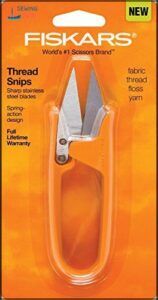
Thread snips are the unsung heroes of your sewing kit—small enough to tuck anywhere, sharp enough to handle precision work. Fiskars Thread Snip Scissors feature ultra-sharp stainless steel blades that extend all the way to the pointed tips, letting you trim threads between buttons or deep in seam allowances without wrestling with bulky shears.
The spring-action handle cuts down on hand fatigue when you’re snipping dozens of thread tails, and that bright orange Softgrip handle makes them easy to spot in a cluttered drawer.
| Best For | Sewers, quilters, and crafters who need a precise, easy-to-handle tool for trimming threads, floss, yarn, and other lightweight materials without hand strain. |
|---|---|
| Blade Material | Stainless Steel |
| Primary Use | Thread trimming |
| Handle Design | Spring-action with loop |
| Length | 7.13 inches |
| Best For | Precision trimming |
| Durability | Top-quality steel |
| Additional Features |
|
- Ultra-sharp stainless steel blades with pointed tips let you snip threads in tight spots like between buttons or deep in seam allowances
- Spring-action design reduces hand fatigue during repetitive cutting tasks
- Bright orange Softgrip handle makes them easy to find in your sewing kit
- Not suitable for cutting thicker fabrics or heavy-duty materials
- At just 0.01 ounces, they’re lightweight but may feel too delicate for some users
- Some reviewers noted potential improvements could be made, though this might increase the price
4. Pinking Shears Stainless Steel Scissors
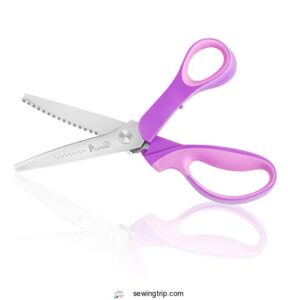
Pinking shears create that signature zigzag edge along fabric—your secret weapon against fraying seams and unraveling edges.
The P.LOTOR 9.3-inch pinking scissors pack stainless steel blades that slice through everything from delicate silks to thick flannel, leaving a clean decorative pattern that keeps woven fabrics from turning into a tangled mess.
The soft-grip grips and ball bearing joint mean you won’t cramp up after cutting yards of curtain lining, and at seven ounces, they’re sturdy without feeling like you’re wielding garden shears.
| Best For | Sewers and crafters who need durable scissors that prevent fabric edges from fraying while staying comfortable through long cutting sessions. |
|---|---|
| Blade Material | Stainless Steel |
| Primary Use | Fabric cutting |
| Handle Design | Soft grip |
| Length | 9.3 inches |
| Best For | Pinking and sewing |
| Durability | Corrosion resistant |
| Additional Features |
|
- Stainless steel blades cut cleanly through everything from delicate fabrics to thick flannel
- Soft-grip handles and ball bearing joint reduce hand fatigue during extended use
- Creates zigzag edges that stop fraying without requiring additional finishing
- May feel bulky or heavy for people with smaller hands or wrist problems
- Blades can be stiff when new and need breaking in
- Not ideal for precision flat-bottom cutting or non-fabric materials
5. Taotree Sharp All Purpose Scissors
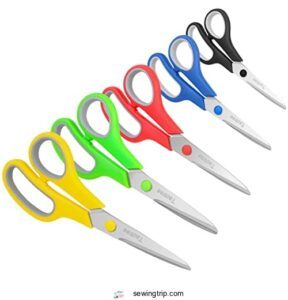
You can’t beat having a workhorse pair that cuts everything without complaining. The Taotree 8-inch all-purpose scissors feature stainless steel blades that stay sharp through fabric, cardboard, thread—basically whatever lands on your cutting mat.
The soft-grip grips work for both lefties and righties, and that adjustable blade pivot means smooth cutting without hand fatigue when you’re trimming seam allowances or snipping pattern pieces. At this price point for a 5-pack, stash one in your sewing room, office drawer, and car.
| Best For | Crafters, sewers, and busy households who need reliable scissors in multiple rooms without breaking the bank. |
|---|---|
| Blade Material | Stainless Steel |
| Primary Use | All-purpose cutting |
| Handle Design | Soft grip |
| Length | 8 inches |
| Best For | Office and home |
| Durability | Stays sharper longer |
| Additional Features |
|
- Sharp stainless steel blades handle everything from fabric to cardboard without dulling quickly
- Soft-grip handles and adjustable pivot make long cutting sessions comfortable for both left- and right-handed users
- Five-pack means you can keep scissors everywhere you need them—sewing room, kitchen, office, car
- Quality may be inconsistent across orders, with some buyers reporting cheaper materials in later purchases
- Handle size runs smaller than expected and might not fit larger hands comfortably
- Durability varies depending on how hard you use them and how you store them
Frequently Asked Questions (FAQs)
What sewing skills should beginners learn first?
You’d think fancy stitches come first, but they don’t.
Start with threading a needle and tying a knot—seriously!
Then master the running stitch and backstitch for repairs that actually hold.
How often should you replace sewing kit supplies?
Replace needles every 8 to 12 uses, thread every 6 to 12 months, and pins when they rust or bend. Swap scissors when they dull, and refresh your entire kit annually!
Can sewing kits help with leather or denim?
But you’ll need waxed thread and heavy-duty needles. Regular thread snaps on tough fabrics like butter under pressure.
Leather kits use thicker needles and reinforced awls to punch clean holes before stitching.
Whats the difference between hand and machine sewing?
Hand sewing uses a needle you control manually—perfect for quick fixes and delicate work.
Machine sewing automates stitches with motorized speed, handling long seams and bulk projects way faster than your fingers ever could.
Are mini sewing kits effective for serious repairs?
Mini kits handle quick fixes—loose buttons, small seams, fallen hems—but serious repairs like reweaving tears or patching large holes need full sewing sets or professional help for lasting results.
Conclusion
An ounce of prevention is worth a pound of cure—and that’s exactly what a well-stocked sewing kit delivers. Whether you’re rescuing a wardrobe malfunction before a presentation, patching a torn tent in the backcountry, or teaching your kid to fix their own ripped jeans, knowing when you need a sewing kit transforms minor disasters into five-minute fixes.
Keep one at home, another in your car, and you’ll never scramble for a safety pin again.
- https://hubpages.com/travel/A-Handy-Dandy-Must-Have-for-Work-Travel-and-Everywhere-Else
- https://trueprepper.com/emergency-sewing-kit/
- https://thedailysew.com/blog/2022/03/the-essential-tools-for-a-basic-sewing-kit/
- https://www.crafterscompanion.co.uk/blogs/inspiration/9-essential-tools-for-your-sewing-kit
- https://patterns.bootstrapfashion.com/diy-dress-form-sewing-pattern.html?i=6bdd9bee