This site is supported by our readers. We may earn a commission, at no cost to you, if you purchase through links.
Pick up a piece of fabric, and you’re holding a story told in threads. Some are tightly interlaced like a city grid; others loop and stretch like a web in motion. The way those fibers connect isn’t decorative—it determines how the fabric breathes, bends, and endures.
A woven cotton resists tugging where a knit jersey yields with ease. To determine fabric construction method is to understand why a shirt feels crisp while another drapes softly across your hand.
Once you learn to read those hidden patterns, every textile becomes a visible map of structure and purpose.
Table Of Contents
- Key Takeaways
- What is Fabric Construction and Why It Matters
- What Are The Primary Methods of Fabric Construction
- How Woven Fabric Construction Works
- How Knitted Fabric Construction Works
- How to Identify Fabric Construction Method
- Seven Ways to Test Fibers for Identification
- Key Fabric Properties Tied to Construction Method
- Measuring and Analyzing Fabric Construction
- Advanced and Modern Fabric Construction Techniques
- Comparing Fabric Construction Methods Side by Side
- Frequently Asked Questions (FAQs)
- Conclusion
Key Takeaways
- Fabric construction defines how fibers or yarns are organized—woven, knitted, or bonded—and directly determines a textile’s texture, strength, and performance.
- Woven fabrics offer stability and strength through interlaced yarns, while knitted structures provide stretch and comfort, and nonwovens balance speed with limited durability.
- Key identifiers like surface pattern, stretch behavior, and thread count help distinguish construction methods and predict properties such as drape, breathability, and resilience.
- Modern techniques—3D knitting, smart textiles, nanotechnology, and recycled fibers—extend traditional construction into high‑performance and sustainable applications.
What is Fabric Construction and Why It Matters
Fabric construction is the framework that shapes how a textile looks, feels, and performs. It determines everything from the fabric’s texture to its strength and comfort.
To better understand how different weave types and materials affect these qualities, explore this helpful guide on essential sewing and fabric terminology.
Let’s look at the key factors that define how construction makes each fabric unique.
Definition of Fabric Construction
Fabric construction refers to how fibers or yarns are organized and bound to form fabric through weaving, knitting, or bonding. It defines the fabric structure, determined by yarn thickness, weave patterns, and fiber binding.
These textile fabric constructions shape fundamental textile properties, making different fabric construction methods essential elements in modern fabric construction techniques. Because each method of weaving, knitting, or non-woven bonding produces fabrics with distinct properties and applications, you can explore key fabric construction methods to better understand their performance.
How Construction Affects Texture, Comfort, and Durability
Once you understand Fabric Construction Methods in theory, you need to see how they shape Fabric Texture, Comfort Levels, and long-term wear. To compare how looped knits and interlaced wovens differ in structure, stretch, and usage, you can review these key knit vs woven differences.
Plain weave structures feel firmer and a bit crisp on the skin, while twill and satin Weave Patterns give a softer, more fluid hand and better drape.
Knit-based Textile Fabric Constructions, built from interlocking loops, naturally stretch with your movement, so everyday comfort improves but Durability Tests often show lower abrasion resistance than comparable wovens. Nonwoven constructions, because they rely on bonded fibers rather than organized Yarn Properties and Weaving Techniques and Structures, usually feel less breathable in apparel and break down faster under repeated stress. That’s why, when you evaluate Fabric Properties for a garment or upholstery project, you always link what you feel and how long it lasts back to the underlying Fabric Construction.
Role of Yarn Count and Thread Density in Fabric Structure
That comfort and feel you sensed earlier trace back to Yarn Count and Thread Density. Finer yarns form tighter Weave Patterns, reducing Fabric Porosity and creating smoother surfaces. Coarser yarns, meanwhile, give body and strength.
By balancing Yarn Fineness with Fabric Density, you control Fabric Structure, airflow, and durability across different Weaving Techniques and Structures.
EPI and PPI Explained
That balance of Yarn Count and Fabric Density comes alive in two key measures: EPI and PPI. EPI counts Warp threads per inch; PPI counts Weft. Together they define Thread Count, controlling Weave Patterns, Fabric Weight, and feel.
Higher EPI-PPI means smoother, denser Fabric Construction—lower ratios give lighter, looser cloth ideal for breathable Weaving applications.
What Are The Primary Methods of Fabric Construction
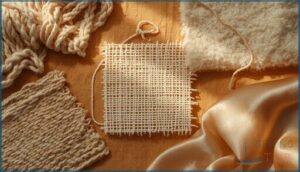
Every fabric starts with a method that shapes how it looks, feels, and performs. These construction approaches define everything from flexibility to strength.
Let’s look at the main ways fabrics are built and what sets each one apart.
Weaving as The Most Common Construction Method
Weaving dominates textile fabric constructions for good reason — the global woven fabrics market hit roughly 180 billion USD in 2023. Loom mechanics interlace warp and weft yarns under controlled yarn tension, locking threads into stable weave patterns.
This tight structure gives woven fabrics their strength and dimensional stability. Thread counting and precise fabric density control let you engineer everything from crisp shirting to heavy-duty canvas.
Knitting and Its Stretch Properties
Knitting transforms yarn into flexible surfaces defined by loops, not crossings. This Knit Loop Structure gives Knitted Fabrics natural give and shape. Stretch depends on Yarn Elasticity and Knit Density.
1. Weft knitting offers fluid drape.
2. Warp knitting adds stability.
3. Stretch Recovery ensures lasting fit.
4. Specialized Knitting Techniques and Structures improve Fabric Drape and control extension.
Nonwoven Fabric Production Techniques
Nonwoven fabrics skip traditional interlacing, forming webs directly from fibers. You’ll see this in Drylaid, Airlaid, Spunbond, Hydroentanglement, and Thermal Bonding techniques—each shaping fiber strength, softness, and uniformity differently. These Nonwoven Fabric Production Techniques now power sophisticated applications beyond disposables.
| Technique | Key Feature |
|---|---|
| Drylaid Process | Carded fiber web with directional strength |
| Airlaid Formation | Random fiber orientation for uniformity |
| Spunbond Extrusion | Continuous filaments with high durability |
| Hydroentanglement | Water jets create soft, strong structures |
| Thermal Bonding | Heat fuses fibers for stability |
Composite and Hybrid Construction Methods
Composite fabrics and hybrid materials take fabric construction further by stacking methods rather than choosing one. You can laminate a breathable membrane between woven layers, braid carbon with aramid for impact resistance, or weave 3D structures with jute and hemp for added mechanical strength.
Smart textiles and nano fibers push these textile fabric construction techniques into performance territory that single-method nonwoven fabrics simply can’t reach.
How Woven Fabric Construction Works
Woven fabric construction is built on how yarns cross and lock together to form a stable surface. Its patterns shape everything from texture to durability.
Here’s how these weaves come together and what sets each one apart.
Warp and Weft Yarn Interlacing
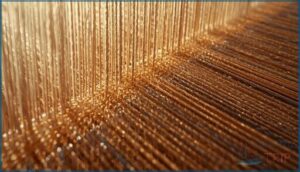
In woven fabric construction, warp yarns run lengthwise under constant tension while weft yarns weave crosswise over and under them, forming precise interlacing patterns.
This yarn path geometry creates a right-angle grid, where each crossing locks the yarns and influences fabric density.
You’ll notice yarn crimp as the waviness from bending, affecting selvedge formation and overall stability in your projects.
Plain, Twill, and Satin Weave Structures
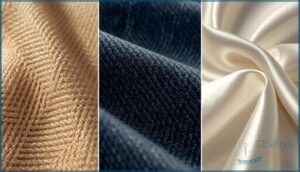
You’ll work with three fundamental Weave Patterns in Fabric Construction: Plain Weave, Twill Weave, and Satin Weave built from systematic Yarn Interlacing and controlled Weft Picks. Plain Weave uses an over-one, under-one sequence that maximizes interlacings. Twill Weave shifts those interlacings stepwise to create diagonal ribs. Satin Weave extends floats across four or more yarns for high surface coverage and potential Fabric Density gains, strongly impacting Textile Strength and surface handle in practical Weaving.
- Plain Weave gives you a firm, balanced grid that behaves predictably in cutting and sewing.
- Twill Weave introduces diagonal ribs that make denim and chino visually distinct and mechanically more pliable.
- Satin Weave delivers long surface floats that feel smooth and look lustrous in dress and lining applications.
- You can read these structures directly in the Yarn Interlacing path if you follow the Weft Picks across a small fabric window.
- Once you see how each Weave Pattern builds, you’ll start linking Fabric Density and Textile Strength intuitively to the underlying Weaving logic.
How Weave Patterns Affect Strength and Appearance
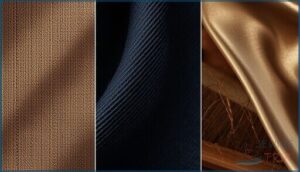
As you’ve seen with plain, twill, and satin weaves, Yarn Tension and Weave Density directly shape Textile Strength and Pattern Durability. A tighter interlacing boosts Fabric Stability, while longer floats in Satin Weave trade strength for luster.
In Twill Weave, diagonal ribbing balances Warp and Weft loads, offering durable flexibility during everyday wear.
Common Woven Fabrics: Denim, Chiffon, Cotton
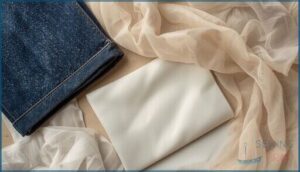
Just as weave patterns affect strength, each woven fabric tells its own story through structure and finish. Denim’s twill weave and indigo Textile Dyeing create a sturdy, iconic surface. Chiffon’s fine plain Weaving and light Yarn Thickness offer translucence, while cotton’s tighter Textile Fabric Constructions deliver breathable durability—a clear example of how Fabric Construction Methods define everyday comfort.
How Knitted Fabric Construction Works
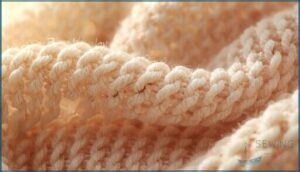
Knitted fabric is built from interlocking loops that create soft, flexible surfaces with natural stretch. Unlike woven structures, its movement and recovery depend on how those loops run through the fabric.
Here’s what defines how knitted fabric construction really works.
Weft Knitting Vs. Warp Knitting
In Knitting, yarn movement defines everything. In Weft Knitting, loops form horizontally, giving knitted fabrics high weft stretch but lower fabric stability. Warp Knitting runs yarns vertically, creating tighter alignment and greater warp density.
That’s why Weft Knitting suits flexible apparel, while Warp Knitting delivers structured knit patterns ideal for performance and technical fabric construction.
Courses and Wales in Knit Structure
You’ve seen how yarn direction shapes knit form; now look closer at its loop geometry. Each knitted fabric is built from horizontal courses and vertical wales—rows and columns of linked loops.
In Knit Fabric Analysis, this alignment defines stitch density, controls fabric elasticity, and reflects how yarn tension balances strength and stability across weft and warp knitting structures.
Why Knit Fabrics Stretch More Than Woven
The secret lies in the knit loop structure. Each loop stores extra yarn between courses and wales, allowing the fabric to elongate before the fibers stretch.
Unlike woven fabrics held by fixed intersections, knitted fabrics release tension through loop movement.
This geometry enhances fabric elasticity, stretch recovery, and comfort despite higher fiber density or yarn tension.
Common Applications of Knitted Fabrics
Across industries, knitted fabrics lead where flexibility and comfort matter most. They shape everything from soft everyday wear to engineered performance gear. Typical Knit Fabric Uses include:
- Sportswear Materials for moisture control and stretch.
- Medical Textiles for compression and support.
- Technical Knits for filtration and protection.
- Fashion Innovations combining design with adaptive Fabric Construction through Weft Knitting and Warp Knitting.
How to Identify Fabric Construction Method
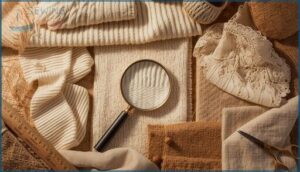
Identifying how a fabric is constructed isn’t guesswork—it’s about noticing patterns and structure. Once you know what to look for, the clues are easy to spot with the right tools and a bit of practice.
Here are a few reliable ways to tell one method from another.
Visual Inspection Techniques
You can tell a lot about fabric construction just by looking closely. Examine surface patterns—woven fabrics form grids, knitted ones show looping stitches, and nonwoven fabrics appear random. Check edge fraying and grain direction for alignment clues.
Under light transmission or fabric microscopy, differences in weaving, knitting, and fiber bonding reveal each fabric type’s unique properties.
The Stretch Test for Woven Vs. Knit Fabrics
Think of the stretch test as your quickest read on Fabric Construction and Fabric Elasticity. Hold a 10 cm section along the crosswise grain and gently pull; a Knit created by interloping yarns usually extends easily and shows clear Stretch Recovery, while a Woven built from interlacing Warp and Weft in stable Weave Patterns barely moves unless cut on the bias.
Repeat in both directions to feel how Yarn Tension, Fiber Blending, Weaving, and Knitting create distinct elastic signatures you can trust when selecting fabrics.
Using a Magnifier or Fabric Microscope
Ever wondered what tiny details hide in a woven or knitted surface? A simple fabric inspection with a magnifier or microscope reveals a story of structure and precision. Use it to spot yarn alignment, count threads, and assess quality.
- Identify weave or knit patterns
- Perform thread counting
- Check for fabric defects
- Compare magnifier types
- Evaluate fabric density
Unraveling Threads to Examine Yarn Systems
Pulling a few threads can reveal more than any label. Yarn Extraction exposes how warp and weft behave—tight, smooth warps or bulkier, lower-twist wefts.
Thread Analysis pairs with Fabric Microscopy to confirm Weave Patterns, Yarn Types and Characteristics, and Fiber Identification, offering direct insight into a fabric’s underlying Construction method, whether Weaving or Knitting.
Seven Ways to Test Fibers for Identification

Knowing what fibers a fabric is made from helps you understand how it’ll perform and how to care for it. There are a few reliable ways to find out, even without lab equipment.
Here’s how to test fibers using simple, practical methods.
Burn Test and Flame Behavior
A burn test quickly reveals how Material Properties link to Fabric Construction. Watch how each Fabric Type behaves near heat—its Fabric Ignition, Flame Resistance, Burn Rates, and Smoke Emission.
Natural fibers often burn clean and fast, while synthetics melt from Heat Transfer. These differences stem directly from each Textile Manufacturing Process and its Fabric Properties.
Feel and Hand Test
Where the burn test ends, your fingers take over. Hand Testing gives you immediate Tactile Cues about Fabric Softness, Texture Analysis, and Fabric Drape without any equipment.
- Scrunch the fabric — resilient wool springs back; cotton stays creased
- Stroke the surface to gauge smoothness or drag from Weaving Techniques in Textiles
- Gently pull to assess stretch and Fabric Density and Properties
Microscopic Fiber Examination
Once your fingers have told you how a fabric feels, Microscopic Testing gives you evidence you can’t argue with. Under a basic lab scope, Fiber Analysis in longitudinal view lets you separate Fiber Types quickly: cotton shows flattened ribbons with twists, wool shows surface scales, and synthetics stay smooth and uniform.
Cross sections and polarized light add another layer of Fiber Science, supporting Fiber Identification in Textile Inspection, Fabric Construction checks, and broader Textile Manufacturing Processes whenever you need to verify Material Properties with confidence.
Moisture Absorption Test
Once you’ve used the microscope to spot scales and ribbons, you can let moisture behavior confirm what you’re seeing. In a simple Moisture Absorption Test, you compare Moisture Regain and Water Absorption to read Fiber Hygroscopy.
Cotton and wool gain noticeable mass and wick water by Capillary Action, while polyester hardly changes, reflecting different Fabric Properties, Fabric Construction choices, and later Fabric Finishing and Properties in Textile Manufacturing Processes and Fabric Measurement and Strength.
Tensile Strength Assessment
Tensile Strength Assessment gives you a hard measure of a fabric’s load-bearing ability. During Fabric Testing, Tensile Machines stretch samples until rupture, revealing how Fabric Construction and fiber orientation influence Strength Measurement.
This Material Analysis anchors Textile Evaluation, comparing Fabric Properties from Weaving or knitting that signal performance, consistency, and reliability in Textile Manufacturing.
Weight and Density Measurement
Weight and Density Measurement pinpoints how substantial or airy a fabric feels. Through GSM Measurement and Density Testing, you can interpret the structure behind its Fabric Construction. Try these basics:
- Weigh a 1 m² swatch for Fabric Weight.
- Perform Thread Counting under magnification.
- Compare Material Density to predict Fabric Properties across different Textile Materials and Yarns.
Key Fabric Properties Tied to Construction Method
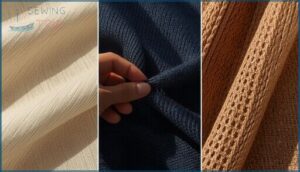
Every fabric behaves differently because of how it’s built. The way threads are arranged changes how strong it feels, how it hangs, and how it breathes.
Here are the key properties that connect construction to performance.
Tensile Strength and Stress Resistance
Plain weave fabric constructions deliver the highest tensile strength because frequent interlacing points lock yarn tension in place and resist slippage under load. Your choice of weave patterns directly shapes fabric durability — plain outperforms satin by distributing stress analysis across more contact points.
Material fatigue accumulates through repeated cycling, so textile technology for workwear prioritizes fabric properties that sustain breaking force over time.
Drape, Stretch, and Recovery
Drape, stretch, and recovery reveal how your fabric construction choices translate into real garment behavior. A low drape coefficient — below 40% — signals fluid, body-skimming movement, while high bending stiffness produces structured silhouettes.
Knitting naturally outperforms weaving for stretch without elastane, but elastane influence dramatically expands elastic recovery. Watch for fabric growth in high-movement zones — permanent bagging signals poor recovery.
Bias-cut textile materials add unexpected drape even in woven constructions.
Breathability and Moisture Permeability
Ever wondered why your athletic shirt feels cooler than your jeans? It’s all about Air Permeability and Moisture Transfer. Knitted Textile Materials, with larger Pore Size, create highly Breathable Fabrics that promote quick drying and efficient Ventilation Systems.
In contrast, dense woven Fabric Types restrict airflow. NonWoven Fabric Applications balance porosity and strength, optimizing Fabric Properties for thermal comfort.
Thread Count and Fabric Density Quality Indicators
Think of Thread Count and Fabric Density as the DNA of cloth—tiny numbers shaping feel and performance. Higher counts signal tighter Weave Patterns, boosting Fabric Durability and Thread Strength, while balanced Fabric Construction maintains comfort.
Fabric Thickness and Yarn Smoothness define touch, proving how precise Weaving directly governs essential Fabric Properties.
Measuring and Analyzing Fabric Construction
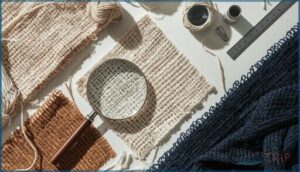
Before you can improve a fabric’s performance, you have to understand how it’s built. Measuring its structure shows you exactly how yarns interact to create strength, texture, and flexibility.
Here’s how to analyze those details step by step.
How to Count Threads Per Square Inch
Accuracy defines fabric density analysis. Thread counting methods reveal how warp and weft interact within the weave structure. You’ll measure fabric count using simple observation tools.
- Mark one-inch squares
- Count threads with magnifiers
- Record warp and weft totals
- Average results across samples
- Compare with thread count standards
That’s how you link yarn thickness measurement to fabric properties.
Understanding Fabric Count in Woven Textiles
Once you’ve counted threads, you can interpret fabric count as the total of warp and weft threads within one square inch.
In woven textiles, fine yarns increase fabric density, while balanced EPI and PPI define its weave pattern and strength.
That’s why high-quality fabric construction depends on controlling both yarn fineness and consistent weaving precision.
Measuring Knit Density: Courses and Wales Per Inch
Where woven fabrics rely on EPI and PPI, knit fabric analysis shifts to stitch density measurement — specifically courses and wales per inch. Courses run horizontally; wales run vertically. Multiply CPI by WPI and you get total loop count per square inch.
For accurate results, take readings from five relaxed spots using a pick counter, since yarn tension control and weft loop length directly affect knitting fabric construction density.
Tools Used for Fabric Construction Analysis
Once you’ve counted courses and wales, you step into tools that make Fabric Testing and Thread Inspection systematic.
In practical Fabric Production and Weaving, you’ll rely on Textile Technology tools such as Fabric Microscopy, Yarn Counters, and Digital Analysis systems to read Fabric Construction Methods accurately and keep your fabric specifications consistent from sample to bulk.
Advanced and Modern Fabric Construction Techniques

Fabric construction has moved far beyond traditional weaving and knitting. Today’s technology brings precision, sustainability, and smart functionality into every thread.
Here are some of the most sophisticated techniques shaping how modern textiles are made.
3D Knitting and Seamless Construction
Bold but accurate: 3D Textiles from Digital Knitting let you turn yarn straight into Continuous Garments with almost no cutting waste. In Knit Fabrication, sophisticated Weft Knitting and Warp Knitting machines shape the body, sleeves, and spacer zones in one pass, achieving Continuous Construction that replaces multiple sewing steps in traditional Fabric Construction.
| Feature | Traditional Knitting | 3D Knitting / Continuous Garments |
|---|---|---|
| Process steps | Knit, cut, sew | Direct garment from yarn |
| Waste level | High cutting offcuts | Near‑zero material waste |
| Typical use | Panels, basic sportswear | Compression wear, 3D uppers |
For example, spacer-based 3D Textiles used in sports footwear combine Knit Fabrication and Smart Yarns to deliver breathable cushioning without extra foam or stitched panels.
Smart Textiles With Integrated Electronic Components
Smart Textiles merge Sophisticated Textile Materials with Sensor Integration, Conductive Materials, and Electronic Embroidery to create fabrics that respond intelligently to the body. Through Power Harvesting and Wireless Transmission, they monitor movement and temperature.
These Smart Textile Innovations, backed by Textile Technology Advancements and Digital Textile Printing Technology, reframe how performance and comfort coexist in modern fabric design.
Nanotechnology Applications in Fabric Production
Nanotechnology lets you tune fabric performance at the level of each fiber, not just the surface. Nano Finishes and Fabric Nanocoatings turn ordinary cotton or polyester into Smart Textiles that resist bacteria, repel stains, or boost Thermal Regulation through nanoencapsulated phase change materials and Nanoencapsulation of active ingredients.
You’ll see these Progressive Textile Materials across sportswear, medical textiles, and digitally tailored designs enabled by Textile Technology Advancements and Digital Textile Printing Technology.
Sustainable Construction Using Recycled Fibers
Sustainability starts with what you spin. Using Recycled Fiber Sources from PET bottles, garments, and cotton waste, manufacturers create Eco Friendly Materials that close the loop within the Circular Economy.
These Sustainable Textiles support Green Manufacturing through reduced carbon emissions and waste. Smart Fabric Construction ensures Sustainable Practices without compromising strength, comfort, or performance.
Comparing Fabric Construction Methods Side by Side
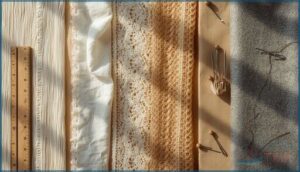
Each fabric construction method brings its own balance of strength, flexibility, and texture. Knowing how these methods compare helps you choose materials that meet your project’s needs.
Here’s how the main construction types stack up side by side.
Woven Vs. Knit: Stability, Stretch, and Use Cases
Think of Fabric Construction as a balance between control and freedom. Woven fabrics hold their shape thanks to tight Yarn Tension and locked Weave Structures between Warp and Weft, ensuring strong Fabric Stability.
Knitting, by contrast, delivers greater Stretch Recovery and Textile Performance—ideal when movement and comfort matter more than rigid precision.
Nonwoven Vs. Traditional Methods: Pros and Cons
Nonwoven fabrics rewrite textile manufacturing with speed and simplicity, skipping the traditional weaving process to boost manufacturing efficiency and cut production costs. Yet, this faster fabric construction limits fabric durability compared to woven structures.
Material sourcing choices—like synthetics versus recycled fibers—strongly shape long-term environmental impact, making balance the core challenge in modern fabric design.
Choosing The Right Construction for Your Sewing Project
You choose Construction Methods the same way you plan Garment Function: start from how the piece will live, not just look. Everyday T‑shirts, leggings, and activewear favor knit Fabric Constructions because looped structures stretch 15–25 percent and absorb movement, so seams and Sewing Techniques stay under less stress.
Structured shirts, blazers, jeans, and bags work better in woven Fabric Construction, where interlaced yarns deliver 2–3 times higher tensile strength, stable drape, and predictable Textile Properties.
When you match Methods of Fabric Construction and Fabric Production Techniques to how hard a garment will be worn and washed, your Fabric Selection stops feeling like guesswork and starts behaving like engineering.
How Construction Method Influences Fabric Selection
Construction method doesn’t just describe how a fabric is made — it predicts how it will perform. Once you understand that, your Yarn Selection and Fabric Stability decisions write themselves:
Fabric construction defines not just how cloth is made but how it feels, performs, and endures
- Woven Weave Patterns lock structure for structured pieces
- Knit Fabric Constructions flex for stretch-dependent garments
- Fiber Blending fine-tunes Textile Comfort across both Methods of Fabric Construction
Understanding Fabric Construction turns Fabric Types from options into answers.
Frequently Asked Questions (FAQs)
How to identify fabric construction?
Identifying fabric construction comes down to three quick checks: look at the surface structure, pull gently to test stretch, and examine the cut edge. Woven fabrics fray; knits curl.
What are the 5 methods of fabric construction?
You’ll usually group the 5 core Fabric Constructions as Fabric Weaving, Knit Construction (Knitting), Nonwoven Methods (Nonwoven fabrics), Braided Fabrics, and Felt Making, with each Fabric Construction producing very different performance and handle.
What are the three primary methods of fabric construction?
The three primary Fabric Construction methods in Textile Engineering are Weaving, Knitting, and Nonwoven fabrics.
Weaving relies on Yarn Interlacing and controlled Weave Patterns, while Knitting uses loops and Nonwoven fabrics depend on direct Fiber Bonding.
What are the 7 ways to test fibers for identification?
Think of detective work with threads—each clue matters. Fiber Types reveal themselves through Burning Reactions, Feel, Microscopic Features, Chemical Dissolving, Density Comparisons, tension, and moisture testing, exposing each fabric’s construction secrets and distinctive Textile Materials’ properties and yarn behaviors.
How do fabric finishes influence construction performance?
Fabric Finishing acts like a control dial on Fabric Construction, where specific Fabric Finishes either stiffen Textile Materials for durability or soften them for comfort.
These finishes reshape Fabric Properties such as strength, shrinkage, breathability, and moisture response across different Construction Methods and the Weaving Process.
The effectiveness of these adjustments is then verified through targeted Performance Testing, grounded in Material Science and Textile Enhancement.
What tools assist in accurately analyzing fabric structure?
Precision depends on the right instruments—Optical Tools for Thread Counting, digital systems for Fabric Inspection, and Microscope Analysis for observing Textile Structures.
Together, they reveal hidden patterns that define Fabric Properties Analysis and advance modern Fabric Engineering.
How can digital weaving software optimize production quality?
Digital weaving software boosts production quality by combining precise Fabric Simulation, Weave Optimization, and Virtual Sampling with loom‑ready files, so you prevent weak constructions, stabilize Weaving performance, and cut waste across modern Fabric Construction in the Textile Industry.
It links Automated Inspection and Digital Quality Control, mapping defects roll‑by‑roll, tightening tolerances, and supporting data‑driven Digital Transformation alongside downstream steps like Digital Textile Printing.
What factors determine the best fabric construction for upholstery?
What really decides the best Fabric Construction for Upholstery Fabrics is how well Textile Materials balance Upholstery Durability with comfort.
You’re looking at Abrasion Resistance ratings, Fabric Density and Thread Count, plus suitable Weave Patterns and Fabric Types that deliver stable, easy‑care Fabric Properties.
How does fiber type affect overall construction behavior?
Different Fiber Types steer Fabric Construction behavior by controlling Fiber Strength, elongation, and surface character, which in turn dictate Yarn Density, Fabric Drape, and overall Textile Performance.
These properties are essential across Natural Fibers, Synthetic Fibers, and Fiber Blends within Textile Materials.
Conclusion
Nearly 60% of fabric performance issues trace back not to fiber type but to construction choices. When you can determine fabric construction method on sight, you read strength, drape, and breathability before you ever cut or sew.
A quick stretch test, a magnifier, and basic thread counts already place you ahead of most hobbyists.
Treat each textile as engineered architecture, and your fabric selections will become deliberate decisions instead of educated guesses every single time.
- https://www.deekontextile.com/blog/easy-methods-to-tell-apart-knit-and-woven-fabrics.html
- https://www.masterclass.com/articles/knit-vs-woven-learn-how-to-identify-the-two-fabric-types
- https://www.bara-studio.com/en/blogs/news/stoffzusammensetzung-mittels-brennprobe-bestimmen
- https://www.fashinza.com/?utm_source=blog&utm_medium=anchorlink
- https://www.fibre2fashion.com/industry-article/9118/understanding-the-basics-of-fabric-construction