This site is supported by our readers. We may earn a commission, at no cost to you, if you purchase through links.
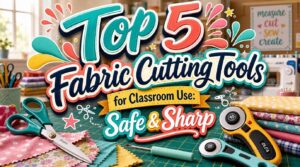
Every semester, at least one student ruins a project—not because they can’t sew, but because they grabbed the wrong scissors. Fabric cutting tools for classroom use aren’t interchangeable, and treating them like they are costs you time, materials, and more than a few frustrated kids. A pair of craft scissors drags through cotton like it owes you money; meanwhile, proper fabric shears slice cleanly on the first pass.
Choosing the right tools upfront changes what students can actually accomplish—and how confidently they do it. These five options cover the range of classroom needs without compromising on safety or durability.
Table Of Contents
Key Takeaways
- Matching the tool to the task — dressmaker shears for pattern pieces, pinking shears for seam finishing, micro-tips for thread trimming — directly determines the quality of your students’ finished work.
- Ambidextrous handles, rounded tips, and ergonomic grips aren’t optional extras; they’re the difference between a safe, productive class period and a first-aid moment.
- Titanium-coated or high-carbon stainless blades hold their edge significantly longer than standard steel, making them the smarter long-term investment for high-rotation classroom use.
- Scissors left uncleaned, un-oiled, and unsheated don’t just wear out faster — they become a liability, so monthly pivot oiling, post-use wipe-downs, and locked storage aren’t negotiable.
Top 5 Classroom Fabric Cutting Tools
Not all classroom scissors are created equal — and if you’ve ever watched a student wrestle a cheap pair through a double layer of denim, you know exactly what that means. The right tool makes a real difference in both safety and finished results.
For a truly clean result, pairing the right scissors with proper techniques for hemming jeans can mean the difference between frayed edges and a finish that looks store-bought.
The right classroom scissors can mean the difference between clean, confident cuts and a student wrestling denim into defeat
Here are five fabric cutting tools worth keeping in your classroom.
1. Westcott 7 Inch Floral Student Scissors
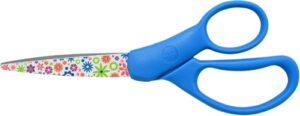
The Westcott 7 Inch Floral Student Scissors punch above their price point for everyday classroom use.
Stainless steel blades handle paper, foam, and poster board cleanly — and the ambidextrous handle means you’re not scrambling for a left-handed pair when half your class needs one.
Soft plastic grips reduce fatigue during longer cutting sessions, which matters more than most teachers expect.
Recommended for ages 12 and up, these aren’t your heavy-duty shears, but for general art and light craft projects, they hold their own.
| Best For | Students aged 12 and up who need a reliable, ambidextrous pair of scissors for everyday art projects and classroom crafts. |
|---|---|
| Blade Material | Stainless steel |
| Blade Length | 7 inches |
| Hand Orientation | Ambidextrous |
| Primary Use | Paper, foam, poster board |
| Package Quantity | 1 pair |
| Price (USD) | Not listed |
| Additional Features |
|
- Sharp stainless-steel blades cut cleanly through paper, foam, and poster board
- Ambidextrous design works for both right- and left-handed users — no extra pair needed
- Ergonomic shape helps reduce hand fatigue during longer cutting sessions
- Not built for heavy-duty materials like thick cardboard or fabric
- Some users find them a bit flimsy for frequent, heavy use
- The 7-inch size can feel too big for younger kids or detailed, precision work
2. Fiskars Beginner Sewing Scissors
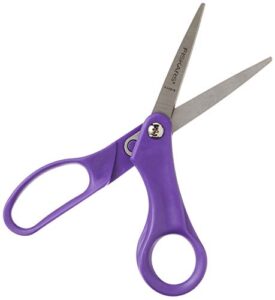
If your students are just discovering fabric — think ages 7 to 10 — the Fiskars Beginner Sewing Scissors are worth a close look. At 7 inches, they’re sized for smaller hands without sacrificing control.
Precision-ground stainless steel blades cut cleanly through cotton, felt, and even light denim with minimal effort. The bent ergonomic grips keep wrists in a comfortable position during longer sessions.
One honest caveat: skip these for heavy or layered materials — they’re built for learning, not industrial workloads.
| Best For | Kids ages 7–10 just getting into sewing, plus left-handed beginners who need a well-balanced, smaller scissor. |
|---|---|
| Blade Material | Stainless steel |
| Blade Length | 7 inches |
| Hand Orientation | Left-hand friendly |
| Primary Use | Fabric cutting |
| Package Quantity | 1 pair |
| Price (USD) | Not listed |
| Additional Features |
|
- Precision-ground blades slice cleanly through cotton, felt, and light denim without much effort
- Bent ergonomic handles keep wrists comfortable during longer cutting sessions
- Compact 7-inch size gives smaller hands real control without feeling clunky
- Blunt tip makes fine-detail work tricky — not great for intricate cuts or paper tasks
- Can struggle with thick or layered fabrics; some users have reported blade breakage under heavy use
- Too small for adult projects that need longer reach or heavier-duty performance
3. LIVINGO 7 Inch Stainless Steel Scissors
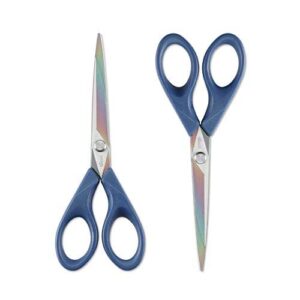
Need something that grips more than just beginner fabrics? LIVINGO 7 Inch Stainless Steel Scissors step up nicely. Titanium-fused blades resist rust, and low adhesion keeps glue and tape from sticking — a real bonus in mixed-media projects.
The ambidextrous grips work for left- and right-handed students without any awkward adjustments. Rated for over 150,000 cuts, these hold their edge through daily classroom use. At $14.99 for two pairs, your budget stays intact too.
| Best For | Left- and right-handed students or home users who need durable, versatile scissors for everyday cutting tasks like fabric, paper, tape, and light crafting. |
|---|---|
| Blade Material | Stainless steel with titanium coating |
| Blade Length | 7 inches |
| Hand Orientation | Ambidextrous |
| Primary Use | Fabric, paper, cardboard |
| Package Quantity | 2 pairs |
| Price (USD) | $14.99 |
| Additional Features |
|
- Titanium-fused blades resist rust and shed glue easily, so they stay clean and sharp longer
- Ambidextrous design means no awkward adjustments whether you’re left- or right-handed
- Two pairs for $14.99 is solid value, especially for classrooms or shared spaces
- Finger holes run small, which can get uncomfortable if you have larger hands
- Not built for heavy-duty jobs like thick leather or industrial materials
- Limited finger insertion makes long cutting sessions a bit tiring
4. ARTEZA Micro Tip Fabric Scissors
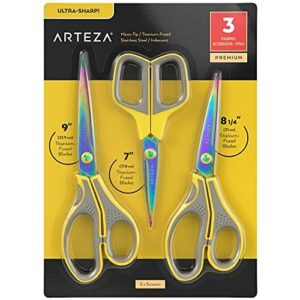
Where LIVINGO grips volume, ARTEZA Micro Tip Fabric Scissors grip the fine work.
Their precision tips handle delicate seams and tricky edges where bulkier scissors would struggle—the same control matters when trimming threads on an overlock machine’s layered stitching.
This three-pair kit — 7 in, 8.25 in, and 9 in — covers everything from thread trimming to denim panels.
The titanium-coated blades stay sharp through multi-layer cuts, and those precision micro-tips reach tight corners without snagging delicate fabric.
Ambidextrous grips fit both hands comfortably, and the spring action reduces squeeze fatigue during long projects.
All that for $13.99 — hard to argue with.
| Best For | Sewers, quilters, and crafters who need precise control for detailed work like seam trimming, appliqué, and tight-corner cuts. |
|---|---|
| Blade Material | Stainless steel with titanium coating |
| Blade Length | 7, 8.25, 9 inches |
| Hand Orientation | Ambidextrous |
| Primary Use | Fabric, sewing, quilting |
| Package Quantity | 3 scissors |
| Price (USD) | $13.99 |
| Additional Features |
|
- Three sizes in one kit means you’re covered for everything from delicate trim work to heavier fabrics like denim
- Titanium-coated blades hold their edge well and cut cleanly through multiple layers without much force
- Ambidextrous handles work comfortably for both righties and lefties, reducing hand fatigue on longer projects
- The lightweight feel can make them seem a little flimsy compared to heavier professional shears
- No storage sheath included, which is a real concern given how sharp those micro-tips are
- At $13.99, some buyers feel the build quality doesn’t quite match the price
5. Westcott Lace Pattern Scissors
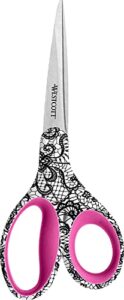
For delicate lace work and decorative edging, the Westcott Lace Pattern Scissors earn their spot on any classroom supply list.
The 5-inch blades are high-carbon stainless steel — rust-resistant and heat-tempered for clean cuts on lightweight fabric without fraying. Fine serration grips the material so it won’t slip mid-cut. Contoured grips reduce fatigue, and the balanced pivot keeps cutting force manageable.
If your students are tracing intricate patterns or finishing decorative trim, these are the scissors that actually cooperate.
| Best For | Students, scrapbookers, and hobbyists who need reliable scissors for everyday craft projects and want to easily spot their pair in a shared workspace. |
|---|---|
| Blade Material | Stainless steel |
| Blade Length | 8 inches |
| Hand Orientation | Not specified |
| Primary Use | Paper, foam, poster board |
| Package Quantity | 1 pair |
| Price (USD) | $14.99 |
| Additional Features |
|
- Clean, accurate cuts on paper, foam, and poster board — great for classroom and hobby use
- The lace pattern makes them easy to identify at a glance when scissors get mixed up
- Comfortable enough for longer crafting sessions despite the slightly heavier build
- Heavier and bulkier than many craft scissors, which can make fine-detail work a bit awkward
- Some buyers have received them with surface scratches or opened packaging — shipping handling seems inconsistent
- Long-term durability is a question mark; at least one user had blade failure around the five-year mark
Best Fabric Tools for Student Projects
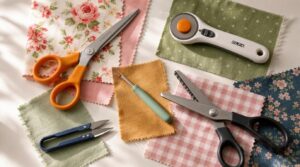
sewing project calls for the same tool — and that’s exactly where students get tripped up. Having the right cutter for the job makes a real difference in both the quality of the work and the safety of the process.
Here are five fabric cutting tools worth knowing before your next classroom project.
Dressmaker Shears for Pattern Pieces
Dressmaker shears are the workhorse of any student sewing lab — and the right pair makes all the difference. Look for 8–9 inch blades with solid Steel Alloy Selection: high‑carbon stainless holds its edge through denim and cotton alike.
Tension Screw Tuning keeps Blade Alignment Guides true, while Edge Serration Types grip slippery fabrics.
Ergonomic grips and smart Weight Distribution Design reduce hand fatigue fast.
The extra‑long stainless‑steel blades provide clean cuts to the tip, ideal for multiple fabric layers.
Pinking Shears for Seam Finishing
Pinking shears do one thing brilliantly — they give every seam a Zigzag Edge that fights fraying before it starts. The Serrated Blade interlocks to grip woven fibers with each pass. Using pinking shears for seam finishing is faster than overlocking in a time‑crunched class.
Here’s what to know about Fabric Compatibility and smart use:
- Best on cotton, linen, and light blends — not knits
- The Offset Handle improves visibility and keeps wrists neutral
- Seam Reinforcement improves with a straight stitch close to the pinked edge
- Blade sharpness matters — dull teeth tear instead of cutting cleanly
- Always use protective storage to prevent nicks between lessons
Safety considerations in student sewing labs include supervising blade handling and storing shears in labeled sheaths.
Micro-tip Scissors for Detail Trimming
Thread ends don’t trim themselves — and a pair of micro-tip scissors makes short work of them.
With a Precision Tip narrower than 3mm, microtip designs slip into tight corners without disturbing surrounding stitches.
Blade Serration grips slippery threads cleanly, while Ergonomic Controls and ergonomic grips reduce fatigue during detail-heavy sessions.
A Guarded Design and consistent Maintenance Routine keep blade sharpness reliable across every student sewing class.
Smart safety considerations in student sewing labs start here.
Rotary Cutters for Straight-edge Cuts
A rotary cutter performs straight-edge cuts the way a pizza wheel performs dough — fast, clean, and surprisingly satisfying. Pair it with a self-healing mat and a non-slip ruler, and your student sewing class gains serious precision.
- Blade Alignment keeps the cutter tracking true along ruled lines
- Edge Tracking improves with beveled blades on a marked grid
- Cut Smoothness depends on blade sharpness — replace dull blades immediately
- Layer Thickness up to four layers is manageable with a 45mm blade
- Speed Control matters: slow, steady strokes beat rushing every time
Protective storage keeps blades safe between lessons.
Duckbill Scissors for Appliqué Work
duckbill scissors as your students’ secret weapon for appliqué — the flat paddle blade pushes fabric away from the cut line so they’re trimming within 1/16 inch of a stitch without nicking anything underneath.
| Feature | What It Does | Why It Matters |
|---|---|---|
| Paddle Blade Design | Lifts fabric from cut line | Protects underlying layers |
| Precision Tip Control | Reaches tight corners | Clean appliqué edges |
| Stitchline Access | Cuts within 1/16 inch | No stitch disturbance |
| Smooth Pivot Action | Reduces hand fatigue | Consistent control |
| Edge Proximity | Trims stabilizer cleanly | Neat embroidery finish |
Safe Cutting Setup for Classrooms
A sharp tool in the wrong setup is just an accident waiting to happen. Before your students make a single cut, the environment around those scissors matters just as much as the scissors themselves.
Here’s what a safe, student-ready cutting station actually looks like.
Rounded Tips and Blade Guards for Younger Students
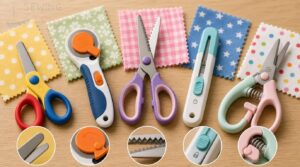
Younger students need tools designed with Puncture Prevention in mind — and rounded-tip designs deliver exactly that. A smooth tip radius of at least 2 mm keeps accidental pokes from becoming first‑aid moments.
Look for scissors meeting Age-appropriate Certification standards like ASTM and EN, plus BPA‑free, lead‑free grips that meet Material Safety Standards.
Guard Lock Mechanisms matter too:
- Color-coded Blade Indicators help students distinguish left- and right-handed pairs instantly.
- Built-in guards hinge open during cutting but lock closed in transit.
- Protective sheaths for scissors add a second layer of security in desks and bags.
Neutral Wrist Grips and Soft Handles
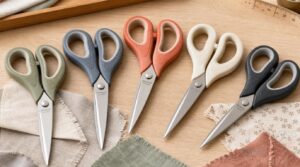
Once rounded tips cover puncture prevention, the next concern is what happens to students’ hands over a full class period. Contoured Grip Shapes and Soft Material Cushioning — think TPE or soft rubber — reduce pressure points and hand fatigue reduction during long sessions.
Non‑Slip Textures and Tactile Feedback Design help students maintain neutral wrist alignment without over-gripping.
Adjustable Handle Size options make ergonomic grips to maintain neutral wrist posture accessible even on a tight budget.
Supervised Cutting Stations and Clear Rules
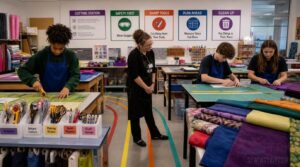
Good methods only get you so far — the station itself does the rest. Visual Queue Lines direct students where to stand, while clear Rule Signage Design keeps expectations visible without lectures.
A supervisor circulates every 60–90 seconds, and Buddy System Checks add a second set of eyes.
Log any incident immediately.
Structure isn’t overkill; it’s what makes student supervision and scissor safety rules actually stick.
Cutting Mats and Non-slip Rulers
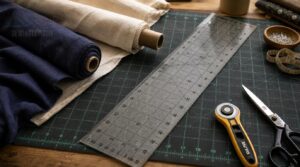
Even the sharpest scissors drift when your mat slides and your ruler shifts — that’s where the setup earns its keep.
Self-healing cutting mats with Integrated Grid Lines eliminate the guesswork. Pair them with a clear acrylic grid ruler and Rubberized Backing, and straight cuts stay straight.
- Self-healing Surfaces close after each pass, protecting blade edges
- Magnetic Ruler Clips and Angle Guide Inserts keep measuring tape and rulers locked in position
- Non-slip mats with printed grids let you skip the separate measuring step entirely
Left- and Right-handed Comfort Options

Choosing left-handed versus right-handed scissors isn’t just a preference — it directly affects control and hand fatigue. Left-handed models feature reversed blade alignment and ergonomic thumb rests angled for southpaw grip. Right-handed versions emphasize balanced weight distribution toward the blade for beginner precision.
Both benefit from soft grip coatings and adjustable tension screws. Ambidextrous handle designs with ergonomic grips help maintain neutral wrist posture for everyone.
Cleaning, Sharpening, and Storage
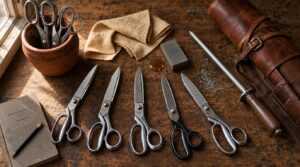
Good scissors don’t maintain themselves — that part’s on you. routine care goes a long way toward keeping your classroom tools sharp, safe, and ready for the next project.
Here’s care actually looks like.
Wiping Blades After Each Use
A dirty blade is a dull blade — it’s that simple. After every use, wipe both blade surfaces with a clean damp cloth for effective Fiber Debris Elimination and Edge Dust Removal.
Then dry immediately with a soft microfiber cloth; Moisture Prevention is non‑negotiable with metal edges. Always wipe away from the edge. Before storage, run a quick Inspection Routine — check for nicks, then sheath it.
Pivot Oiling and Tension Checks
Think of the pivot point as the heartbeat of your scissors — when it seizes up, everything suffers. Your Oil Application Technique matters: one drop of non-reactive machine lubricant, applied monthly with a lint‑free cloth. That’s it.
Pivot Tension Calibration is equally critical; a squeaking blade signals, your Squeak Diagnosis Procedure should begin immediately.
Adjustable tension screws let you dial in smooth, wobble‑free action. Log every service in your Maintenance Log Tracking system.
Sharpening or Replacing Dull Blades
A dull blade doesn’t just cut poorly — it’s a safety hazard waiting to happen.
For blade sharpening, a 1000–6000 grit whetstone selection covers most classroom scissors without breaking the budget. Honing rod technique works well for quick touch-ups between lessons. Electric sharpening safety rules apply when speed matters.
Blade replacement timing is straightforward: visible chips or corrosion? Swap it. No cost-benefit analysis needed.
Sheaths, Cases, and Locked Storage
A blade left naked in a drawer is an accident—and a liability. Protective sheaths for scissors are your first line of defense.
Beyond that, portable protective cases with foam insert customization keep each tool locked in place during transport. Lockable cabinet design with weather‑resistant seals controls access and blocks moisture.
Add an asset tagging system, and your entire cutting tool inventory stays accountable.
Preventing Rust and Edge Damage
Rust doesn’t announce itself — it just quietly destroys your tools. After sharpening, apply a thin rust-preventive coating to seal micro-scratches where moisture hides.
Non-reactive, fabric-safe anti-corrosion lubricants protect pivot points without staining student projects.
Store scissors in humidity controlled drawers with silica gel packs.
Reapply edge coating every three to six months.
Good blade edge geometry and consistent blade maintenance are what make edge retention last.
Frequently Asked Questions (FAQs)
What are five cutting tools?
Every sharp tool has its place.
You’ve got fabric scissors, rotary cutters, pinking shears, dressmaking shears, and embroidery scissors — five workhorses that handle everything from straight cuts to fine thread trimming.
What are the different types of fabric cutting equipment?
Fabric cutting equipment spans hand tools—dressmaking shears, pinking shears, rotary cutters, snips, seam rippers—and industrial machines: Round Knife Machines, Band Knife Machines, Industrial Knife Machines, Laser Cutting Systems, and Water Jet Cutters.
How to cut fabric straight for beginners by hand?
Ironically, the secret to cutting fabric straight by hand isn’t the scissors — it’s everything else. Ruler alignment, wrist positioning, and edge stabilization do the real work.
Keep your grip relaxed, let blade sharpness do the cutting, and trust the line.
How do blade materials affect cutting performance over time?
Blade material decides how long your scissors stay sharp. Stainless steel resists corrosion well; titanium coatings extend edge retention by up to 30 percent. On abrasive fabrics, material hardness is everything.
Can fabric scissors safely cut paper or tape?
Think of your fabric scissors as a scalpel — using them on paper or tape is like performing surgery with a butter knife afterward.
Paper causes blade abrasion and edge micro-nicks; tape leaves adhesive buildup that contaminates your next fabric cut.
How often should classroom scissors be professionally sharpened?
Plan on professional sharpening every 6–12 months — but usage frequency and fabric type impact that schedule considerably. Heavy classroom rotation or thick materials? Bump it to every 4–6 months.
Conclusion
Picture two classrooms side by side: one stocked with dull craft scissors, the other with proper fabric cutting tools for classroom use. Same students, same patterns, same thread—completely different outcomes.
Sharp, purpose-built tools don’t just cut more cleanly; they build confidence stitch by stitch.
The right shears won’t make every project perfect, but the wrong ones guarantee frustration.
Equip your students well, and watch what they’re actually capable of creating.