This site is supported by our readers. We may earn a commission, at no cost to you, if you purchase through links.
You can spot a twill weave long before you touch it—the diagonal ribs give it away. Tilt the fabric under light, and those tiny, staircase-like lines will catch your eye, running left or right across the surface.
That pattern isn’t decorative by chance; it’s the structural fingerprint of a specific interlacing technique that controls the fabric’s strength and flexibility. From denim to herringbone, the same logic of thread overpasses governs them all.
Learning twill weave identification techniques means seeing with a technician’s eyes—recognizing the rhythm of the weave hidden beneath the fabric’s finish.
Table Of Contents
- Key Takeaways
- What is Twill Weave?
- Recognizing Twill Weave Patterns
- Visual Inspection Techniques for Twill
- Magnification Methods for Twill Analysis
- Thread Counting and Weave Density
- Tactile Clues in Twill Identification
- Advanced Digital Identification Techniques
- Common Types of Twill Weave
- Distinguishing Twill From Other Weaves
- Practical Tips for Sewing With Twill
- Frequently Asked Questions (FAQs)
- Conclusion
Key Takeaways
- Twill weave is defined by its diagonal ribs formed through a stepped over-under interlacing of warp and weft threads, creating a strong yet flexible structure.
- Visual and tactile identification relies on spotting continuous diagonal lines, assessing line angle and direction, and feeling for smoothness and drape differences compared to plain weaves.
- Magnification, thread counting, and digital tools like FFT image analysis reveal the precise weave repeat, float pattern, and angle for accurate classification.
- Common twill types such as denim, gabardine, herringbone, and serge differ in yarn fineness, wale angle, and fabric weight but share the same structural logic and durability advantages.
What is Twill Weave?
Before you can spot twill by sight, you need to know what makes it tick. This weave has its own structure, logic, and look that set it apart from others.
For a deeper look at how different weave patterns behave, this guide on recognizing fabric weave types breaks down twill’s unique structure and purpose in everyday textiles.
Let’s start by breaking down what twill really is, how it’s built, and the main traits that define it.
Definition of Twill Weave
Think of twill weave as a Basic Weave with attitude: its surface shows clear diagonal ribs, called a Diagonal Wale, running in one main direction. In this weave structure, warp and weft threads follow a stepped interlacing pattern, so each weft passes over one or more warps, then under two or more. Those Longer Floats between points of Yarn Interlacing create the signature twill weave diagonal effect and softer hand.
These diagonal ribs are one of the key twill fabric properties that distinguish it from plain and satin weaves.
Twill Weave in Textile Construction
In textile construction, a twill weave forms through a repeated offset where each weft crosses over and under multiple warp threads. This staggered interlacing shifts row by row, creating diagonal ribs that move across the fabric’s face. The pattern can run upward or downward, depending on setup, and requires at least three frames to form its structure. These diagonal ribs contribute to.
Key Features of Twill Weave
As that interlacing pattern stacks into diagonal ribs, a few features stand out. You’ll see a consistent wale across the face with a clear Face/Back Contrast, and the Wale Angle usually falls somewhere between about 45° and 63°.
Those longer floats of warp and weft create a smoother Texture and tighter Float Structure than plain weave, which is exactly why twill feels dense, flexible, and quietly strong.
Recognizing Twill Weave Patterns
Spotting a twill weave starts with training your eye to catch its signature pattern. The trick is knowing what those subtle diagonal lines are telling you about the fabric’s structure.
Here’s how to recognize the key visual clues that set twill apart.
Diagonal Rib Identification
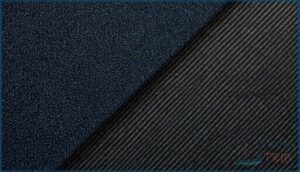
Want a quick field test for tw? Look for a strong directional look: diagonal ribs running as continuous, parallel lines across the surface.
On denim or workwear, the Rib Angle is obvious, around mid-slope, and you can trace one wale from edge to edge. On suiting, you’ll see finer, more Subtle Ribs.
Good Yarn Clarity, plus clear Face Contrast, makes the weaving pattern jump out.
Z-Twill Vs. S-Twill Direction
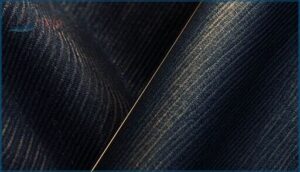
Direction tells the story of twill weave. In Z-Twill, diagonal lines climb from lower left to upper right—a crisp, right-hand tilt tied to classic denim. S-Twill runs opposite, softer in hand and historical uses.
Yarn Twist Impact shapes Bias Torque and subtle Fade Pattern Differences, making fabric weave identification as much visual and tactile analysis as interlacing pattern study.
Common Twill Line Angles
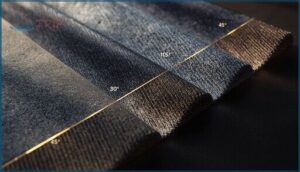
Twill line angles define your fabric weave identification game. Typical Angle Range spans 15 to 75 degrees to the weft, with 45-Degree Standard hitting that sweet spot for balanced diagonal lines in everyday chino or shirting twills.
Steep Angle Uses push past 60 degrees in workwear, sharpening wales toward vertical for warp strength. Reclining ones dip below 30 degrees, easing drape weft-wise.
Master these, and you’ll spot twill weave’s signature every time.
Visual Inspection Techniques for Twill
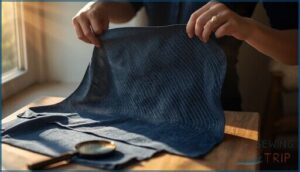
Visual inspection gives you the quickest way to spot twill without fancy tools. Hold the fabric right and those telltale signs jump out. You’ll check light, lines, and comparisons next.
Using Natural Light
Think of natural light as your free lab equipment for fabric weave identification. Start by taking your twill weave sample to different Window Orientation options in the same room; north light usually gives softer, more even Diffuse Lighting, while west or south windows create stronger Color Shifts that can mislead your eye.
Around Midday Light, brightness and spectrum make fabric texture and diagonal lines easier to judge during manual inspection.
Spotting Diagonal Lines
Spotting twill’s diagonal lines is where fabric weave identification really starts to feel satisfying. Look for three things in sequence:
- Track Rib Continuity – follow a ridge with your fingertip; a true twill weave gives you an unbroken slant, not a zigzag or grid, as warp and weft threads step forward in a fixed order, creating that stable weave structure and Face Clarity.
- Watch Light Reflection – tilt the cloth; the diagonal lines should brighten and darken in bands because grouped floats catch light differently, especially when Yarn Contrast is high.
- Judge Steepness Factors – compare the angle of those diagonal lines to the fabric edge; around 45 degrees is common, while noticeably steeper or flatter ribs still read as twill, just with different density relationships between warp and weft that you’ll learn to recognize over time.
Comparing With Other Weaves
When you compare twill vs other weaves, you’re really doing fast fabric classification by eye and hand. Plain weave looks like a flat grid with maximum interlacing points, high snagging resistance, and a crisp, less fluid drape. Satin weave shows long, glossy floats, the fewest interlacing points, low snag resistance, and the greatest drape differences. Twill sits in the middle: visible diagonals, moderate gloss, softer drape, and balanced durability.
| Weave type | What you’ll notice first |
|---|---|
| Plain weave | Flat grid, matte face, firm structure, high snag resistance. |
| Twill weave | Diagonal ribs, fuller hand, good drape, hides dirt and creases. |
| Satin weave | Very smooth shine, visible floats, snags easily, fluid drape. |
| Pile or others | Raised loops/tufts, 3D surface, not defined by diagonal lines. |
Magnification Methods for Twill Analysis
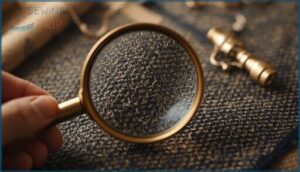
Once your eyes have done all they can, magnification gives you the next level of control. With a simple hand lens or small magnifier, you can start to see how each thread actually interlaces.
In the next steps, you’ll use that closer view to spot floats, track the “steps” of the pattern, and separate true twill from plain weave lookalikes.
Using a Hand Lens or Magnifier
Ever wonder how professionals read fabric like a map? The secret is magnification. A linen tester or hand lens lets you see twill weave diagonals up close and track every warp and weft thread.
- Magnifier Selection – use 5x–6x.
- Fabric Positioning – set squarely.
- Lighting Techniques – tilt toward light.
- Structure Viewing – follow ribs.
- Integrated Scales – measure repeats precisely.
Identifying Floats and Steps
Once you’ve got the twill weave under magnification, you’re not just looking at diagonals anymore—you’re reading Float Length and Step Number like a code. Follow one warp or weft yarn and start Counting Floats: note how many warp and weft threads it passes over before it tucks under.
Those floats, arranged in stepped interlacing patterns, create the Visual Float Signs you see as smooth diagonal ribs. Longer floats link into softer, clearer wales; shorter ones break the line into a crisper, more textured weave structure.
By tracking how each new pick shifts the floats—one thread at a time or more—you’re effectively measuring the Step Number that drives the angle and rhythm of those float paths.
Differentiating Twill From Plain Weave
Under magnification, you’re no longer guessing—you can see the Interlacing Differences between twill weave and plain weave in the paths of the warp and weft threads.
In plain weave, the structure is strict over‑one‑under‑one, so crossings form a tight grid with clear Density Contrasts and a flatter Surface Texture.
Twill shows a stepped diagonal pattern of floats, giving thicker yarn clustering, softer Drape Comparisons, and a more three‑dimensional weave structure you can’t miss.
Thread Counting and Weave Density
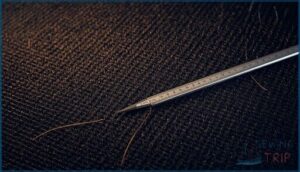
Once you’ve examined the surface and weave pattern, the next step is to measure density. Thread counting helps you see how tightly the fabric is built and how the twill lines repeat.
Here’s what to pay attention to as you take a closer look.
Counting Warp and Weft Threads
Thread Count Accuracy starts with understanding Warp Weft direction and reading warp and weft threads separately, not as a vague single number.
To apply solid Manual Counting Tips, mark a 1-inch window parallel to the selvedge for warp, then perpendicular for weft, and count each thread.
For finer twill weave, Magnifier Use matters: drop a pick glass over the fabric and let its built-in scale show true thread count within the weave structure.
Assessing Twill Thread Repeat Patterns
You already counted warp and weft threads; now you’re ready to read the pattern they form. Focus on three things: Repeat Dimensions, Step Progression, and Float Analysis along each diagonal pattern.
Use this quick Sequence Mapping routine:
- Mark a small grid and trace warp and weft threads.
- Note how many ends and picks before the weave structure repeats.
- Track how far the float shifts each pick to see the weave ratio.
- Check diagonal angle for Angle Verification against typical Twill Weave Construction.
Estimating Fabric Stability
Durability in twill starts with Dimensional Stability: how well the fabric holds size and shape after stress, washing, and wear. Dense twill weave structures with higher ends and picks resist shrinkage, seam slippage, and distortion, while looser fabric construction will torque, bag out, and fray sooner. You also read stability through Shear Resistance, Bending Stiffness, and Tear Strength, because these fabric properties reveal how the weave will behave in real use.
| Factor | Low Stability Twill (Risk) | High Stability Twill (Preferred) |
|---|---|---|
| Dimensional Stability | Twists after washing, seams drift | Shape holds, seams stay aligned |
| Shear Resistance | Legs twist, bias distortion | Minimal skew, balanced twill weave |
| Tear Strength | Frays at stress points | Withstands repeated load and abrasion |
Think of this as reading the weave’s long-term promise: you’re not just seeing twill, you’re forecasting performance in motion.
Tactile Clues in Twill Identification
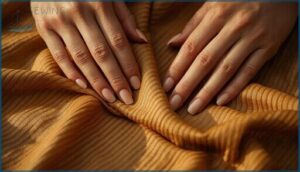
Beyond how a fabric looks, the way it feels in your hands reveals a lot. Twill’s distinct texture and body become clear the moment you run your fingers across it.
Here’s what to pay attention to when using touch to confirm a twill weave.
Surface Texture and Smoothness
You feel twill weave before you really see it. Your fingers pick up a directional fabric texture: smoother along the diagonal ribs, slightly grainier across them. Yarn smoothness matters here; finer, cleaner yarns give lower surface roughness and a softer fabric hand, while coarse, hairy yarns feel drier and scratchier. Surface luster and finish effects also shift your perception of surface smoothness.
- Calendered twill feels cool, flat, and slick, with higher apparent surface luster.
- Peach-finished twill feels suede-like: smoother to the hand but visually fuzzier.
- Mercerized twill shows a tighter, rounder surface, combining cleaner shine with a more polished glide across the weave structure.
Even without magnification, these cues tell you a lot about P, surface smoothness, and how the weave structure and finishing shape the fabric’s touch.
Fabric Weight and Drape
Weight speaks volumes about twill weave behavior. Heavier fabrics above 300 gsm keep firm structure, while lighter twills under 200 gsm flow closer to the body. Fiber stiffness, weave density, and drape assessment together reveal how a fabric moves and folds—key clues when reading fabric texture and fabric properties through touch.
| Weight Metrics (gsm) | Fiber Stiffness | Observed Drape |
|---|---|---|
| 320 (heavy) | Dense cotton, denim | Rigid, minimal flow |
| Variable | Wool, blends | Flexible yet full-bodied |
Comparing Tactile Feel With Plain Weave
When you close your eyes and just use your hands, twill weave usually reads as softer Surface Smoothness, fuller Cushioning Feel, and higher Fabric Pliability than a comparable plain weave because of its longer floats and fewer interlacings in the weave structure.
Plain weave, with its tight 1×1 grid, pushes back more: higher Friction Differences, crisper fabric texture, and a thinner, firmer pinch between your fingers.
For instance, slide two similar-weight cottons across your palm—twill glides and flexes, while plain weave feels grabbier, flatter, and more rigid, a clear demonstration of the characteristics of twill versus plain weave in real use.
Advanced Digital Identification Techniques

When manual inspection isn’t enough, digital tools can uncover what the eye can’t. Modern imaging and data analysis make it easier to identify twill structures with precision.
Here’s a look at two of the most effective methods used in sophisticated fabric analysis today.
FFT-Based Pattern Recognition
Think of FFT-based analysis as taking your twill weave into the Frequency Domain and letting the math do the staring for you. In practice, you feed a fabric image into an image processing routine that applies a 2D FFT, then study the power spectrum where Weave Periodicity turns into clean, symmetric peaks related to Yarn Density and spacing. Twill’s diagonal ribs show up as oriented energy bands, so you can read Twill Angle directly from the dominant spectral direction and separate warp and weft contributions for detailed fabric characterization and automated fabric pattern identification.
- Use FFT power spectra to spot regular weave repeats and density.
- Track dominant spectral orientation to quantify Twill Angle and rib direction.
- Compare peak layouts to distinguish twill weave from plain or satin structures.
- Filter frequencies, then inverse FFT to isolate yarn systems for precise pattern recognition.
Automated Textile Inspection Tools
You don’t have to rely only on your eyes anymore. With Automated Textile Inspection, you use Camera Systems and Computer Vision as a second, tireless inspector that watches every centimeter of twill in real time. These platforms stream high-resolution images into Digital Image Analysis in Textiles, where algorithms handle Twill Weave Classification, Fabric Characterization, and Real-time Detection of broken ends, floats, and shade streaks. Loom Integration lets the system slow or stop the machine when defects repeat, while Data Analytics turns defect maps and trend charts into hard evidence that your process changes actually improved quality.
| Element | What it Does | Why it Matters for Twill |
|---|---|---|
| Cameras + LEDs | Capture uniform, high-res fabric views | Reveal subtle diagonal faults |
| AI Algorithms | Classify defects and twill patterns | Support objective decisions |
| Dashboards | Visualize defects over time | Guide targeted corrections |
Common Types of Twill Weave
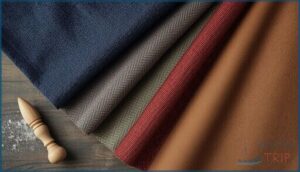
Twill isn’t just one style—it comes in several distinct forms, each with its own texture and purpose. From sturdy workwear fabrics to sleek suiting materials, these variations share the same diagonal structure but look and feel different in practice.
Let’s look at some of the most common types you’re likely to encounter.
Denim and Gabardine
Denim and gaberdine sit at two ends of the twill weave spectrum, and you can read them through their wale and Fabric Yarn choices. Denim Twill Variations use a 3×1 or 2×1 weave structure with coarse cotton yarns and a clear, bold diagonal. Gaberdine (modern gabardine) relies on finer, tightly spun yarns, a steep Gabardine Wale Angle, and a smooth, suit-weight handle.
- Look for blue warp and pale weft on denim’s face and back.
- Check gaberdine for a sharp, tight wale and cleaner surface.
- Compare weight: most denim feels heavier and stiffer than gabardine.
- Assess drape: gaberdine hangs cleaner, denim holds its shape longer.
Herringbone and Houndstooth
Where gaberdine favors refinement, herringbone patterns introduce motion within the twill weave. The herringbone twill reverses its diagonal, forming stacked V-shapes that create subtle depth.
Houndstooth contrast, in comparison, breaks the weave structure into bold four-pointed checks with strong color boundaries.
Both twill weave derivatives highlight how directional control transforms basic Twill Weave Features into visually lively fabrics.
Chino and Serge Twills
Chino and serge take twill weave in opposite directions. Chino uses fine cotton yarns in a subtle diagonal weave structure, producing a smooth, lightweight fabric around 6–8 oz/sq yd that works well for casual trousers.
Serge leans on wool or wool blends, with deeper, more visible ribs and a heavier drape suited to uniforms and suits. Same Twill Weave Features, very different results.
Distinguishing Twill From Other Weaves
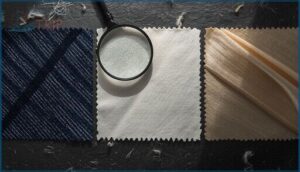
Now that you know how twill looks on its own, it’s time to compare it with other weaves. Each type has a distinct structure that affects texture, sheen, and strength. Here’s how to spot the key differences at a glance.
Twill Vs. Plain Weave Characteristics
Ever noticed how some fabrics catch light in soft diagonals while others stay perfectly flat? That’s the Surface Appearance difference between twill weave and plain weave. Twill’s shifted warp and weft threads create diagonal texture and better Drape Hand, while plain weave’s tight grid locks stability.
Their Structural Differences drive higher Durability Comparison and define each weave’s typical performance.
Twill Vs. Satin and Pile Weaves
Drama lives on the surface: twill weave shows diagonal ribs, satin weave looks flat and glossy, while pile weave stands up in loops or fuzzy tufts.
Surface differences come from yarn floats and weave structure; satin’s long floats boost shine but hurt wear performance, twill’s shorter floats improve strength and fabric drape, and pile’s raised third-yarn layer feels plush yet crushes and abrades faster.
Practical Examples for Comparison
Picture your own closet as a mini lab for fabric analysis. When you compare denim jeans to a smooth cotton sheet, you’re really seeing Plain Weave Contrast versus twill weave and its diagonal ribs created by a different weave structure.
Check an Oxford shirt next: its Basket Weave looks bumpy and grid-like, while a Dobby Weave dress shirt shows tiny woven motifs—both clearly different from the cleaner lines you’ll notice across types of twill weaves in well-fitting trousers.
Practical Tips for Sewing With Twill
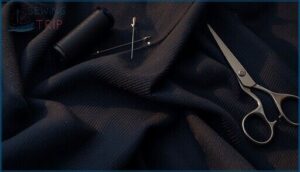
Sewing with twill isn’t hard, but it does ask for a bit of strategy. The fabric’s weight, structure, and diagonal ribs all affect how it behaves at the machine.
Here’s what to be aware of before you start your next twill project.
Choosing Projects for Twill Fabrics
When you’re choosing fabric for projects, start by matching twill’s strengths to the job. Medium‑weight cotton twill works well for everyday garment applications like trousers, chinos, and structured skirts because it balances drape and durability. Heavier denim twill suits hard‑wearing workwear needs, jackets, and overalls that see constant abrasion.
For home decor, reach for heavy twill for upholstery and curtains, and lighter brushed twill for throws and cushion covers.
Beginner projects benefit from stable twill in simple designs like tote bags, aprons, and straight‑seamed A‑line skirts, where the clear diagonal ribs help you keep grainlines honest.
In short, use the characteristics of twill and the typical uses of twill fabric as your roadmap when you’re choosing fabric for projects so your material selection helps both function and design.
Matching Twill to Project Requirements
Matching twill to your project is mostly about balancing strength, comfort, and look. Heavier cotton twill suits work pants or uniforms where abrasion resistance matters most. Lighter twills drape better for shirts or dresses that need movement.
Upholstery projects call for dense, tight weaves that resist wear.
For breathable, flexible garments, stick with mid‑weight cotton twill that still holds structure.
Care and Maintenance Considerations
Twill weave may look tough, but careless washing can break its rhythm fast. Stick to a Washing Temperature below 30°C and air-dry flat to protect clothing durability.
Gentle Ironing Guidelines prevent ridge shine, while prompt Stain Treatment keeps its stain resistance intact.
Good fabric care and maintenance preserve twill’s strength, shape, and wrinkle resistance longer than you’d expect.
Frequently Asked Questions (FAQs)
How do you identify a twill weave?
You identify a twill weave by spotting clear diagonal lines in the weave structure, then confirming, under magnification, that the warp and weft create stepped Yarn Interlacing with a consistent Weave Repeat, longer Float Lengths, and a softer Fabric Hand.
How to identify weave type?
Recognizing fabric weave type starts by observing weave patterns, light reflection, and fabric feel.
Then, studying warp and weft under magnification reveals everything—where yarn quality, fiber content, and weave structure become apparent.
What is the main visual characteristic of twill weave?
The main visual characteristic of twill weave is a field of continuous diagonal lines—raised ribs that run across the fabric surface.
These features create strong Ribs Visual Impact, clear Twill Angle Variation, and noticeable Face/Back Contrast in woven fabrics during fabric analysis.
How does yarn quality impact twill identification?
Funny how two twills with the same weave can look totally different just because the yarns changed. Finer, well-twisted, low‑hairiness yarns give you clean, continuous diagonals, while coarse, hairy, uneven yarns make ribs chunkier, fuzzier, and sometimes irregular, so reading twill direction and repeat takes more effort.
How can fabric shrinkage affect twill pattern clarity?
Fabric shrinkage quietly rewrites fabric structure, and your twill weave tells on itself through Diagonal Distortion, Skew Bowing, and Float Changes.
As density impact rises with repeated laund cycles, continuity of diagonal lines drops, softening overall pattern clarity.
Which statistical methods verify twill recognition accuracy?
You usually verify twill recognition accuracy with a Confusion Matrix, Kappa Statistic, ROC Curve, Cross Validation, and class‑wise Error Rate, then apply statistical analysis such as ANOVA method, t-test, and p-value checks to compare models.
How do finishing treatments change twill weave appearance?
Ironic, isn’t it? You chase twill’s crisp diagonals, then fabric finishing quietly rewrites the script: calendering effects flatten and gloss ribs, Napping changes and Sueding impact blur them, while Resin, washes, and enzymes either sharpen or visually drown the twill weave’s lines.
These processes alter fabric properties, weave characteristics and uses, and even the mood of your textile design.
Conclusion
Once you’ve got the pattern, fabric no longer leaves you at loose ends. You can read diagonal lines like sentences, checking angle, direction, and repeat. With consistent practice, your twill weave identification techniques turn from theory into reflex.
Soon you’ll recognize denim, gabardine, or herringbone the way musicians hear chords. Each inspection becomes a controlled experiment: observe, test, compare, then decide. When you trust the structure, fabric stops being vague and becomes a system mastered.
- https://textilelearner.net/twill-weave-features-classification-derivatives-and-uses/
- https://www.wangusilk.com/news/industry-news/how-to-distinguish-plain-twill-and-satin-weave-raw-linen-fabrics.html
- https://mypacklove.com/blogs/label/what-is-twill-weave-pattern-benefits-and-woven-label-guide
- https://yanmaotextile.com/what-is-twill-fabric-a-complete-guide-to-this-classic-weave/
- https://www.bolianfiltration.com/how-to-identify-plain,-twill-and-satin-patterns.html