This site is supported by our readers. We may earn a commission, at no cost to you, if you purchase through links.
Cut a yard of quilting cotton, wash it once, and it comes back smaller. Not dramatically—maybe half an inch, maybe more—but enough to throw off your blocks, your borders, your whole plan.
Quilters have wrestled with this for generations, and the culprit isn’t a defective fabric or a rogue washing machine. It’s physics.
Cotton fibers absorb water, swell, and release the tension locked in during manufacturing. Heat accelerates the process, agitation adds its own pressure, and the dryer finishes the job.
Understanding exactly why quilting fabric shrinks after washing puts you in control of your cuts, your dimensions, and your finished quilt.
Table Of Contents
- Key Takeaways
- Why Quilting Fabric Shrinks
- Heat Causes Fabric Contraction
- Moisture Triggers Shrinkage
- Washing Agitation Distorts Fibers
- Cotton Shrinks More Than Synthetics
- Weave Affects Shrinkage
- How Much Cotton Shrinks
- Pre-Wash Before Quilting
- Measure Shrinkage Before Cutting
- Top 3 Quilt Coverlet Picks
- Frequently Asked Questions (FAQs)
- Conclusion
Key Takeaways
- Cotton shrinks 3–5% on its first wash because water releases tension locked into the fibers during manufacturing — pre-washing before you cut eliminates that surprise.
- Heat is a multiplier: hot water (60°C+) and high dryer temps can push shrinkage beyond what either would cause alone, so cold water and low heat are your safest defaults.
- Weave structure matters as much as fiber content — tight weaves resist shrinkage, while loose weaves let fibers shift freely under moisture and agitation.
- Always test a 6-inch swatch first, calculate your shrinkage percentage with simple math, and add that margin back into your cut dimensions before starting any quilt project.
Why Quilting Fabric Shrinks

Quilting fabric doesn’t shrink by accident — there are real, specific reasons it happens. Understanding them helps you stay ahead of the problem before you cut a single piece.
Knowing those causes becomes especially useful when you’re working with quilt patterns for beginners, where precise fabric prep can make or break your finished design.
Here’s what’s actually going on.
Fiber Relaxation After Washing
When you toss quilting fabric into the washer, something called fiber relaxation kicks in almost immediately. Water boosts molecular mobility inside each fiber, loosening the yarn twist release that built up during production.
This is relaxation shrinkage in action — fibers returning to their natural resting state.
Knitted and loosely woven fabrics feel this shift most, making pre-washing a smart first step in any quilt construction process.
The greatest shrinkage occurs in the fully relaxed state(https://kktmadhusanka.blogspot.com/2016/10/relaxation-shrinkage-of-fabric.html).
Tension Release From Manufacturing
Fiber relaxation tells only part of the story. During manufacturing, fabric gets stretched over rollers and wound under tension — a process called Roller Tension Control.
That stress stays locked inside the fibers. Residual Stress Relaxation happens when water finally frees it.
Think of fabric construction and shrinkage resistance like a coiled spring: wash it once, and it unwinds.
That’s why fabric preshrink always pays off.
Changes During Drying
Drying is where shrinkage often finishes what washing starts. As moisture leaves, capillary pull draws fibers closer together — tightening the whole cloth.
A differential moisture gradient across the fabric creates uneven tension, causing fabric curling and stitch line contraction near the edges. Edge tension pulls seams out of square.
Dryer heat speeds this up. Air dry or use a low heat dryer setting to slow it down.
Heat Causes Fabric Contraction

Heat is one of the biggest reasons your quilting fabric comes out smaller than it went in.
Whether it’s your wash cycle or dryer setting, temperature plays a key role at every step.
Here’s how each one affects your fabric.
Hot Water and Higher Shrinkage
Hot water is one of the biggest culprits behind cotton shrinkage.
When wash temperatures hit 60°C or higher, Thermal Relaxation Kinetics kicks in — fibers release manufacturing tension fast. Hot water triggers Hydrogen Bond Disruption in cotton’s cellulose structure, while Enzyme Activity Acceleration speeds up fiber realignment.
Cellulose Crystallinity Shift then locks fibers into a tighter, smaller arrangement. Capillary Force Consolidation pulls them even closer as temperature and moisture combine — shrinking your quilt construction more than you’d expect.
Dryer Heat Effects on Quilt Fabric
Once your quilt leaves the washer, the dryer becomes the next test. Heat Transfer Uniformity matters here — uneven heat creates hot spots that pull seams and distort batting. Poor Dryer Cycle Timing compounds this fast.
Watch for these dryer heat impacts on textiles:
- Tumble Action Impact tosses fabric repeatedly, stressing seams and reducing Seam Heat Stability
- High temperatures damage Fabric Loft Preservation, flattening batting permanently
- Overheating adds 1–2% extra shrinkage beyond what washing already caused
Why Low Heat Helps
Low heat is your fabric’s best friend in the dryer. Keeping temperatures below 120°F allows fibers to relax gradually through Even Moisture Release instead of snapping tight from Reduced Thermal Stress.
Gentle Heat Benefits include Low Temperature Stabilization that preserves weave dimensions.
Gradual Drying with low-heat settings reduces dryer heat impact on textiles — making temperature controlled drying and heat and moisture exposure far less damaging to your quilt’s final size.
Moisture Triggers Shrinkage
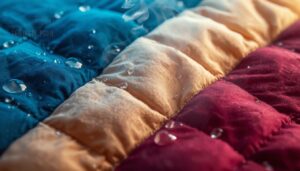
Heat gets a lot of the blame for shrinkage, but moisture is just as much a culprit. Water alone can change the size of your fabric before the dryer even enters the picture.
Here’s what actually happens when your quilting fabric gets wet.
Natural Fibers Absorb Water
Natural fibers are basically sponges by design. Cotton’s cellulose structure is loaded with hydroxyl groups — tiny molecular hooks that latch onto water molecules the moment fabric gets wet. Capillary pore absorption pulls moisture deep into each fiber almost instantly.
Cotton’s cellulose structure acts like a sponge, instantly latching onto water molecules at the fiber level
Three factors drive this:
- Hemicellulose hydrophilicity boosts water uptake in amorphous fiber regions
- Surface roughness influence creates extra entry points for moisture
- Cellulose crystallinity effect — lower crystallinity means higher absorption
That’s why cotton fabrics and quilt layer shrinkage go hand in hand.
Fiber Swelling and Tightening
When fibers soak up water, they don’t just get wet — they physically expand.
This moisture-induced plasticization pushes polymer chains apart, temporarily softening the structure.
Fiber orientation effects mean anisotropic swelling stretches certain directions more than others.
Higher polymer crystallinity and crosslink density resist this expansion.
As drying begins, fiber contraction pulls everything tight again.
| Fiber State | Behavior |
|---|---|
| Wet | Swells, softens |
| Drying | Contracts, tightens |
| Dry | Locks new shape |
Why Wet Fabric Changes Size
Here’s what’s really happening when your fabric for quilts hits the water.
Fiber Cross‑Section Expansion pushes individual threads apart, while Capillary Wicking Effects pull moisture deep into the weave.
That triggers Molecular Bond Relaxation and Yarn Slip, shifting interlacing points closer together.
Surface Tension Shift during drying locks everything in place.
The result is reduced dimensional stability — and a smaller quilt than you planned.
Washing Agitation Distorts Fibers

Heat and moisture get a lot of the blame for shrinkage, but the washing machine’s movement plays its own role. Every spin cycle puts your fabric through a kind of controlled chaos.
Here’s what’s actually happening inside that drum.
Movement Inside The Washer
Inside your washer, the drum isn’t just spinning — it’s tumbling your fabric in a carefully choreographed cycle.
Here’s what’s happening during a vigorous wash cycle:
- Drum Rotation Speed shifts between 500–800 RPM, agitating fibers repeatedly.
- Tumble Direction Reversal tosses clothes alternately, stressing fiber alignment.
- Fins and Ridges lift garments and drop them repeatedly.
- Load Balance Sensors detect uneven loads, adjusting drum motion.
- Shock Absorber Tuning controls tub movement, but mechanical agitation still strains fabric.
Overloading the washer amplifies all of this.
Friction Between Fabric Layers
When layers rub together in the wash, Surface Roughness Impact becomes a real factor. Cotton’s texture grips other layers — that’s Layer Slip Resistance at work.
Add Moisture Grip from wet fibers swelling, and Fiber Alignment Effects worsen quilt layer shrinkage quickly.
| Factor | Effect on Fabric |
|---|---|
| Surface roughness | Increases interlayer drag |
| Moisture presence | Raises fiber grip |
| Fiber alignment | Affects dimensional stability |
| Coating Lubrication | Reduces layer friction |
How Agitation Changes Shape
All that friction does is something sneaky — it reshapes your fabric from the inside out. Washing agitation causes Fiber Kink Formation, where repeated twisting locks fibers into tighter placements. Here’s what’s happening:
- Axis Alignment Shift redirects fibers along one dominant direction
- Layer Compression flattens stacked fabric sections unevenly
- Stitch Line Pull draws edges inward at seam points
- Micro Fold Persistence freezes creases even after spin-drying
- shrinkage potential rises as dimensional stability breaks down
The effects of mechanical agitation on fabric dimensions are cumulative — each cycle adds up
Cotton Shrinks More Than Synthetics
Not all fabrics react to washing the same way. Cotton, polyester, and blended quilting fabrics each behave differently when heat and moisture enter the picture.
Here’s what you need to know about each one.
Cotton Shrinkage After Washing
Cotton is the biggest offender regarding shrinkage. Untreated cotton generally shrinks 2–5% on the first wash, driven by yarn twist release, spin cycle impact, and fabric coating effect breaking down in water. Tension redistribution and temperature gradient effects lock fibers into a tighter shape.
| Condition | Wash Temperature | Cotton Quilt Shrinkage |
|---|---|---|
| Cold wash | ~30°C | 1–2% |
| Warm wash | ~40°C | 2–3% |
| Hot wash | ~60°C | 3–5% |
Prewashing fabrics before cutting eliminates most surprises.
Polyester’s Low Shrink Risk
Polyester tells a very different story. Unlike cotton, polyester is a hydrophobic fiber — it barely absorbs water, which means moisture can’t swell and tighten its structure. Add molecular crystallinity and heat setting stability into the mix, and you’ve got a fiber engineered to hold its shape.
Polyester generally shrinks less than 1% under normal laundering. Here’s why it performs so well:
- Strong intermolecular bonds resist fiber relaxation during washing.
- Low water absorption prevents the swell-and-contract cycle that plagues cotton.
- Heat setting stability locks in dimensions after the first wash.
- Low mechanical shrinkage means agitation barely affects its shape.
- Synthetic fibers maintain size across repeated wash-and-dry cycles.
For quilt construction considerations for shrinkage control, polyester is remarkably reliable. Its synthetic blend benefits carry over even in mixed fabrics, reducing overall fabric shrinkage substantially.
Blends and Dimensional Stability
Blending cotton with polyester changes the game. A poly cotton blend normally shrinks just 1–3%, because polyester’s low moisture absorption offsets cotton’s tendency to swell and contract.
Fiber Ratio Effects matter here — more synthetic content means better dimensional stability of fabric. Anti Shrink Finishes and Resin Crosslinking can push stability even further.
Even a cotton spandex blend benefits from improved Yarn Alignment and Moisture Management during laundering.
Weave Affects Shrinkage
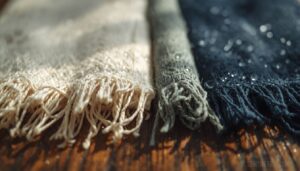
How your fabric is constructed matters just as much as what it’s made of. The way threads are interlocked — tight or loose, woven or knit — directly shapes how much a fabric shrinks in the wash.
Here’s how different fabric structures behave.
Woven Vs Knit Fabric Behavior
Not all fabric behaves the same in the wash. Knit vs. weave differences shape how much your fabric for quilts changes size. Here’s what sets them apart:
- Loop elasticity in knits allows stretch recovery but increases shrinkage risk.
- Interlacing density in woven fabric limits movement.
- Knits show more edge distortion after washing.
- Woven fabrics offer better dimensional stability.
- Wash temperature affects each structure differently.
Tight Weaves Resist Change
Think of a tight weave like a packed crowd — nobody moves much.
Thread Density Stability works the same way: denser interlacement means less room for fibers to shift under heat or moisture. Interlacement Stress Distribution spreads tension evenly, so tighter weaves hold their shape after washing.
Moisture Migration Control slows water absorption, limiting swelling.
Add Finishing Treatments Effect and Dimensional Stabilization Techniques, and your fabric construction becomes genuinely shrinkage‑resistant.
Loose Weaves Shrink Faster
Loose weaves have fewer interlacing points, so fibers move freely during washing. Lower Fiber Interlock Density means the Tension Relaxation Rate spikes fast — threads pull inward as manufacturing stress releases.
The Capillary Pull Effect draws water deep in, triggering Moisture‑Induced Compaction. Agitation‑Induced Packing does the rest.
That’s why fabric weave matters: tighter weaves win on shrinkage resistance, while loose cotton quilting fabric construction and shrinkage resistance go hand in hand.
How Much Cotton Shrinks
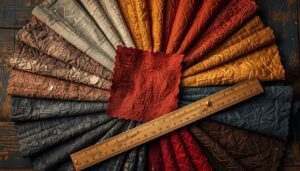
Cotton’s shrinkage isn’t random — it follows pretty predictable patterns depending on how you wash and dry it. A few key numbers are worth knowing before you cut a single piece of fabric for your quilt.
Here’s what the data actually shows.
Typical Shrinkage Percentages
Not all fabrics shrink equally — and the numbers tell the story. The Cotton Shrink Range usually falls between 3 and 7 percent after the first wash. Linen Shrink Variation can reach up to 7 percent.
Wool risks permanent Wool Felting Loss through felting.
Polyester Minimal Shrink stays under 1 percent, while blends offer solid Blend Stability Index, shrinking just 1 to 3 percent.
Wash Temperature Differences
Temperature is the single biggest dial you can turn.
Cold water (around 20–30°C) offers Cold Cycle Advantages — keeping shrinkage to just 1–2%.
Warm Cycle Tradeoffs sit around 2–3% at 40°C: better cleaning, slightly more risk.
Hot Cycle Risks are real — hot water at 60°C can push cotton to 5% shrinkage.
Temperature Uniformity and careful Thermal Load Management across your washing temperature choices make all the difference.
Dryer-added Shrinkage Amounts
Your washer sets the stage, but the tumble dryer often seals the deal. Dryer heat acts as the primary cause of shrinkage after washing, adding another 1–2% beyond what water alone does. Shrinkage variability increases with higher temperature gradients inside the drum.
Low heat drying minimizes this risk considerably. Post dry stretching damp fabric also helps recover a little lost dimension.
Pre-Wash Before Quilting
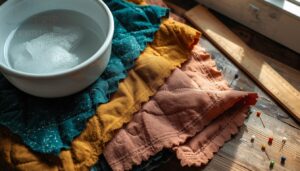
Pre-washing your quilting fabric before cutting is one of the smartest moves you can make. It gets the shrinkage out of the way before it can throw off your carefully measured pieces.
Here’s what to keep in mind when you do it.
Why Pre-washing Matters
Skipping the prewash step is a gamble you don’t want to take with your quilt. Prewashing fabrics to control shrinkage isn’t just about size — it’s about the whole finished piece staying true.
Here’s what prewash benefits actually deliver:
- Sizing Accuracy: Prewashed cotton reveals real dimensions before you cut.
- Color Transfer Prevention: Excess dye rinses out early, protecting neighboring fabrics.
- Fabric Softening: Stiff manufacturing finishes wash away, improving drape and stitch quality.
Pattern Fit Assurance and Stability After Construction both depend on this one simple step. Think of it as quilt construction considerations for shrinkage control built right into your workflow.
Matching Wash and Dry Settings
Once you’ve committed to prewashing, matching your settings is where precision pays off. The right cycle pairing protects your fabric’s dimensions before a single cut is made.
| Fabric Type | Wash Setting | Dry Setting |
|---|---|---|
| 100% Cotton | Cold water | Low heat |
| Poly-Cotton Blend | Warm water | Sensor Dry Coordination |
| Delicate/Silk Blend | Cold water | Air dry |
Cycle Temperature Pairing and Load Size Balance both matter here — even good settings fail with an overloaded drum.
Using Low-heat Drying
Low heat drying is your safety net after a careful wash. Once fabric is clean, high dryer heat can still trigger cotton quilt shrinkage — undoing your careful prep work. Use a Gentle Tumble Cycle on low heat or an Air Fluff Setting when possible.
- Enable Moisture Sensor use to stop drying at the right moment
- Use a Large Capacity Dryer for even airflow
- Keep Lint Filter Maintenance consistent for efficient drying
Measure Shrinkage Before Cutting
Skipping this step is how quilters end up with blocks that don’t quite line up.
Before you cut a single piece, it’s worth running a quick test to see exactly how your fabric behaves. Here’s what to do.
Test Swatch Before Sewing

Before you cut a single piece, run a quick swatch test. Cut a small sample — your Swatch Size Selection matters, so aim for about six inches square.
Prewash it using your planned cycle and temperature. This fabric preshrinking step reveals how much your yardage will actually move.
Consistent Measurement Tools and note your Recording Test Conditions carefully for reliable fabric measurement before and after preshrink.
Calculating Shrinkage Percentage
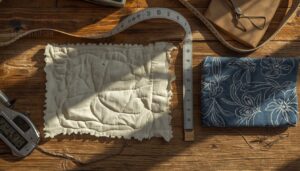
Once your swatch is washed and dried, the math is simple. The Shrinkage Formula is: (original − final) ÷ original × 100. For example, if your fabric measurement before and after preshrink goes from 6 inches to 5.85 inches, that’s 2.5% shrinkage.
Use Digital Caliper for precision. For Dimensional Averaging, measure both dimensions:
- Record original length
- Record original width
- Measure final length
- Measure final width
- Apply the shrinkage calculation formula to each, then average for overall shrinkage percentages
Adjusting Quilt Dimensions
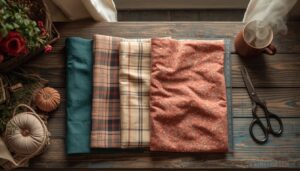
Knowing your shrinkage percentage puts you in control. If cotton shrank 3%, add that margin back into your block count recalculation and border width scaling before you cut a single piece. Adjust sashing proportion and backing size estimation accordingly.
Prewashing techniques for quilt fabrics eliminate most surprises, so your finish edge squaring stays true and your final dimensions actually match what you planned.
Top 3 Quilt Coverlet Picks
Now that you know how to handle shrinkage, it’s worth putting that knowledge to work with the right quilt. Picking a quality coverlet means less worry about washing and more time enjoying your bed.
Here are three solid picks worth a look.
1. Loves Cabin Queen Bed Coverlet
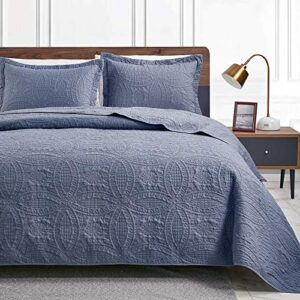
Love’s Cabin Queen Bed Coverlet is a smart pick if you want a low-maintenance option that won’t fight you at laundry time. Made from brushed polyester, it generally shrinks less than 1% — so pre-washing stress is basically off the table.
The ultrasonic pressing holds its shape wash after wash without thread breakage. At 90 × 96 inches, it fits most queen beds with decent overhang, and the reversible bluish-grey coin pattern keeps styling simple.
| Best For | Anyone who wants a fuss-free, good-looking bed cover that handles frequent washing without falling apart — great for pet owners, parents, or anyone furnishing a guest room or rental. |
|---|---|
| Material | Brushed polyester |
| Quilt Size | 90″ x 96″ |
| Pillow Shams | 2 shams, 20″ x 26″ |
| Machine Washable | Yes |
| Reversible Design | Yes |
| Lightweight Build | Yes, summer-friendly |
| Additional Features |
|
- Holds its shape after washing thanks to ultrasonic pressing — no threads unraveling or fabric going lumpy over time.
- Lightweight and breathable, so it works year-round: cool enough for summer, easy to layer when it gets cold.
- The reversible bluish-grey coin pattern is simple and versatile — fits most bedroom styles without clashing.
- The quilted look is embossed, not stitched — if you love the feel of a real quilt, this won’t quite scratch that itch.
- Can run short on the sides of deeper queen mattresses, especially if you’ve got a thick mattress topper underneath.
- Only available in this one color and pattern, and there’s no king size option — so matching a larger bed setup is tricky.
2. Akkialla Olive Green Queen Quilt Set
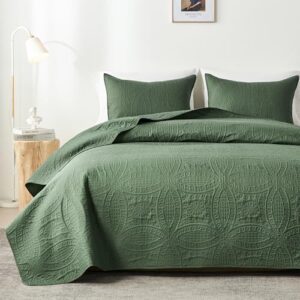
The Akkialla Olive Green Queen Quilt Set is a solid choice if you want style and easy care in one package. Its 100% brushed polyester microfiber resists shrinkage — generally under 1% — so pre-washing is simple.
The 90 × 96-inch quilt fits most queen beds well, and the jacquard-style stitching holds up through multiple washes without loose threads.
Cold, gentle machine washing keeps the olive green color true. lightweight enough for year-round use and doubles as furniture protection if you have pets.
| Best For | Anyone who wants a low-maintenance, pet-friendly quilt that looks put-together without spending a lot. |
|---|---|
| Material | 100% polyester microfiber |
| Quilt Size | 90″ x 96″ |
| Pillow Shams | 2 shams, 20″ x 26″ |
| Machine Washable | Yes |
| Reversible Design | Yes |
| Lightweight Build | Yes, year-round use |
| Additional Features |
|
- Soft microfiber fabric holds up well after washing — no shrinking, no loose threads
- Light enough to use year-round, and doubles as a sofa or chair protector for pets
- Comes as a full set with two pillow shams, so your bed looks complete right out of the box
- It runs thin, so if you want something with real weight and warmth, this probably isn’t it
- The surface can have a slight sheen that looks more plasticky than quilted in person
- The olive green may come out darker than the photos suggest, especially in dim lighting
3. Sleep Zone Queen Lightweight Coverlet Set
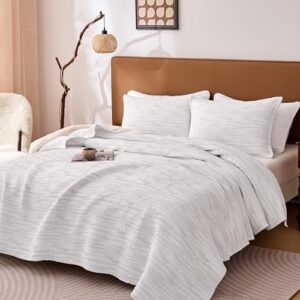
The Sleep Zone Queen Lightweight Coverlet Set keeps things simple — and that’s a good thing. Its 100% microfiber polyester construction means shrinkage stays well under 1%, so you won’t lose much size after washing.
The 90 × 96-inch coverlet fits queen beds comfortably, and the jersey knit feel is soft without being heavy. Machine wash cold, tumble dry low, and you’re done.
It’s a practical, low-fuss pick for warm sleepers who want easy care without the guesswork.
| Best For | Warm sleepers or anyone in a hot climate who wants a lightweight, easy-care bedding set that looks put-together without a lot of effort. |
|---|---|
| Material | 100% polyester microfiber |
| Quilt Size | 90″ x 96″ (Full/Queen) |
| Pillow Shams | 2 shams, 20″ x 26″ |
| Machine Washable | Yes |
| Reversible Design | Yes |
| Lightweight Build | Yes, breathable fill |
| Additional Features |
|
- Reversible stripe design gives you two looks in one, so it’s easy to refresh your room without buying anything new.
- OEKO-Tex certified microfiber is soft, breathable, and safe — great for year-round use, especially spring and summer.
- Machine washable and durable, so it holds up well over time without a lot of fuss.
- It runs thin, so if your bedroom gets cold at night, this won’t cut it on its own.
- Some buyers find it more translucent than expected — it doesn’t quite have the quilted, structured look of a traditional coverlet.
- The packaging has been a letdown for some, which can make the first impression feel a bit underwhelming.
Frequently Asked Questions (FAQs)
What causes fabric shrinkage?
Fabric shrinks because fibers relax, absorb moisture, and react to heat. Manufacturing tension releases on first wash, causing fibers to contract back to their natural size — often noticeably.
Can fabric shrink?
Yes, fabric can shrink. Natural fibers like cotton, wool, and linen are especially prone to it.
Heat, moisture, and agitation all play a role — sometimes working together to pull your fabric out of shape.
Why do my clothes shrink when I wash or dry?
Your clothes feel fine going in, but come out smaller. Heat, moisture, and agitation cause fibers to contract and release built-up tension, permanently shrinking fabric dimensions during washing and drying.
How does moisture affect fabric shrinkage?
Moisture is the main trigger. When water soaks into natural fibers, they swell and shift.
As they dry, they lock into a tighter position — leaving your fabric noticeably smaller than before.
Does 100% cotton quilt shrink?
Think of cotton like a rubber band stretched tight in the store. Once washed, it snaps back. Yes, a 100% cotton quilt will shrink — generally 3–5% after the first wash.
Is Kelly Clarkson a quilter?
Kelly Clarkson is indeed a quilter. She’s crafted custom quilts for her fellow coaches on The Voice and even gifted one to host Carson Daly — a hobby she openly celebrates.
How to avoid 100% cotton from shrinking?
Don’t let cotton shrink your quilting dreams.
Wash in cold water, use a gentle cycle, and air dry or tumble dry on low heat.
Remove fabric while slightly damp to keep fibers relaxed and dimensions intact.
Can pre-shrunk fabric still shrink after quilting?
Yes, pre-shrunk fabric can still shrink after quilting. Expect another 1–3% change during the first wash. Planning your quilt dimensions with that small margin keeps the finished size right on target.
Does fabric shrink differently when hand-washed?
Hand washing is gentler on fibers, so yes — fabric normally shrinks less. Cool water and minimal agitation limit shrinkage to under 2 percent on most pre-shrunk quilting cottons.
How does shrinkage affect quilt seam alignment?
Shrinkage pulls warp and weft unevenly, shifting seam lines so blocks no longer meet cleanly.
Even small differences between fabrics cause gaps or overlaps — especially when top and backing shrink at different rates.
Conclusion
Fabric shrinkage isn’t some mysterious defect—it’s cotton doing exactly what cotton does. The fibers swell, the tension releases, and your carefully measured yard quietly becomes something smaller.
Congratulations, physics wins again.
But now you know why quilting fabric shrinks after washing, which means you’re ahead of the problem before it starts.
Pre-wash, test a swatch, adjust your dimensions, and cut with confidence.
The fabric hasn’t changed—your understanding of it has.