This site is supported by our readers. We may earn a commission, at no cost to you, if you purchase through links.
淋 Mid-project thread snapping is one of the most frustrating things that can happen at a sewing machine. You’re moving along fine, then — snap. Again. You re-thread, try once more, and it breaks in the same spot.
It’s not random bad luck. Your upper thread keeps breaking for specific, fixable reasons. Most of the time, the culprit is something small — a slightly bent needle, tension set one notch too high, or a thread path that’s off by one guide.
Once you know what to look for, the fix takes minutes.
Table Of Contents
- Key Takeaways
- Common Reasons Upper Thread Keeps Breaking
- Troubleshooting Thread Breakage Step-by-Step
- Thread Issues With Specific Fabrics
- How Machine Settings Affect Thread Breaks
- Preventing Upper Thread Breakage
- Top 5 Products for Reducing Thread Breaks
- When to Seek Professional Sewing Machine Repair
- Frequently Asked Questions (FAQs)
- Conclusion
Key Takeaways
- Most upper thread breaks trace back to just a few fixable culprits: wrong threading, tension set too high, a dull or bent needle, or old thread that’s gone brittle.
- Re-threading with the presser foot raised — so the tension discs open properly — solves more breaks than any other single fix.
- Matching your needle size and thread weight to your fabric is the easiest way to prevent snapping before it starts.
- If thread keeps breaking after you’ve tried every basic fix, something inside the machine is likely damaged and needs a qualified technician.
Common Reasons Upper Thread Keeps Breaking
Upper thread breaking is frustrating, but it almost always comes down to a handful of fixable things. Most of the time, the cause is something simple — and once you spot it, the fix takes less than a minute.
If you want to dig deeper, brushing up on sewing machine stitch types and tension basics can help you spot the root cause faster.
Here are the most common reasons your upper thread keeps snapping.
Incorrect Threading Techniques
Most upper thread breaking problems trace back to one root cause: threading errors. Skipping a thread guide creates sharp angles that saw through the thread. Threading with your presser foot down keeps the tension discs closed, so the thread never seats properly. Always raise the foot first. Follow the exact threading sequence in your manual — every guide matters.
Proper thread tension settings are vital for preventing breaks, and checking the thread tension settings can help resolve issues.
Tension Set Too Tight
Threading isn’t always the culprit. Sometimes your sewing machine’s tension dial is simply cranked too high. When upper thread tension is too tight, it snaps within a few stitches — especially at speed.
Look for bobbin thread dots showing on top, or fabric distortion along the seam. Start at 4–5 on the dial. Lower it one step at a time until thread breaking stops. Proper thread tension settings are essential for preventing thread breakage.
Damaged or Wrong Needle
Sometimes the problem isn’t tension at all — it’s your needle. A dull tip, tiny burr, or bent needle creates friction that snaps thread fast. Needle Tip Damage and Needle Eye Problems cause upper thread breaking more than most sewers realize. Wrong Needle Size adds stress too.
Replace it every 6–8 hours. Bent needles especially cause thread breakage — swap it first.
Poor Quality or Old Thread
Your needle isn’t always the culprit. Old or cheap thread causes upper thread breaking just as often.
Thread Shelf Life matters — cotton thread weakens after 5–10 years. Fiber Degradation makes it fuzzy, brittle, dry. UV Damage and Moisture Effects speed that up.
Poor thread quality also means inconsistent thickness. Thread Coating Wear adds friction.
Run a quick snap test — if it breaks easily, replace it.
Thread Catching on Machine Parts
tiny machine parts can quietly destroy your thread.
Needle Plate Burrs snag the upper thread on every downstroke. Bobbin case snags grab the loop mid‑stitch. Take‑Up Lever catches and yanks thread against rough casting edges. Thread Guide damage frays it slowly. Internal lint debris narrows clearances, forcing the thread to scrape instead of glide.
Run a fingertip over each spot — rough edges tell the truth fast.
Incompatible Thread and Fabric
Mismatched thread and fabric is a quiet troublemaker. Thread Weight Mismatch is a real issue — heavy 30wt thread on chiffon creates friction that snaps the upper thread quickly.
Fiber Type Compatibility matters too. Cotton thread on stretchy knits breaks because it can’t flex with the fabric. Get your Fabric Thickness Pairing and Needle-Thread Pairing right, and thread breaking drops dramatically.
Troubleshooting Thread Breakage Step-by-Step
Thread snapping mid-seam is frustrating, but most fixes are simpler than you’d think. Working through each possible cause one at a time saves you from chasing the wrong problem.
Here’s exactly where to start.
Stop Sewing and Remove Broken Thread
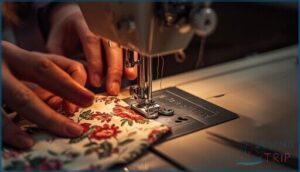
淋 The moment upper thread snaps, stop — don’t keep stitching.
Lift your foot, then raise the needle to its highest point using the handwheel.
This frees the fabric safely without bending anything.
Next, cut the upper thread near the eye and pull it toward the spool.
Clear the hook area with tweezers.
Check the takeup lever for any wrapped thread.
Re-Thread The Machine Properly
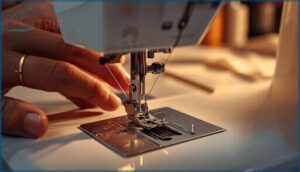
Re-threading is a reset — done right, it solves most upper thread breaking instantly.
First, raise your presser foot. This opens the tension discs for proper Tension Disc Contact. Next, follow your machine’s numbered path for Thread Guide Alignment. Make sure Spool Stabilization with a cap or foam pad. Thread the needle front to back for correct Needle Eye Direction. Match your Bobbin Thread Matching weight to avoid hidden stress.
Adjust Tension Settings
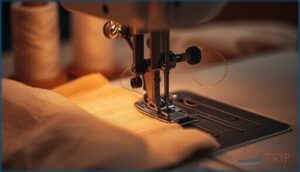
Tension is the silent troublemaker behind most upper thread breaking.
- Start at 4–5 for Fabric Weight Matching on medium materials
- Lower one number for Thread Type Calibration with heavier threads
- Run a Test Stitch Evaluation on scrap fabric first
- Confirm Bobbin Tension Sync — no loops underneath
- Fine‑tune tension adjustment until stitches lock cleanly in the middle
Inspect and Replace The Needle
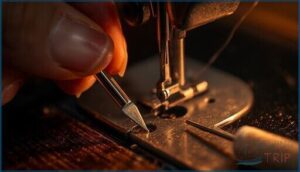
A dull needle is often the real culprit. Run your finger along it — any roughness means it’s done. Burrs around the needle eye shred thread on every stitch, and poor scarf alignment throws off hook timing completely.
Check needle orientation, confirm the groove fits your thread size, and swap it out. Stick to a needle wear schedule: fresh needle, new project.
Check Thread Path and Spool
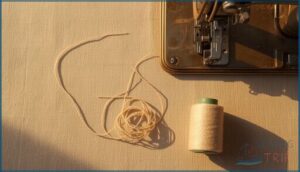
Now trace the full path from spool to needle.
Spool orientation matters — cross wound spools feed best horizontally; stacked ones vertically.
Wrong setup? The thread twists and jerks.
Check your cap fit next; a loose cap causes uneven feed.
Walk the thread through every guide, confirm tension disc seating with the presser foot up, and feel for any snag points.
Examine Bobbin Area for Issues
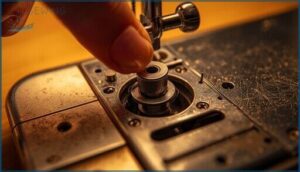
Now peek inside the bobbin area — this spot causes more upper thread breaks than most people expect. Pull out the bobbin and check its orientation first; a backwards-loaded bobbin throws tension completely off.
Run your fingernail along the bobbin case edge feeling for bobbin case burrs. Lint accumulation and hook race friction are sneaky culprits too. Clean it out, then reinsert correctly.
Thread Issues With Specific Fabrics
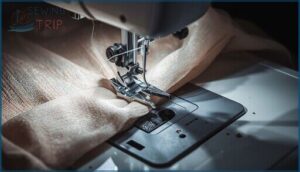
Not all fabrics play nice with thread — and that changes everything about how you sew.
Some materials demand a completely different approach just to keep your upper thread from snapping.
Here’s what you need to know for the trickiest ones.
Sewing Thick Materials
Pushing through thick fabric like denim or canvas puts real stress on your upper thread. Your needle size matters most here — switch to a 100/16 or larger for heavy layers.
Drop your tension one or two numbers, slow your machine speed down, and lengthen your stitch to 3–4mm. Match your thread weight to the fabric, and adjust presser foot pressure so layers feed smoothly.
Sewing Stretch or Fleece Fabrics
淋 Fleece and stretch fabrics play by different rules than denim.
Your upper thread breaks here for three main reasons:
- Needle angle and fabric feed: Use a ballpoint or stretch needle (size 80/12–90/14) so it glides between loops instead of tearing them
- Stitch density and tension: Reduce stitch density, widen your zigzag slightly, and lower bobbin tension one notch
- Thread lubrication and stretch thread: Polyester stretch thread manages fleece’s pull without snapping
Using Metallic or Specialty Threads
Metallic thread is the drama queen of your thread collection. That glittery finish comes at a cost — it breaks easily if your setup isn’t right.
Use a needle with a larger eye size (90/14 works well) to cut friction. Lower your thread tension, slow your speed, and don’t skip stabilizer selection. Proper spool orientation, stitch density adjustment, and light thread lubrication keep metallic thread manageable and snap‑free.
How Machine Settings Affect Thread Breaks
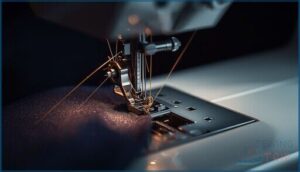
Your machine settings can quietly work against you, even when everything else looks fine.
Small tweaks to tension, stitch type, or presser foot pressure can make the difference between smooth sewing and constant breaks.
Here’s what to check on your machine first.
Upper Thread Tension Adjustment
Think of the tension dial as a pressure valve — turn it too high and the upper thread snaps under stress. Most machines work best between 4 and 5 for medium fabric weight impact.
For Tension Dial Calibration, small one-number adjustments matter.
Run Stitch Test Patterns on scraps first.
Thread Type Compatibility and Bobbin Tension Sync keep everything balanced, preventing thread breaking.
Stitch Length and Type
Stitch settings quietly drive more thread breaks than most sewists realize. Short stitch friction builds fast — stitches below 1.8 mm sawing the thread repeatedly through the same spot. Zigzag thread wear compounds this with side‑to‑side rubbing. Here’s what stitch formation actually does to your thread:
- Short stitches increase friction and heat
- Zigzag thread wear adds lateral stress points
- Satin stitch tension spikes during dense overlaps
- Stretch stitch pull re‑stresses the same thread section repeatedly
Match your stitch length and type to your thread.
Presser Foot Pressure
presser foot pressure quietly snaps your upper thread.
When the foot clamps down hard, the fabric drags instead of gliding — pulling thread tension beyond its limit.
For Fabric Pressure Matching, start with a mid-range setting, usually 3.
Use Foot Pressure Testing: lower the foot, then gently tug the fabric. It should resist slightly, not lock down.
Calibration Methods and Seam Quality Impact improve immediately when pressure is right.
Needle Positioning
Where your needle sits changes everything. Needle Alignment, Needle Height, and Needle Orientation all affect how thread moves through the machine — and a tiny shift can snap it clean.
- Wrong Needle Path rubs thread against the needle plate edge
- Incorrect Stitch Width Position pushes the needle into metal
- A needle inserted too low misses the hook’s timing entirely
Check needle and bobbin care together. Needle size matters too.
Preventing Upper Thread Breakage
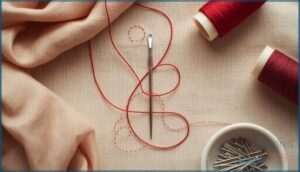
Most thread breaks are actually preventable.
A few simple habits — like choosing the right needle, storing your thread properly, and slowing down on tricky fabrics — can make a huge difference.
Here’s what to keep in mind going forward.
Selecting The Right Needle and Thread
Getting needle size matching and thread weight pairing right makes a huge difference.
For everyday cotton or poplin, a size 80/12 needle with standard 40–50 weight thread works well.
Heavy denim needs a 90/14 or larger.
Specialty needle types — like ballpoint for knits or microtex for silk — protect your upper thread from friction and snapping.
Thread material choice matters just as much as thread tension.
Regular Machine Maintenance
Even the right needle and thread won’t save you from a dirty machine. A solid sewing machine maintenance routine stops most thread breaking before it starts. Keep these habits:
- Lint Removal Routine: Brush the bobbin case and feed dogs every 2–3 bobbins
- Oil Application Schedule: One drop at manually specified points after heavy use
- Tension Disc Polishing: Wipe gently to prevent snags
Clean machines snap thread less.
Proper Thread Storage
Thread quality drops fast in bad storage. Keep spools in Airtight Containers at temperatures between 50°F–77°F — that’s your Temperature Control sweet spot.
Humidity Management matters too: aim for 40–60% relative humidity. Use silica gel packets if your space runs damp. Light Blocking is simple — opaque boxes work. Add Organizational Labeling so you grab the right thread fast.
Slowing Sewing Speed for Problem Fabrics
Speed is your secret weapon against thread breaking.
On thick fabrics like denim, slow down—Heat Reduction and Friction Management protect your thread from snapping under pressure.
Delicate Stretch Handling means easing off the pedal on jerseys and chiffon too.
Good Stitch Timing, Fabric Thickness Matching, and steady tension work together.
Slow and controlled beats fast and frustrating every time.
Top 5 Products for Reducing Thread Breaks
The right tools can make a real difference when thread keeps snapping on you.
A few simple upgrades — needles, bobbins, and organizers — go a long way toward smoother, uninterrupted sewing.
Here are five products worth keeping in your sewing space.
1. Schmetz Universal Sewing Machine Needles
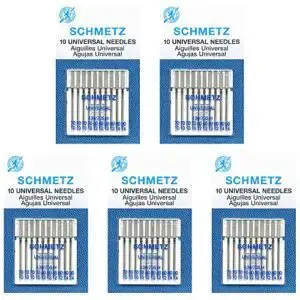
瑱 A bad needle breaks more thread than you think. Schmetz Universal needles are a solid fix.
They fit all standard home machines using the System 130/705 H shank — that’s the flat-back needle most domestic machines take.
The slightly rounded tip slips between fabric fibers instead of cutting them, which reduces friction on your upper thread.
You get 50 needles in assorted sizes, so you can match the needle to your fabric every time.
Fewer breaks, cleaner stitches.
| Best For | Home sewers who want reliable, everyday needles that work across most machine brands and fabric types. |
|---|---|
| Product Type | Sewing Needles |
| Piece Count | 50 pieces |
| Compatibility | Universal home machines |
| Primary Use | General sewing |
| Skill Level | All levels |
| Value Rating | Good value |
| Additional Features |
|
- 50 needles in assorted sizes gives you plenty to work with and lets you match the needle to your fabric
- The slightly rounded tip is gentle on fabric fibers, which means fewer snags and cleaner stitches
- Works with wovens and knits, so you’re covered for most everyday projects
- Not the right pick for heavy-duty materials like leather or thick canvas
- Needle performance can vary depending on your specific machine
- You’ll need to swap them out fairly often to keep stitch quality at its best
2. Sewing Machine Needles Assortment Set
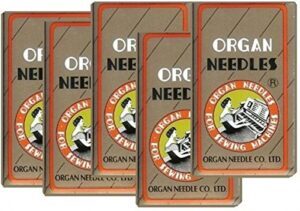
Variety is your best defense against thread breaks. The MSB 50-piece assortment gives you sizes 9 through 18 — ten needles per size — so you’re never stuck using the wrong one.
Thin fabric? Grab a size 9. Heavy denim? Size 16 or 18.
Each needle uses a flat-back shank, compatible with most home machines. Matching needle size to fabric is one of the easiest ways to stop upper thread from snapping mid-seam.
| Best For | Home sewers who work with a variety of fabrics and want a reliable stash of needles without constantly reordering. |
|---|---|
| Product Type | Sewing Needles |
| Piece Count | 50 pieces |
| Compatibility | Home sewing machines |
| Primary Use | General sewing |
| Skill Level | All levels |
| Value Rating | Good value |
| Additional Features |
|
- 50 needles across five sizes means you’re covered for everything from lightweight chiffon to heavy denim
- Flat-back shank works with most home sewing machine brands — no compatibility headaches
- Great value if you sew regularly and go through needles fast
- Not built for industrial or heavy-duty machines
- Quality might not match pricier needle brands for demanding projects
- Some breakage is possible, though usually comes down to using the wrong size for the fabric
3. Doublelin Prewound Polyester Bobbins
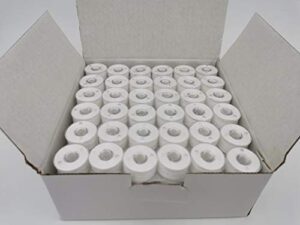
Bobbin problems are sneaky — they cause upper thread breaks even when everything else looks fine. Doublelin’s prewound polyester bobbins help fix that.
Each one is factory-wound in size L, which fits Brother, Babylock, and Janome machines. The 60S/2 spun polyester thread runs low-lint and stays tension-stable, so your upper thread isn’t fighting the bobbin. You get 144 bobbins per box — less rewinding, fewer interruptions, and more consistent stitching from start to finish.
| Best For | Home sewers, embroidery studios, and small production shops using Brother, Babylock, or Janome machines who want to stop wasting time rewinding bobbins mid-project. |
|---|---|
| Product Type | Prewound Bobbins |
| Piece Count | 144 pieces |
| Compatibility | Brother, Babylock, Janome |
| Primary Use | Embroidery and sewing |
| Skill Level | Professional to home |
| Value Rating | Reduces operating costs |
| Additional Features |
|
- Bulk pack of 144 means you’re stocked for a long time — less downtime, more sewing
- Low-lint 60S/2 polyester keeps tension steady and reduces those mystery upper thread breaks
- Plastic-sided bobbins drop right in with no fuss on compatible machines
- Won’t work with machines that need metal bobbins, so check your manual first
- Some users run into thread-start hiccups or light lint buildup depending on the machine
- Only comes in white, so thread color matching through the bobbin isn’t an option
4. Bobbin Thread Organizer Clips
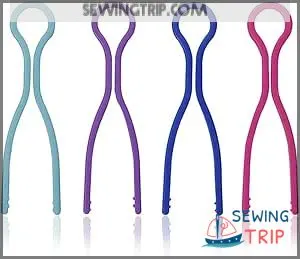
Tangled bobbins cause more thread breaks than most people realize. These organizer clips fix that.
Each silicone clip snaps around your bobbin’s rim — no tools, no fuss — keeping the thread tail locked so it won’t unravel in your drawer.
The set comes in 20 assorted colors, so you can color-code by thread type. They fit Types A, A/15, and L bobbins.
Tidy bobbins mean fewer kinks, less lint in your machine, and fewer frustrating breaks mid‑seam.
| Best For | Quilters, embroiderers, and crafters who want to keep their bobbins and thread tidy — especially great if you have limited storage space, travel with your supplies, or deal with arthritis. |
|---|---|
| Product Type | Bobbin Clips |
| Piece Count | 20 pieces |
| Compatibility | Types A, A/15, & L |
| Primary Use | Thread organization |
| Skill Level | All levels |
| Value Rating | Budget-friendly |
| Additional Features |
|
- Color-coded organization makes it easy to match thread to bobbins at a glance
- Simple snap-on design works without tools — easy for anyone to use, including those with limited hand mobility
- Compact and travel-friendly, keeping threads from unraveling on the go
- Won’t fit large embroidery cone threads, so not ideal for every setup
- Can be tricky to use alongside storage pins or pegboards
- Doesn’t always stop thread from unwinding completely
5. Willbond Bobbin Holders For Sewing Machines
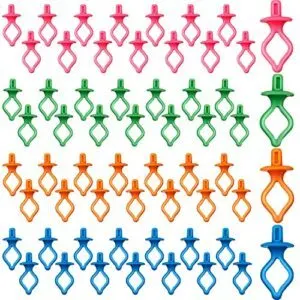
淋 Losing track of which bobbin matches which spool? That’s how tension problems start.
Willbond Bobbin Holders solve it simply.
Each flexible silicone stem pushes through your bobbin and anchors into the spool core — keeping them paired together in storage.
The set includes 60 holders in four bright colors, compatible with Type A, L, and M bobbins.
No more grabbing the wrong bobbin mid‑project.
Matched thread means balanced tension, and balanced tension means fewer breaks.
| Best For | Sewists, quilters, and embroidery enthusiasts who want a simple way to keep bobbins and spools matched and organized. |
|---|---|
| Product Type | Bobbin Clips |
| Piece Count | 60 pieces |
| Compatibility | Various spools and bobbins |
| Primary Use | Thread organization |
| Skill Level | All levels |
| Value Rating | Budget-friendly |
| Additional Features |
|
- Comes in four bright colors, so you can color-code your thread collection and find what you need fast.
- Flexible silicone means they’re easy to put on and take off without damaging your spools.
- 60 pieces in one pack gives you plenty to work through a large thread collection.
- May not fit every spool size or bobbin type, so double-check compatibility before buying.
- Can run a bit long for certain spool organizers or racks, which might require some tweaking.
- Colors on screen may look slightly different from what actually arrives in the package.
When to Seek Professional Sewing Machine Repair
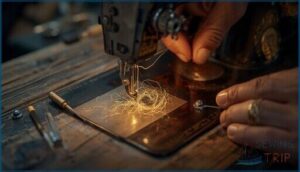
Sometimes the problem is bigger than a needle swap or a tension tweak.
If you’ve tried everything and the thread still keeps snapping, your machine might be telling you something’s wrong on the inside.
Here’s how to know when it’s time to hand things off to a pro.
Persistent Thread Breakage After Troubleshooting
You’ve rethreaded, swapped needles, and adjusted tension — but the thread keeps breaking. That’s a sign something deeper is wrong.
Hidden tension imbalance, thread path roughness, needle plate burrs, or spool cap mismatch can all defeat basic sewing machine troubleshooting. operator speed stress plays a role. When fixing the obvious doesn’t stop your upper thread from breaking, it’s time to call a pro.
When basic fixes fail and thread keeps breaking, hidden machine damage is speaking louder than your troubleshooting
Signs of Internal Machine Damage
Some problems go deeper than basic sewing machine troubleshooting.
Watch for these warning signs:
- Gear grinding or clunking sounds — internal gears are colliding, not meshing
- Needle bar misalignment — your needle repeatedly nicks metal inside the bobbin area
- Feed dog wear — fabric jerks unevenly despite correct settings
- Tension spring failure or motor overheating — thread tension stays unpredictable, or the machine runs hot
These need a technician, not a quick fix.
Finding a Qualified Sewing Machine Technician
Once you’ve spotted internal damage, it’s time to call in a pro.
Not just any repair shop — a qualified one.
Here’s what to look for:
| What to Check | Why It Matters | What to Look For |
|---|---|---|
| Certification verification | Proves real training | Sewing Doc Academy or SMI credentials |
| Experience portfolio | Shows hands-on skill | Repair logs, brand specialization |
| Warranty coverage | Protects your investment | Written guarantee, genuine parts |
Check customer reviews too.
Shops like City Sewing have earned trust through transparent pricing and thorough post-repair testing.
Frequently Asked Questions (FAQs)
Can embroidery designs cause upper thread to break?
Yes, they absolutely can. Stitch density, tiny stitches, sharp corners, overlapping layers, and complex jumps all stress upper thread.
Poor embroidery techniques push thread tension past its limit, causing breaks mid‑stitch.
How does humidity impact thread strength and durability?
humidity‑driven brittleness makes threads snap under tension. Moisture‑induced elasticity keeps fibers supple. Fiber swelling effects alter moisture‑related friction.
Store the thread with storage humidity control near 65% for best thread quality.
Can a dirty machine cause the upper thread to break?
Absolutely. dirty machine is one of the sneakiest causes of thread breaking.
Lint in tension discs, bobbin debris, and burrs on the plate all stress your upper thread — routine cleaning fixes it fast.
Does thread color or dye affect its breaking tendency?
Color rarely matters as much as you’d think. Dye chemistry impact and fiber material sensitivity play minor roles.
Thread quality and thread tension cause far more thread breaking than shade ever will.
Conclusion
Like Penelope unraveling her weaving each night, a snapping thread can feel like you’re never making progress.
But unlike her, you don’t have to keep starting over.
Now that you know why your upper thread keeps breaking, every snap is just a clue pointing to a fast fix.
Check the needle.
Adjust the tension.
Re-thread with intention.
The machine hasn’t beaten you — you’ve simply learned its language.
Sew on with confidence.
- https://www.digitizingusa.com/showblog/why-does-my-top-thread-keep-breaking
- https://support.brother.com/g/b/faqend.aspx?c=ca&lang=en&prod=hf_600_2eus&faqid=faqh00000318_000
- https://www.singermachines.co.uk/faq/upper-thread-snaping-on-sewing-machine.html
- https://en.sewingguide.de/product-overview/silvercrest-snmd33a1/faq/oberfaden-reisst
- https://sewingmachineman.substack.com/p/sewing-machine-thread-breaking