This site is supported by our readers. We may earn a commission, at no cost to you, if you purchase through links.
Most sewing kits look deceptively simple from the outside—a tin, a pouch, maybe a few compartments. Open one up, though, and you’ll often find anywhere from five to a dozen needle types, each built for a specific job. That’s not overkill; it’s precision.
A sharp meant for hemming cotton will mangle silk, and a universal machine needle won’t save you when you’re mending a stretched-out knit. Knowing what needles are included in sewing kits—and why each one belongs there—turns a cluttered little tin into a genuinely useful toolkit.
The difference between a frustrating stitch and a clean one often comes down to a single millimeter of shaft width.
Table Of Contents
Key Takeaways
- Needle type and size directly determine stitch quality — using the wrong one for your fabric causes puckering, skipped stitches, or damage that can’t always be fixed.
- Most kits include sharps, universal, embroidery, and darning needles because those four cover the widest range of everyday tasks, from hemming cotton to mending wool.
- Point shape matters as much as size: ballpoint tips protect knit fabrics, fine points glide through silk, and reinforced points punch through denim without shredding your thread.
- Replace needles every 8–10 hours of use and store them with silica gel — a dull or rusty needle is the most common cause of frustrating, unexplained stitching problems.
Why Sewing Kits Include Multiple Needles
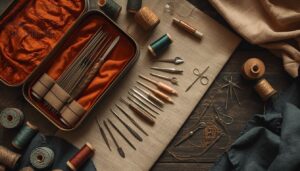
A sewing kit isn’t one-size-fits-all — and neither are the needles inside it. Different fabrics, threads, and projects each call for a specific needle type, point shape, or size.
Brushing up on sewing needle sizes and types before you start can save a lot of frustration mid-project.
Here’s what you’ll usually find, and why each one earns its place in the kit.
Different Needles for Different Sewing Tasks
Think of your needle kit as a toolbox — a screwdriver can’t do a hammer’s job, and the same logic applies here. Quilting needle selection, leather needle applications, and basting needle usage all call for different tools. Sharps handle everyday hemming, crewel needle techniques suit wool embroidery, and specialty needle options like wing stitch needles create decorative openwork. Matching the right needle to the task is simply non-negotiable.
For knit and jersey fabrics, use ballpoint needles for knits to avoid thread runs.
Why Size and Point Shape Matter
Size and point shape work together like a lock and key. Get them wrong, and you’ll see seam puckering, fabric distortion, or broken thread tension almost immediately.
- Fine points (60–75) prevent fabric distortion on silk
- Medium points (9–14) balance stitch strength on cotton blends
- Ballpoint tips protect knit fibers from splitting
- Larger sizes (110+) handle thread tension in heavy canvas
Understanding needle point shapes and their effect on stitching — and choosing appropriate needle types for different fabrics — eliminates needle wear problems before they start.
Basic Kits Vs Specialty Sewing Kits
Once you know what point shapes do, picking the right kit gets easier.
Basic kits cover everyday needs — sharps, embroidery needles, and universals for most fabrics.
Specialty kits go further, adding precision tools for beading, appliqué, or heavy canvas work.
| Feature | Basic Kits | Specialty Kits |
|---|---|---|
| Intended Audience | Beginners, casual sewers | Craft-focused, expert sewers |
| Basic Needle Types | Sharps, universals, darning | Curved, beading, twin needles |
| Specialty Needle Options | Rarely included | Core focus |
| Needle Material Differences | Standard carbon steel | Nickel-plated or titanium-coated |
| Packaging Organization | Labeled compartments | Color-coded trays |
| Accessory Inclusions | Thread, thimble, scissors | Technique-specific tools |
| Cost Comparison | Budget-friendly | Higher investment |
| Needle Size Selection | Sizes 7–18 | Sizes 3–24, task-matched |
| Needle Storage | Basic case or tin | Structured pouch or tray |
| Organizing and storing sewing needles safely | General guidance | Type-specific sorting system |
Sewing Kits Usually Include These Needles
Most sewing kits aren’t random — they’re put together with a real purpose in mind. The needles inside are chosen to cover the tasks you’re most likely to encounter, from quick repairs to decorative work.
Each needle type has a specific job, so browsing a sewing machine needle types chart helps you understand exactly what you’re working with before you thread up.
Here’s what you’ll usually find when you open one up.
Sharps for Everyday Hand Sewing
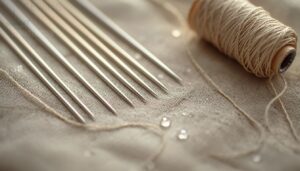
Sharp needles are the backbone of any hand sewing kit — and for good reason. These hand sewing needles come in sizes 2 through 12, with needle size matching your fabric weight making all the difference.
For everyday fabrics like cotton and linen, sizes 7–9 are ideal. Using the correct size ensures good hand pressure and stitch length control, which develop naturally with a comfortable grip.
Threading is simplified by their small round eye, designed to minimize fabric pull beautifully. This feature enhances precision and ease during sewing tasks.
Universal Needles for General Machine Sewing
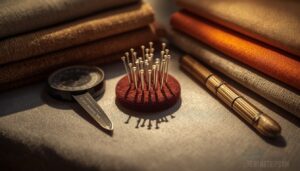
Universal needles are the workhorses of machine sewing — grab size 80/12 as your typical starting size for most woven fabrics.
Their Needle Point Geometry sits between sharp and rounded, handling cotton, polyester, and blends without skipping stitches.
Thread Weight Matching matters here: pair light threads with sizes 70/10–80/12.
Color‑Code Identification on packaging makes needle size matching fast and foolproof.
Embroidery Needles With Larger Eyes
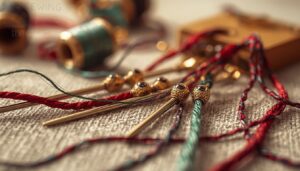
Embroidery needles earn their place in most kits through one clever feature: an oversized needle eye built for thicker threads and multi-strand floss. That eye design innovation means reduced thread snags and real thread compatibility across rayon, silk, and metallic threads.
Here’s why they matter:
- Sizes 7–9 cover lightweight to midweight fabrics
- Elongated eyes enable speed stitching on complex designs
- Durability coatings resist corrosion through heavy use
- Needle sizes 70/10–90/14 pair perfectly with light embroidery threads
Darning Needles for Mending and Repairs
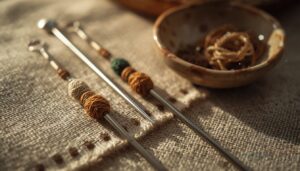
Darning needles are the mending workhorses of any kit.
Their long shafts — usually 60–70mm — give you the Needle Length Options needed to weave repairs smoothly across larger holes.
The elongated Eye Size Benefits let you pair with bulky wool or Bulk Thread Pairing without fraying.
These Steel Finish Advantages mean less friction, longer life, and cleaner Darning Stitch Styles every time.
Milliner Needles for Fine Handwork
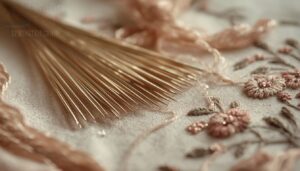
Milliner needles are the quiet specialists most sewists overlook — until they try bullion knots without one. Their long shaft control makes wrapping thread cleanly far easier.
The round eye advantage fits multiple strands without fraying, and nickel‑free options exist if metal sensitivity is a concern.
- Sharp point pierces silk without snags
- Slender shaft prevents fabric distortion
- Enables off‑loom beadwork threading
- Ideal for Brazilian embroidery wraps
- Consistent diameter for even hand stitches
Beading Needles in Decorative Kits
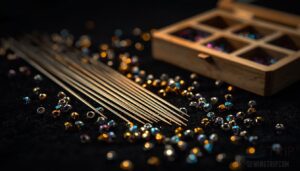
Beading needles are the most specialized hand sewing needles you’ll find in decorative kits — and for good reason. Their slender stainless steel bodies handle bead hole navigation without splitting thread. Reinforced eyes reduce fraying, while varied needle lengths between one and two inches give you real versatility. Metal finishes like nickel or gold plating guarantee smooth thread compatibility.
Specialty needles for niche sewing projects like peyote or brick stitch belong in labeled containers, organized by size.
Needle Sizes You’ll Usually Find
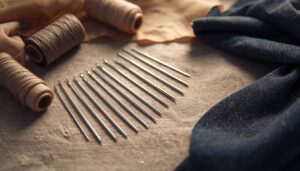
Needle size matters more than most beginners expect — the wrong one can snag delicate silk or struggle with heavy denim.
Most kits cover a practical range, from fine sizes for lightweight fabrics all the way up to heavy-duty options. Here’s what you’ll commonly find.
Fine Sizes for Silk and Lightweight Fabric
Silk is unforgiving — the wrong needle leaves visible holes or puckers that won’t press out. That’s why micro-needle selection matters so much here. For delicate fabrics, stick to sizes 60/8–70/10 for machine work and 9–12 for hand sewing.
- Silk Eye Compatibility: small eyes reduce thread friction and protect drape
- Thread Tension Balance: finer needles help maintain even, skip-free stitches
- Stitch Length Optimization: shorter lengths prevent stress on sheer weaves
- Overlay Needle Impact: lightweight needles preserve translucency on silk overlays
Medium Sizes for Cotton and Blends
Once you move past delicate silks, cotton blends are refreshingly forgiving — but they still reward the right match. Universal needles in sizes 60/75 to 90/14 deliver optimal results here. Their 2.0–2.5mm shaft diameter ensures clean fabric piercing, while maintaining compatibility with standard polyester or cotton threads. This setup guarantees good stitch consistency and zero fabric puckering.
| Fabric Type | Needle Size | Best For |
|---|---|---|
| Light cotton blend | 60/75 | Blouses, shirts |
| Medium cotton blend | 80/12 | Jackets, pants |
| Stretch cotton blend | 90/14 | Active wear, fitted tops |
Matching needle size to fabric weight and thickness extends needle longevity significantly.
Heavy Sizes for Denim and Canvas
Heavy fabrics like denim and canvas require heavy duty needles—specifically, denim needles ranging from 90/14 to 110/18. These needles feature a sharp, reinforced tip that punches through dense weaves without shredding the thread.
Always pre-wash denim first to prevent shrinkage after sewing.
Pair these specialty needles for denim, leather, and delicate fabrics with heavy thread selection and a walking foot technique for even feeding.
How Needle Sizes Are Labeled
Once you move past denim, it helps to understand how needle sizes are actually labeled. Most packaging shows two numbers — like 70/10 or 90/14 — using the NM-US conversion system. The NM gauge (European) comes first; the US size follows. Higher NM means a thinner shaft.
Many brands add color-coded tags and eye size markings so you never have to guess.
Hand and Machine Needle Differences
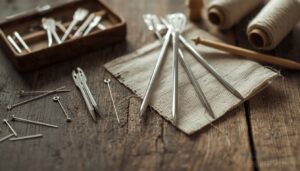
Hand and machine needles aren’t interchangeable — they’re built differently from the ground up. Most kits include both types, but knowing which one to reach for makes a real difference in your results.
Here’s what you’ll usually find in each category.
Hand-sewing Needles Commonly Packed in Kits
Most hand-sewing kits pack four core needle types.
Sharps needles (sizes 5–10) handle everyday hemming — their slim shaft flexibility and thread compatibility with standard cotton make them your go-to.
Embroidery needles offer a wider eye for floss.
Tapestry needles suit weaving and canvas work.
Some kits add ergonomic grips for hold.
Organize needles by type and size so you’re never guessing mid-project.
Machine Needles Commonly Packed in Kits
Machine needles are the workhorses of any sewing kit. Most kits pack universal needles in sizes 70/10 to 90/14 — a range that covers cotton, linen, and everyday blends without drama.
Package count options usually run 5–10 per pack, and color‑coded packaging makes it easy to organize needles by type and size at a glance.
- Stainless‑steel coating keeps tips sharp through hours of stitching
- Tip geometry types differ subtly — universal needles balance wovens and light knits
- Machine compatibility range spans most standard home machines
When Kits Include Stretch, Denim, or Twin Needles
Not every kit goes beyond the basics — but the good ones do. When stretch fabric performance is the goal, look for stretch needles (sizes 70/10–90/14) with their ball-point design. Denim seam strength demands dedicated denim needles with reinforced shafts. Twin needle alignment delivers clean parallel hems on knits.
Specialty needles for denim, leather, and delicate fabrics appear in kits targeting serious sewers, as kit composition logic varies by purpose.
Choosing The Right Needle for Fabric Type
Matching needle to fabric is how you keep stitch tension balanced in check—and avoid headaches. Fiber composition compatibility matters more than most beginners expect. Always perform a scrap test first.
- Delicate fabrics (silk, chiffon): size 60–70 sharp; coated needles reduce fraying.
- Cotton/blends: size 80–90 universal needles for woven and knit fabrics.
- Denim/canvas: specialty needles (size 90–110 reinforced) for heavy-duty materials.
- Knits: ballpoint needles, size 70–90; selecting the correct type prevents runs.
- Watch for needle wear signs: skipped stitches, snags, or uneven tension indicate a replacement is needed.
Storing and Replacing Kit Needles
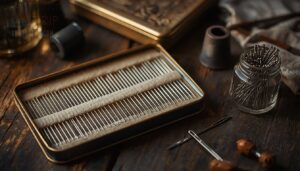
Good needles are worth protecting — and knowing when to let them go matters just as much.
A little care goes a long way toward keeping your kit ready for any project.
Here’s what you need to know about sorting, storing, and replacing your needles properly.
Sorting Needles by Type and Size
Think of your sewing kit as a tiny toolbox — chaos in there costs you time on every project. Sort needles by type first: sharps, universal, embroidery, and darning. Then organize needles by size within each group, using labeling and categorizing methods like eye-size tags or color-coded bins.
| Needle Type | Size Range | Best For |
|---|---|---|
| Sharps | 7–9 | General hand sewing |
| Universal | 70/10–90/14 | Cotton, linen, blends |
| Fine/Silk | 60–75 | Delicate fabrics |
| Embroidery | 7–10 | Decorative floss work |
| Darning | 3–7 | Mending and repairs |
Slider trays with quick-grab sections keep everything visible. A size‑fabric matrix taped inside the kit lid eliminates second-guessing entirely.
Preventing Rust and Tip Damage
Rust is a needle’s quiet killer — and it sneaks up faster than expected. Moisture control is your first line of defense: tuck silica gel packets into your kit and wipe needles dry before storage.
Rust sneaks up fast — silica gel and dry storage are a needle kit’s quiet armor
A light oil treatment on metal surfaces adds a protective coating that resists humidity.
Establish a regular inspection routine to catch early corrosion before it compromises needle sharpness.
Signs a Needle Should Be Replaced
Your needle is already telling you when it’s done — you just need to listen. A bent shaft, rough burr on the tip, or rust discoloration are obvious red flags. But skipped stitches and frequent thread breaks are just as serious.
Replace needles every 8–10 hours of use. Understanding needle wear keeps your seams clean and your fabric safe.
Safe Disposal of Broken or Dull Needles
Once a needle’s done, don’t just toss it in the trash. Safe disposal of used needles and sharps protects everyone — sanitation workers included.
Here’s how to handle it:
- Drop broken needles into an FDA-cleared sharps container immediately.
- Seal and label it before it reaches capacity.
- Check local regulations for community drop boxes or mail-back programs.
- If a needle injury response is needed, wash the area and seek medical guidance.
Frequently Asked Questions (FAQs)
What does a sewing kit come with?
Most sewing kits surprise you — they’re more than thread spools and fabric scissors.
You’ll find a seam ripper, needle threader, marking pens, and a small but mighty needle collection ready for almost anything.
What needle do sewing machines come with?
Most machines come with an OEM machine needle — usually a factory-installed point in baseline needle size 80/
It serves as a default stitch needle, designed for woven fabrics like cotton and general everyday use.
How to hand sew with arthritis?
Arthritis doesn’t have to end your hand sewing. Use ergonomic thimbles, padded grips, and self-threading needles.
Take rest intervals, choose supportive seating, and keep joints warm — gentle threading becomes easy with the right setup.
What 10 tools should be included in a sewing kit?
A basic sewing kit should include needles, a seam ripper, needle threader, thimble, pincushion, tailor’s shears, scissors, measuring tape, pins, and thread — the essential tools for a beginner sewing kit.
Can sewing kit needles work with a serger?
Serger needle compatibility is specific. Overlock needles have a shorter shank and a built-in groove design that standard kit needles lack. Using kit needles risks thread tension problems and blade jamming hazards due to these fundamental differences.
Always verify compatibility with your machine manual to avoid issues.
Are kit needles compatible with all sewing machine brands?
Most kit needles fit brands like Brother, Singer, and Janome — but always check your manual. Brand-specific guidelines, shank compatibility, and needle bar spacing vary, so manufacturer needle specs matter more than assumptions.
How many needles should a beginner kit include?
A solid beginner kit should include at least five needles. That count covers your core skill level matching needs — hand sewing, machine work, and one specialty needle — without overwhelming you.
Do needle coatings affect stitch quality or durability?
Coatings genuinely change how a needle performs.
Titanium and chrome coatings cut friction, reduce heat buildup, and keep tips sharper longer — meaning fewer skipped stitches and more consistent stitch quality across every project.
Can you reuse needles across different fabric projects?
Yes, you can reuse needles across projects — but check for burrs, bends, and dye contamination first. Fiber transfer between fabrics is real. After 8 hours of use, just swap it out.
Conclusion
Think of your sewing kit as a tradesperson’s toolbox—every needle earned its place through a specific job only it can do.
Now that you know what needles are included in sewing kits, you’re not just organizing a tin; you’re building a system. The right point, the right shaft, the right eye—matched to your fabric—turns guesswork into clean, confident stitches.
Store them well, swap them out when dull, and they’ll never let you down mid-seam.