This site is supported by our readers. We may earn a commission, at no cost to you, if you purchase through links.
Rayon thread looks stunning fresh off the spool—rich sheen, vivid color, threads that almost glow. But wash it 25 times and you’ve lost nearly a third of that color. That’s not gradual fading; that’s a visible, measurable decline most embroiderers don’t anticipate until a favorite piece looks washed out.
Thread choice shapes how long your work survives real-world use. Frequent laundering, outdoor exposure, and machine tension all stress fibers differently—and not every thread bears that stress equally. Polyester, rayon, cotton, and metallic threads each carry distinct strengths and serious trade-offs worth knowing before you buy.
Table Of Contents
Key Takeaways
- Polyester thread outlasts rayon and cotton in every measurable category — holding color through 50+ wash cycles, retaining 70–90% strength after 1,000 hours of UV exposure, and resisting moisture weakening where rayon loses up to 30% tensile strength when wet.
- Core-spun construction and correct needle pairing aren’t optional extras — two-ply core-spun thread cuts breakage by up to 35%, and mismatched needle size alone can snap fine thread before your design even takes shape.
- Rayon looks stunning on the spool but fades fast — nearly a third of its color gone after just 25 washes, making it a poor choice for anything that sees a laundry basket regularly.
- Storage and washing habits quietly determine how long your work survives — keep spools below 60% humidity at 18–22°C, wash finished pieces in cold water on a gentle cycle, and you’ll extend thread life well beyond what most embroiderers expect.
Why Thread Longevity Matters
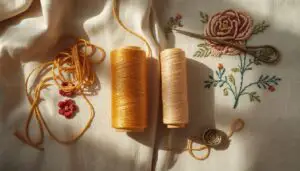
Thread longevity isn’t just a nice-to-have — it’s the difference between a piece that holds up and one that falls apart after a few washes. wrong thread choice costs you time, money, and the quality of your finished work.
Getting the basics right from the start makes all the difference, and these sewing machine thread tricks for tension and stitch quality can save your project before problems even begin.
determines how long your embroidery thread lasts.
Wash Resistance and Colorfastness
Every wash cycle is a stress test; your thread either passes or fails.
durability metric isn’t just aesthetic — it’s a durability metric.
Rayon loses up to 30% color after just 25 washes, while polyester holds firm across 50 cycles with no measurable loss.
Water hardness effects accelerate dye loss, and without polymer fixative coatings or smart dye class selection, color transfer prevention becomes nearly impossible to guarantee.
Manufacturers often reference the ISO 105 series rating to quantify color durability.
Break Resistance During Stitching
Color holding up is only half the battle. Break resistance is where thread durability really gets tested.
Needle burrs slice through weak fibers silently — regular needle maintenance eliminates that risk.
Core-spun construction improves thread core reinforcement, cutting breakage by up to 35%. Pair that with tension calibration, stitch length tuning, and thread lubrication, and you’ll see considerably fewer interruptions mid-project.
UV Exposure for Outdoor Embroidery
Outdoor embroidery faces a threat that break resistance can’t solve: UV rays. Sun degrades dye bonds within weeks, shifting colors noticeably.
For durable outdoor projects, prioritize:
- UV resistant dye with documented outdoor lightfastness testing ratings
- UV stabilized coatings applied during production or as surface treatments
- UV protective storage when items aren’t in use
Polyester holds up best — retaining 70–90% strength after 1,000 hours of sunlight exposure.
Sheen Retention Over Time
Sheen fades quietly — and unlike break resistance, you won’t notice until a finished piece looks flat under light. Polymer surface coating and fiber finish smoothness both determine how long a thread holds its glow. Heat-induced gloss loss and light reflectivity degradation accelerate without storage light control.
Polyester’s UV resistance and colorfastness keep sheen levels consistent, while rayon dulls noticeably after 25 washes.
Polyester Thread Lasts The Longest
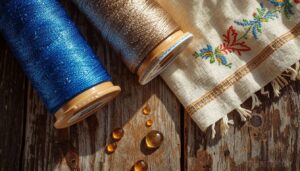
Regarding lasting through hundreds of washes, UV exposure, and daily wear, polyester thread consistently comes out on top. It’s not just marketing — the numbers back it up.
Here’s what makes polyester the go-to choice, and when other threads simply can’t keep up.
Why Polyester Outperforms Rayon and Cotton
Polyester thread holds a clear edge in three ways that directly affect your work:
- Abrasion Resistance & High Tenacity — polyester fibers withstand repeated stress without thinning, reducing breakage failures substantially.
- Low Lint Production & Rapid Drying — less fiber shedding keeps needle plates cleaner, and moisture wicking speeds drying after washing.
- Thread Durability — unlike rayon thread or cotton thread, polyester resists fading and deformation through dozens of wash cycles.
When Polyester is The Best Buying Choice
When durability is non‑negotiable, polyester thread earns its place. It manages high‑speed stitching without heat damage, produces low lint production, and its moisture management properties reduce color bleed. Thread longevity testing confirms this across fiber types.
| Project Type | Why Polyester Wins |
|---|---|
| Uniforms & workwear | Excellent break resistance |
| Outdoor decoratives | UV and moisture stability |
It’s simply the smartest material cost versus performance analysis you can make.
Where Monofilament Nylon Also Performs Well
Monofilament nylon earns its place in demanding environments where polyester may not be your first instinct. Think reinforced safety gear, heavy duty nets, and marine canvas work — applications where chemical‑resistant stitching and high‑temperature zones push thread to its limits.
Break resistance testing protocol confirms it holds up under sustained stress, with humidity effects on fibers remaining minimal.
When Softer-looking Threads Sacrifice Lifespan
Soft-finish threads are a quiet compromise.
That matte, gentle look often comes from rayon or cotton blends with finer filaments — and those choices carry real costs:
- Higher Needle Friction accelerates increased surface abrasion at entry points
- Moisture Uptake weakens fibers across wash cycles
- Reduced Tensile Strength raises breakage risk under tension
- UV sensitivity causes faster color breakdown outdoors
- Ply reductions undermine break resistance testing protocol benchmarks
The Soft Finish Tradeoff is real — thread durability suffers when aesthetics lead.
How Embroidery Thread Types Compare
Not all threads age the same way — and that difference shows up fast once you start washing, stitching, or leaving work in the sun. Choosing the wrong type can mean faded colors, broken stitches, or a finished piece that won’t survive its first season.
Here’s how the main thread types actually stack up against each other.
Polyester Vs Rayon Durability
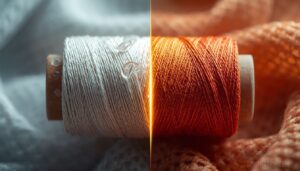
When wet, rayon thread can lose up to 30% of its fiber tensile strength — that’s a real liability in high-wash applications. Polyester thread holds its shape, resists Pilling Tendency, and delivers consistent Tensile Strength Retention across both dry and damp conditions. UV Degradation and Heat Dimensional Stability also favor polyester, while rayon’s softer look comes at a measurable cost to break resistance and thread durability.
Rayon loses up to 30% tensile strength when wet, while polyester holds its shape, resists pilling, and outlasts rayon in every durability category
| Property | Polyester Thread | Rayon Thread |
|---|---|---|
| Moisture Weakening | Minimal | Up to 30% loss |
| UV Degradation | 70–90% strength retained | Fades faster |
| Pilling Tendency | Low | Moderate–High |
Polyester Vs Cotton Wear Resistance
Cotton thread feels premium in hand, but it carries hidden costs in wear resistance. Here’s where the gap shows up most:
- Moisture Retention: Cotton absorbs water, weakening fibers and accelerating material fatigue through wash cycles.
- Heat Deformation: Cotton loses shape faster under heat, reducing Stitch Definition over time.
- Abrasion Wear: Polyester thread outperforms cotton consistently in abrasion tests.
- Fiber Elasticity: Polyester stretches and recovers; cotton doesn’t.
- Break Resistance: Cotton thread durability drops noticeably at high needle speeds.
Metallic Thread Lifespan and Weak Points
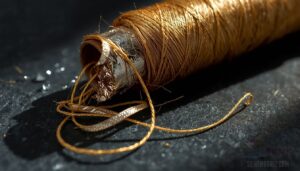
Metallic thread is a different beast entirely. That glittering finish comes from a thin foil wrap bonded to a nylon or polyester core — and that’s exactly where foil core fraying begins, right at needle entry stress points.
Heat buildup weakens the wrap fast, humidity tarnishes and dulls the sheen, and protective coating wear kicks in after repeated washing.
Break resistance? Lower than polyester by a wide margin.
Specialty Threads for Decorative Use
Beyond metallic thread, specialty options open up a different world entirely — each engineered for a specific performance demand:
- Reflective Light Bounce threads contain micro glass beads, holding brightness after 40°C washes.
- Marine Salt Resistance nylon retains color past 500 UV‑exposure hours.
- Fire‑Resistant Fabric Compatibility threads withstand 260°C without fraying.
- Boho Thread Texture metallics resist tarnish across wash cycles.
WonderFil Specialty Threads covers most of these categories. Cotton‑Rich Matte Finish blends and glow‑in‑the‑dark threads prioritize aesthetics over sheen and break resistance, so weigh UV resistance of threads against your project’s actual demands.
Best Thread Type for Frequent Washing
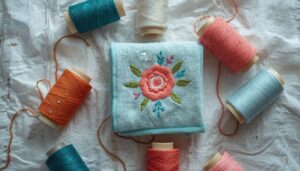
Frequent washing is where specialty threads often fall short — and where polyester pulls ahead decisively. Its colorfastness holds after 50 cycles with no measurable dye migration.
Nylon abrasion resistance and monofilament lint control make both strong runners-up for washability of embroidered garments.
For uniforms or towels, skip rayon entirely.
Thread break resistance measurement and embroidery thread longevity testing consistently confirm: polyester wins this category.
What Affects Thread Durability Most
Thread quality only tells part of the story.
How you use it — the construction, the needle, the fabric, the machine settings — determines how long it actually holds up.
These five factors have the biggest impact on durability.
Core-spun Vs Flat-wrapped Construction
Think of thread construction as the difference between a woven rope and a wrapped one.
Core-spun thread integrates its sheath fibers directly during spinning — which sheath integration protects the filament core, boosting abrasion resistance and reducing pilling tendencies considerably. For break resistance, core-spun wins consistently.
Flat-wrapped thread keeps its outer layer mechanically separate, so inconsistent wrap tension risks core exposure and earlier wear.
Ply Count and Twist Strength
Ply count and twist direction work together more than most embroiderers realize. Two-ply core-spun threads cut breakage failures by up to 35% versus single-ply — because opposite twist balance stabilizes fibers under load without adding twist-induced stiffness.
Ply distribution uniformity also matters: denser embroidery areas benefit from extra plies, improving wear resistance by 15–30%.
Higher twist counts reduce looping and strengthen tensile ply interaction at speed.
Thread Weight and Needle Pairing
Thread weight and needle size work as a system — get one wrong and breakage climbs fast.
- Thread Weight Scaling: 40 wt thread pairs with 80/12–90/14 needles for clean, low-friction passes
- Eye Size Optimization: 60 wt thread needs a 65/9–70/10 needle; a tight eye snaps fine thread
- Needle Shaft Strength: heavier denim work demands 90/14+ shafts to resist bending under load
- Ply Count Coordination: multi-ply threads need larger eyes to feed without abrasion
- Stitch Length Influence: longer stitches reduce friction cycles, protecting lighter thread weights
Fabric Type and Stitch Density
Fabric type quietly controls how much strain your thread absorbs with every stitch. Heavy fabric density — denim, canvas — tolerates tighter spacing without puckering. Lightweight stitch spacing on silk or chiffon demands restraint; push density too high and you’re fighting the fabric.
| Fabric Type | Density Approach |
|---|---|
| Heavy (denim, canvas) | High density, standard stabilizer |
| Medium (cotton twill) | Moderate density, cut-away stabilizer |
| Knit (jersey) | Knit Stretch Balance — reduce density, loosen tension |
| Sheer/Ultra-light | Micro density, Underlay Optimization required |
Stabilizer Interaction matters just as much as weave. Without proper underlay, even quality polyester breaks under compression. Fabric type influence on thread strain is real — match your setup, or pay for it in rework.
Machine Tension, Speed, and Friction
Your machine is either working with your thread or quietly destroying it. Tension plate coatings wear down over time — spindle wear monitoring catches drift before skip stitches multiply.
High speed embroidery demands speed-friction balance; push too fast, and frictional heat degrades colorfastness and fiber integrity. Needle eye geometry paired with feed path optimization reduces abrasion at every contact point, making thread tension adjustment and needle size selection your most effective thread breakage prevention strategies.
How to Choose Longer-Lasting Thread
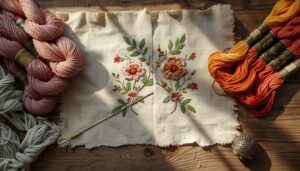
Choosing thread that holds up long-term comes down to a handful of decisions you make before the first stitch. The right brand, fabric match, and storage habit can be the difference between embroidery that fades in six months and work that lasts years.
Here’s what actually moves the needle.
Best Brands for Durability and Colorfastness
Not all thread brands are created equal — and in long-term projects, that gap shows fast. Madeira and Isacord lead Premium Polyester Brands in colorfastness evaluation across brands, holding color through 50+ washes.
Robison-Anton tops break resistance testing protocol results.
These brands meet Dye Stability Standards and carry Industry Certification backing thread quality standards.
Brand Warranty Programs and Longevity Guarantees reflect genuine confidence in their product.
Matching Thread to Fabric and Project Use
Match your thread to your fabric the way you’d match a tool to a job — precisely.
Fiber Blend Matching means cotton fabrics stay paired with cotton or blended threads to minimize puckering; polyester fabrics need polyester for matched stretch and recovery. Thread weight matching directly impacts breakage resistance — too fine on denim raises seam stress noticeably.
Colorfastness Compatibility and Moisture Absorption Fit keep your finished piece stable long-term.
Best Thread for Towels, Denim, and Uniforms
Each end use has its own demands. Towels need a high tenacity polyester with a moisture resistant finish — loop stress and hot-water cycles will break anything less. Denim calls for bonded polyester coating and heavy-duty denim thread to survive daily abrasion. Uniforms require uniform colorfastness above all else.
- Towels: high tenacity polyester, moisture resistant finish
- Denim: bonded polyester, core-spun construction
- Uniforms: colorfast polyester, verified through break resistance testing protocol
Storage and Washing Habits That Extend Life
Good storage habits are half the battle. Keep spools in Cool Dry Storage — relative humidity below 60%, temperature around 18–22°C — and add Silica Gel Desiccants to pull moisture before it weakens fibers. Thread age impact is real: UV and humidity degrade tensile strength silently.
Cold Water Wash on a Gentle Cycle with Air Drying preserves colorfastness and prevents breakage.
When Premium Thread Saves Money
Storing your spools correctly leads naturally into a smarter buying decision. Premium thread isn’t just about quality — it’s a cost‑benefit analysis of thread brands that pays off measurably:
- Reduced Spool Replacement and Decreased Thread Waste cut restocking frequency
- Lower Labor Hours from Minimized Downtime boost weekly output
- Extended Inventory Life lowers shipping costs over time
Madeira at $2.50 per skein saves $11 net per project versus DMC.
Frequently Asked Questions (FAQs)
What are the best quality embroidery threads?
The cream of the crop in embroidery threads — Madeira, Isacord, and Robison‑Anton — consistently top user review aggregation charts for colorfastness, break resistance, and machine compatibility ratings across polyester and rayon blends.
What is the difference between 40 wt and 60 wt embroidery thread?
40 wt gives you bold coverage and opacity differences on dense fabrics; 60 wt delivers fine detail with lower break resistance risk. Match thread weight to your project’s demands.
What brand of thread does the embroidery library use?
Embroidery Library primarily uses Madeira threads for colorfastness, and Isacord through direct collaboration.
For sheen with wash durability, Mettler Poly Sheen earns top marks, while Sulky remains the go-to metallic choice.
Can embroidery thread expire sitting in storage?
Thread doesn’t have an expiration date, but it does degrade.
Humidity over 60%, dust accumulation effects, and poor temperature stability quietly rob fibers of breakage resistance — often before you ever notice the problem.
Does thread color affect how quickly it fades?
Yes — color does affect fade speed. Bright reds and pinks lose intensity faster than blues or greens.
Hue light sensitivity, pigment molecular size, and dye class stability all determine how quickly a thread’s color breaks down.
Which thread works best for hand embroidery durability?
For hand embroidery durability, polyester wins. Its breakage resistance, colorfastness, and thread moisture absorption stability outlast cotton and rayon.
Pair it with correct needle eye clearance and hand tension techniques for lasting results.
Can thread shrink after the first wash?
Yes — fiber relaxation is real. Cotton threads can shrink 3–5% after the first wash. Pre-shrunk fibers and cold water wash minimize this. Heat exposure makes it worse.
Does thread thickness affect embroidery design clarity?
Thick thread flatters bold shapes. Thin thread protects fine detail.
Match thread weight to stitch density and fabric texture — that balance governs edge definition, line weight perception, and color contrast impact.
Conclusion
Thread is the skeleton of every embroidered piece—invisible when strong, catastrophic when it fails. Knowing which embroidery thread lasts longer isn’t just a purchasing decision; it’s how you protect hours of careful work from a single wash cycle.
Polyester holds color, resists tension, and outlasts the alternatives on projects that matter. Match your thread to your project’s real demands, store it correctly, and your work won’t just survive—it’ll endure.
- https://threadsketchinginaction.com/how-to-choose-the-best-machine-embroidery-thread/
- https://www.hooptalent.com/uk/blogs/news/thread-basics-master-types-materials-and-techniques-for-machine-embroidery
- https://marathonthreads.ca/pages/tips?srsltid=AfmBOoqpcrvS_cXpto_Cl8PFgx64-4SR_0jqr9mLJWKTzAc-Ai3RtxjD