This site is supported by our readers. We may earn a commission, at no cost to you, if you purchase through links.
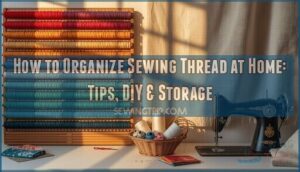
A tangled thread drawer has derailed more sewing projects than a broken needle ever could. You reach for black thread, pull out a knotted mess of navy, charcoal, and mystery spools, and suddenly the whole afternoon feels lost. Sound familiar? Thread creep is real—collections grow faster than storage solutions, and before long, your sewing space feels more like a yarn yard sale than a creative haven.
The good news: organizing sewing thread at home doesn’t require a full weekend overhaul or a Pinterest-worthy craft room. A few smart systems and the right storage picks can transform that chaos into something you’ll actually enjoy working with.
Table Of Contents
- Key Takeaways
- Step-by-Step Guide to Organizing Sewing Thread
- DIY Sewing Thread Organizer Ideas
- Maintenance Tips for Thread Organization
- Top 9 Thread Storage Solutions for Home
- 1. Sulky Universal Slimline Thread Storage Box
- 2. New brothread Rotating Wooden Thread Rack
- 3. Winsome White Storage Cabinet
- 4. Ikea Helmer Metal Drawer Unit White
- 5. iDesign Linus Clear Jewelry Drawer Organizer
- 6. Pipishell Bamboo Expandable Silverware Drawer Organizer
- 7. Backerysupply Clear Plastic Drawer Organizer
- 8. ArtBin Isacord Thread Storage Trays
- 9. Songmics White Floating Picture Ledge Shelf
- Advanced Strategies for Thread Organization
- Frequently Asked Questions (FAQs)
- Conclusion
Key Takeaways
- Sorting your thread by type and color first makes every storage decision easier and faster after that.
- You don’t need to buy anything new — glass jars, ice cube trays, and cutlery trays already do the job beautifully.
- Keeping your most-used threads right next to your machine cuts interruptions and keeps your momentum going.
- A quick declutter every few months, plus storing thread away from light and humidity, keeps your whole system working long-term.
Step-by-Step Guide to Organizing Sewing Thread
Getting your thread collection under control doesn’t have to be a big production. A few simple steps can turn that tangled mess into a system that actually works for you.
Whether you’re starting fresh or tackling years of chaos, these thread organization ideas for your sewing room make it surprisingly easy to build a setup that sticks.
Here’s how to get started.
Sort Your Thread Collection by Type and Color
Start by dumping every spool onto a flat surface — yes, all of them. Sort by thread types first: group your all-purpose polyester, cotton, embroidery, and serger cones separately.
Then tackle thread colors within each group using simple color coding, light to dark.
This thread classification approach makes future storage solutions way easier to plan, since you’ll know exactly what fiber types and quantities you’re working with.
Discard Damaged or Unwanted Threads
Now that your spools are sorted, take a hard look at what’s actually worth keeping. Thread damage is real — if a strand snaps easily when you tug it, toss it. Yellowing, fuzziness, or that dry, brittle feel signals fiber decay.
Good storage hygiene means clearing out thread clutter now. For disposal methods, synthetic threads go in the trash; natural fibers may qualify for thread recycling programs.
Choose an Organization Method (Color, Type, Project)
With the clutter gone, it’s time to build your system. Thread organization comes down to three solid approaches: sort by color for quick visual matching, use type classification to separate cotton from polyester and specialty threads, or go project planning style and group everything by current work.
Pick what fits your workflow. Many sewists mix both color coding and thread sorting techniques — and that’s perfectly fine.
Label Threads for Easy Identification
Once your system is set, labels lock it all in place. Good Label Design saves you from squinting at tiny spool text forever. Here’s what to put on each label for smart thread management:
- Write the fiber content — cotton, polyester, or silk — for quick thread visibility
- Add weight like 40 wt for better Thread Coding
- Include brand and color number for easy reorders
- Use Color Systems — colored dot stickers by fiber type
- Try Digital Labels with a unique ID linking to your phone inventory
Store Frequently Used Threads Separately
Keeping your most-reached-for colors in a dedicated High Use Zone is a breakthrough for Sewing Efficiency. Think black, white, and your go-to neutrals — those Thread Spools deserve prime real estate right beside your machine. Thread Proximity means fewer interruptions and better Thread Accessibility during projects.
| Zone Type | Best For | Container Idea |
|---|---|---|
| Near-machine shelf | Frequent Color swaps | Small open rack |
| Project tray | Current sewing thread | Divided caddy |
| High Use Zones | Daily thread organization | Clear 20-slot bin |
DIY Sewing Thread Organizer Ideas
You don’t need to spend a lot to keep your threads in order. Some of the best organizers are already sitting around your house.
Here are a few creative ways to put them to work.
Repurposing Household Containers for Thread Storage

You don’t need to spend a dime to get your thread under control. Some of the best DIY thread organizer ideas are already sitting in your kitchen.
- Glass Jar Storage – Clear jars show colors at a glance; a 500ml jar holds up to 20 spools
- Spice Rack Hacks – Carousel racks spin for quick access to your most-used thread colors
- Cutlery Tray Organizers – A five-compartment tray fits 30–40 spools laid flat in a drawer
- Shoe Box Solutions – Add cardboard dividers to stop spools from rolling and mixing
- Pill Bottle Crafts – Perfect for bobbins and small spools, especially in your travel kit
Repurposed kitchen storage is a genuine space-saving thread storage win.
Creating Thread Racks With Wooden Dowels

A DIY thread rack with wooden dowels is one of the most satisfying builds you can tackle in an afternoon. Grab birch or maple dowels — 6 to 8 mm thick — and a simple plywood base.
Space pegs about 2 inches apart so spools slide off easily. Mount it to studs, add a light finish, and your sewing thread organization is sorted.
Using Glass Jars and Clear Boxes for Visibility
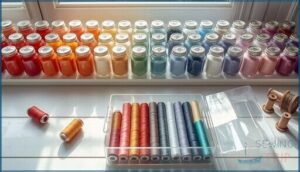
Glass jars and clear boxes are game-changers for thread visibility. You can spot every color at a glance — no digging required.
- Use 16–32 oz mason jars for spool organization by color coding families together.
- Low, wide clear box benefits include single-layer storage, so labels stay readable.
- Place clear containers at eye level for the fastest thread storage access.
Ice Cube Trays for Bobbin and Small Spool Organization
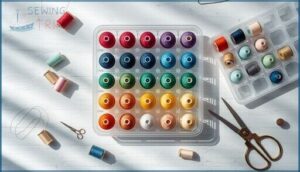
Your junk drawer might already hold the perfect bobbin storage fix — ice cube trays work surprisingly well for sewing thread management.
| Tray Type | Best For | Capacity |
|---|---|---|
| Rigid plastic | Cube organization, stacking | 12–24 bobbins |
| Silicone | Easy bobbin removal | 24–32 spools |
| Mini format | Thread protection, travel kits | 32+ small spools |
Each compartment keeps thread spools separated, preventing tangles and simplifying spool management instantly.
Custom Drawer Inserts and Pegboards
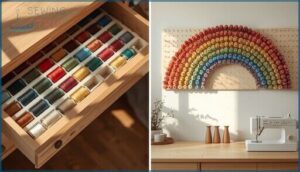
Custom drawer inserts take your thread management from chaotic to calm. Cut foam board or thin wood into strips, space them 3–4 centimeters apart, and your spools stay upright and sorted.
For your wall, a pegboard with wooden dowels holds dozens of spools at once — mount it at eye level so colors are easy to spot.
Both storage solutions make your sewing space feel truly organized.
Maintenance Tips for Thread Organization

Getting your threads organized is only half the battle — keeping them that way is where the real magic happens.
Organizing your threads is easy — keeping them that way is where the real work begins
A few simple habits can make your whole system last longer and work better. Here’s what actually helps.
Regular Decluttering and Inventory Checks
Every few months, schedule a quick Thread Purge — your future self will thank you. A simple Declutter Schedule every three to six months keeps your thread organization from spiraling out of control.
Do a Storage Audit to check for weak, faded, or nearly empty spools. Good Inventory Management and Thread Tracking mean fewer duplicate buys and a sewing supplies storage system that actually works.
Rotating Threads to Maintain Quality
Once you’ve cleared out the clutter, it’s time to think about Spool Management and Thread Aging. Use a simple first-in, first-out system — pull from the front, restock from the back.
Prioritize older cotton over polyester in your Fiber Rotation, since cotton weakens sooner. Good thread quality maintenance means your Storage Systems and Color Coding always work in your favor.
Keeping Threads Away From Sunlight and Dust
Sunlight and dust are your thread’s worst enemies. UV rays fade colors and weaken fibers over time — and dust quietly builds up on exposed spools.
Here’s how to nail Thread Preservation with smart Storage Materials:
- Store threads in opaque containers for built-in Sunlight Filters
- Use closed cabinets away from windows for Climate Control
- Add Dust Protection with lidded boxes between sewing sessions
- Place sewing thread storage solutions on north-facing walls
Labeling Systems for Quick Access
Protecting your thread is half the battle — knowing where everything lives is the other half. A simple label maker system does the heavy lifting here. Use Spool Markers for color numbers, Color Coding dots for thread families, and Thread Tags for project types. Inventory Lists taped inside lids keep duplicates in check. Effective thread storage solutions can also help maintain an organized sewing space.
| Label Type | Tool to Use | Best For |
|---|---|---|
| Spool Markers | Ultra-fine Sharpie | Color numbers |
| Color Coding Dots | Colored stickers | Thread families |
| Thread Tags | Label Makers | Project categories |
| Inventory Lists | Printed spreadsheet | Avoiding duplicates |
Top 9 Thread Storage Solutions for Home
Finding the right storage solution can make all the difference in keeping your threads tidy and easy to grab. There are so many great options out there, from wall-mounted racks to rolling drawer units, all designed to fit different spaces and budgets.
Here are nine of the best thread storage solutions you can use at home.
1. Sulky Universal Slimline Thread Storage Box
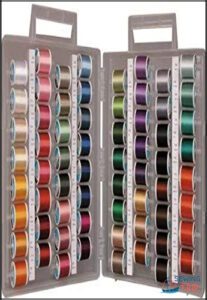
The Sulky Universal Slimline Thread Storage Box is a serious breakthrough for sewists who hate digging through tangled spools. It holds up to 64 mixed-size spools, and because it’s made from translucent plastic, you can spot the color you need instantly.
It’s lightweight at just 6 pounds when full, so carrying it to class is no problem. You can prop it open on your table or hang it on the wall. That patented lifting tab system? Genuinely clever.
| Best For | Sewists and quilters who want quick, organized access to a large thread collection without the hassle of digging through a messy bin. |
|---|---|
| Material | Plastic |
| Primary Color | Clear |
| Assembly Required | No |
| Mounting/Placement | Wall or Freestanding |
| Weight | 6 lbs |
| Sewing Use | Primary use |
| Additional Features |
|
- Holds up to 64 spools of mixed sizes, so your whole collection stays in one spot
- Translucent design makes it easy to find the right color fast
- Works freestanding or wall-mounted, which is handy no matter how your space is set up
- It’s on the pricier side compared to basic storage options
- The spindles can snap if you try to force larger or chunkier spools onto them
- Very large or oddly shaped spools might not fit without some workarounds
2. New brothread Rotating Wooden Thread Rack
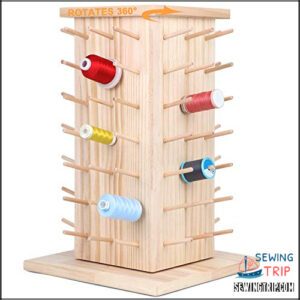
If your thread spools keep sliding, tangling, or disappearing into a drawer, this rack is your new best friend. The New brothread Rotating Wooden Thread Rack holds up to 84 spindles — expandable to 93 — and spins a full 360° so every spool stays visible and within reach.
Each 2-inch spindle fits mini king spools perfectly. It’s built from smooth beech wood, ships unpainted for DIY customization, and even includes inner compartments for accessories.
Practical, pretty, and genuinely fun to spin.
| Best For | Sewers, quilters, and embroidery enthusiasts who work with mini king spools and want an organized, space-saving display that’s easy to customize. |
|---|---|
| Material | Beech Wood |
| Primary Color | Natural |
| Assembly Required | Yes |
| Mounting/Placement | Countertop |
| Weight | Not specified |
| Sewing Use | Primary use |
| Additional Features |
|
- Holds up to 84 spools (expandable to 93) and rotates a full 360°, so finding the right color takes seconds
- Built from solid beech wood — sturdy, smooth, and ready to paint or stain however you like
- Longer spindles and wider spacing mean mini king spools actually fit without a fight
- Not compatible with large thread spools, so it won’t work for everyone’s collection
- Requires assembly before use, which adds a little setup time out of the box
- Inner storage space is limited, so bigger accessories won’t have a home here
3. Winsome White Storage Cabinet
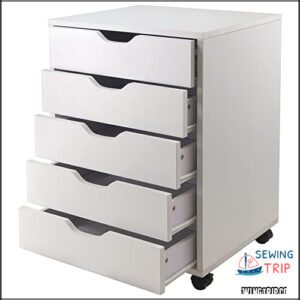
Drawers are a thread lover’s secret weapon — and the Winsome Halifax White Storage Cabinet delivers. It’s a five-drawer unit built from composite wood with a clean white finish that blends into any craft room.
Each drawer glides smoothly and holds about 12 pounds of spools, bobbins, and notions. The top surface supports up to 35 pounds — great for a small sewing machine.
Add optional casters, and you’ve got a rolling thread station that follows you around the room.
| Best For | Crafters, sewists, and home office users who want flexible, organized storage that looks good and moves with them. |
|---|---|
| Material | Composite Wood |
| Primary Color | White |
| Assembly Required | Yes |
| Mounting/Placement | Floor/Rolling |
| Weight | 40.3 lbs |
| Sewing Use | Secondary use |
| Additional Features |
|
- Five smooth-gliding drawers give you plenty of room to sort thread, bobbins, notions, or office supplies by category
- Clean white finish works in almost any room — craft space, home office, mudroom, you name it
- Optional casters turn it into a rolling station you can move wherever the project takes you
- Drawers don’t pull out all the way, so grabbing stuff from the back can be a bit of a reach
- Assembly can take up to three hours, and the instructions aren’t always easy to follow
- The composite wood can be tricky to work with — small screws may strip if you’re not careful during assembly
4. Ikea Helmer Metal Drawer Unit White
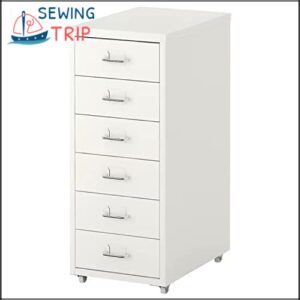
The Ikea Helmer Metal Drawer Unit punches well above its price tag. With six drawers, label slots, and four rolling casters, it offers impressive functionality.
Each drawer is deep enough to hold full rows of thread spools laid front to back, and the slim drawer height keeps everything visible at a glance. The steel frame wipes clean easily, and you can even stick magnetic bobbin holders right on the sides.
At just 28 cm wide, it tucks neatly beside any sewing table.
| Best For | Anyone who needs a compact, mobile storage solution for light items like office supplies, craft materials, or small tools — especially in tight spaces. |
|---|---|
| Material | Steel |
| Primary Color | White |
| Assembly Required | Yes |
| Mounting/Placement | Floor/Rolling |
| Weight | Not specified |
| Sewing Use | Secondary use |
| Additional Features |
|
- Comes with six drawers and label slots, so staying organized is easy right out of the box.
- Rolling casters make it simple to move around whenever you need to reposition.
- Steel construction wipes clean easily and holds up fine for everyday light use.
- Assembly can be tricky and time-consuming, and the unit isn’t the sturdiest once built.
- Drawers can slip off their tracks, and the top piece may not stay secured during movement.
- The small wheels struggle on carpet, so it really only works well on hard floors.
5. iDesign Linus Clear Jewelry Drawer Organizer
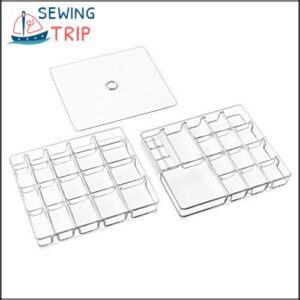
Sometimes the simplest solution is already hiding in your drawer. The iDesign Linus Clear Jewelry Organizer Tray Set gives you 40 compartments spread across three stackable trays, making it perfect for sorting bobbins, small spools, and specialty threads by color or type.
The BPA-free plastic is crystal clear, so you can spot exactly what you need without digging. Each tray measures about 8.75" x 7.75", fits neatly into most drawers, and cleans up with a quick wipe.
| Best For | Crafters and organizers who need a simple, no-fuss way to sort small items like jewelry, threads, or office supplies in a drawer or on a countertop. |
|---|---|
| Material | BPA-free Plastic |
| Primary Color | Clear |
| Assembly Required | No |
| Mounting/Placement | Drawer or Countertop |
| Weight | Not specified |
| Sewing Use | Secondary use |
| Additional Features |
|
- 40 compartments across three trays gives you plenty of room to sort items by color, type, or size
- Crystal-clear plastic means you can see everything at a glance — no digging required
- Stackable and modular, so you can customize the setup to fit your space
- Compartments may be too small for bulkier jewelry like chunky bracelets or statement earrings
- No lid or locking mechanism, so stacked trays can shift if bumped
- The plastic can feel a little lightweight, which might not suit everyone’s taste
6. Pipishell Bamboo Expandable Silverware Drawer Organizer
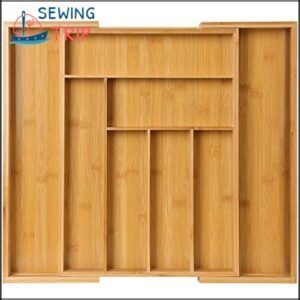
If you want something that looks as good as it works, the Pipishell Bamboo Expandable Silverware Drawer Organizer is worth a look. It stretches from 13" to nearly 20" wide, so it fits most sewing drawers without any awkward gaps.
You get 6–8 compartments for separating spools, bobbins, and small notions. The natural bamboo surface is smooth, easy to wipe clean, and honestly just nice to look at.
At $25.99, it’s a practical upgrade that keeps your thread drawer tidy and tangle-free.
| Best For | Anyone who wants a stylish, natural-looking way to keep their kitchen, office, or craft drawers neat and organized. |
|---|---|
| Material | Bamboo |
| Primary Color | Natural |
| Assembly Required | No |
| Mounting/Placement | Drawer |
| Weight | 3 kg |
| Sewing Use | Secondary use |
| Additional Features |
|
- Expands from 13" to nearly 20", so it fits a wide range of drawer sizes without leaving awkward gaps
- Bamboo looks great and wipes clean easily — way nicer than your average plastic organizer
- Six to eight compartments give you plenty of room to separate and sort whatever you’re storing
- Needs 72 hours to air out before you can actually use it
- Won’t work in drawers narrower than 13" or especially shallow ones
- At $25.99, it costs a bit more than basic plastic options
7. Backerysupply Clear Plastic Drawer Organizer
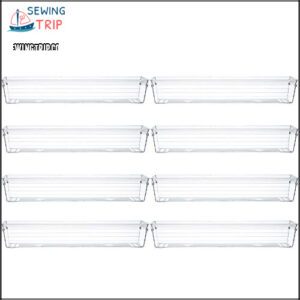
If you’d rather keep things simple and clear, the Backerysupply Clear Plastic Drawer Organizer is a solid pick. You get 8 rectangular trays, each measuring 9 inches long by 3 inches wide. That’s plenty of room to line up your spools side by side without any tangling.
The clear acrylic makes it easy to spot colors fast. Trays wipe clean in seconds and hold up to 22 pounds. It’s straightforward, affordable, and genuinely useful.
| Best For | Anyone who wants a no-fuss, see-through storage solution for lightweight items like sewing threads, jewelry, or kitchen utensils. |
|---|---|
| Material | Acrylic Plastic |
| Primary Color | Clear |
| Assembly Required | No |
| Mounting/Placement | Drawer or Countertop |
| Weight | Not specified |
| Sewing Use | Secondary use |
| Additional Features |
|
- Clear acrylic makes it easy to find what you need at a glance
- Set of 8 trays gives you plenty of flexibility to organize different items
- Easy to wipe clean and rearrange however you like
- Plastic feels a bit flimsy, so it’s not great for heavy or bulky items
- Corners can break during shipping, so inspect it when it arrives
- Not ideal if you need something more durable for long-term heavy-duty use
8. ArtBin Isacord Thread Storage Trays
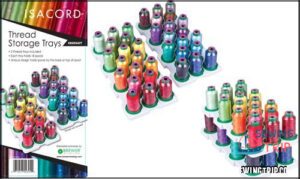
Now, if you’re working with Isacord embroidery thread specifically, the ArtBin Isacord Thread Storage Trays are worth a look. You get two trays, each holding 18 spools — 36 total. The clever design grips spools at the base or top, so they stay upright even when you’re moving things around.
They’re compact, stackable, and fit right inside an ArtBin Super Satchel box. Perfect for keeping your embroidery colors sorted and ready to grab.
| Best For | Embroiderers who use Isacord or compatible thread and want a tidy, portable way to store and access their spool collection. |
|---|---|
| Material | Polyester |
| Primary Color | Assorted |
| Assembly Required | No |
| Mounting/Placement | Stackable/Portable |
| Weight | 12.8 oz |
| Sewing Use | Primary use |
| Additional Features |
|
- Holds 36 spools across two trays — solid capacity for a growing thread collection
- Grips spools at the base or top, so they stay put instead of rolling around
- Fits neatly into an ArtBin Super Satchel, making it easy to pack up and go
- Won’t work with traditional spools like Metrosene or Sulky — pretty limited in compatibility
- Some users found spools still tipped over in the trays during transport
- You’ll need extra storage once your collection grows beyond 36 spools
9. Songmics White Floating Picture Ledge Shelf
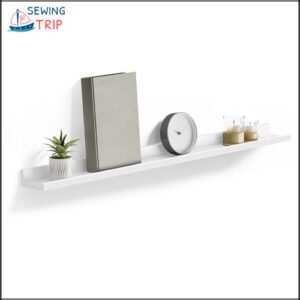
Not all thread storage has to come in a box. The Songmics White Floating Picture Ledge Shelf takes a different approach — and it works surprisingly well.
Mount it on your sewing room wall, then line up your labeled thread boxes or small containers right on the ledge. It’s 43.3 inches wide, holds up to 26.5 lbs, and keeps everything visible at a glance.
Clean, simple, and out of the way.
| Best For | Sewers who want their thread boxes or small containers visible, organized, and off the table without taking up cabinet space. |
|---|---|
| Material | MDF |
| Primary Color | White |
| Assembly Required | Yes |
| Mounting/Placement | Wall-mounted |
| Weight | 3.5 lbs |
| Sewing Use | Secondary use |
| Additional Features |
|
- At 43.3 inches wide, it fits a solid row of thread boxes, jars, or small containers side by side
- The front edge keeps things from sliding off — handy in a busy sewing room
- Easy to clean surface handles dust and the occasional spill without any fuss
- Only one shelf per purchase, so covering a whole wall adds up fast
- The 26.5 lb limit on drywall is fine for thread, but won’t hold heavier supplies
- Paint drips or surface imperfections have been reported, which matters if you want a polished look
Advanced Strategies for Thread Organization

Once you’ve got the basics down, it’s time to take your thread collection to the next level. A few smarter habits can save you serious time and keep your sewing space running like a well-oiled machine.
Here are five sophisticated strategies worth adding to your routine.
Sorting by Project, Weight, and Fiber Type
Sorting by project, weight, and fiber type is the backbone of smart thread management. It keeps everything findable fast.
- Project Sorting – Group dress, quilt, and denim projects separately.
- Thread Weight – Match 50wt for fine seams, 30wt for topstitching.
- Fiber Types – Store cotton, polyester, and rayon apart.
- Color Coding – Arrange by rainbow order within each group.
Effective thread organization involves using a thread management system to keep threads tidy.
Creating a High-Use Section for Essentials
Your high-use zone is the secret weapon of smart sewing essentials organization. Keep 20 to 40 Essential Thread spools — your go-to neutrals and everyday colors — within arm’s reach of your machine.
A small wall rack or shallow drawer manages thread storage perfectly here. Clear containers boost Thread Visibility for Quick Access, seriously improving your Sewing Efficiency and overall thread management every single session.
Keeping a Thread Inventory List
A simple list can transform your thread management overnight. Keeping a thread inventory means no more buying duplicates or forgetting what you own.
Track these five essentials:
- Brand name and color number
- Spool quantities per shade
- Storage location (drawer or rack)
- Fiber type notes
- Low-stock reminders
Digital Cataloging in Google Sheets makes Thread Tracking seamless, supporting smarter sewing thread organization every time.
Color-Coding and Rainbow Arrangements
A rainbow on your wall isn’t just pretty — it’s a power move for thread organization. Arrange your thread colors in ROYGBIV order, grouping pinks with reds and corals with oranges. Visual labels make shade mapping instant.
| Color Family | Includes | Storage Tip |
|---|---|---|
| Reds & Pinks | Crimson, rose, blush | Left-side rack |
| Blues & Teals | Navy, turquoise, sky | Center drawer |
| Neutrals | White, gray, black | Separate bin |
Rainbow order turns thread display into a quick visual inventory.
Preventing Tangles With Dedicated Bobbin Boxes
Bobbins are tiny chaos agents — loose ones tangle fast. A dedicated bobbin box fixes that.
Look for designs with foam insert security; the foam grips each bobbin snugly so nothing rolls or snags. Tuck thread tails before closing the lid for solid thread tail management. Clear lids mean no digging.
These portable storage solutions keep your tangle-free system intact, even on the go.
Frequently Asked Questions (FAQs)
How to store big spools of thread?
Big spools need closed boxes or deep drawers for dust protection and thread visibility. Match storage materials to your spool sizes, and stack containers vertically for shelf optimization without tangling.
How do I store thread long-term without damage?
Keep thread in a cool, dark spot between 15°C and 25°C. Humidity management matters too — aim for 40–60%. Dust prevention and light protection preserve fiber quality for decades.
Can humidity affect sewing thread quality at home?
Yes, humidity is a quiet troublemaker for thread quality. Damp air weakens cotton and causes fiber damage, while dry air makes threads brittle. Aim for 40–60% humidity to protect thread durability and support smart storage solutions.
What thread quantities should a beginner start with?
Start small. A beginner’s Essential Spool Counts of 6 to 12 spools is plenty. Grab Thread Starter Sets in black, white, beige, and gray for your Core Color Selection before anything else.
How do I untangle severely knotted thread spools?
Severely knotted thread spools aren’t a lost cause. Use a needle or seam ripper to loosen tight spots, work slowly from the outside in, and pull loops apart gently.
Should metallic and specialty threads be stored differently?
Absolutely. Metallic thread and other specialty fibers need extra care. Store them flat in divided, lidded containers away from light and humidity. This protects the delicate coating and keeps your thread preservation methods working long-term.
Conclusion
Fewer tangles mean fewer headaches. Better storage means more time actually sewing. Knowing how to organize sewing thread at home means your creative space finally works for you, not against you.
Start small—sort one drawer, hang one rack, label one shelf. You don’t need a perfect system from day one. You just need a starting point.
Pick one idea from this guide, put it into action today, and watch your whole sewing routine change.
- https://ylithreads.com/blogs/thread-education/how-to-read-thread-labels
- https://organized31.com/clever-thread-storage-ideas/
- https://so-sew-easy.com/printable-fabric-labels/
- https://www.hooptalent.com/blogs/news/mastering-thread-box-storage-smart-solutions-for-every-sewing-space
- https://www.superiorthreads.com/education/reading-thread-labels