This site is supported by our readers. We may earn a commission, at no cost to you, if you purchase through links.
Most sewists spend hours choosing the perfect fabric, then grab whatever thread is nearby without a second thought.
That shortcut costs more than you’d expect—mismatched thread causes broken seams, puckered stitches, and fabric that wears out long before it should.
Thread isn’t just the stuff that holds things together; it’s an active participant in how your finished piece performs, moves, and lasts.
Knowing how to match thread to fabric type changes everything from the tension on your machine to the drape of a finished hem.
The details ahead will make that choice feel obvious every time.
Table Of Contents
- Why Thread Selection Matters for Every Fabric
- Thread Types and What They’re Best For
- How to Match Thread Material to Fabric Fiber
- Thread Weight Systems Explained Simply
- Matching Thread Weight to Fabric Weight
- How to Match Thread Color to Fabric
- Thread-to-Needle Compatibility by Weight
- Project-Specific Thread and Fabric Matching Guide
- Troubleshooting Common Thread and Fabric Mismatches
- Eco-Friendly Thread Options Worth Knowing
- Frequently Asked Questions (FAQs)
- Conclusion
Why Thread Selection Matters for Every Fabric
Thread choice isn’t just a detail — it’s what holds your work together, literally.
Getting it right starts with understanding your options — this guide to choosing the right thread for your sewing project breaks down exactly what works for different fabrics and techniques.
Pick the wrong one and you’ll deal with broken seams, puckered fabric, or stitches that just don’t look right.
Here’s what every sewist should understand before threading that needle.
How The Wrong Thread Damages Your Fabric
Using the wrong thread doesn’t just make your seams look off — it can physically wreck your fabric. Thread tension issues stretch fibers out of shape, while needle size mismatch punches unnecessary holes in delicate cloth.
Over time, thread coating failure and UV degradation weaken the seam from the inside out. Fabric and thread selection aren’t minor details — they’re what holds everything together.
What Makes a Thread Good or Bad?
So what separates a great thread from a frustrating one?
It comes down to a handful of thread properties: tensile strength (how much pull it endures before snapping), elongation rate (its stretch and recovery), abrasion resistance, lubrication quality, and uniformity consistency.
Thread weight and fiber compatibility matter too.
Nail these, and your thread selection works with your fabric — not against it.
The Connection Between Thread and Seam Quality
Those thread properties don’t exist in isolation — they directly shape your seam.
When tensile strength, elongation matching, and abrasion durability align with your fabric, seam efficiency can hit 85–90%.
Thread weight, tension optimization, and fabric compatibility work together like a team.
Get thread selection right, and your seam strength holds through every wash, stretch, and wear.
Thread Types and What They’re Best For
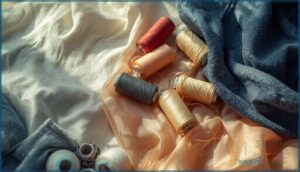
Not all threads are created equal — and that’s actually a good thing.
Each type has its own strengths, and knowing which one suits your fabric can make a real difference in how your project holds up. Here’s a look at the main thread types and where each one truly shines.
Cotton Thread for Natural Fibers
Cotton thread is the natural partner for fabrics like cotton, linen, and rayon — and for good reason.
It offers real shrink control, manages hot-iron pressing without complaint, and its matte finish keeps seams looking subtle.
Mercerized strength and lint reduction make it a workhorse for quilting.
It’s also biodegradable, so your fabric selection can stay eco-conscious from start to finish.
Polyester Thread for Synthetic and Mixed Fabrics
When your fabric is polyester, nylon, or a blended mix, polyester thread is your most reliable choice. Its dimensional stability means seams won’t pucker after washing, and its moisture resistance keeps strength intact even in damp conditions. Corespun construction gives you softness without sacrificing durability.
- Bonds naturally with synthetic fibers for flexible, seam‑friendly results
- Heat‑set performance prevents shrinkage and distortion after machine drying
- Chemical durability endures frequent washing with minimal degradation
- Slight elasticity accommodates stretch fabrics like activewear and knits
- Fabric compatibility extends to blends, including poly‑cotton and spandex mixes
Silk Thread for Delicate and Luxury Fabrics
When luxury is the goal, silk thread delivers where others fall short.
Its smooth filament construction ensures fine stitch visibility without snagging delicate fabrics, while its natural sheen matching makes seams disappear into silk satin or charmeuse beautifully.
Stretch compatibility keeps seams flexible, hypoallergenic benefits matter for skin-close garments, and luxury color saturation means your thread weight stays invisible yet perfectly coordinated.
Nylon Thread for Upholstery and Heavy-Duty Use
When your project involves sofas, car seats, or tool belts, nylon is your go-to heavy-duty thread. Bonded nylon upholstery thread manages serious stress — size 69 holds around 11 pounds, while size 138 pushes 22 pounds.
Be aware of its UV limitations: prolonged sun weakens it fast. Match thread weight to fabric thickness carefully, and pair size 92 with a 125/20 needle for clean results.
Specialty Threads: Metallic, Conductive, and Embroidery
Specialty threads open up a whole new world — and yes, that includes sewing electricity into your clothes.
- Metallic thread durability comes from a synthetic core wrapped in foil, delivering shimmer finishes without sacrificing strength.
- Conductive embroidery techniques stitch stainless steel or silver fibers directly into smart textile integration applications.
- Heated fabric design uses low-voltage conductive threads as resistive warming elements.
- Embroidery thread — usually 40wt rayon or polyester — balances sheen with fabric compatibility.
- Slow your machine down for metallic; it rewards patience.
How to Match Thread Material to Fabric Fiber
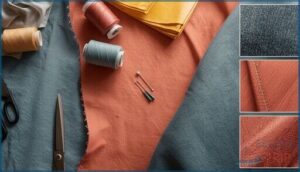
Picking the right thread starts with knowing what your fabric is actually made of.
Fiber type affects how thread behaves in the seam — get it wrong and you’ll fight tension issues, puckering, or wear over time.
Here’s how to match thread material to the three main fabric categories you’ll encounter.
Natural Fiber Fabrics and Their Ideal Thread Types
Natural fibers have a simple rule: like calls to like. Your Cotton‑Linen Pairing works best with 50wt cotton thread — same fiber, same shrinkage rate, no surprises after washing.
Silk‑Thread Benefits shine on delicate weaves, draping cleanly without puckering.
The Wool‑Core Spun Choice keeps custom seams strong yet smooth.
Hemp‑Thread Compatibility and Organic Fiber Matching follow the same logic — match the fiber, and your thread matching practically solves itself.
| Natural Fiber | Best Thread Choice |
|---|---|
| Cotton & Linen | 50wt cotton thread |
| Silk | Fine silk or 60wt polyester |
| Wool | Polyester core spun |
| Hemp & Organic | Organic cotton thread |
Synthetic Fabrics and Stretch Materials
Synthetic fabrics like spandex, lycra, and nylon demand polyester thread — full stop. Polyester stretches up to 26% before breaking, which means your elastic seam design actually moves with the fabric instead of snapping mid-wear. That’s stretch-fit durability in action.
For activewear, also consider woolly nylon in your serger loopers. It’s soft, recovers beautifully, and keeps synthetic fibers locked in comfortable, lasting seams.
Blended Fabrics: Choosing The Right Compromise
Blended fabrics sit between two worlds — and so does your thread choice. 60/40 cotton-polyester shirt blend? Reach for polyester thread. It manages the stress points while matching the fabric’s strength.
But if softness and fiber balance matter more than durability — think a 70/30 cotton-rich dress — cotton thread ages naturally alongside the fabric, keeping seams smooth and color harmony intact.
Thread Weight Systems Explained Simply
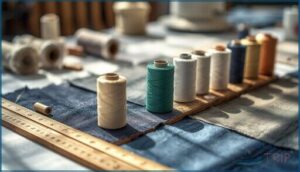
Thread weight numbers are one of those things that look confusing at first but make total sense once someone breaks them down for you.
There are actually a few different measuring systems out there, and knowing how they work helps you pick the right thread with confidence every time. Here’s what you need to understand.
What Are WT, TEX, and Denier?
Thread weight labels can feel like a secret code — but once you crack it, everything clicks. Three systems dominate the industry:
- WT (Weight): Uses a direct vs inverse scale — higher numbers mean finer thread
- Tex: An industry standard measuring grams per 1,000 meters
- Denier: Global practice standard measuring grams per 9,000 meters
- Conversion formulas exist between all three systems
- Fiber compatibility influences which system your supplier uses
Tex and Denier both increase with thickness. WT does the opposite.
Which is Thicker: 40 or 60 Weight Thread?
Now that you understand how the WT system works inversely, here’s the part that trips up most beginners: 40 weight thread is actually thicker than 60 weight.
Think of it like road widths — fewer kilometers fit into one kilogram, so each strand is bulkier.
| Feature | 40 Weight Thread | 60 Weight Thread |
|---|---|---|
| Thickness Comparison | Thicker diameter | Finer, slimmer strand |
| Visual Appearance | Bold, defined stitches | Subtle, blends into fabric |
| Strength Difference | Higher tensile strength | Lighter but still reliable |
| Needle Compatibility | Size 80/12–90/14 | Size 60/8–70/10 |
| Fabric Suitability | Denim, canvas, twill | Silk, chiffon, fine cotton |
Your thread selection shapes everything — from how a seam holds under stress to whether your fabric puckers or lies flat.
How to Determine The Right Thread Weight for Your Project
So how do you actually choose? Start with your fabric weight guide: light fabrics like silk call for 60 wt, medium cotton takes 40–50 wt, and heavy denim needs 30 wt.
Then factor in project strength needs and stitch visibility control. Stretch compatibility matters too — garment construction on knits demands thread that moves. Sustainable thread choices like organic cotton or recycled polyester fit right into this decision.
Matching Thread Weight to Fabric Weight
Think of thread weight and fabric weight as dance partners — when they’re mismatched, everything falls apart. The good news is that once you understand the basic groupings, choosing the right thread becomes almost instinctive.
Thread weight and fabric weight are dance partners — mismatch them, and everything falls apart
Here’s how it breaks down across the three main fabric weight categories.
Lightweight Fabrics: Silk, Chiffon, and Voile
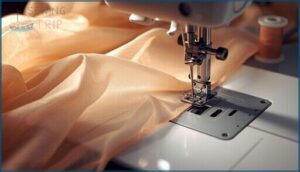
Silk, chiffon, and voile demand respect — one wrong move, and you’ve got puckered seams or snapped thread.
For Sheer Fabric Handling, your thread weight is everything. Stitch Length Optimization starts at 1.5–2mm, and Thread Tension Control keeps seams flat. For Fabric Transparency Matching and Seam Finish Techniques, lean on these thread selection essentials:
- Use 60–100wt lightweight fabric thread (like InvisaFil) for near‑invisible stitches
- Silk thread hand‑bastes beautifully but slips on machines — choose fine polyester instead
- 70/10 microtex needles with your thread for clean fabric compatibility
Medium-Weight Fabrics: Cotton, Linen, and Quilting Fabric
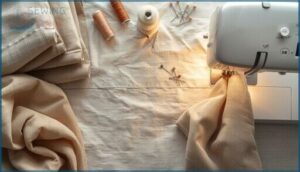
Cotton, linen, and quilting fabric are the sweet spot of garment construction — forgiving enough to teach you, demanding enough to keep you honest.
For thread weight, 50wt cotton thread works with quilting cotton beautifully; 40wt works better on linen.
Pair both with an 80/12 or 90/14 needle, keep stitch length around 2.5mm, and mind your fabric grain direction for clean, flat seams.
Heavy Fabrics: Denim, Canvas, and Upholstery
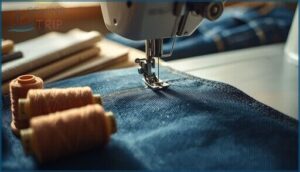
Heavy fabrics like denim, canvas, and upholstery don’t forgive weak thread choices.
For denim stitch reinforcement, reach for Tex 60–105 heavy-duty thread; marine canvas needs Tex 100 with UV protection and abrasion resistance built in.
Upholstery thread coatings add durability where seams face constant friction.
Match needle size to thread weight — think 18/110 to 20/125 — and always test on scraps first.
How to Match Thread Color to Fabric
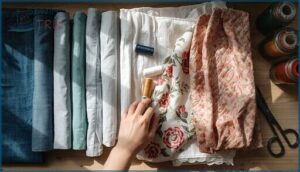
Choosing the right thread color can make or break your project’s look.
It’s not always as simple as grabbing the closest match. Here’s what you need to know before picking your thread.
The Golden Rule: Should Thread Be Lighter or Darker?
Most dressmakers follow one golden rule: go one shade darker than your fabric.
Why? Darker tones recede visually, improving seam visibility by letting stitches sink into the cloth.
Lighter thread, though, highlights every wobble.
Think of it as contrast balance — you want low contrast for subtle seams.
Always do a quick light-shade testing on a scrap before committing.
Value matching beats perfect color matching every time.
Color Matching Basics for Beginners
Color matching thread isn’t guesswork — it’s a skill you can nail with the right habits. Start with Spool vs Strand: always unroll 6–12 inches and lay it flat on your fabric. The spool looks darker than it actually stitches. Then step toward a window — Natural Light Testing reveals shade differences that artificial lighting completely hides.
- Use Neutral Thread Choices as your safety net: medium greys and warm beiges blend across dozens of fabrics
- Leverage Color Chart Systems like Threadcolors.com to cross-reference thread numbers when store options feel overwhelming
- Apply Practical Testing Methods — sew a short test seam, then check it from three feet away
Choosing Thread for Solid Vs. Patterned Fabric
Solid fabrics leave nowhere to hide — every thread mismatch catches the light like a scratch on glass. Shade Contrast Rules say go one shade darker on solids; matte finish threads reduce light interaction that exposes mismatches. Patterned fabric forgives more, letting Neutral Palette Choice do the heavy lifting.
| Fabric Type | Thread Strategy |
|---|---|
| Solid | Matte thread, one shade darker |
| Patterned | Match dominant background color |
| Busy Print | Grey neutral for Fabric Compatibility |
Run a quick Thread Visibility Test: lay your thread across the fabric and squint.
How to Match Thread When You Can’t Find an Exact Color
Sometimes you just can’t find an exact match — and that’s fine. Nail value-based matching first: squint at your fabric and thread together, ignoring hue entirely.
Use the single strand test by pulling one thread off the spool and laying it flat against the fabric. Check your selection with daylight evaluation near a window.
When all else fails, neutral palette choice saves you.
Thread-to-Needle Compatibility by Weight
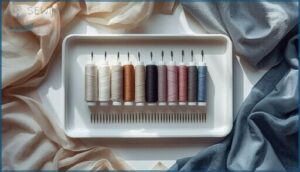
Getting your thread weight right is only half the equation — your needle has to keep up.
Use the wrong needle size and you’re setting yourself up for skipped stitches, fraying, or thread that snaps mid-seam.
Here’s what you need to know to match them properly.
Needle Size Chart by Thread Weight
Think of needle size as a Metric Needle Mapping system — the number literally tells you the shaft diameter in millimeters.
For fine-thread needle pairing, 60wt thread needs a 60/8–70/10; 50wt takes a 70/10–80/12.
For medium sewing, 40wt pairs with 80/12–90/14.
Need heavy-duty needle selection for denim? Match 30wt thread to a 90/14–100/16.
Simple Tex Conversion Guide logic: thicker thread, bigger needle.
How Mismatched Needles Cause Thread Breakage
Now that you’ve got the size chart down, here’s what actually goes wrong when you ignore it.
Using the wrong needle size triggers a chain reaction:
- Needle Eye Friction shreds thread fibers — a size 70/10 needle destroys 40wt polyester in under 10 minutes.
- Deflection-Induced Abrasion causes flex against the needle plate, breaking thread five times more often on heavy‑fabric thickness like denim.
- Heat Buildup Effects push temperatures past 50 °C, melting polyester threads mid‑seam.
- Groove Depth Mismatch exposes filaments to direct fabric contact, weakening thread by 40 % per pass.
- Tension Amplification Issues spike effective tension by 15 %, snapping thread at the take‑up lever.
Wrong needle, broken thread. It’s that simple.
Choosing The Right Needle for Specialty Threads
Specialty threads need specialty needles — full stop.
Metallic thread, for example, demands a needle with an extra-large metallic needle eye to protect that delicate foil wrap from fraying. Use an 80/12 to 90/14, and drop your upper tension slightly.
For embroidery needle size, 75/11 or 80/12 manages 40wt beautifully.
Conductive thread compatibility depends on a smooth, snag‑free eye too — treat it like silk.
Project-Specific Thread and Fabric Matching Guide
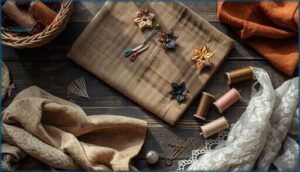
Every project has its own personality, and your thread and fabric pairing should reflect that.
From quilting cotton to stretchy knits to sheer lace, the right combination makes all the difference between a project that holds up and one that falls apart at the seams.
Here’s a straightforward breakdown by project type to help you make the right call every time.
Quilting Projects: Cotton Thread on Quilting Fabric
Cotton thread is your best friend for quilting fabric — it moves with the layers, helps layer bonding, and won’t fight your fabric’s natural give.
For most quilt block designs, 50 wt hits the sweet spot: balanced thread tension, clean stitches, and enough stitch density to hold everything together. Need something nearly invisible? Drop to 80 wt and let the quilting fabric speak for itself.
Stretch and Knit Fabrics: Using Polyester or Wooly Nylon
Knit fabrics need thread that moves with them — and your two best options are polyester thread and wooly nylon. Polyester manages everyday knit tops well, offering just enough stretch without losing seam stability. Wooly nylon shines in high‑stretch leggings and swimwear.
- Seam Elasticity Comparison: Wooly nylon recovers better under stress; polyester keeps seams flatter
- Serger Loop Settings: Use wooly nylon in the loopers for ideal Skin Comfort Feel
- Heat Sensitive Care & Moisture Management: Polyester tolerates higher iron temps; both dry fast after washing
Denim and Canvas: Heavy Thread for Heavy Fabric
Denim and canvas don’t forgive weak thread — they’ll eat it alive. For these workhorses, you need heavy-duty thread matched to fabric thickness.
| Use Case | Thread Type | Thread Weight |
|---|---|---|
| Denim seams | Core‑spun construction | Tex 60–80 |
| Decorative topstitching | Bonded polyester | Tex 105–120 |
| Canvas bags | UV‑resistant thread | Tex 70–90 |
| Outdoor canvas | Bonded polyester | Tex 90–120 |
| Industrial sewing machines | Bonded polyester | Tex 150–300 |
Lace and Sheers: Fine Thread for Delicate Work
Lace and sheers demand a lighter touch — one wrong thread choice, and you’ve got puckering, visible seams, and ruined fabric.
Ultra‑thin thread in the 60–80 weight range keeps sheer stitch visibility minimal. For lace thread tension, drop your machine to 3–4. Size 70/10 needles protect delicate edges, while fine thread finish and delicate edge stabilization keep everything clean and precise.
Embroidery and Decorative Stitching on Various Fabrics
Embroidery is where thread personality really shines — and fabric compatibility determines everything.
On silk satin, filament silk threads deliver peerless Rayon Sheen for decorative stitching.
Metallic Accents work beautifully on natural fabrics with careful Needle Size Matching.
For knits, Wooly Nylon Stretch keeps decorative stitches flexible.
Matching Thread Weight and Thread and Yarn Types to your base fabric guarantees Stitch Quality that actually holds.
Troubleshooting Common Thread and Fabric Mismatches
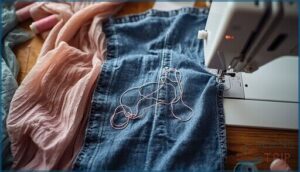
Even experienced sewers hit snags — snapping thread, puckered seam, needle that just won’t cooperate.
Most of these problems trace back to a mismatch between your thread and fabric, and the fix is usually simpler than you’d think. Here’s what’s likely going wrong and how to sort it out.
Why is My Thread Breaking?
Thread breaking usually comes down to one of five culprits: wrong needle size, poor thread quality, burrs and nicks on machine parts, an incorrect threading path, or tension issues.
For example, running 40wt thread through a 70/10 needle creates serious friction — snap. Check your threading path first, match thread weight to fabric thickness, and always run your finger along the hook assembly feeling for rough spots.
Why is My Fabric Puckering?
Puckering usually points to one of four things: Tension Imbalance between your upper and lower threads, Presser Foot Pressure set too high, Feed Dog Timing that is off, or a Fabric Weight Mismatch with your thread weight.
Dense Stitch Density Effects compound fast — too many stitches per inch distort seams badly.
Check your tension first, then test on a scrap before committing.
Why is My Thread Not Going Through The Fabric?
Once tension is sorted, the next head‑scratcher is thread that simply won’t penetrate the fabric. Usually it’s a needle‑size mismatch — your thread weight needs a needle wide enough to carry it through cleanly.
Hook timing errors, feed‑dog malfunctions, tension imbalance, or fabric thickness overload from bulky layers can all stop thread cold. Match your needle to your thread selection and fabric thickness first.
How to Test Thread Compatibility on Fabric Scraps
Before committing to any thread, cut a scrap at least 10 by 15 centimeters from your actual fabric bolt — same weave, same finish.
Mark your grainlines so you can run stitch length trials along warp, weft, and bias.
Test tension adjustments, check seam strength evaluation by pulling firmly, and compare thread weight against fabric thickness.
That honest little scrap tells you everything before you cut into the real thing.
Eco-Friendly Thread Options Worth Knowing
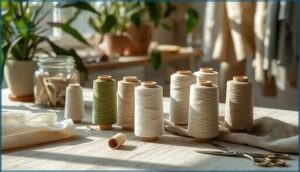
If you’re looking to sew with a lighter footprint, there are plenty of thread options to explore.
Choosing the right eco-friendly thread can make a real difference in your projects and the planet.
Let’s look at some choices that balance quality with sustainability.
Organic Cotton and Recycled Polyester Threads
Sustainable sewing isn’t just a trend — it’s a smarter way to work. Two standouts worth your attention:
- Organic cotton thread earns GOTS Certification Benefits through zero synthetic pesticides and cuts chemical inputs by 91%.
- rPET polyester thread delivers rPET Bottle Upcycling, recycling 30 bottles per 100g while slashing CO2 by 70%.
- Dye Absorption Efficiency shines in organic cotton — vibrant color, naturally.
- Fabric Compatibility holds strong — organic cotton suits natural weaves; recycled polyester thread manages knits and synthetics.
- Biodegradation Timeline favors cotton: fully soil-degradable within five years.
Biodegradable Threads for Specialty Projects
Some threads aren’t built to last — and that’s exactly the point.
Biodegradable options like lyocell, PLA, and hemp serve specialty fabrics in ways conventional thread simply can’t.
Think medical sutures that dissolve after healing, eco-bookbinding for temporary archives, compostable embroidery floss for short-run displays, or hemp netting that breaks down with crop residues.
Sustainable sewing and smart garment construction go hand in hand.
How to Store Thread to Extend Its Life
Storing thread well is half the battle.
Keep spools in a cool spot — Temperature Control means staying between 15°C and 25°C.
UV Protection matters too; even a few months of sunlight can strip tensile strength.
Moisture Management and Chemical Isolation prevent brittleness and discoloration.
Use a simple Rotation System so older thread gets used first.
Smart Thread Storage and Organization makes your eco‑friendly choices last.
Frequently Asked Questions (FAQs)
How to color match thread to fabric?
Hold your thread spool next to the fabric in natural daylight — indoor lighting skews color accuracy quickly. When in doubt, go one shade darker.
It blends better than lighter thread every time. Testing a thread line on a fabric swatch can confirm the best match.
How do I identify fabric type?
Check the label first.
If it’s missing, try a fiber burn test, static swipe test, water droplet test, or magnification inspection — each reveals whether you’re working with natural or synthetic fibers.
Refer to a fabric burn test chart for detailed flame and residue characteristics.
Does thread have to match fabric?
Not always — thread matching is less a rule than a conversation between fabric and purpose.
Color, fiber, and weight all play a role, but functional necessity and aesthetic contrast both have their place.
Which is thicker, 40 wt or 50 wt thread?
40 wt thread is thicker. The thread weight measurement works counterintuitively — lower numbers mean larger diameter. That thickness difference gives 40 wt a clear strength contrast over the finer 50 wt.
Should thread be lighter or darker than fabric?
Go lighter, and every stitch waves hello. Go darker, and the seam quietly disappears.
For most fabrics, one shade darker wins — it hugs the fabric value and keeps your light‑dark balance invisible.
What is dirty quilting?
Dirty quilting is a relaxed, speed sewing approach where improvised layouts and casual piecing take priority over flawlessness.
Think scrappy aesthetic, quick basting, and fabric combinations sewn on instinct — quilting that’s done, not obsessed over.
What is the 3-3-3 rule for clothing?
Simply stated, the 3-3-3 rule is mini capsule basics in action: pick 3 tops, 3 bottoms, and 3 shoes — 9 pieces that increase outfit combinatorics, seasonal flexibility, and packing efficiency through smart color coordination.
What are the 8 types of fabric?
cotton, linen, silk, wool (natural fiber categories); polyester, nylon, acrylic, spandex (synthetic fiber groups).
Each offers unique performance characteristics—think breathability, stretch, durability—which affects fabric selection, thread matching, and fiber compatibility.
Why did God say not to mix linen and wool?
It’s almost as if God dropped a textile bombshell—no mixing linen and wool!
This rule weaves Holiness Symbolism, Idolatry Prevention, Priestly Distinction, and Spiritual Boundaries into fabric selection, anchoring Mystical Balance and honoring divine Fiber Compatibility.
What color thread matches everything?
If you want a thread color that matches almost everything, reach for Light Gray or Medium Gray. These neutrals blend into most fabrics, making color management and fabric coordination easy.
Warm Beige and Off‑White also round out a reliable neutral palette.
Conclusion
Matching thread to fabric isn’t just a detail—it’s the secret sauce, the superhero cape, the difference between a garment that survives the apocalypse and one that unravels at the first sneeze. When you master how to match thread to fabric type, your stitches become invisible allies, working overtime for beauty and durability.
The right thread transforms your sewing from guesswork to craftsmanship. So next time, don’t just grab any spool—choose wisely, and watch your projects thrive.
- https://qiandaoapparel.com/blogs/b2b-apparel-insights/how-to-identify-various-fabric-compositions
- https://dresspatternmaking.com/blog/fabric-burn-test-chart
- https://www.mh-chine.com/blog/products/fabric-101
- https://www.bolianfiltration.com/how-to-identify-plain,-twill-and-satin-patterns.html
- https://www.gentlepk.com/burn-fiber-test/