
This site is supported by our readers. We may earn a commission, at no cost to you, if you purchase through links.
A metal zipper can make or break a finished piece. On a custom jacket or a leather bag, those gleaming teeth signal quality—but one crooked seam or puckered edge tells a different story.
The gap between a zipper that looks factory-perfect and one that looks homemade usually comes down to technique, not talent. Get the right foot on your machine, prep your fabric properly, and the whole process clicks into place.
This guide walks you through every step of the metal zipper insertion technique—from tools and prep to that final press—so your finished seams speak for themselves.
Table Of Contents
Key Takeaways
- The right zipper foot, matched to your machine’s shank and fabric type, is the single biggest factor in getting clean, professional stitching close to the metal teeth.
- Basting before your final stitch isn’t optional—it locks placement and saves you from ripping out crooked seams later.
- Metal zipper problems, from puckering to broken needles, trace back to tension settings, needle size, or skipping interfacing on the seam allowance.
- Small finishing steps—pressing with a cloth, crimping stops correctly, and running a slider test—are what separate a polished result from one that looks homemade.
Essential Tools for Metal Zipper Insertion
Getting the right tools together before you start makes everything go more smoothly.
A quick look at how to dye a shirt black step by step helps you know exactly what supplies to grab before you begin.
Metal zippers have their own quirks, so your setup needs to match the job.
Here’s what you’ll want on hand before you sew a single stitch.
Choosing The Right Zipper Foot
Your zipper foot is the unsung hero of clean metal zipper insertion. The wrong one ruins everything — skipped stitches, broken needles, crooked topstitching. Get this right first.
- Shank Compatibility — Match your foot to your machine’s low or high shank
- Foot Width Selection — Narrow feet sew closest to metal teeth
- Teflon vs Metal — Teflon glides over vinyl and leather without dragging
- Adjustable vs Fixed — Adjustable feet fine‑tune your needle‑to‑teeth distance
- Two‑Sided vs Single — Two‑sided feet let you stitch both sides evenly
Choosing the right zipper foot ensures best fabric compatibility.
Selecting Appropriate Thread and Needles
Once your zipper foot is sorted, thread and needle choices become your next power move. Get these wrong, and even perfect fabric preparation falls apart.
| Fabric Type | Thread Type | Needle Size |
|---|---|---|
| Light cotton | Polyester Thread Choice (50wt) | 70/10 Universal |
| Denim/Canvas | Thread Weight Selection (30wt) | 90/14 Denim |
| Leather/Coated | Bonded nylon thread | 100/16 Leather |
| Knits/Stretch | Polyester Thread Choice (50wt) | 80/12 Universal |
| Delicate wovens | Thread Weight Selection (60wt) | 70/10 Microtex |
Needle size matching and Needle Type Recommendations depend on your fabric. Thread Color Coordination helps small flaws disappear. For zipper installation on bags, nylon thread works best with metal teeth. Refer to the needle size guidelines for best performance.
Pins, Clips, and Measuring Tools
Once thread and needle are set, placement tools make or break your zipper installation.
Fine glass-head pins pierced perpendicular to the tape — spaced every inch or so — keep metal teeth aligned without shifting. Use sewing clips at bulky ends where pins struggle.
A seam gauge usage routine ensures consistent ruler alignment, and measuring tape tips help you verify both sides stay perfectly even.
Marking and Stabilizing Materials
Good placement tools get you far, but marking and stabilizing materials seal the deal.
For delicate fabrics especially, knit fusible interfacing for stabilizing without stiffening is the kind of detail that quietly saves the whole project.
Tailor Chalk Techniques let you mark seam allowances cleanly on the fabric’s wrong side—and wipe away easily later.
Tracing Wheel Applications transfer zipper stop guides with precision.
Wash-Away Adhesive Use holds tape flat without pins.
Fusible Interfacing Selection and Stabilizing Tape Benefits keep fabric preparation solid, preventing wavy seams before you stitch.
Preparing Fabric and Metal Zipper
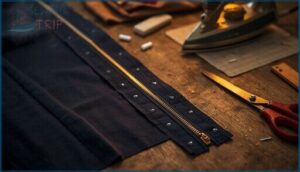
Good prep work is what separates a zipper that looks polished from one that fights you the whole way. Before you sew a single stitch, your fabric and zipper both need a little attention.
Here’s what to take care of first.
Marking Seam Lines and Placement
Accurate marking is what separates a polished zipper from a crooked one.
Start by using Chalk Line Techniques or Water‑Soluble Pencils to draw your seam allowance—usually 1.6 cm from center—on the fabric’s wrong side. Fabric Pen Markings work great for zipper insertion placement lines.
Follow these five marking steps:
- Use Ruler Alignment Methods to draw a straight vertical seam placement line.
- Mark the zipper stopper position with a horizontal cross‑line.
- Apply Transfer Paper Usage to transfer pattern notches accurately.
- Note the 0.5 cm teeth exposure line for precise seam construction.
- Mark fabric preparation and handling notches before pressing seams open.
Interfacing for Stability
Stabilizing your fabric before zipper insertion makes all the difference. Cut fusible strip width to about 1 inch, then center your interfacing placement along the seam allowance on the wrong side. Press for 15 seconds with steam — those are your heat press settings.
For stabilizing knit fabrics, use a woven fusible like SF101; it manages weight distribution techniques without adding bulk. Let it cool fully before you sew.
Finishing Raw Edges
Protecting your raw edges before zipper installation is non‑negotiable. Fraying fabric near metal teeth creates real problems quickly. Pick the method that fits your material:
- Zigzag Stitch Finish — set 2.5 mm width and length for clean seam allowance control
- Pinking Shears Trim — quick and bulk‑free for light cottons
- Overcast Stitch Edge — mimics a serger without extra equipment
- Bias Tape Binding or French Seam Enclosure — ideal for sheers and curved openings
Solid seam finishing sets up perfect fabric preparation every time.
Safety Precautions With Metal Teeth
Metal teeth don’t forgive careless stitching — one wrong move can snap a needle or snag your fabric.
Before you start zipper installation, build these safety habits into your process.
| Safety Focus | What To Do |
|---|---|
| Hand crank control | Switch from pedal to hand wheel near teeth |
| Needle selection safety | Use size 100/16 jeans needles only |
| Foot positioning guard | Align zipper foot edge against tape, never teeth |
| Teeth removal method | Use pliers to clear obstructing end teeth |
| Fabric protection tactics | Lengthen stitches and sew slowly near metal |
Step-by-Step Metal Zipper Insertion Technique
This is where everything you’ve prepped finally comes together. The actual insertion process breaks down into four clear moves, and each one builds on the last.
Here’s how to work through them.
Aligning and Pinning The Zipper

Think of pinning as setting your map before the journey.
Start with your Seam Line Marking as your anchor — align the Zipper Tape Edge exactly with your seam allowance.
Teeth Alignment Guides keep the zipper centered and flat.
Use a smart Pin Placement Strategy: pins every one to two inches, perpendicular, with a slight Pin Angle Technique toward the zipper head for clean, bulk‑free zipper installation.
Basting for Accurate Placement
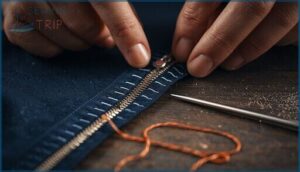
Basting is your secret weapon for zipper installation that actually stays put. Skip it, and you’re gambling on misalignment. Here’s why it matters:
- Hand Basting Techniques use loose stitches along the seam allowance to lock placement before permanent stitching.
- Machine Basting Settings at 4–5 mm give you easy Basting Removal Methods later.
- Stitch Placement Precision keeps your topstitching within 1/8 inch of the teeth every time.
Stitching Close to Metal Teeth
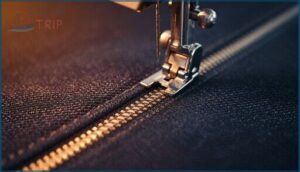
Now that basting is locked in, it’s time to stitch for real.
Set your stitch length to 3–3.5 mm and position your zipper foot snug against the teeth.
Keep your seam allowance consistent — about 3 mm from the teeth. Use a size 90/14 needle, and if things get tight near the stops, use hand wheel control to ease the needle through safely.
Moving The Zipper Pull for Smooth Sewing

Once you’re a few centimeters from the pull, stop with your needle down — that’s your Needle Down Pivot. Lift the presser foot, slide the zipper tab behind the needle, then lower the foot and keep going.
This Pull Positioning Strategy and smart Hand Fabric Control keep your stitching techniques on track, your zipper foot steady, and your timing sequence clean all the way to the end.
Troubleshooting Common Metal Zipper Issues

Even experienced sewers hit snags when working with metal zippers. The good news is that most problems have simple fixes once you know what to look for.
Here are the most common issues you’ll run into and exactly how to solve them.
Avoiding Broken Needles and Machine Damage
Broken needles don’t happen randomly — they’re usually preventable. Use a size 90/14 or 100/16 denim needle for metal zippers, and replace it before each project. Your sewing machine will thank you.
- Use Hand Wheel Control near metal stops
- Adjust Presser Foot Pressure on thick layers
- Apply Thread Tension Management to avoid needle flex
- Follow a Machine Maintenance Routine before zipper installation
Needle Size Selection matters more than most sewers realize.
Preventing Puckering and Wavy Seams
Needles aren’t the only thing that can go wrong — wavy seams are just as frustrating.
The fix usually starts with Interfacing Placement: apply fusible strips along the zipper seam to stabilize the fabric. Then check your Tension Settings and Stitch Length Adjustment, aiming for 2.5–3.0 mm.
Fabric Grain Alignment keeps ripples from forming.
Finish with a careful Pressing Technique from the wrong side.
Fixing Misaligned Zipper Teeth
Misaligned teeth are easier to fix than you’d think. Start with pliers realignment — use needle-nose pliers for precise tooth-by-tooth slider adjustment.
For zipper tape stabilization, support the zipper tape with your finger while bending.
Tooth replacement covers anything too bent to save.
Good cleaning prevention keeps grit away, protecting your zipper installation long-term.
Consistent zipper care and smart sewing techniques make all the difference.
Adjusting Stitch Tension for Best Results
most metal zipper problems actually start with tension. Your base tension settings should sit around 4–4.5 for medium‑weight fabrics — but always test on a fabric‑zipper sandwich first.
Stitch balance testing tells the truth: loops on top mean tension is too tight. Fabric‑specific tension and thread type impact your results, so adjust in small 0.5‑mark steps and trust what your seam shows you.
Loops on top never lie — tight tension shows itself, so adjust slowly and trust your seam
Finishing Touches for a Professional Look
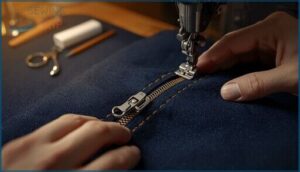
You’ve done the hard part — now it’s time to make your work look intentional. A few finishing steps separate a good zipper from a great one. Here’s what to focus on to pull everything together cleanly.
Pressing Around Metal Zippers
Heat Shielding is your best friend near metal teeth.
Always lay a press cloth over the zipper before touching it with your iron — metal zippers max out at 130°C, so keep heat low.
Steam Timing matters too: apply a quick burst, then immediately use the Clapper Technique to set the seam.
Directional Pressing from below the zipper upward keeps everything crisp and flat.
Securing Zipper Ends and Stops
The last inch makes or breaks the whole zipper installation. Nail these four finishing moves:
- Bottom Stop Installation: Press the stop 1–3 mm past the last tooth so the slider can’t escape.
- Top Stop Placement: Set it 2–5 mm above the chain for a firm, satisfying click.
- Zipper End Caps: Fold the tape into a three‑fold bundle, add glue, then cap it cleanly.
- Heat‑Sealed Tape Ends or Reinforced Tape Fold: Seal or stitch cut edges 3–6 mm from the teeth using your zipper foot.
Checking Zipper Functionality
Before you call it done, put your zipper through its paces.
Run the Slider Test first — glide it up and down 20 to 30 times, checking that movement stays smooth.
Then confirm Teeth Engagement by pulling the tapes apart gently.
Test Stop Verification at both ends, and try the Self‑Lock Test under light tension.
A solid Durability Cycle check means your garment construction will actually last.
Tips for Seamless Integration in Garments and Bags
Color matching starts the whole process — grab a zipper tape that mirrors your fabric shade exactly. Tape width selection matters too: 25mm works beautifully for medium-weight cottons.
Layer interfacing placement along seam allowances before the zipper installation begins. Control stitch density using 2.5mm lengths for clean seam finishing.
A little beeswax lubrication keeps things gliding, while smart fabric choice ties your garment construction together flawlessly.
Frequently Asked Questions (FAQs)
How to insert a zipper easily?
Start with the right zipper foot adjustment, stable fabric, and quick basting tricks. Use proper thread tension tips and metal zipper lubrication for smooth zipper installation every time.
How to make a metal zipper glide smoothly?
Rub candle wax or graphite along the teeth for smooth gliding.
Clean the zipper first with mild soap, then dry it completely.
Regular zipper maintenance prevents rust and keeps every pull smooth.
How to install metal zipper ends?
Think zipper ends install themselves? They don’t. Press U-shaped brass bottom stops over teeth, crimp both wings firmly, then snap top stops above the last tooth. Done.
How to get a metal zipper back on track?
Pull the slider down to the last tooth, apply a touch of beeswax for lubrication, then ease both chain sides into the slider’s channel evenly.
Slow tension control keeps everything aligned.
How to install zipper insertion pin?
Slide the new pin onto the zipper end, aligning the grooves precisely. Crimp both sides firmly with pliers, then sew through the fabric and plastic backing using strong thread.
Test the closure several times afterward.
How to zip a difficult zipper?
When a difficult zipper won’t budge, start with lubrication methods — beeswax or graphite works well.
Check for fabric obstruction removal needs, apply tension reduction by relaxing the garment, then use teeth alignment tricks for smooth zipping.
What is the best lubricant for metal zippers?
Like a well-oiled hinge, a smooth zipper starts with the right lubricant. Beeswax wins for most metal zippers — clean, dry, and fabric-safe. Silicone sprays work too, but use sparingly.
What to put on a zipper to make it slide easier?
Beeswax lubrication, graphite dry lubricant, petroleum jelly slip, or a candle‑wax crayon all work well.
silicone spray application does the trick.
Rub your choice along the teeth, then work the slider up and down.
Is Vaseline a good lubricant for zippers?
Vaseline works in a pinch, but it’s a short-term fix.
Its lubrication effectiveness fades fast, and dirt attraction makes things worse over time.
wax or silicone protect your zipper longer.
How to use a metal zipper jig?
Seat the slider into the jig’s central slot, feed both tape halves into the side channels with teeth pointing inward, then pull steadily downward until the teeth click and interlock securely.
Conclusion
Metal zippers look intimidating, yet they’re actually the most forgiving hardware once you know the rules. Every step of the metal zipper insertion technique—the careful basting, the zipper foot work, the slow stitching near those teeth—trains your hands to move with confidence.
You’ve got the tools, the sequence, and the troubleshooting skills now. Trust the process you’ve built, press those seams flat, and let the finished piece say everything words don’t need to.
- https://uark.pressbooks.pub/teachingappareldesign/chapter/zippers-teaching-apparel-production/
- http://quarterinchmark.blogspot.com/2014/09/tutorial-how-to-instal-metal-zipper.html
- https://designerstitch.com/how-to-sew-an-exposed-zipper/
- https://www.polkadotchair.com/how-to-sew-a-zipper/
- https://mpl.seoon.top/