This site is supported by our readers. We may earn a commission, at no cost to you, if you purchase through links.
Walk into any embroidery shop and you’ll find walls lined with thread—hundreds of colors, a dozen thread types, and brands making competing claims about durability, sheen, and stitch performance. Most embroiderers learn their preferences the hard way: a fraying thread mid-project, a color that fades after two washes, or a weight that buries the detail work they spent hours planning.
Cotton remains the dominant choice across hand and machine embroidery alike, but "cotton thread" covers more ground than most people realize. Stranded, perle, mercerized, 30 wt, 60 wt—each one behaves differently under the needle and produces a distinct result on fabric. Knowing which thread matches your project, machine, and technique changes everything.
Table Of Contents
Key Takeaways
- Thread type determines everything from texture to durability — stranded cotton gives you strand-by-strand control, while perle cotton locks in bold, fray-resistant structure that won’t budge mid-project.
- Weight is your most critical machine variable: 60 wt. keeps delicate lettering under 4 mm crisp and clean, 40 wt. handles everyday fills, and 30 wt. gives sculptural depth on heavy fabrics like denim and canvas.
- DMC dominates both hand and machine embroidery with 500+ colorfast shades, wash resistance up to 95°C, and consistent stitch performance — making it the most reliable choice across skill levels and project types.
- Mercerization isn’t just a marketing term — the sodium hydroxide treatment boosts tensile strength by up to 30%, improves dye uptake by 25%, and keeps shrinkage under 3%, making treated cotton significantly more durable than its untreated counterpart.
Cotton Thread Types Compared
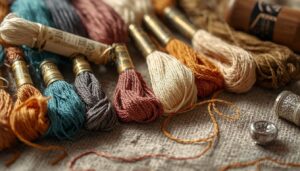
Cotton thread isn’t one-size-fits-all — and once you see the differences between types, you’ll never reach blindly into your thread drawer again.
Each type has its own job to do — something this beginner’s guide to sewing thread selection breaks down in a way that actually makes sense.
Each variety has its own personality, from how it splits to how it catches the light.
Here’s how the main cotton thread types stack up against each other.
Stranded Cotton Vs Perle Cotton
Stranded cotton and perle cotton solve completely different problems. DMC stranded cotton gives you fiber flexibility — six divisible strands mean you control thread weight and layering techniques stitch by stitch.
DMC Perle Cotton 5, by contrast, is non-divisible, delivering bold texture contrast and stitch longevity through its tightly twisted cord structure.
Hand feel tells the story instantly: one’s soft, one’s firm. Perle cotton provides high durability and fraying resistance.
Coton à Broder Vs Floche
Both threads share mercerized cotton DNA, but their personalities differ. Coton à broder’s four-ply, tighter twist suits structured whitework; floche’s five finer plies spread softly for smocking and heirloom monograms. Regional popularity shapes availability too — floche runs roughly 100 colors versus coton à broder’s 186.
Key differences at a glance:
- Ply count: 4-ply vs. 5-ply
- Twist: Firmer vs. looser
- Size range: Sizes 16–30 vs. fixed size 16
- Best use: Cutwork vs. smocking
Mercerized Vs Non-mercerized Cotton
Mercerization transforms cotton’s performance through a sodium hydroxide bath under tension, boosting tensile strength by up to 30% and creating dramatic luster differences. This process delivers significant strength gains while enhancing visual appeal.
Dye uptake improves by roughly 25%, resulting in richer colors that stay vibrant through repeated washes. Additionally, it offers shrinkage reduction (under 3%) and better mildew resistance, ensuring long-term durability.
Non-mercerized cotton, while softer and matte, is noticeably less durable compared to its treated counterpart.
Matte Finish Vs Subtle Sheen
Finish is where things get surprisingly strategic. A matte finish absorbs light evenly, giving your cotton embroidery thread a calm, classic look — ideal for heirloom and traditional work.
Subtle natural sheen, like you’ll find in mercerized options from DMC or Aurifil, shifts color perception and adds dimension.
Texture contrast between the two directly shapes design mood under different lighting conditions.
Divisible Vs Non-divisible Thread
Think of it as a fork in the road: you either want control or consistency.
Stranded cotton — your regular 6-stranded cotton embroidery floss — gives you full strand flexibility, letting you split down to one fine strand or stack all six for bold coverage. Nondivisible options like perle cotton and floche lock in their thickness permanently.
- Strand Flexibility: Stranded cotton splits into 1–6 strands; perle cotton comes fixed at sizes 3, 5, 8, or 12
- Tactile Handfeel: Stranded cotton feels softer and limper; perle and floche feel springy, almost cord-like
- Needle Catch: Nondivisible threads’ tight twist reduces needle catch on rough fabric edges
- Unraveling Propensity: Multi-strand setups tangle more easily; nondivisible thread stays flat with minimal luster variation across the thread length
Best Uses for Each Cotton Type
Each cotton type has a clear home. Stranded cotton suits cross stitch and surface shading — two strands on 14-count Aida are the classic starting point. Perle cotton 5 suits canvaswork embroidery and thread crochet beautifully. Coton à broder delivers heirloom monograms with clean, flat coverage.
Choosing the right cotton thread type really comes down to matching structure, thread weight, and divisibility to your specific technique.
Thread Weights and Stitch Results
Thread weight changes everything — the boldness of your fill, the crispness of tiny letters, even how often your thread snaps. It’s one of those variables that looks minor on paper but hits hard in practice.
Thread weight is a minor variable on paper that hits hard in practice, controlling fill boldness, letter crispness, and breakage
Here’s how 30 wt, 40 wt, and 60 wt each behave, and what that means for your finished work.
30 Wt Vs 40 Wt Vs 60 Wt
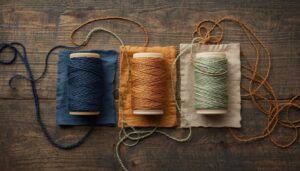
Thread weight is the single variable that changes everything.
At 30 wt, you’re working with 0.35 mm thickness — ideal for denim and canvas over 300 GSM, though your king spool holds only 4,400 yards.
Step down to 40 wt (0.25 mm) and yardage climbs to 5,500.
Choose 60 wt for delicate silks under 150 GSM, where thread longevity and color saturation remain crisp without puckering.
Coverage, Texture, and Stitch Definition
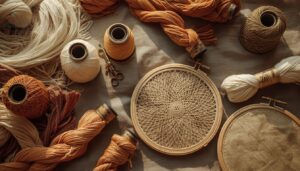
Coverage consistency begins with weight. At 30 wt., you achieve broad thread coverage and rich texture depth—stitches feel almost sculptural.
Dropping to 40 wt. sharpens stitch clarity, enabling a seamless blend across fills that heavier threads cannot match.
At 60 wt., edge definition becomes razor-precise. Spacing stitches at 0.4 mm delivers a glossy, uniform satin surface where every pass looks intentional.
Small Lettering and Detail Work
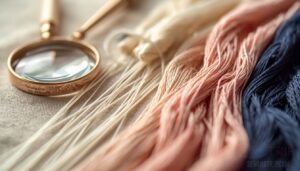
For small letters under 4 mm, use 60 wt stranded cotton to maintain tight stitch density without bulk choking the curves. Script font styles require precise thread twist control—employ a 65/9 or 70/10 needle and ensure proper fabric stabilization to prevent puckering.
At 5–7 mm letter heights, 40 wt thread paired with a 75/11 needle achieves optimal results, balancing detail and stability.
Satin Stitch and Fill Stitch Performance
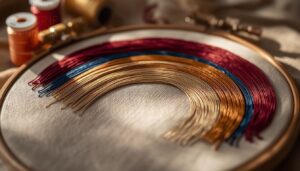
Satin stitch performance hinges on density thresholds—aim for 0.3 to 0.4 mm with 40 wt cotton for full, clean coverage. Keep width constraints in mind: anything beyond 12 mm risks looping.
Fill stitches work better at 0.4 to 0.45 mm density. Sheen influence matters too—mercerized cotton lifts edge highlights noticeably.
Stabilizer selection prevents puckering when stitch length impacts compound across wider satin spans.
Ply Count and Twist Differences
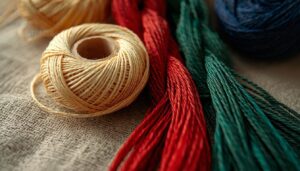
Smooth satin fills reveal every flaw in their thread’s construction — and ply count is usually the culprit. Here’s what drives the difference:
- Thread ply count — Perle’s tight 2-ply twist density creates a rounded, sculptural cord; floche’s 5-ply, looser build lies flat.
- Ply-twist balance — Balanced S-twist vs Z-twist construction prevents kinking mid-stitch.
- Twist direction — Most commercial threads are finished with a Z-twist, stabilizing the yarn through tension disks.
How Weight Affects Thread Breakage
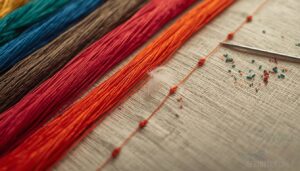
Twist sets up the structure—weight determines the stress. A mismatch between 30-wt cotton and a 65/9 needle creates friction-driven heat buildup, fraying fibers mid-stitch.
Dense designs boost stitch density, impacting fabric integrity rapidly.
Match fabric weight to thread weight, monitor needle eye wear, and ensure thread lubrication to mitigate issues.
Balanced thread tension reduces breakage by 60–80% on mid-range cotton, ensuring smoother stitching.
Top Cotton Thread Brands Compared
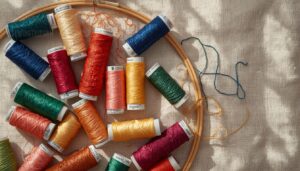
Picking the right cotton thread brand isn’t just about price — it’s about how the thread actually behaves in your hands or through your machine.
Every brand has its strengths, and a few have some real trade-offs worth knowing before you stock up.
Here’s how the top names stack up across the factors that matter most.
DMC Vs Aurifil Vs Artiste
Here’s the real brand showdown — DMC vs Artiste vs Aurifil — and each earns its reputation differently:
- DMC leads in brand reputation, durability, and wash resistance up to 95°C
- Aurifil wins on smooth machine performance and subtle sheen for delicate work
- Artiste suits beginners on a budget, though machine data stays limited
Customer loyalty follows performance — choose accordingly.
Color Range and Shade Consistency
Color range is where brand differences really show up. DMC stranded cotton covers 500 solid hues across 12 color families, with 20–40 graduated shades per family — that’s serious shade graduation precision for detailed blending. Aurifil offers subtle sheen but limited conversion charts, making cross-brand color matching trickier.
Batch matching tolerance matters too: quality manufacturers hold ΔE below 1.2 under D65 daylight standards.
| Feature | DMC | Aurifil |
|---|---|---|
| Hue Family Coverage | 500 solids, 12 families | Moderate, limited charts |
| Lightfastness Ratings | 4–5 blue wool scale | Good, sheen-focused |
| Dye Uniformity Standards | ΔE below 1.5 per batch | Consistent, low lint |
Smoothness, Lint, and Spool Quality
Feel every stitch? Thread quality starts before the needle. DMC’s mercerized cotton wins the brand showdown — tighter twist tightness, finer fiber surface, and serious lint control keep your bobbin area cleaner longer.
Aurifil delivers a smooth finish with minimal fuzz. Artiste sits mid-range on spool winding and spool material consistency.
For cotton embroidery thread across any thread weight, DMC simply runs cleaner.
Durability After Washing and Ironing
DMC excels in durability, with its mercerized floss retaining tensile strength through 20 wash cycles. Stitch loosening prevention ensures designs remain intact, showing less than 3% loosening overall. Additionally, color bleed resistance stays solid even at 95°C, underscoring its reliability.
Aurifil impresses with dimensional stability and ironing heat tolerance up to 300°F. Its threads demonstrate zero measurable shrinkage after 10 cycles, confirming exceptional wash resistance and colorfastness under demanding conditions.
Price Per Spool and Value
Price tells only half the story — yardage reveals the rest. A Yardage Price Analysis highlights stark differences: DMC machine thread costs approximately $0.008 per yard, while Aurifil 50wt comes in at $0.012 per yard.
- DMC skein — $1.15 for 8.7 yards
- DMC bulk 25-pack — $1.00/skein
- Aurifil 50wt large spool — $16.48 for 1,422 yards
- Aurifil 3-spool set — $45.48 for 4,200+ yards
Spool Size Economics plays a critical role in bulk purchasing — larger spools significantly lower the cost per unit. Seasonal discounts can reduce DMC skein prices to as low as $0.45, underscoring the importance of a Comparative Cost Analysis when planning inventory purchases.
Best Brand for Hand Embroidery
For hand embroidery, DMC wins this brand showdown — DMC vs Artiste vs Aurifil — almost every time.
With 500+ colors, impeccable thread uniformity, and double mercerization that community feedback consistently praises, it’s hard to argue otherwise.
Aurifil shines for finer thread weight work, but DMC’s accessible packaging design, ethical sourcing reputation, and washability up to 95°C make it the go-to across hand embroidery techniques.
Best Brand for Machine Embroidery
For machine embroidery, DMC takes the crown in this brand showdown — DMC vs Artiste vs Aurifil — and it’s not particularly close.
Here’s why DMC wins for machine use:
- Stitch consistency stays reliable across long runs
- Breakage resistance holds strong at 350–400 stitches per minute
- Colorfastness performance survives washes up to 95°C
- Software integration with conversion charts for Sulky and Madeira
- Wholesale pricing drops further with bulk sourcing options
Machine Compatibility and Performance
Cotton thread and machines don’t always get along right out of the box — a few settings can make or break your results. Getting the most out of your cotton thread means knowing how your machine manages it at every level, from needle choice to bobbin pairing.
Here’s what you need to know to keep things running smoothly.
Which Cotton Threads Run Best by Machine Type
Not every cotton thread plays nicely with every machine — and matching the two correctly saves hours of frustration.
| Machine Type | Best Cotton Thread |
|---|---|
| Home single-needle | Aurifil 50 wt |
| Home multi-needle | DMC 40 wt |
| Light industrial | 40–50 wt mercerized |
| High-speed industrial | Long-staple 40 wt cones |
| Multi-head commercial | Consistent 40 wt, 2,000–5,000 m spools |
Home machine preference leans towards 50 wt for lower friction. Industrial speed handling demands long-staple strength. Larger spool sizes impact means fewer stops, cutting color change downtime greatly.
Needle Sizes for Different Cotton Weights
Once your machine type is sorted, needle selection becomes the next critical variable.
For 60 wt cotton, a 65/9 to 75/11 needle prevents shredding on fine work. Standard 40 wt cotton — your DMC or Aurifil workhorse — runs cleanly on 80/12 to 90/14. Heavy 28–30 wt threads require 100/16 or larger needles for optimal performance.
Needle gauge impact is real: incorrect sizing splits fibers rapidly, compromising stitch quality.
Tension Settings for Cleaner Stitches
With needle selection locked in, thread tension is next. Set your upper tension dial between 4 and 5 for standard 40 wt cotton — mercerized varieties hold steadily at 4.5. Use a bobbin tension gauge targeting 18–22 grams pull resistance.
Stitch balance testing on scrap fabric is non-negotiable. Make quarter-turn adjustments only, checking both fabric surfaces until knots sit cleanly in the middle layer.
Speed Limits to Reduce Breakage
Speed becomes your next variable after setting tension. For 40 wt cotton threads—whether DMC, Aurifil, or Artiste—your ideal stitch rate sits between 500–600 stitches per minute.
Pushing speeds above 700 stitches per minute increases risks, as thread breakage under tension climbs fast. Always run a breakage test run first to establish safe thresholds.
Apply weight-specific limits based on test results, and make environmental speed adjustments for hot shops to maintain consistency.
Lint Buildup and Maintenance Needs
Cotton thread sheds. That’s just its nature — and your machine feels every fiber. After dialing in speed, lint management becomes your next discipline.
- Lint trap cleaning: Clear traps after every session; they catch up to 90% of cotton shedding.
- Tension disc maintenance: Brush discs daily and raise the presser foot first — it releases springs and removes 80% more buildup.
- Bobbin case cleaning: Remove and brush the case after each bobbin change to prevent tension shifts.
Run thread path inspection every four hours, and vacuum under the needle plate every 25 hours to prevent thread breakage.
Bobbin Thread Pairing for Cotton Embroidery
Your bobbin choice matters more than most embroiderers realize. For true Fiber Harmony, pair a 60-weight or 80-weight light-weight bobbin under your cotton top thread — it reduces bulk without sacrificing stitch lock. A neutral bobbin color like white or beige manages multi-color designs effortlessly.
For durability on high-wear items, a synthetic bobbin choice works well, though bobbin material pairing with all-cotton layers suits heirloom work best.
Dial bobbin tension to 18–22g pull resistance, and use bobbin tension adjustment when dense satin stitches cause breakage.
Common Machine Issues With Cotton Thread
Even seasoned embroiderers hit walls with cotton — and the culprits are usually the same five suspects:
- Thread wear aging — Spool dryness makes old cotton brittle, causing it to snap mid-stitch.
- Needle dullness — Needle dullness shreds thread fibers. Replace needles every 8–10 hours.
- Misthreading hazards — Skipped guides create sharp pull points that cause thread breakage.
- Thread path blockage — Effective lint management and breakage prevention in high-speed stitching start with cleaning every 10–12 hours.
- Thread tension drift — Unbalanced bobbin tension or upper thread tension ruins stitch formation quickly.
Machine embroidery troubleshooting gets easier once you know where to look.
Choosing The Best Cotton Thread
Picking the right cotton thread comes down to what you’re actually making — and that changes everything from brand to weight to finish. There’s no single "best" thread, but there’s a best thread for your project.
Here’s how to match the right cotton to the work in front of you.
Best Thread for Beginners
DMC stranded cotton floss is your best starting point — full stop. Its 6 separable strands let you master simple stitch basics at your own pace, starting with just 2 or 3 strands for backstitches or cross-stitches.
As budget floss, it punches well above its price. Long-staple construction manages breakage prevention naturally, while 500+ shades make color matching tips almost easy.
Best Thread for Monograms and Lettering
Monograms demand precision — outline crispness lives or dies by thread weight and ply. For hand embroidery sizing under 5mm, 60wt cotton is your go-to.
In the brand showdown DMC vs Artiste vs Aurifil, DMC stranded cotton wins for colorfastness and stabilizer compatibility on tricky fabrics.
Moisture sensitivity matters too — mercerized threads hold definition wash after wash.
Best Thread for Whitework and Heirloom Sewing
Whitework and heirloom sewing reward thread choices built on thread longevity and stitch uniformity.
DMC floche glides smoothly through fine batiste, delivering fabric compatibility and a soft sheen that mirrors historical techniques. For bolder outlines, perle cotton adds structure without bulk.
Cotton embroidery floss—split to two strands—passes colorfastness testing at 95°C, keeping your heirloom quilt crisp wash after wash.
Best Thread for Quilting and Dense Designs
Dense quilting demands a thread that works as hard as you do. For reliable colorfastness, lint management, and breakage prevention, match your quilting cotton thread to the job:
- 50 wt – smooth tension, balanced moisture control
- 40 wt – strong stitch definition for visible designs
- 28 wt – bold lines with careful thread twist setup
- 80 wt – micro quilting with minimal bulk
Cotton Vs Polyester for Embroidery Projects
Once your quilting thread is sorted, the next big call is cotton versus polyester — and the durability contrast is real.
Polyester wins on wash resistance and color retention, holding its colorfastness after dozens of cycles. Cotton brings a softer, natural finish but fades faster.
| Factor | Cotton | Polyester |
|---|---|---|
| Tensile Strength | Moderate | High |
| Wash Resistance | Fair | Excellent |
| Color Retention | Fades faster | Long-lasting |
Matching Thread to Fabric and Design Style
Polyester manages stress well, but cotton’s real advantage shines when fabric and design style align perfectly. Match thread to both:
- Sheen compatibility — Matte cotton suits heirloom and whitework; rayon-finish cotton enhances bold monograms.
- Fabric stretch match — Stable wovens pair best with cotton; knits require polyester’s flexibility.
- Thread density balance — Lighter fabric weights demand finer thread weights.
- Contrast stitching — Darker thread on pale cloth intentionally makes topstitching pop.
- Color fade coordination — Test single strands in natural daylight before committing.
Cost Vs Performance for Hobbyists and Bulk Buyers
Budget shapes every thread decision. DMC stranded cotton at around 97p per skein delivers reliable colorfastness and a hobbyist cost that’s hard to argue with.
For bulk pricing, cone spools cut your cost-per-yard by up to 40 percent — that’s real durability ROI over time.
Aurifil’s price-performance analysis holds up for serious embroiderers, while wholesale economies of scale favor commercial buyers ordering 20-kilogram minimums.
Frequently Asked Questions (FAQs)
What is the difference between 40 wt and 60 wt embroidery thread?
The key difference is thickness. 40 wt measures 25 mm and suits everyday designs, while 60 wt at 15 mm delivers enhanced design detail capability — especially for lettering under 6 mm.
What is the difference between Coton a Broder and Perle?
Coton à broder’s four-ply loose twist gives you smooth, flat satin-stitch fills, while perle cotton’s tight two-ply cord builds bold, textured outlines—same cotton family, completely different results on the hoop.
How should cotton embroidery thread be properly stored?
Store cotton embroidery thread using cool, dry storage, away from sunlight and humidity.
Use silica gel for moisture control to maintain optimal conditions.
Wind threads neatly to prevent tangles and ensure ease of use.
Rotate stock with a FIFO inventory system for effective long-term care.
What humidity levels prevent cotton thread deterioration?
Think of your thread as a living archive — it breathes with the air around it. Keep relative humidity between 40% and 60%, and you’ll sidestep both brittleness and mold.
Can cotton thread be custom-dyed for commercial projects?
Yes — cotton thread takes custom dye beautifully, especially mercerized varieties. Commercial dyeing uses reactive dyes at 60–90 °C for strong colorfastness, with Pantone-matched color matching hitting ΔE 1–2 accuracy.
Are bulk discounts available for cotton embroidery thread?
Like unlocking a members-only sale, bulk discounts on cotton embroidery thread are very real. Wholesale pricing kicks in through supplier tiers, with minimum order thresholds often starting around $150, substantially slashing your cost per spool.
Conclusion
DMC alone offers over 500 color-coded cotton shades—yet most embroiderers consistently reach for fewer than 30. That narrow comfort zone is exactly where a solid cotton embroidery thread comparison pays off.
When you understand how weight, finish, and fiber behavior interact, you stop guessing and start choosing with purpose. The right thread doesn’t just hold stitches together—it carries the entire feel of a finished piece.
Know your options, and your work will show it.
- https://www.needlenthread.com/2014/02/embroidery-thread-comparisons-lining-up-all-the-cottons.html
- https://www.aurifil.com/aurifil-products/aurifil-cotton-12wt
- https://www.hooptalent.com/blogs/news/ultimate-guide-to-dmc-embroidery-threads-types-comparisons-expert-tips
- https://www.maggieframes.com/blogs/embroidery-blogs/ultimate-guide-to-embroidery-thread-types-selection-uses-and-expert-tips
- https://www.mh-chine.com/blog/products/dmc-cotton-thread