This site is supported by our readers. We may earn a commission, at no cost to you, if you purchase through links.
Picking thread colors by instinct works—until it doesn’t. You pull what looks right from your basket, stitch for an hour, and realize the whole design reads as a muddy blob because three of your colors share the same value.
A thread color wheel for embroidery solves exactly that problem, giving you a visual map that shows not just which colors exist, but how they relate, contrast, and behave beside each other on fabric.
Understanding the wheel means you stop guessing and start choosing with intention—whether you’re planning a soft floral with gentle analogous hues or a bold geometric that needs punchy complementary contrast.
The difference between a forgettable piece and one that genuinely pops often comes down to this one tool.
Table Of Contents
Key Takeaways
- color wheel gives your thread choices a real foundation—once you can see how hues relate, you stop guessing and start picking with purpose.
- Value (how light or dark a color is) matters more than hue alone, because threads that share the same value will blend into a muddy mess no matter how pretty they look separately.
- Thread finish, fabric color, and lighting all shift how a color actually reads once it’s stitched, so always test swatches on your real fabric before committing to a palette.
- Classic color schemes—analogous for smooth flow, complementary for bold pop, monochromatic for quiet depth—give you a reliable starting point for any project, from soft florals to geometric designs.
What is an Embroidery Color Wheel?
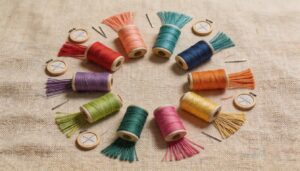
An embroidery color wheel is a circular chart that maps thread colors by their relationships, showing you at a glance which shades sit next to each other and which ones stand apart.
It’s the starting point for choosing thread colors that work in harmony, turning guesswork into confident, intentional design choices.
Think of it as a cheat sheet for your thread basket — one that takes the guesswork out of pairing colors.
what the wheel covers and why it matters for your embroidery work.
How The Wheel Organizes Thread Colors
Think of the color wheel as a map for your thread colors. It arranges hues in a circular color relationship, using radial hue ordering to show how close or far apart colors sit from each other — that’s hue proximity mapping at work.
Red, blue, and yellow anchor the wheel as primaries, with secondary and tertiary colors filling the wheel segment divisions between them, making palette selection clear.
For precise matching, consult the digital conversion charts provided in the guide.
Why Color Placement Matters in Embroidery
Where you place each color in your design shapes what the eye notices first. Warm threads near the center create focal color anchoring, while background neutral balance keeps surrounding areas calm.
This directional color flow and visual weight distribution guide the viewer naturally through your work.
The color wheel is the primary tool for planning these relationships — turning random choices into deliberate color pathing and visual contrast that actually holds together.
How a Thread Color Wheel Differs From Paint Mixing
Paint mixing follows pigment chemistry — thread color doesn’t work that way.
When you’re using a color wheel for embroidery thread, you’re working with dyed fibers, not blended pigments. Fiber sheen impact, stitch density effect, and fabric background all influence how a color actually looks once it’s stitched.
Dye lot variability means two spools labeled identically can appear slightly different in natural light. That’s why physical swatch reliance matters far more than any digital reference.
- fiber finish — matte cotton reads softer than silky rayon
- Stitch direction and density affect how light hits, altering perceived hue
- base color bleeds through, shifting the thread’s apparent shade
- compare swatches on your actual fabric before committing to a palette
Primary, Secondary, and Tertiary Colors
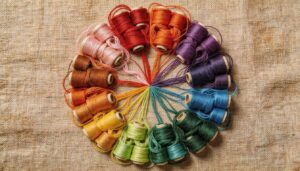
Think of the color wheel as a map, and primary, secondary, and tertiary colors as your landmarks. Once you know where each one sits, picking thread colors stops feeling like guesswork.
Here’s how each group works and what it means for your embroidery palette.
Primary Thread Colors: Red, Blue, and Yellow
Red, blue, and yellow are the anchors of every color wheel — the three primary colors that no mixing can create. In embroidery, each one carries real weight beyond color theory.
| Thread Color | What It Brings to Your Design |
|---|---|
| Red | Bold energy, emotional symbolism, strong fabric contrast |
| Blue | Cool balance, excellent thread durability, cultural meanings |
| Yellow | Warmth, highlight power, seasonal trends like spring and autumn |
| Red + Blue | Energetic cool-warm tension |
| Red + Yellow | Inviting, sun-warmed palette energy |
Master these first.
Secondary Colors Made From Primary Pairings
When two primary colors meet on the color wheel, something new is born. Mix red and yellow thread in equal parts, and you get orange. Blend yellow with blue, and green appears. Combine red and blue with consistent saturation, and purple emerges. These secondary color pairings create vivid contrast with primaries in your embroidery thread colors.
- Orange Creation Method – Equal red + yellow thread
- Green Mixing Proportions – Balanced yellow + blue blend
- Purple Hue Balance – Red + blue at consistent saturation
- Secondary Color Pairing – Bridges between primary colors on the wheel
- Contrast with Primaries – Secondaries pop boldest beside their opposite primaries
Tertiary Colors and In-between Thread Shades
Once you’ve mixed your primaries into secondaries, tertiary colors step in to fill the gaps.
To blend tertiaries smoothly into your work, try varying stitch angles and keeping bands 2–4 mm wide—techniques covered in these embroidery color blending tips and tricks.
Think of them as the in-between thread shades — red-orange, yellow-green, blue-violet — sitting right where neighbors meet on the color wheel.
Using a thread shade guide and Thread Blend Charts, you can apply Subtle Hue Shifts through Saturation Modulation, smart Midtone Ratio choices, and Tertiary Contrast for natural color blending between shade and tint.
Building Balanced Embroidery Palettes From Basic Hues
Now that you understand all three color classes, you can start building real palettes. A triadic color scheme pulls three evenly spaced hues for lively balance, while complementary pairings punch up contrast.
Keep Hue Temperature Balance in mind — mix warm and cool threads intentionally. Use Digital Palette Tools and Thread Brand Matching to finalize choices, and watch for Seasonal Color Trends to stay current.
Value, Tint, Tone, and Shade
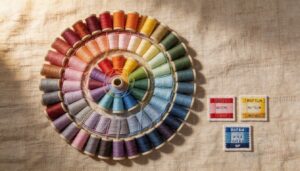
Knowing how to work with value, tint, tone, and shade is what separates a flat design from one that actually feels alive.
These aren’t just fancy terms — they’re the tools that control how light, deep, or muted your threads look next to each other.
Here’s what each one means for your embroidery work.
Why Value Affects Stitched Contrast
Value contrast is simply how light or dark your thread looks against the fabric — and it quietly runs the whole show. Think of it as your value hierarchy: lighter threads advance, darker shades recede, and that difference creates depth perception in your stitching.
Light threads advance, dark threads recede — value contrast is the quiet force that gives your stitching real depth
High stitch density amplifies luminance contrast, while fabric reflectivity shifts how values are read.
Color theory starts here, before hue even enters the picture.
Using Tints for Highlights
A tint is simply your thread color with white added — and it’s your best friend for creating highlights in embroidery design. Tint placement techniques work by applying lighter thread colors where light would naturally hit your fabric.
This light source simulation adds real dimension. Edge brightening strategies, like placing pale tints along raised stitching, instantly lift your work off the surface.
Using Shades for Shadows
Shades are your shadow-makers — they’re pure hues with black added, and they do the heavy lifting in embroidery design.
Shadow Temperature Control matters here: cool blue-gray shades work beautifully under blue or purple elements, while warm light sources call for amber-leaning shades.
Layered Shade Gradation, built through stitch direction shadow and Fabric Texture Interaction, creates convincing depth that flat color never can.
Using Tones for Softer, Muted Designs
Where shades bring drama, tones bring calm. A tone is simply a pure hue with gray added, softening it into something quieter. Think dusty rose instead of fire-engine red.
Tone layering builds subtle gradients through muted contrast, creating gentle depth without shouting. Fabric tone pairing matters too — muted hues work beautifully on raw linen. Use tone hierarchy to guide the eye softly across monochromatic color palettes.
Avoiding Muddy Color Combinations in Embroidery
Muddy results often sneak up on you. When highly saturated hues share similar value levels, they flatten each other out — no winner, no focal point.
That’s where Neutral Buffers help: a soft gray or taupe between competing colors restores Saturation Balance.
Apply Temperature Grouping by keeping warms and cools separate, then run quick Lighting Tests on your actual fabric before committing.
Color Schemes for Embroidery
Knowing your color wheel is one thing — knowing how to build a palette from it is where the real magic happens.
There are five tried-and-true color schemes that embroiderers rely on, each creating a different mood and visual effect. Here’s a look at what each one does and when to reach for it.
Analogous Palettes for Smooth Transitions
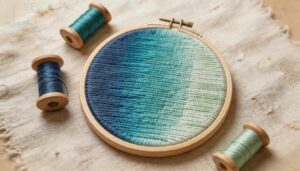
When you want colors that flow like a gentle sunrise, analogous colors are your best friend. These are three or more neighbors on the color wheel — think blue, blue‑green, and green — that share undertones for easy color blending.
Here’s how to use them well:
- Hue Spacing Strategy — Keep hues three to five degrees apart for natural transitions
- Temperature Harmony — Pair cool blues with blue‑greens to avoid abrupt jumps
- Saturation Balance — Anchor with medium saturation; lower it on supporting embroidery thread hues
- Stitch Gradient Techniques — Use long‑and‑short stitches through the gradient zone for smooth color harmony
Midtone Neutrality ties everything together, keeping your design cohesive without competing focal points.
Complementary Palettes for Bold Contrast
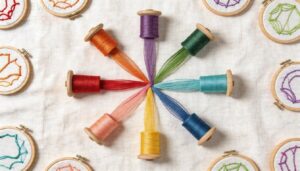
Analogous palettes keep things calm — but sometimes your design needs to shout. That’s where complementary colors come in.
These sit directly opposite each other on the color wheel, creating instant color contrast.
A Red‑Green Pairing pops on holiday pieces, Blue‑Orange Contrast energizes coastal embroidery thread work, and Purple‑Yellow Impact draws focus. Turquoise‑Coral Vibrancy and Pink‑Lime Pop add bold life to any color palette.
Split-complementary Palettes for Flexible Contrast
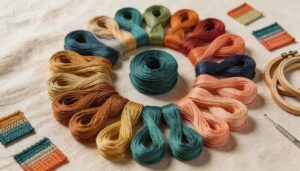
Think of split-complement as complementary’s easygoing cousin. You still get strong color contrast, but with more breathing room.
Pick your base color, then instead of its exact opposite on the color wheel, choose the two hues flanking it.
This Hue Distance Adjustment gives your embroidery thread palette Contrast Gradient Control, a natural Warm-Cool Mix, and smarter Accent Saturation Balance — without the visual clash.
Triadic Palettes for Lively Balance
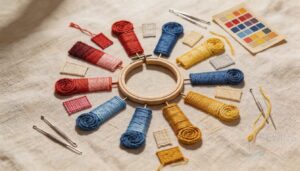
A triadic color palette uses three colors equally spaced around the color wheel—like red, blue, and yellow—creating real color harmony through this spacing.
Select one dominant embroidery thread for large fills, then employ the remaining two hues for striking focal points. Warm-Cool Pairing maintains energetic balance within the design.
Adjusting Value Gradient and Stitch Density introduces depth without causing visual chaos, refining the composition’s dimensionality.
Monochromatic Palettes for Depth and Unity
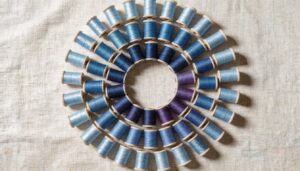
monochromatic palette keeps you within one hue on the color wheel, letting lightness gradient and value spacing do all the heavy lifting. Use lighter tints for highlights and deeper shades for shadows to build real dimension.
Subtle saturation modulation and temperature shifts keep things from looking flat, while finish adaptation — swapping matte cotton for silk — adds quiet depth without breaking hue harmony.
Choosing Thread Colors for Designs
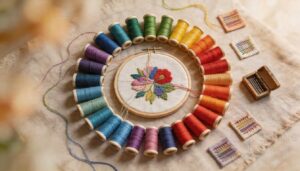
Picking thread colors can feel overwhelming when you’re staring at hundreds of shades and not sure where to start. The good news is that few simple decisions — made in the right order — can turn that chaos into a cohesive design.
Here’s what to think through as you build your palette.
Selecting a Dominant Color
Every strong embroidery piece has one color doing the heavy lifting — that’s your dominant color. Using a color wheel for embroidery color selection makes this choice clearer, because you can see how primary colors, hue harmony, and saturation balance all connect.
Here’s how to choose yours:
- Match the dominant hue to your design’s mood using basic color theory
- Run a lighting test on fabric before committing — colors shift indoors
- Consider thread finish influence; a shiny rayon reads more intense than matte cotton
- Check the contrast ratio between your dominant thread and background
- Factor in scale proportion — bolder areas need a steadier, mid-saturation anchor color
Adding Accent Colors Without Overpowering
Accent colors are the spice in your palette — a little goes a long way. A good Accent Placement Strategy keeps accents to about 10 percent of your stitch area, using a Limited Palette Ratio of 60-30-10 across your color families.
Thread Finish Impact matters too: glossy threads punch harder than matte, so shorten your Accent Stitch Length accordingly.
Whether you’re working analogous, triadic, or complementary color schemes, Subtle Contrast Balance keeps everything harmonious.
Matching Thread Colors to Design Mood
Color sets the emotional temperature of your design before a single stitch catches the eye. Warm vs Cool thread families are your starting point — reds and oranges energize, blues and violets calm.
The color wheel is the primary tool for exploring Emotional Color Psychology and Seasonal Mood Palettes.
Color harmonization through color theory and color matching guides make design aesthetics feel intentional, not accidental.
Planning Focal Points With Contrast
mood sets the tone, contrast does the directing. A bright thread — your Brightness Pop — against a dark fabric stops the eye cold.
Build Contrast Layers outward: high value at the center, softer hues beyond.
Edge Sharpness with a Focal Outline backstitch, then shift Stitch Direction near the center.
subtle angle change catches light and locks the focal point in place.
Creating Floral, Landscape, and Modern Palettes
Three themes, three approaches.
For florals, start with a neutral background — ivory or cream — then layer pastels using analogous hues for soft petal transitions, with seasonal hue selection guiding your mood-driven accent limits.
Landscapes call for foliage texture mapping across olive-to-emerald greens, grounded by warm ochres.
Modern designs? One bold accent, clean gradient layering techniques, and neutral background balancing keep everything sharp.
Blending Thread Families and Gradients
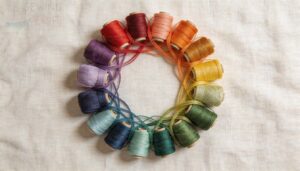
Blending thread colors is where your embroidery really starts to come alive. It’s not just about picking pretty shades — it’s about understanding how light, medium, and dark tones work together to create depth and flow.
Here’s what you need to know to blend thread families like a pro.
Working With Light, Medium, and Dark Families
Think of your thread collection as a family — every hue has a light child, a medium sibling, and a dark parent.
- Light families create highlights and airy contrast against dark fabrics.
- Medium tones anchor midpoint transitions across curved surfaces.
- Dark shades define edges, shadows, and depth.
- Applying color families to shading in stitching makes stitch value mapping feel natural, not guesswork.
Creating Smooth Shading With Related Hues
Smooth shading starts with subtle hue shifts — move along related colors on the wheel rather than jumping across it. Value step mapping keeps your highlights and shadows in the same color family, so nothing looks out of place.
Use the stitch overlap technique to layer threads gradually, and let your gradient stitch direction guide the light edge fade naturally across curved surfaces.
Blending Colors for Depth and Dimension
Depth comes alive when you stack related hues deliberately. Start with your midtone, then build Layered Hue Transitions toward highlights and shadows using Opacity Stacking — thin passes, not heavy single stitches.
Feathered Edge Blending softens borders naturally.
Use Temperature Contrast Shifts and Saturation Gradient Control to push planes forward or back.
Your color wheel is the primary tool for managing value, shade, tint, and tone in thread selection.
Using Color Families in Satin and Fill Stitches
Regarding satin and fill stitches, color theory really earns its keep.
Use Family Highlighting to pull lighter tones across raised surfaces, then lean on Shadow Family Choice for defined edges.
Contrast Pairing keeps focal points sharp, while Satin Sequencing and Fill Gradient Flow guide the eye naturally.
Your color wheel is the primary tool for smart thread selection and color matching across primary, secondary, and tertiary colors.
Practical Color Wheel Tips
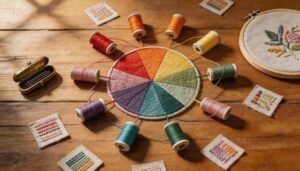
Knowing your color theory is one thing — putting it to work at your embroidery table is another.
A few simple habits can save you from frustrating surprises and help your finished piece look exactly the way you planned.
Here are some practical tips to keep your color choices accurate and consistent.
Comparing Thread Swatches on Fabric
Before you commit to a color palette, always test your threads directly on the fabric you’ll be using. Fabric background influence is real — a thread that looks perfect on white can feel dull on cream.
Stitch density visibility, hoop tension effect, and stabilizer color shift all change how your final piece reads.
simple swatch documentation log with color codes and fabric types for future reference.
Checking Colors in Natural and Indoor Light
Light is sneaky — the same thread can look at two completely different colors depending on where you’re standing. That’s metamerism, and it’s why a daylight comparison is non‑negotiable before finalizing any palette. Use a neutral backdrop when checking swatches to keep color fidelity in embroidery accurate.
- Natural light (5000K–6500K) shows true hues best
- LED color temperature and CRI rating influence how warm or cool threads appear
- Metamerism checks under both window light and room light catch surprises early
Adjusting for Matte, Glossy, and Metallic Threads
Thread finish changes everything about how color reads on fabric.
Matte threads diffuse light, so bump up stitch density and use stronger color values to keep them from looking washed out.
Glossy threads pop brighter — loosen tension slightly to avoid ridges.
Metallic threads need a larger needle eye, shorter lengths, and a firmer stabilizer.
Always test first; your color wheel is the primary tool for understanding color relationships, but thread material rewrites the rules.
Keeping a Reference Chart for Future Projects
Your color chart is your stitch diary — don’t skip it. Log each thread brand, exact color code, and finish alongside a Swatch Labeling note and dye lot number.
Use a color conversion chart for Cross-Project Sharing and Stock Tracking across brands.
Digital Backup keeps your thread color chart safe if your binder disappears.
Chart Versioning tracks updates, so Embroidery Thread Color Matching stays consistent every single time.
Common Color Wheel Mistakes to Avoid
Even with a solid reference chart in hand, a few habits can quietly unravel your palette. Value imbalance is the sneaky one — when every thread sits at the same lightness, stitches disappear into fabric.
Undertone mismatch, oversaturation, palette overload, and contrast neglect follow close behind.
Using a color wheel for embroidery color selection keeps these honest, because the color wheel is the primary tool for understanding color relationships.
Frequently Asked Questions (FAQs)
How to choose thread color for embroidery?
Start with your fabric. Pick a thread that complements its tone, suits your stitch technique, and matches the mood you want. A simple color wheel makes the whole process click.
What is the color wheel for embroidery designs?
color wheel is the primary tool for organizing hues into a visual map.
It arranges primary, secondary, and tertiary colors in a circle, helping you plan stitched palettes with confidence and clarity.
Is there a universal thread color chart?
No single universal thread color chart exists across all brands, but standardized numeric codes and brand conversion tables make cross-brand matching straightforward.
DMC, Anchor, and Madeira each maintain their own systems with digital color references to help you match accurately.
Which thread brands offer the most color variety?
Gutermann leads with over 1,000 color references, while Aurifil, Madeira, and Isacord each offer 400–500+ shades. DMC embroidery floss, Anchor, and Madeira all publish color conversion charts for easy cross-brand matching.
How do seasonal trends influence embroidery thread palettes?
Seasonal trends quietly shape which threads land in your basket.
Spring calls for soft pastels, summer pushes high contrast brights, autumn leans earthy, and winter welcomes metallic accents to finish the year with warmth.
Can digital tools help with thread color selection?
Yes — digital tools genuinely help. A palette generator or digital color picker translates your colors into exact thread codes instantly, saving guesswork and keeping your selections consistent across every project.
How should threads be stored to preserve their color?
Store threads in a cool, dry spot — ideally between 60 and 75°F — away from sunlight and moisture. Label bobbins clearly, use silica packets, and keep colors grouped for easy access.
How do different thread materials affect color appearance?
Your thread material shapes how color looks on fabric.
Rayon threads shine brightly, silk threads glow richly, and polyester threads stay bold after washing — while cotton floss gives a softer, matte finish.
Conclusion
Color theory can feel intimidating at first—like it belongs in art school, not your stitching basket.
But a thread color wheel for embroidery isn’t about rules; it’s about giving your instincts a reliable foundation.
Once you understand how values shift, how complements pop, and how analogous hues flow, your choices stop feeling like guesses.
You’ll reach for thread with confidence, knowing exactly why it works—and that’s when your embroidery truly starts speaking for itself.