This site is supported by our readers. We may earn a commission, at no cost to you, if you purchase through links.
Most beginners who sit down at a serger for the first time describe the same moment: staring at four thread spools, two loopers, and a blade spinning fast enough to trim fabric mid-stitch, wondering what they’ve gotten themselves into. It looks less like a sewing tool and more like something that escaped from a factory floor. That reaction makes sense—but it doesn’t mean the machine is beyond reach.
Beginners usually go from fumbling through a 12-minute setup to threading confidently in under five minutes within two weeks of practice. The gap between "total beginner" and "this actually works" is smaller than the machine makes it look.
Clean seams, professional-looking edges, and stretch-ready stitches for knit fabrics follow shortly after. The transition from intimidation to capability happens faster than most expect.
Table Of Contents
Key Takeaways
- Most beginners go from fumbling through a 12-minute setup to threading confidently in under five minutes within just two weeks of practice — the learning curve is real but short.
- A serger doesn’t replace your regular sewing machine; it teams up with it, handling edge finishing and knit seams while your regular machine tackles zippers, buttonholes, and topstitching.
- Mastering tension settings is the single most important skill to nail early — almost every common problem, from puckering to skipped stitches, traces back to tension being off.
- Starting with knit fabrics and scrap practice runs builds the muscle memory you need faster than any manual, making your first real projects surprisingly satisfying.
Is a Serger Beginner Friendly?
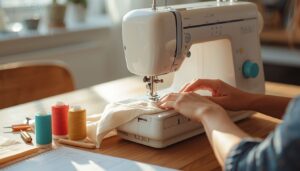
Sergers can look intimidating at first glance — all those threads, that spinning blade, the speed. But most beginners figure out the basics faster than they expect.
Once you see what a serger is actually used for, the learning curve starts to feel a lot less steep.
Here’s what actually shapes the learning experience.
Why Sergers Seem Harder at First
When you first sit down at a serger, it honestly looks like a small spaceship. The complex thread path alone — weaving through multiple looper coordination points — triggers real speed anxiety before you’ve even turned it on. Here’s what trips most people up early:
- Four threads, four tensions, zero mercy
- Upper and lower loopers that must sync perfectly
- Blade safety awareness while fabric is moving fast
- No muscle memory yet for threading order
Maintaining balanced thread tension helps prevent skipped stitches.
Don’t fear the threads. Practice practice practice on scraps, and that learning curve visualization shifts fast.
What Beginners Usually Struggle With
Thread tangles, blade safety, and foot pedal timing—these are the real stumbling blocks for beginners. Speed management often catches newcomers off guard, as sergers operate at high speeds. Don’t fear the threads, but always respect the blade.
Fabric puckering occurs when tension settings are off, making this a critical area to master. Beginners should prioritize understanding tension adjustments before tackling other techniques.
Practice, practice, practice is key to making threading and tension settings feel natural over time.
Why The Learning Curve is Manageable
Here’s the good news: that initial overwhelm fades faster than you’d expect. A beginner’s guide to serger and overlocker usage breaks everything into small, winnable steps. Progressive skill-building means you’re never tackling everything at once.
- Color-coded threading paths simplify serger basics for beginners
- Easy-to-follow manuals walk you through tension settings for serger setup
- Clear video demos show threading and tension settings for serger visually
- Incremental speed control lets you practice without racing the machine
- Community troubleshooting connects you with others mastering understanding and using a serger
Suddenly, it clicks.
How Fast Most New Users Improve
Progress comes faster than you’d think. Most beginners hit their first real achievement — clean, aligned seams — within two days.
By week two, set-up speed drops from 12 minutes to about five. Tracking your wins, even small ones, keeps momentum going.
With consistent practice frequency and fabric adaptability as your goal, learning tension settings starts feeling like second nature around week four.
When a Serger Makes Sewing Easier
Once you get comfortable, a serger genuinely transforms how fast projects come together. Here’s where it really pulls its weight:
- One-step finishing trims and stitches simultaneously — serious time-saving advantages right there.
- Reduced fraying keeps edges clean without extra handwork.
- Seam stretchability makes stretchy fabrics actually enjoyable to sew.
- Consistent edge quality gives every project professional-looking seams automatically.
Serger Vs Sewing Machine
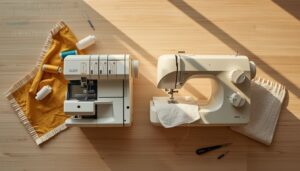
A serger and a sewing machine aren’t rivals — they’re just built for different jobs. Once you know what each one does best, you’ll stop guessing which machine to grab.
Here’s a quick breakdown of how they compare.
What a Serger Does Differently
A regular sewing machine stitches. A serger does three jobs at once — and that changes everything.
Thanks to its blade cutting mechanism and thread interlocking system, a serger trims, stitches, and finishes your fabric edge in a single pass. That’s the fast single-pass finish you see on store-bought clothes.
A serger trims, stitches, and finishes fabric edges in one single pass — just like store-bought clothes
| Serger | Regular Sewing Machine |
|---|---|
| Trims edge while stitching | No automatic trimming |
| Uses 3–4 threads via loopers | Uses 1–2 threads |
| Overlock stitch elasticity for knits | Limited stretch stitches |
| Edge finishing in one step | Separate finishing needed |
| Up to 1,500 stitches per minute | Usually slower |
When Beginners Need Both Machines
Here’s the truth — one machine rarely does it all. A serger manages trimming and overlock finishing, but your regular machine still owns zippers, buttonholes, and precise topstitching. That dual machine workflow is where the magic lives.
Think of pinking shears and bias tape as the budget-friendly middle ground — explore advanced seam finishing techniques to figure out which tools actually fit your workflow.
| Task | Best Machine |
|---|---|
| Edge finishing | Serger |
| Zipper insertion | Regular machine |
| Seam assembly | Both together |
Complementary seam strategies like this keep your projects fast and professional.
Best Uses for Knit Fabrics
Knit fabrics are basically a serger’s happy place. That stretch-loving differential feed manages everything from activewear panels to sleepwear comfort without puckering or distorting seams.
| Knit Project | Serger Advantage |
|---|---|
| Layering tees | Clean, stretchy seams |
| Baby wear softness | Gentle, fray-free edges |
| Home textile accents | Fast, professional finish |
One of the best beginner tips for serger operation? Start with knit fabrics — they’re forgiving and rewarding.
Why Sergers Create Cleaner Seams
Think of a serger as a three-in-one finishing machine. Edge Trimming Integration means it cuts, wraps, and locks in one pass — no fraying, no bulk. That Multi-Thread Interlock and Looper Wrap Uniformity creates Stitch Elasticity that regular stitches can’t match.
| Seam Quality Factor | Serger Advantage |
|---|---|
| Fabric fraying prevention | Encapsulated edge holds wash after wash |
| Seam Bulk Reduction | Cleaner, flatter seams every time |
Professional looking seams, guaranteed.
Jobs a Regular Machine Still Handles Better
Your serger is a seam-finishing rockstar — but it’s not the whole band. A regular machine still owns buttonhole precision, topstitching alignment, and zipper installation.
Need heavyweight quilting or upholstery seams? Stick with your sewing machine.
| Task | Best Machine | Why |
|---|---|---|
| Buttonholes & Zippers | Regular Machine | Controlled, precise results |
| Topstitching | Regular Machine | Consistent spacing |
| Decorative Embroidery | Regular Machine | Stitch variety wins |
Beginner-Friendly Serger Features
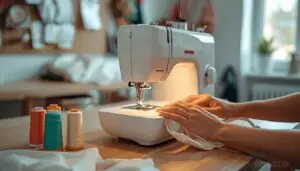
Not all sergers are created equal, and as a beginner, the right features can make a huge difference in how quickly you get comfortable. Some machines practically hold your hand through the learning process.
Focus on features worth looking for before you buy, as these will significantly ease your transition into serging.
3. thread Vs 4-thread Capability
When stitch strength is your deciding factor between a 3-thread overlocker and a 4-thread machine, key differences emerge. A three-thread setup excels at managing lightweight fabric finishes, while a four-thread overlock adds a second needle thread, enhancing seam elasticity on knits and activewear.
The four-thread option slightly increases thread usage, but this trade-off boosts durability for stretch fabrics. For most beginners, the 4-thread machine ultimately offers greater versatility due to its adaptability across fabric types and superior seam integrity.
Color-coded Threading Paths
Color-coded threading paths are honestly one of the best beginner-friendly features a serger can have. Guide Color Consistency ensures each thread follows its own distinct color trail—blue for the upper looper, green for the lower—making misrouting quickly obvious.
Thread Path Diagrams printed directly on the machine, combined with Numbered Thread Steps, render serger threading methods almost foolproof. Even Tension Color Matching helps users spot setup errors before stitching begins.
Differential Feed for Smoother Seams
Once threading clicks, your next win is differential feed. That little dial controls how fast the front and back feeds move the fabric through — and it’s a huge help for knit fabrics.
Feed Ratio Testing on scrap swatches helps you dial in smooth seams fast. Start at 1.0, adjust in small steps, and keep a Calibration Log.
Edge Roll Control and Fabric Slip Prevention become surprisingly easy once you understand the dial.
Adjustable Stitch Length and Width
Beyond stitch length and stitch width, their Length‑Width Interaction functions like seasoning—small adjustments significantly impact results.
For woven fabrics, use 2.5 mm length with 5 mm width. Knits require 3.0–3.5 mm length and wider width. Always conduct a Sample Swatch Test first.
Fine‑Tuning Controls and Presser Foot Effect hold greater importance than beginners often realize.
Easy Tension Controls for New Users
Tension settings can feel intimidating, but most beginner sergers make it manageable. Dials are labeled so you can follow dial calibration tips right on the machine. Visual tension indicators show at a glance if something’s off.
Many models include preset tension ranges for cotton, jersey, and fleece — and some even offer tension memory settings. These features simplify adjustments for different materials.
Fabric tension differences between knits and wovens become obvious quickly once you practice.
Safety Features That Reduce Mistakes
Modern sergers are actually built with beginners in mind — and the safety features prove it. You don’t have to white-knuckled every stitch.
- Button lock lever holds the presser foot in place so it won’t shift mid-stitch
- Blade safety shield covers the knife whenever the foot lifts
- Pedal start control only runs when you apply steady pressure
- Thread break troubleshooting is easier with built-in sensors that stop the machine automatically
These serger safety features make beginner serger operation feel less scary and more user-friendly.
Threading and Tension Basics
Threading a serger for the first time can feel like solving a puzzle with too many pieces. But once you understand the basics, it clicks fast.
Here’s what you need to know to get started without the frustration.
Correct Threading Order for Beginners
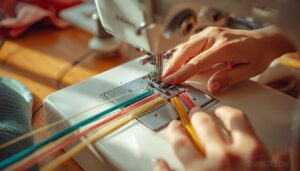
Think of threading like following a map — skip one turn and you’re lost. Begin with the upper looper sequence, then work your way down through the take-up lever path before reaching the needles. This sequential approach ensures precision.
Thread guide mapping maintains order, while correct spool orientation prevents tension issues later. These steps collectively safeguard against common threading errors.
Always trim your thread ends closely before starting to sew. This simple practice eliminates unnecessary friction and ensures smooth operation.
How to Test Stitches on Scrap Fabric
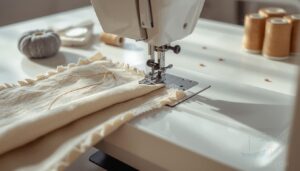
Before you touch your real fabric, always run a quick test on scrap fabric first. Grab a piece that matches your project’s fabric weight, then check stitch density, edge curl evaluation, and how the needle height adjustment affects feeding. Try a stabilizer impact trial if needed.
A simple thread tension adjustment here saves you from ripping out seams later — trust that.
Signs Your Tension Needs Adjustment
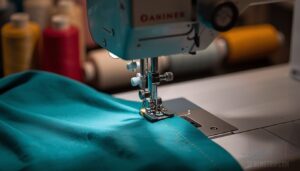
Your serger communicates through its stitches—you just need to learn the language.
Watch for these three dead giveaways:
- Uneven stitch length or thread nests under the fabric means tension settings are off-balance.
- Looper thread loops appearing on top signal loose upper thread tension.
- Fabric puckering or bobbin thread visible on the surface screams tight tension.
A quick tension adjustment resolves all three issues.
Choosing The Right Needles and Thread
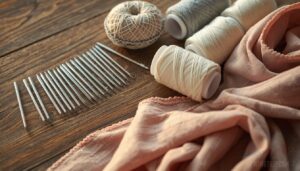
Your needle and thread choices matter more than you’d think. For knits, ballpoint needles (sizes 75/11–90/14) glide between fibers instead of piercing them, preventing runs and ensuring smooth stitching. Wovens, however, require a universal needle for optimal results.
Thread selection is equally critical: lighter fabrics demand finer thread, while heavier materials need thicker options. Prioritize polyester serger thread for consistent fiber compatibility and clean, stretchy seams.
Common Threading Mistakes to Avoid
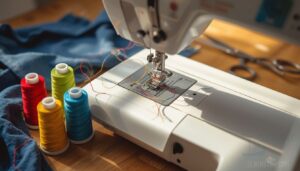
Even with the right needle and thread, mixed thread paths trip up beginners constantly. Sound familiar? Here are three mistakes worth avoiding:
- Ignoring the presser foot — always lift it before threading to release tension discs.
- Tangled looper thread — skipping a guide creates chaos fast.
- Overloaded bobbin — overfilling causes uneven feeding and frustrating jams.
Color-coded threading paths exist for a reason. Use them.
Simple Safety Habits During Setup
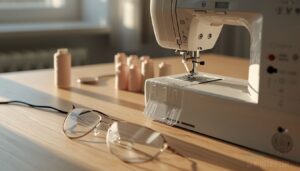
Threading done right means nothing if you’re not set up safely. Power off before adjusting anything — blades are sharp and fast. Keep your blade guard engaged and plug into a grounded outlet.
Yes, eye protection is worth it. A clean workspace keeps small parts from disappearing.
These beginner tips for serger operation take seconds but save real headaches.
First Projects to Build Confidence
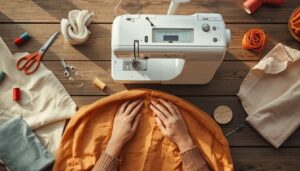
The best way to get comfortable with your serger is to just start using it — no pressure, no big project on the line.
A few simple practice runs will teach you more than any manual ever could.
Here are the best starting points to build real confidence fast.
Practicing on Scrap Fabric First
Grabbing a handful of scrap fabric before touching your real project is honestly the smartest move you can make. Think of it as you’re serger’s warm-up lap. Practice Weight Matching by testing scraps that mirror your actual fabric. Use Layered Scrap Stacking to simulate thicker seams, and run Thread Path Rehearsal until threading feels automatic.
- Build muscle memory before the stakes get real
- Dial in your differential feed without wasting good fabric
- Ramp up speed gradually — slow wins first
- Keep the Blade Guard Safety engaged every single time
Finishing Raw Edges on Woven Fabric
Once your scraps are done, woven fabric is the perfect real-world test. Raw edges fray quickly without seam finishing, but your serger manages that in one pass. Skip the zigzag workaround — overlocking trims and encloses the edge cleanly.
You can also try Pinking Shears Trim, Fray Check Application, or a Bias Tape Finish for variety.
Sewing Basic Knit Seams
Knit fabrics are where your serger really shines. Set your differential feed slightly above 1 to prevent wavy seams, and dial in your threading and tension settings for the serger before touching your project.
A four-thread overlock gives you stitch density control and manages stretchy fabrics without popping. Keep your seam allowance width consistent, and your knit fabric’s grain consistency will thank you.
Making a Simple Rolled Hem
Rolled heems look fancy, but they’re actually one of the most satisfying beginner wins.
Start with hem foot alignment and stabilizer placement under slippery fabrics like chiffon. Roll width adjustment keeps your rolled hem stitch consistent — aim for 1 to 3 millimeters. Match thread selection to your fabric weight, press gently after, and you’ve just leveled up.
Easy Beginner Projects With Straight Seams
Starting simple is the whole secret. A tote bag, basic apron, or simple pillowcase gives you straight seams to practice on — no curves, no stress. These first serger projects build real muscle memory fast.
Knock out a coaster set for quick wins, or try a zipper pouch once you’re feeling bold. Honestly, you’ll be hooked before you finish your second one.
When to Combine Serging and Regular Sewing
Think of your two machines as a team — the serger manages edges, your regular machine manages the details.
- Use edge-to-assembly flow: serge raw edges first, then assemble with your regular machine
- Apply bulk seam reduction on heavy fabrics by serging before joining
- Master fabric shift timing when switching between knits and wovens
- Try hybrid seam planning for buttonholes, zippers, and topstitching
- Build a stitch sequencing strategy so both machines work together, not against each other
Top 5 Beginner Serger Essentials
Once you’ve got a few practice runs under your belt, having the right supplies on hand makes everything smoother. A few simple essentials can save you from frustrating mid-project stops and messy results.
Here’s what belongs in every beginner serger kit.
1. New Brothread All Purpose White Polyester Thread
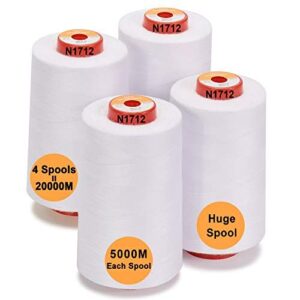
Thread is one of those things you don’t think about until your serger keeps breaking mid-seam. New Brothread’s All Purpose White Polyester Thread saves you that headache. Each cone holds about 5,500 yards — so you’re not constantly re-threading mid-project.
The 40-weight polyester is strong, runs smoothly through your machine, and manages everything from knits to denim without drama.
Four cones per pack means you’re stocked for a long time. A solid choice when you’re still learning the ropes.
| Best For | Sewers and quilters who work on high-volume projects and want a reliable, affordable polyester thread that plays nice with most machines. |
|---|---|
| Primary Use | Serging & sewing |
| Material | 100% polyester |
| Pack Quantity | 4 cones |
| Brand | Connecting Threads |
| Skill Level | Beginner–Advanced |
| Price Range | Budget-friendly |
| Additional Features |
|
- Four large cones give you roughly 22,000 yards total — you won’t be running to the store mid-project anytime soon.
- Strong, smooth polyester that holds up well through laundering, bleaching, and heavy everyday use.
- Works with most major sewing and serger brands, so compatibility is rarely an issue.
- Only available in white for this SKU — other colors have to be bought separately.
- The 40-weight is a bit heavy for delicate fabrics or fine embroidery work.
- A few users have reported occasional breakage, which hints at some inconsistency in quality control.
2. Schmetz ELX705 Serger Needle 80/12
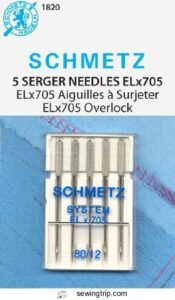
Your needle matters more than you’d think. The Schmetz ELX705 80/12 is built specifically for electronic sergers — overlock, cover, safety stitches, all of it.
Its reinforced blade resists bending, the chrome finish keeps things running smoothly, and the ballpoint tip won’t shred your knits.
At $9.23 for a five-pack, it’s an easy buy. Just confirm your serger uses the ELX705 system before ordering.
Wrong needle, wrong results — it’s that simple.
| Best For | Sewers and serger enthusiasts who own an electronic serger that uses the ELX705 needle system and want reliable, consistent stitch quality. |
|---|---|
| Primary Use | Serger needle replacement |
| Material | Steel (needle) |
| Pack Quantity | 5 needles |
| Brand | Schmetz |
| Skill Level | Intermediate |
| Price Range | Budget-friendly |
| Additional Features |
|
- Works seamlessly across multiple stitch types — overlock, cover, safety, and mock-safety
- Schmetz is a trusted brand with tight manufacturing tolerances, so you get consistent results every time
- At $9.23 for five needles, it’s an affordable way to keep your serger running right
- Only works with sergers that specifically use the ELX705 system — won’t fit standard sewing or embroidery machines
- Five needles won’t last long if you’re sewing heavily, so frequent reorders are likely
- No info on needle coating or material, which may matter to sewers working with specialty fabrics
3. Schmetz Universal Sewing Machine Needles
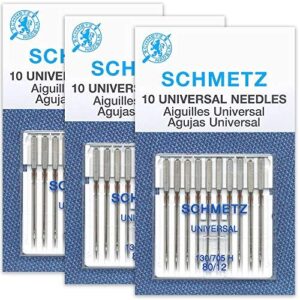
Your serger’s covered—but what about your regular machine? Keep a pack of Schmetz Universal Needles 130/705 H nearby for everything else. These size 80/12 needles work on most home machines—Brother, Singer, Janome, Bernina—so you’re not hunting down brand-specific options.
The slightly rounded point works with both wovens and light knits without chewing up your fabric.
Thirty needles for $14.51 means you’ve always got a fresh one ready. Dull needles cause more problems than you’d expect.
| Best For | Home sewists who use multiple machine brands and want a reliable, all-purpose needle that handles both woven and knit fabrics without fuss. |
|---|---|
| Primary Use | General machine sewing |
| Material | Steel (needle) |
| Pack Quantity | 30 needles |
| Brand | Schmetz |
| Skill Level | Beginner–Advanced |
| Price Range | Budget-friendly |
| Additional Features |
|
- Works with most major home machine brands, so no need to stock brand-specific needles
- The slightly rounded point is gentle on fabric, cutting down on skipped stitches and snags
- 30 needles at $14.51 is solid value—you’ll always have a fresh needle on hand
- Only one needle type in the pack, so you’ll need separate purchases for denim, leather, or stretch projects
- 30 needles can go fast if you sew frequently or tackle bigger projects
- Not built for industrial or heavy-duty machines
4. Auloea Mini Wireless Handheld Vacuum
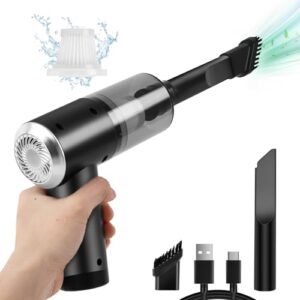
Now, here’s something you didn’t know you needed until right now — a tiny vacuum for your sewing space. The Auloea Mini Wireless Handheld Vacuum weighs under a pound and runs cordless, so you can chase thread trimmings and lint out of every corner without dragging out a full-size machine.
It even has a built-in LED light for those dark crevices around your machine.
Small dust cup means you’ll empty it often, but cleanup stays quick and painless.
| Best For | Sewists and crafters who want a lightweight, grab-and-go vacuum for clearing thread clippings, lint, and fine debris from their workspace and machine. |
|---|---|
| Primary Use | Surface cleaning |
| Material | Plastic & motor |
| Pack Quantity | 1 unit |
| Brand | Unbranded |
| Skill Level | Beginner |
| Price Range | Mid-range |
| Additional Features |
|
- Cordless and under a pound — easy to grab and maneuver without any hassle
- Built-in LED light helps you spot and clean those dark, hard-to-reach spots around your machine
- Washable filter and detachable dust cup make upkeep simple and cheap
- Small dust cup fills up fast, so expect to empty it often during longer sessions
- Suction can drop off when the brush attachment is in use, which limits it on bigger messes
- Some users reported early failures, so long-term reliability isn’t a sure thing
5. New Brothread Wash Away Water Soluble Stabilizer
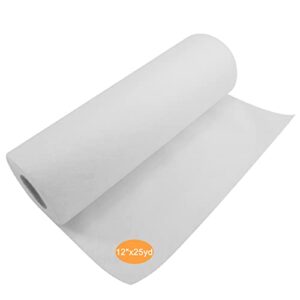
New Brothread Wash Away Water Soluble Stabilizer is one of the sneakier useful picks here. When serging knits or delicate fabrics, keeping everything stable is half the battle. This roll dissolves completely in cold water, leaves zero residue, and works as both backing and topping.
Its lightweight design (1.5 oz per yard) ensures it won’t bulk up thin materials. Stitch, rinse, done—the process couldn’t be simpler.
| Best For | Embroiderers and sewists working with delicate, stretchy, or high-pile fabrics like towels, fleece, and terry cloth who need a stabilizer that disappears completely after stitching. |
|---|---|
| Primary Use | Embroidery stabilizing |
| Material | Natural fleece |
| Pack Quantity | 1 roll |
| Brand | Unbranded |
| Skill Level | Intermediate |
| Price Range | Mid-range |
| Additional Features |
|
- Dissolves fully in cold or warm water with no backing residue left behind
- Works as both a backing and a topping, so one roll covers multiple uses
- Non-toxic and skin-friendly material makes it safe for wearables and items that touch skin
- Not great for dense designs—heavy stitch counts may need multiple layers
- Can get sticky during wash-out and requires thorough rinsing to fully clear
- Too light for heavy or heavily textured fabrics that need stronger support
Frequently Asked Questions (FAQs)
Is a serger beginner friendly?
Yes — and more than you’d expect. With color-coded threading guides and automatic tension controls, most beginners feel surprisingly comfortable after just a few practice sessions on scrap fabric.
What is the most trouble-free sewing machine?
For sheer simplicity, a four-thread serger wins. Color-coded threading, automatic tension, and built-in blade guards make setup almost foolproof — letting you focus on sewing, not troubleshooting.
Is a serger harder to use than a sewing machine?
A serger is harder to set up — and easier to sew with. More threads, more guides, more to learn upfront.
But once you’re rolling? It finishes seams faster than any sewing machine ever will.
How do you choose the right serger brand?
Start with brand reputation, warranty terms, and available support. Look for metal-frame builds, color-coded threading, and easy tension controls. Match features to your budget and the fabrics you’ll sew most.
Can a serger replace a coverstitch machine entirely?
Not even close. A serger manages seams beautifully, but it can’t replicate the clean, parallel topstitching a coverstitch machine delivers — especially on knit hems.
They’re different tools built for different jobs.
What fabrics should beginners completely avoid serging?
Skip chiffon, delicate sheers, heavy denim, and loosely woven fabrics like gauze when you’re starting out.
They shift, snag, or overwhelm the blade before you’ve built enough control to handle them.
How often should serger blades be replaced?
Blades last 6–24 months depending on how often you sew and what fabrics you cut. Check them monthly. If edges look frayed or ragged instead of clean, replace them immediately.
Conclusion
Maybe you don’t consider yourself a "technical" person—but a serger doesn’t care about that. Can beginners learn to use a serger? Absolutely, and faster than you’d expect. The threading clicks into place. The tension starts making sense. Your seams stop fraying.
What felt like a factory machine becomes the most satisfying tool in your sewing space. You just have to sit down, run some scrap fabric through, and let the doing teach you.