This site is supported by our readers. We may earn a commission, at no cost to you, if you purchase through links.
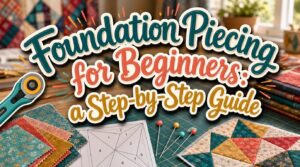
Most quilters assume precision comes with experience—that until you’ve made a dozen blocks, your points won’t meet and your corners won’t line up. Foundation paper piecing flips that assumption on its head. The printed template does the hard work for you, giving you a stitch line to follow instead of a seam allowance to guess at.
That single shift changes everything for a beginner. You’re sewing on a line, not toward one. The result is tight, accurate blocks from your very first attempt—no years of practice required.
Grab your rotary cutter, and let’s get your first block right.
Table Of Contents
- Key Takeaways
- What is Foundation Paper Piecing?
- Top 5 Foundation Piecing Supplies
- Prepare Paper, Fabric, and Machine
- Step-by-Step Foundation Piecing Tutorial
- Place The First Fabric Piece Correctly
- Align The Next Fabric Right Sides Together
- Sew Directly on The Printed Line
- Trim Seams to ¼ Inch
- Press Seams With a Dry Iron or Roller
- Check Fabric Coverage With Light
- Repeat for Each Numbered Section
- Join Completed Template Units
- Remove Paper Backing Cleanly
- Press and Finish The Quilt Block
- Frequently Asked Questions (FAQs)
- Conclusion
Key Takeaways
- Foundation paper piecing lets you sew on a printed line instead of guessing at seam allowances, so your blocks come out accurate from the very first attempt.
- A short stitch length of 1.5–1.8mm isn’t just for precision — it perforates the paper as you sew, making removal clean and easy when you’re done.
- Your five core supplies (a lockstitch machine, 50wt cotton thread, a universal 80/12 needle, a self-healing cutting mat, and a rotary cutter) do most of the heavy lifting before you even touch the template.
- Always print at 100% scale and verify with the 1-inch test square before cutting anything — a slightly off print quietly throws every piece out of proportion.
What is Foundation Paper Piecing?
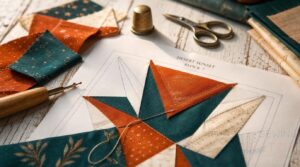
Foundation paper piecing is a method where you sew fabric onto a printed paper template, using the lines as a guide for perfectly straight, accurate seams. It sounds fussy, but it’s actually one of the most forgiving techniques a beginner can learn.
Once you get the hang of it, this foundation paper piecing tutorial for beginners walks you through every step—from prepping templates to sewing crisp, square blocks.
Here’s what you need to know to get started.
How Foundation Piecing Works
Foundation paper piecing works by sewing fabric pieces onto a printed paper template in a specific order, guided by a template numbering system that keeps everything in sequence. Fabric is placed on the unprinted side, and you sew directly on the printed lines—using a short stitch length to create paper perforations for easy removal later. After sewing, trim the fabric to ensure proper seam allowance control.
Layered fabric alignment and backstitch reinforcement lock every seam securely in place, maintaining structural integrity throughout the process.
The short stitch length technique is critical, as it creates perforations that simplify paper removal after stitching, streamlining the final assembly.
Why Beginners Use Paper Templates
Paper templates give you something priceless when you’re just starting out — a built-in safety net. They handle error containment naturally, letting you focus on one numbered section at a time before moving to the next.
You gain real tactile feedback as fabric settles along the printed path, while quick corrections remain easy without re-cutting anything.
That confidence boost alone makes paper templates worth it.
Foundation Piecing Vs. Traditional Piecing
So how does foundation paper piecing actually differ from traditional piecing? With traditional piecing, you cut fabric and sew pieces directly together — no templates involved. That means your accuracy differences come down entirely to your seam allowance consistency.
Foundation paper piecing guides every stitch along printed lines, reducing fabric waste and easing the learning curve. Fewer tool requirements, sharper results.
Benefits for Accurate Quilt Blocks
Those printed lines do more than guide your stitching — they quietly solve problems you didn’t know you’d have. Corner Precision is improved because fabric follows exact reference lines every time. Seam Consistency remains reliable across every block, giving you true Block Uniformity throughout your quilt.
You’ll also notice Fabric Waste Reduction from accurate cuts, and that adds up to real Time Efficiency.
Foundation paper piecing genuinely delivers seam accuracy without demanding mastery from you.
Foundation paper piecing delivers precise, accurate seams without requiring mastery to achieve them
Best Beginner-friendly FPP Patterns
Some patterns just click right away — and these five are perfect starting points:
- Granny Square Blocks and Starburst Mini Quilts build confidence with simple, repeating shapes.
- Nine-Patch Starter layouts teach core foundation paper piecing techniques for beginners in a compact format.
- Flying Geese Borders and Sawtooth Edge Blocks introduce directional sewing without overwhelming complexity.
Many beginner-friendly tips and free block patterns for each style are easy to find online.
Top 5 Foundation Piecing Supplies
Having the right supplies makes foundation paper piecing so much easier — and honestly, a lot more enjoyable. You don’t need a huge collection to get started, just five key tools that do the heavy lifting. Here’s what you’ll want to have on hand before you begin.
1. Juki TL2010Q Portable Lockstitch Machine
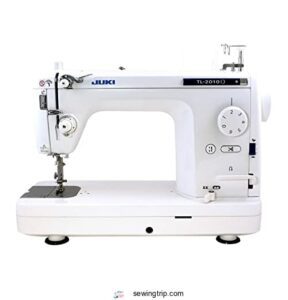
The Juki TL-2010Q is built from aluminum alloy, weighs 38 pounds, and operates at speeds up to 1,500 stitches per minute. This robust construction and high velocity allow it to effortlessly handle paper and fabric without hesitation.
Its knee lifter ensures hands-free control for fabric guidance, while the automatic thread trimmer eliminates the need for constant manual snipping. These features streamline the sewing process, enhancing efficiency and focus.
For foundation paper piecing, the machine’s consistent straight stitch is indispensable, delivering precision and reliability with every seam.
| Best For | Quilters, bag makers, and sewists who work with heavy fabrics and need a fast, reliable straight-stitch machine for serious projects. |
|---|---|
| Primary Use | Quilting & sewing |
| Price | $1,199.00 |
| Weight | 38 lb |
| Material | Aluminum alloy |
| Brand/Origin | Juki |
| Quilting Compatible | Yes |
| Additional Features |
|
- The knee lifter and automatic thread trimmer are genuine time-savers—less fussing, more sewing.
- All-metal aluminum build handles denim, upholstery, and thick quilt layers without breaking a sweat.
- Consistent, high-speed straight stitching makes it a dream for foundation paper piecing and large quilting projects.
- Straight stitch only—no zigzag or decorative options, so it can’t replace a full-featured machine.
- At 38 pounds, "portable" is relative; moving it around frequently gets old fast.
- There’s a real learning curve, and a misangled foot pedal can accidentally trigger the thread cutter.
2. Gutermann White Mercerized Cotton Thread
Good thread makes a bigger difference than most beginners expect. Gutermann’s 50-weight mercerized cotton — crafted from 100% long-staple cotton with a subtle sheen — feeds smoothly through paper and fabric without adding bulk to seams. Its low-lint construction ensures a cleaner bobbin area during extended quilting sessions.
Each 273-yard spool offers ample yardage for multiple blocks, combining practicality with performance. The thread’s colorfast, strong, and flexible nature supports precise piecing while pressing flat beautifully.
For quilts with white backgrounds, this thread disappears into the work, delivering seamless results.
| Best For | Quilters and hand-sewers working with lightweight cotton fabrics who need a fine, smooth thread that blends seamlessly into their work. |
|---|---|
| Primary Use | Hand & machine sewing |
| Price | $7.80 |
| Weight | 4.54 g |
| Material | Mercerized cotton |
| Brand/Origin | Gütermann |
| Quilting Compatible | Yes |
| Additional Features |
|
- Lays flat and feeds smoothly, giving you clean, even stitches without bulk or lint buildup
- 273 yards per spool gives you plenty of yardage to work through multiple quilting blocks
- The mercerized finish adds a subtle sheen and real durability for long-lasting seams
- Very thin thread can be hard to see and may snap on the first stitch when working with dense or heavy fabrics
- Prone to tangling at the tail end — a little beeswax goes a long way here
- Cotton-only friendly, so it’s not the right pick for synthetic fabrics that need a stronger polyester thread
3. Schmetz Universal Machine Needle Size 80 12
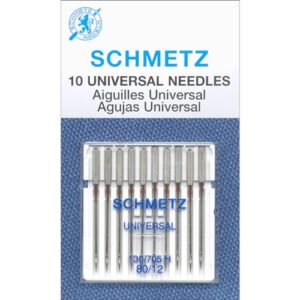
Paper dulls a needle faster than you’d think — and a dull needle means skipped stitches, frayed thread, and frustration. That’s why the Schmetz Universal 80/12 is worth keeping in your supply kit.
Its slightly rounded point glides through cotton and paper without snagging, while the standard eye accommodates 50-weight thread without friction. These features ensure smoother stitching and reduce thread damage.
Each pack includes 10 needles, allowing you to swap one in after every project effortlessly. This simple habit maintains needle sharpness and delivers noticeably cleaner results.
| Best For | Sewists and quilters who work with woven and knit fabrics and need a reliable, everyday needle that fits most home machines. |
|---|---|
| Primary Use | General sewing |
| Price | Not listed |
| Weight | 0.02 lb |
| Material | Steel |
| Brand/Origin | Imported (India) |
| Quilting Compatible | Yes |
| Additional Features |
|
- Works with a wide range of machine brands, so you’re not hunting for something brand-specific
- 10 needles per pack gives you plenty to swap in and keep your stitching sharp
- Great value for the price — easy to stock up without breaking the bank
- Not built for heavy materials like leather or upholstery, so specialty projects will need a different needle
- Only 10 per pack means frequent reordering if you sew a lot
- Imported product, so shipping can take longer than buying from a local or domestic source
4. Olfa Double Sided Rotary Cutting Mat
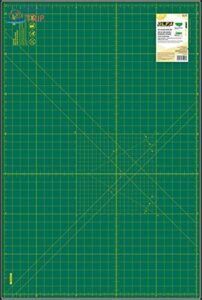
Your cutting mat is your silent workhorse — and the Olfa Double-Sided Rotary Cutting Mat earns that role well. At 24 x 36 inches, it provides serious room to work, whether you’re cutting a single fabric strip or laying out multiple pieces at once.
The grid side features angle marks at 30°, 45°, and 60°, ensuring squaring up blocks takes seconds. This precision simplifies aligning and measuring tasks for accurate cuts.
Its self-healing surface reseals after each cut, protecting both your blade and table from damage. This durability extends the mat’s lifespan while maintaining a clean workspace.
Store it flat, away from sunlight, and it will last for years. Proper care preserves the mat’s functionality, making it a reliable long-term investment.
| Best For | Quilters, sewists, and fabric crafters who need a large, precise cutting surface for rotary cutter work. |
|---|---|
| Primary Use | Fabric cutting |
| Price | Not listed |
| Weight | 2.3 lb |
| Material | Self-healing composite |
| Brand/Origin | RM-MG |
| Quilting Compatible | Yes |
| Additional Features |
|
- Big 24×36 inch surface gives you plenty of room to cut multiple layers or pattern pieces at once.
- The self-healing design keeps the surface smooth and extends your rotary blade’s life.
- Grid side with angle markings makes measuring bias strips and squaring up blocks quick and easy.
- Only works with rotary cutters — utility knives will damage the mat.
- At 1.5mm thin, cut lines can show up more visibly over time compared to thicker mats.
- Comes with a chemical odor out of the box and will warp if stored rolled or left in direct sunlight.
5. OLFA 45mm Quick Change Rotary Cutter
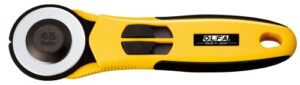
The OLFA 45mm Quick Change Rotary Cutter is one of those tools that just makes sense once you hold it. Its ergonomic rubber grip fits your hand naturally, whether you’re left- or right-handed, ensuring comfort during use.
The quick-change blade system eliminates the hassle of searching for a screwdriver mid-project. With one push, the blade snaps in or out, streamlining your workflow.
The 45mm tungsten steel blade delivers clean cuts through fabric and paper layers alike. Weighing just 9 grams, it reduces wrist strain during extended cutting sessions.
| Best For | Sewers, quilters, and crafters — especially left-handed users — who want fast, comfortable, and precise cutting without tool-free blade swaps slowing them down. |
|---|---|
| Primary Use | Fabric cutting |
| Price | $28.99 |
| Weight | 9.07 g |
| Material | Rubber & steel |
| Brand/Origin | OLFA |
| Quilting Compatible | Yes |
| Additional Features |
|
- The ergonomic rubber grip with finger grooves makes it easy to hold for long cutting sessions without your hand wearing out.
- Switching blades is genuinely quick — no tools, no fuss, and it flips for left- or right-hand use in seconds.
- The 45mm tungsten steel blade cuts cleanly through fabric, leather, vinyl, and multiple layers with minimal effort.
- The sliding lock can slip loose on its own, which is a bit unsettling when a razor-sharp blade is involved.
- The split blade cover only exposes half the blade, so thick or dense materials like heavy leather or burlap can feel unstable to cut.
- It’s really built for OLFA RB45 blades — use anything else and you might run into compatibility headaches.
Prepare Paper, Fabric, and Machine
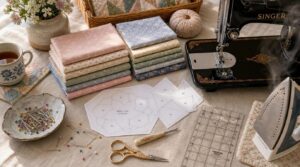
Before you sew a single stitch, a little prep work makes all the difference. Getting your paper, fabric, and machine ready the right way sets you up for clean seams and frustration-free piecing.
Here’s what you need to check off before you start: ensuring all materials are properly prepared to streamline your workflow.
Choosing The Right Paper for FPP
Not all paper is created equal, and choosing the right paper for FPP makes a surprising difference in your results. Paper weight between 90 and 100 gsm hits the sweet spot — stable enough for accurate seams, yet light enough for clean removal of paper backing.
Look for good transparency to enable easy alignment, along with built-in grid markings, reliable print compatibility, and micro-perforations for tear-away ease.
Printing Templates at 100% Scale
Open your template in a PDF viewer and set the scale to 100% — sometimes labeled "Actual Size" or "don’t scale." Disable any Fit to Page or auto-scaling options in both the print preview and your printer driver settings.
Ensure your paper size matches the template exactly, as mismatched settings can silently shrink your pieces.
Checking The 1-inch Test Square
Once your template is printed, check the 1-inch test square on the page using a ruler. Ensure the ruler is laid flat on a clean surface to eliminate parallax, allowing for accurate edge-to-edge comparison.
Proper ruler alignment is critical here. Verify that measurements match precisely, as this confirms your printer’s calibration remains consistent.
If the square is even slightly off, reprint and recheck immediately. Do not proceed with fabric until accuracy is confirmed.
This step ensures your project’s precision, preventing costly errors from misaligned prints.
Cutting Templates With Extra Margin
Now that your test square checks out, grab your scissors — it’s time to cut those templates. Leave about ⅛ inch around every printed edge. This blade drift compensation keeps your margins intact when the rotary cutter shifts slightly.
For consistent margin width across all pieces:
- Mark margin zones clearly on each template
- Use a sharp blade to prevent ragged edges
- Cut every template before touching your fabric
Cutting Fabric Oversized for Coverage
Every fabric piece needs to be cut at least ½ inch larger on all sides than its template section—that’s your oversize margin calculation in action. For stable fabric margins, maintain grain-aligned cutting using a rotary cutter technique: lay pieces flat with ¼ inch between layers.
This layer spacing guideline, combined with smart seam allowance management in FPP, ensures everything is perfectly covered.
Setting Stitch Length for Paper Piecing
One small setting makes a surprisingly big difference: your stitch length. For foundation paper piecing, the ideal length range lies between 1.5 and 2.0 mm. Start machine calibration at 1.8 mm, then adjust from there. Stitch length testing on scrap first saves headaches later.
- 1.5 mm — perforates cleanly for easy paper removal
- 1.8 mm — reliable starting point for most cotton weights
- 2.0 mm — better for heavier fabrics needing fabric weight adjustment
Perforation consistency along every seam is what makes paper removal feel satisfying rather than frustrating.
Using The Correct Needle and Thread
Pairing the right needle and thread is like choosing the right tool for the job — it matters more than most beginners expect.
| Factor | Recommendation | Why It Matters |
|---|---|---|
| Needle type | 80/12 universal | Clean penetration through fabric and paper |
| Thread weight | 50wt cotton thread | Low bulk, smooth stitching |
| Brand options | Aurifil or Gutermann | Consistent tension, minimal breakage |
| Skipped stitch prevention | Replace needle each project | Paper dulls the tip fast |
| Thread material selection | Cotton for woven quilts | Matches fabric behavior naturally |
Your sewing machine manages needle size matching automatically once you’ve loaded the right combination — so don’t skip this step.
Organizing Numbered Fabric Sections
Label each fabric piece with its corresponding number using a removable fabric-safe marker, then sort pieces into small zip pouches or labeled envelopes. A workflow board with checklist management keeps your assembly sequence visible.
Color coding and color sorting help with fabric layout planning, ensuring managing fabric scraps in paper piecing keeps stress-free.
Step-by-Step Foundation Piecing Tutorial
This is where everything clicks into place. You’ll work through each section of your template one piece at a time, building the block from the ground up.
Here’s exactly how to do it, step by step.
Place The First Fabric Piece Correctly
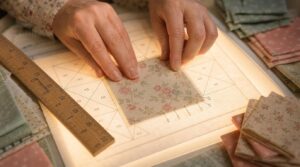
Getting the first piece down right is the foundation — literally. Place your fabric right side up on the blank side of the paper template, with a ¼-inch seam allowance extending past each edge (that’s your Fabric Edge Extension). A quick Orientation Confirmation can save headaches later.
- Do a Ruler Perpendicular Check to keep edges square
- Use fine pins or a Pinning Strategy along one edge to prevent shifting
- Try using a light box for template alignment to see the printed lines through the fabric
- Add Initial Basting Stitches to lock fabric alignment before committing
Align The Next Fabric Right Sides Together
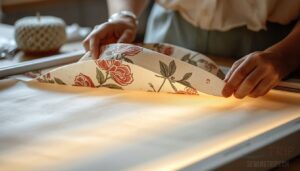
Lay your next fabric piece right side down on top of the first, aligning raw edges — that’s your Edge Alignment Technique in action. Use Pinning Strategies to hold it steady, then perform a Fabric Orientation Check.
Ensure your seam allowance extends at least ¼ inch past the printed line. A light box confirms everything lines up perfectly.
Sew Directly on The Printed Line
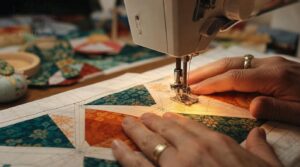
Sew directly on the printed line — the paper acts as a guide, eliminating guesswork. Use a short stitch length around 1.5 mm for clean paper perforation later.
Maintain good thread tension to keep everything flat during stitching.
LED backlighting helps you track contrast ink lines through fabric layers, eliminating the need for smudge-free marking tools.
Trim Seams to ¼ Inch
Once the line is sewn, fold the paper back along the seam and trim the seam allowance down to a quarter inch. Quarter inch consistency keeps seam bulk control in check — especially when layers stack up. An Add-a-Quarter ruler makes edge trimming tips easy to apply every time.
Measure after each trim. This small habit is your best measurement verification tool.
Press Seams With a Dry Iron or Roller
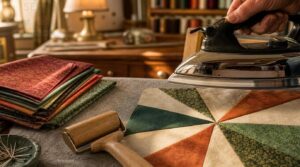
Now that your seam is trimmed, pressing locks everything in place. Set your iron to a hot dry iron setting — no steam — and hold it at a slight angle along the seam using the Iron Angle Technique. Lift and reposition; don’t drag.
Prefer a seam roller? The Roller Press Method works great too.
Let it cool before moving on.
Check Fabric Coverage With Light
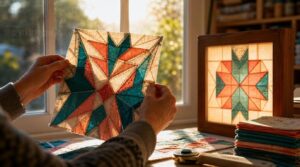
Once your seam is pressed and cooled, hold the block up to a light source — a window works, but a lightbox provides uniform illumination you can trust. Backlit inspection is your best friend here.
Check for these five things:
- Light placement directly behind the block
- Angle assessment along each seam edge
- Coverage documentation of any gaps you spot
- Uniform illumination across the full section
- Corner coverage aligned to your template lines
Repeat for Each Numbered Section
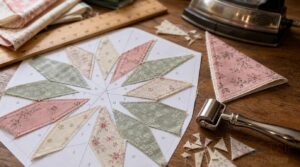
Now repeat this same process — place, align, sew, trim, press, check — for every numbered section on your template.
Section numbering exists for a reason: it tells you the exact order to build the block. Skip ahead, and your pieces won’t fit.
| Step | Action | Key Detail |
|---|---|---|
| Place | Fabric wrong-side to paper | Extend ¼ inch past section edge |
| Sew | Stitch printed line | 1.5–1.8 mm stitch length |
| Press | Iron or seam roller | Dry heat, medium setting |
Join Completed Template Units
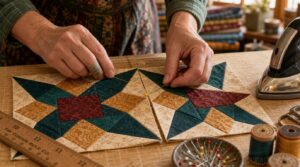
Once each template section is complete, it’s time to bring your units together. Match seam intersections carefully—this is where seam intersection alignment truly matters. Consistent foundation lines help your edges meet without gaps or skew.
Press seams to one side for clean nesting, and verify block width uniformity with your ruler. Check edge square verification at every corner to ensure precision.
Flat, precise joins make everything that follows easier.
Remove Paper Backing Cleanly
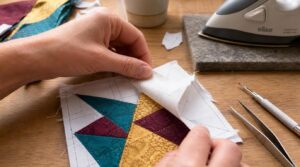
Now peel off the paper carefully, taking your time. Fold back each section along the stitching line and tear with steady, controlled pulls. Use a vinyl spatula or tweezers near stubborn spots for precise peeling, ensuring tools work without stress.
Apply gentle heat from a dry iron to loosen resistance, while a seam roller safeguards seam protection.
Always test adhesive remover on a scrap first before use.
Press and Finish The Quilt Block
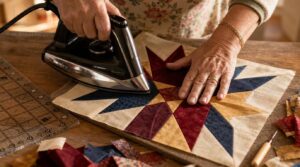
This final press is what separates a good block from a great one. Begin with a center-out pressing path, using a dry iron method with no steam and light pressure.
Nest your seams so they lock against each other, then square the block to exact dimensions with a corner ruler. Press, don’t iron.
Cool flat, trim, and you’re done.
Frequently Asked Questions (FAQs)
Can I reuse foundation paper piecing templates?
Yes — and here’s the odd part: the more carefully you sew, the longer your templates last. Freezer paper templates usually survive 5 to 10 uses before losing adhesiveness or showing wear.
How do I fix fabric sewn on the wrong side?
Unpick seams with a seam ripper, flip fabric so right sides face together, repress seams flat, use a fresh needle, and verify right side before resewing.
What seam allowance works best for joining blocks?
A full quarter‑inch seam allowance joins blocks cleanly. Use a scant allowance to offset thread width compensation.
Test strips first — fabric type impact varies, and seam allowance testing saves you from misaligned corners later.
How do I handle curved sections in FPP patterns?
Curved sections require a shorter stitch length—around 15 to 18 stitches per inch—and careful inner curve trimming to lay flat.
Use lightbox alignment to confirm coverage, and a walking foot helps keep layers feeding smoothly.
Can I wash finished FPP blocks before quilting?
You can wash finished FPP blocks before quilting. Test for color bleed first, use cold water, and press with a dry iron after drying to keep everything flat and quilt-ready.
Conclusion
Think of your printed template as training wheels that never slow you down—they just keep everything perfectly aligned while you build confidence. Foundation piecing for beginners removes the guesswork that stops most new quilters cold.
You’ve got the supplies, the steps, and now a finished block to prove it works. Keep that first block somewhere visible. It’s not just fabric and thread—it’s proof that precision was always within reach.
- https://www.gathered.how/sewing-and-quilting/quilting/how-to-foundation-paper-piece-patchwork
- https://remivailstudio.com/blogs/modern-quilting-tips/piece-perfect-mastering-the-art-of-foundation-paper-piecing-for-beginners?srsltid=AfmBOooe8oRkZA7xH83Cs3tukJY8XOGcSbLPBtrBieQ68-YkW9Lv0DJ3
- https://andsewi.com/category/how-to-foundation-paper-piece/
- https://www.blossomheartquilts.com/2016/12/foundation-paper-piecing-tutorial/
- https://the-weekendquilter.com/blogs/blog/foundations-of-foundation-paper-piecing