This site is supported by our readers. We may earn a commission, at no cost to you, if you purchase through links.
Most quilters assume sharp, perfect points come only after years of practice and a graveyard of wonky blocks. That assumption crumbles the moment you try foundation paper piecing.
The paper template does the heavy lifting—you sew on the lines, and precision follows almost automatically. Scrap fabrics you’d otherwise toss suddenly become kaleidoscope stars and intricate feathers.
This foundation paper piecing tutorial walks you through everything: the right supplies, how to prep your templates, and a sewing workflow that keeps each block crisp, square, and ready to join.
Table Of Contents
Key Takeaways
- Foundation paper piecing removes the guesswork from quilting by letting you sew directly onto a numbered template, so sharp points and clean seams happen almost automatically.
- A short stitch length (1.5–1.8 mm) is the secret to two things at once: it locks seams tightly and perforates the paper so it tears away cleanly when you’re done.
- Your supplies don’t need to be fancy, but a few smart picks—specialty FPP paper, a fresh 80/12 needle, and fine cotton thread—make a real difference in how clean your blocks turn out.
- Cutting fabric oversized, pressing after every seam, and trimming blocks with a clear ruler are the three habits that separates a flat, polished quilt from one that fights you at the finish line.
Foundation Paper Piecing Basics

Foundation paper piecing sounds fancy, but it’s really just sewing fabric onto a printed paper template — and once it clicks, you’ll wonder how you ever quilted without it.
One thing worth knowing early on: stitch length affects both quilt durability and how easily the paper tears away once you’re done.
Foundation paper piecing is just sewing onto a printed template — and once it clicks, you’ll never quilt the same way again
Before you cut a single scrap, it helps to get comfortable with a few key ideas that make the whole process feel less mysterious. Here’s what every beginner should know going in.
What Foundation Paper Piecing Is
Foundation Paper Piecing is a paper piecing technique where you sew fabric onto a printed paper template — stitch by stitch, section by section. Think of it as a map guiding every cut and seam. Using a short stitch length ensures easy removal of the foundation paper.
This foundation paper piecing tutorial covers the basics beautifully:
- Precise points land exactly where they should
- Scrap fabrics find new life, boosting cost efficiency
- Design flexibility opens up complex shapes for beginners
How FPP Differs From Traditional Piecing
Traditional hand piecing relies on your eye and steady hand to match seams — no guide, just skill. Foundation Paper Piecing flips that approach entirely.
You sew directly onto a printed template, ensuring seam precision comes built-in. This method delivers less guesswork, lower fabric waste, and sharper points without years of practice.
It’s machine-sewn, faster to assemble, and the template does the heavy lifting for you.
Why FPP Creates Accurate Quilt Blocks
Paper Stability prevents fabric shifting mid-stitch, enabling Sharp Corner Retention and Precise Point Geometry to occur almost automatically. This foundational control ensures every element aligns as intended.
Sequenced Piece Placement eliminates guesswork about positioning. Combined with careful template alignment, accurate stitching, smart seam allowance management, and precision cutting, these steps guarantee Uniform Block Dimensions—ready for flawless assembly.
Best Beginner-friendly FPP Projects
Once your blocks are lining up beautifully, the real fun begins — choosing what to make! Heart Blocks are a perfect first project, using just a few fabric pieces and a simple Color Palette for stunning contrast.
Mini Quilts let you practice free FPP patterns without committing to a big project.
Simple Borders and Star Shapes build confidence fast in this step-by-step quilting tutorial for beginners.
Common Foundation Paper Piecing Terms
A little vocabulary goes a long way in FPP. Each paper template is divided into numbered zones — that’s Segment Numbering — so you always know which fabric comes next.
You’ll use Flip‑and‑Sew to fold pieces over the seam line, trimming your seam allowance to ¼ inch as you go.
Shorter Stitch Length perforates the foundation for easy No‑Tear Foundation removal later. Simple as that!
Top 5 Foundation Paper Piecing Supplies
Having the right supplies makes foundation paper piecing so much smoother — and honestly, more fun. A few key tools do most of the heavy lifting, so it’s worth knowing which ones actually pull their weight.
Here are the five supplies that will set you up for success.
1. Toyagator Premium Translucent Tracing Paper

Toyagator Premium Translucent Tracing Paper is a solid, budget-friendly pick for beginners, offering 100 sheets at a 41 lb weight. This thickness ensures resistance to tearing and curling while maintaining transparency for tracing FPP templates. The paper is also acid-free, preventing yellowing over time.
A key limitation is that it’s hand-tracing only, as it’s not printer-compatible. However, it excels for sketching patterns or checking placement over a lightbox, delivering reliable performance for precision work.
| Best For | Beginners and hobbyists who need reliable tracing paper for sketching, pattern-making, or lightbox work without breaking the bank. |
|---|---|
| Sheet/Unit Count | 100 sheets |
| Primary Use | Tracing & drafting |
| Material | Translucent paper |
| Quilting Compatible | Yes |
| Package Weight | 8 oz (227 g) |
| Acid-Free / Safe | Yes, acid-free |
| Additional Features |
|
- 100 sheets give you plenty to work with before running out
- Thicker 41 lb weight means less tearing and curling mid-project
- Acid-free and pH-neutral, so your work won’t yellow over time
- Not compatible with printers or copiers — hand tracing only
- Won’t hold up well if it gets wet, so keep it away from moisture
- May feel too thick for graphic design overlays that need ultra-thin film
2. Carol Doak Foundation Paper

Carol Doak’s Foundation Paper is practically the leading choice for FPP — and for good reason. Each pack provides 100 letter-sized sheets compatible with inkjet and laser printers, allowing you to print templates directly without hand-tracing.
The paper strikes a perfect balance: lightweight yet sturdy. It won’t add bulk to seams but remains stable during sewing, ensuring precision.
Best of all, it tears away cleanly after stitching, leaving no residue or thread pulls behind.
| Best For | Quilters who love foundation paper piecing and want to print patterns directly without the hassle of hand-tracing. |
|---|---|
| Sheet/Unit Count | 100 sheets |
| Primary Use | Foundation paper piecing |
| Material | Biodegradable paper |
| Quilting Compatible | Yes |
| Package Weight | 11.2 oz (318 g) |
| Acid-Free / Safe | Yes, acid-free |
| Additional Features |
|
- Prints cleanly on inkjet, laser, and standard copy machines — no extra setup needed.
- Tears away smoothly after stitching without pulling seams or leaving residue.
- Thin and semi-transparent, so lining up your fabric is easy and accurate.
- More fragile than regular copy paper — erasing can tear it, so pencil markings aren’t ideal.
- Only comes in letter size, which may need adjusting if your printer or cutter is set up for A4.
- At $17.95 for 100 sheets, the cost per sheet is noticeably higher than generic alternatives.
3. Juki TL2010Q Portable Lockstitch Machine
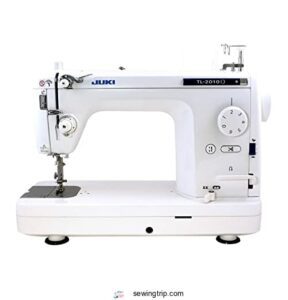
If you’re serious about FPP, the Juki TL-2010Q is worth every penny. This machine is built for straight-stitch precision — exactly what paper piecing demands. It reaches up to 1,500 stitches per minute, but the speed control lever lets you dial it back for tricky sections. The knee lifter is a transformative tool, freeing your hands to guide fabric without fumbling.
Its aluminum body manages heavy layers without complaint, and the automatic thread trimmer keeps your workflow moving smoothly between sections.
| Best For | Quilters and sewists who work primarily with straight stitches and need a fast, durable machine that can handle heavy fabrics and large projects. |
|---|---|
| Sheet/Unit Count | 1 machine |
| Primary Use | Straight-stitch quilting |
| Material | Aluminum alloy |
| Quilting Compatible | Yes |
| Package Weight | 38 lb (17 kg) |
| Acid-Free / Safe | N/A (metal machine) |
| Additional Features |
|
- The knee lifter is a game-changer — keeps your hands free to manage bulky layers while you sew
- Built like a tank thanks to the aluminum body, so denim, upholstery, and thick quilts are no problem
- Automatic thread trimmer and needle threader cut down on the little frustrations that slow you down during long sessions
- Straight stitch only — if you ever need a zigzag or decorative stitch, this isn’t your machine
- At 38 lbs, it’s portable in theory, but hauling it around regularly gets old fast
- There’s a learning curve out of the box, and the manual warns you’ll want to keep it close for the first few weeks
4. Gutermann White Mercerized Cotton Thread
Thread might seem like a small detail, but it makes a real difference in FPP. Gutermann’s white mercerized cotton thread is a quilter’s quiet workhorse — smooth, strong, and low-lint, so it glides through paper foundations without gunking up your machine.
Its 50–60 weight range ensures seams stay thin and crisp. The mercerized finish also minimizes fraying, keeping piecing beautifully intact.
Just keep it away from heavy synthetics — this thread performs best on cotton fabrics.
| Best For | Quilters and hand-sewers working with lightweight cotton fabrics who need a smooth, low-lint thread that keeps seams clean and precise. |
|---|---|
| Sheet/Unit Count | 1 spool |
| Primary Use | Hand & machine sewing |
| Material | Mercerized cotton |
| Quilting Compatible | Yes |
| Package Weight | 4.54 g |
| Acid-Free / Safe | Not specified |
| Additional Features |
|
- Mercerized finish means it glides through fabric and paper foundations without fraying or leaving lint behind
- Fine enough to keep seams thin and crisp — great for detail work like FPP and eyebrow threading
- 273 yards per spool gives you plenty to work with for the price
- Very thin and hard to see, and it can snap on the first stitch if your fabric is dense or heavy
- Prone to tangling at the end — a little beeswax helps, but it’s an extra step
- Strictly a cotton-fabric thread; skip it if you’re working with synthetics or heavier materials
5. Schmetz Universal Machine Needle Size 80 12
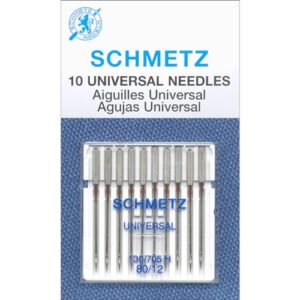
Your needle is the unsung hero of FPP — and the Schmetz Universal 80/12 earns its spot in every quilter’s kit. Its slightly rounded tip glides through woven cottons without shredding fibers, and the polished eye keeps your 50-weight thread running smoothly.
Paper dulls needles fast, so swap in a fresh one for each project. You get 10 per pack, which makes that easy.
Compatible with most home machines, it’s a simple, affordable upgrade that quietly keeps your stitches clean and consistent.
| Best For | Quilters and home sewers who need a reliable, everyday needle that works with most machines and handles woven and knit fabrics without fuss. |
|---|---|
| Sheet/Unit Count | 10 needles |
| Primary Use | General fabric sewing |
| Material | Steel |
| Quilting Compatible | Yes |
| Package Weight | 0.02 lb (9 g) |
| Acid-Free / Safe | Not specified |
| Additional Features |
|
- Works with a wide range of home machines, including Singer and Viking
- 10 needles per pack makes it easy to swap fresh ones often — great for paper piecing
- Affordable and easy to stock up on
- Only 10 needles per pack, so heavy users will need to reorder often
- Not suited for leather, denim, or heavy upholstery fabrics
- Imported, so shipping can take longer than buying local
Prepare Patterns and Fabric

Getting your patterns and fabric ready is honestly where the magic begins.
A few smart choices upfront save you a lot of headaches once you’re at the machine.
Here’s what you need to do before you sew a single stitch.
Choosing The Right Foundation Paper
Not all foundation paper is created equal, and picking the right one makes your whole project easier.
Regular printer paper excels in Paper Weight and Ink Compatibility — it’s cheap and tears away cleanly.
If you love seeing through to your lines, tracing paper or Vellum tracing paper offers better Translucency Level.
FPP specialty paper like Carol Doak’s balances Tear Strength with Reusability Options beautifully.
Skip cardstock — it’s just too stiff.
Printing Templates at 100% Scale
Once your paper is chosen, getting your template printed right matters more than most beginners expect. Open your PDF, find the print settings, and set Page Scaling to None — sometimes labeled "don’t scale" or "Actual Size." Skip "Fit to Page" entirely.
Confirm Printer Tray Selection matches your paper size, then run a Calibration Test Print. These steps ensure exact size printing, which keeps every seam lining up perfectly.
Checking The 1-inch Test Square
Now that you’ve got your template printed, grab a ruler and check the test square on your sheet — it should measure exactly one inch. This quick calibration step catches printer scaling errors before you cut a single piece of fabric. Hold your ruler’s accuracy within 1/16 inch.
Nail this, and your seam allowance and paper placement stay spot-on throughout the whole block.
Cutting Templates With Paper Scissors
Once your test square checks out, it’s time to cut those templates — and yes, use paper scissors, not your fabric scissors. Scissor blade care matters here!
- Tape templates down for paper stabilization
- Use a light grip technique along the cut line
- Practice small snip control at tight corners
- Verify each precisely cut edge against your pattern
Keep your cutting mat clean and you’re set.
Selecting Fabric Scraps for Each Section
Value Contrast first — light, medium, and dark in each section. Color Pairing warm tones against cool ones keeps things lively. Scale Mixing means pairing a bold print with a quiet micro-print nearby.
For Texture Matching, stick to similar-weight cottons.
Good Scrap Organization — sorted by color family and size — makes fabric selection for quilt blocks so much faster.
Cutting Fabric Oversized for Coverage
Cut every fabric piece a generous ½ to ¾ inch bigger than its template section — that’s your oversized seam allowance doing its job. Place each scrap on your cutting mat, then use your rotary cutter to trim a clean, straight edge. Mark excess edges with a fabric pencil for easy aligning margins later.
This bulk reduction strategy means fewer seam ripper moments ahead!
Using Light to Check Placement
Holding your fabric up to the light is one of those small tricks that saves big headaches. Before you sew, peek through the fabric to confirm every piece sits exactly where it should.
- Use a lightbox for backlit alignment — it shows fabric edges clearly
- Try shadow-free checking with a diffuse, even light source
- Apply the light angle technique — low angles reveal gaps fast
- Do a color consistency check to spot wrong fabrics instantly
- Reuse the same lighting setup every time for reliable results
Sew, Trim, and Finish Blocks
This is where the real magic of foundation paper piecing comes together. Each step builds on the last, so working through them in order makes the whole process feel surprisingly smooth.
Here’s exactly what to do from your very first stitch all the way to joining your finished blocks.
Placing The First Fabric Piece

Place your first fabric piece wrong-side down on the non-printed side, ensuring grain alignment runs parallel to the paper’s long edge.
Check arrow matching against your template markings, then confirm a full ¼-inch margin overlap on all sides.
A light dab of adhesive securing keeps things flat—no need to prevent air pockets if it’s sitting flush.
Sewing With a Short Stitch Length

Set your machine between 1.5 and 1.8 mm—that sweet spot perforates the paper just enough for easy tearing later. Always do stitch testing on scrap fabric first, because thread tension surprises nobody, like a puckered seam mid-project!
- Needle selection matters: an 80/12 universal keeps stitches clean on paper foundations
- Short stitch length locks seams securely through every paper piecing layer
- Edge finishing stays neat when tension is balanced before you begin
Adding Each Fabric Section in Order

Think of your template numbers as a road map — follow them in order and you won’t get lost.
| Step | Action | Why It Matters |
|---|---|---|
| 1 | Place fabric on Section 1 | Anchors your starting point |
| 2 | Light-check verification | Confirms full area coverage |
| 3 | Sew along seam line | Ensures seam line consistency |
| 4 | Pinky-finger guidance while feeding | Prevents fabric distortion |
| 5 | Press between each new addition | Keeps layers crisp and flat |
Each piece needs overlap measurement of at least ¼ inch beyond the seam line. Trust your section numbering — fabric alignment stays true when you don’t skip ahead.
Trimming Seams to ¼ Inch
Now that each section is sewn down, it’s time to press and trim those seam allowances to a clean ¼ inch. Fold the fabric back along the stitched line, then use your seam gauge or add-a-quarter ruler as a trim guide. Trim excess fabric with confidence — bulk reduction here keeps your block flat and neat.
For corners, snip diagonally to avoid lumpy intersections.
Pressing Seams After Each Step

Once you’ve trimmed, pressing is where your block really comes to life. Grab your iron and use these steps for sewing and pressing seams cleanly:
- Press from the wrong side first, lifting — never sliding — the iron
- Match your steam settings to your fabric temperature (cotton loves steam; synthetics prefer dry heat)
- Choose open vs. side pressing based on your pattern’s needs
- Allow seam cooling before moving on — rushing causes puckering
Good pressing tools make all the difference in finishing and pressing quilt blocks beautifully.
Trimming The Finished Quilt Block

Now that your seams are pressed flat, it’s time for finishing and trimming quilt blocks to their exact size. Place your block right-side up and use the ruler flush technique — aligning your clear acrylic ruler with seam intersection alignment points.
Trim incrementally using the incremental trimming method, rotating 180 degrees after two sides. Do a final trim check for edge square verification before moving on.
Removing Paper Without Damaging Stitches

With your block trimmed and square, it’s time for paper removal — one of the most satisfying steps!
- Flip to the back side and fold along the perforations.
- Use tweezers for handling tight corners.
- Try using moisture on stubborn bits.
- Do a final seam check for loose threads.
Short stitches make perforation techniques work beautifully. Press when done.
Joining Multiple FPP Blocks Accurately

Once your blocks are pressed and paper-free, joining them is where the quilt truly comes alive. Use grid alignment to keep edges within ⅛ inch across every seam. Corner pinning every two inches prevents shifting.
Check diagonal squaring to confirm true 90° corners. Mind your template orientation so nothing ends up mirrored.
Trim bulk at joins, and press flat before adding the next row.
Frequently Asked Questions (FAQs)
What is foundation paper piecing?
Foundation paper piecing (FPP) is a quilting technique where you sew fabric pieces onto a printed paper template in numbered order.
The paper guides every stitch, giving you sharp points and accurate shapes every time.
How do I make a foundation paper-pieced block?
Start with a printed paper template, place fabric pieces in numbered order, sew through the lines, trim seam allowances to ¼ inch, press each section flat, then remove the paper.
How do I print a foundation?
Open your printer dialog, choose "Actual Size" or the No Scaling Option, and pick Color Mode Choice if your pattern uses color guides.
Confirm Print Margin Settings won’t crop edges, then print.
How do you make a foundation piecing?
You place fabric scraps onto a numbered paper template, sew in order, trim seams to ¼ inch, press, then tear away the paper once your block is complete.
Can I use freezer paper for curved FPP designs?
Freezer paper works wonderfully for curved FPP designs. Its curved template adhesion keeps fabric steady while you sew intricate designs.
Just press gently, use a short stitch length, and peel slowly when done.
How do I fix puckered seams in finished blocks?
Puckered seams usually mean tension is off or the seam wasn’t pressed flat.
Lower your top thread tension, use a walking foot, and give it a good steam block. A seam roller and light starch spray smooth things right out.
What thread colors work best for scrappy quilts?
Neutral Blends like white or gray 50wt cotton thread — Gutermann or Aurifil — disappear beautifully into fabric scraps.
Try Tone on Tone for harmony, Color Accents for personality, or Variegated Threads for simple High Contrast magic.
How do I resize FPP patterns for different blocks?
To resize FPP patterns, adjust your printer’s scale percentage to match your target block size.
Always print a test square first to verify accuracy, then record the new dimensions so you can reuse the pattern later.
Can FPP blocks be machine quilted after assembly?
Once the paper is removed and seams are pressed, your FPP blocks are ready for machine quilting.
Use a walking foot for even feeding, and keep your stitch density balanced so those crisp points stay sharp.
Conclusion
Remember the first time you threaded a needle by candlelight, squinting at something you hoped would hold? Foundation paper piecing hands you that same quiet confidence—without the guesswork.
You’ve got the templates, the technique, and a scrap bin full of potential.
Every block you stitch from here is proof that precision isn’t a talent reserved for experts. It’s a skill you’ve already started building, one numbered section at a time.
- https://quietplaydesigns.com/blogs/blog/foundation-paper-piecing-tips-part-one?srsltid=AfmBOorFhhv4WTGXGjWOnK42WBm1wIgOUJUeNKGIDSZH4icfqBbDW2pA
- https://www.modernlymorgan.com/how-to-foundation-paper-piece-tutorial/?srsltid=AfmBOop0KGITx-xnHERrsH7BBEOz5vpRgPeQOuFx-uQ_uNimwsquDPBf
- https://www.blossomheartquilts.com/2016/12/foundation-paper-piecing-tutorial/
- https://www.diaryofaquilter.com/how-to-foundation-paper-piece-quilts/
- https://weallsew.com/beginner-friendly-foundation-paper-piecing/