This site is supported by our readers. We may earn a commission, at no cost to you, if you purchase through links.
Somewhere in England, around 1770, a quilter picked up a scrap of paper and changed needlework forever. She wrapped fabric around it, stitched the folded edges down, and discovered something striking—paper made precision possible. That single insight became the English paper piecing method, and 250 years later, quilters still swear by it.
There’s something almost meditative about working this way. No sewing machine humming, no rushing. Just fabric, paper, and a needle moving through cloth at whatever pace feels right. This technique quietly solves everything—one perfectly wrapped hexagon at a time.
If you’ve ever struggled with wonky points or mismatched seams, this technique quietly solves everything—one perfectly wrapped hexagon at a time.
Table Of Contents
- Key Takeaways
- What is English Paper Piecing?
- Top 6 English Paper Piecing Supplies
- Prepare Templates and Fabric
- Choosing Paper, Cardstock, or Reusable Templates
- Cutting Accurate Paper Shapes for EPP
- Adding ¼-inch to ⅜-inch Seam Allowance
- Using Acrylic Templates for Clean Fabric Cuts
- Rotary Cutting Tips for Small EPP Pieces
- Fussy Cutting Fabric Motifs for Decorative Blocks
- Organizing Prepared Pieces Before Stitching
- Baste and Stitch EPP Pieces
- Thread Basting Folded Fabric Around Templates
- Glue Basting for Faster Preparation
- Comparing Thread Basting Vs Glue Basting
- Keeping Stitches Out of The Paper Template
- Sewing Pieces Together With Whipstitch
- Using Flat-back Stitch for Invisible Seams
- Reinforcing Corners and Matching Points Neatly
- Removing Paper Templates After Assembly
- Finish English Paper Piecing Projects
- Creating Beginner-friendly Hexie Flowers
- Joining Small EPP Units Into Larger Blocks
- Adding EPP Blocks to Quilts and Appliqué Projects
- Pressing Seams for a Flat Quilt Top
- Preparing The Quilt Top With Batting and Backing
- Using EPP for Coasters, Tote Bags, and Wall Hangings
- Storing Templates for Future English Paper Piecing Projects
- Frequently Asked Questions (FAQs)
- Conclusion
Key Takeaways
- English Paper Piecing uses paper templates to hold fabric shapes precisely in place, letting you hand-stitch perfect hexagons, diamonds, and triangles without a sewing machine.
- You can baste with thread or a glue stick — thread holds stronger, glue moves faster — so match your method to however you like to work.
- The right supplies make a real difference: quilting-weight cotton, a fine size-10 needle, and 50wt thread keep your stitches nearly invisible and your seams flat.
- EPP isn’t just for quilts — those same hand-stitched blocks translate beautifully into coasters, tote bags, and wall hangings once you’ve got the basics down.
What is English Paper Piecing?
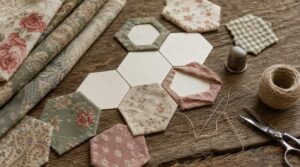
English Paper Piecing is one of those crafts that sounds fancier than it is — but once you get it, you’ll wonder why you ever relied on a sewing machine. At its heart, it’s a hand-sewing method that uses paper templates to shape fabric into crisp, precise pieces.
If you ever want to pair your hand-stitching hobby with a reliable machine for backing or binding, a best sewing machine for home use doesn’t need to be fancy — just a good fit for how you actually sew.
Here’s what you need to know before we get into the good stuff.
Definition of The English Paper Piecing Method
English Paper Piecing — EPP — is a handstitching technique where you wrap fabric around paper templates, then join the pieces using the whip stitch method. It’s all about handcrafted accuracy.
The paper acts as your guide, keeping every edge crisp and every angle true. The technique’s scope is wide — hexagons, diamonds, triangles — and the precision benefits are real.
No machine needed. Just your hands, a needle, and intention. utilizes small fabric scraps to make the most of leftover material.
How Paper Templates Stabilize Fabric Shapes
That’s where paper templates earn their keep. Think of them as a skeleton — holding everything in its place while you work. Edge rigidity keeps corners from softening into mush. Angle preservation means your diamonds stay diamond-shaped. And fabric creep control? No sneaky shifting mid-stitch.
Here’s what paper stabilizers do for you:
- Lock seam lines for consistent seam lines across every piece
- Support precise point alignment at corners and joins
- Prevent distortion when basting or handling small shapes
- Enable clean, repeatable cuts — especially with rotary cutters and acrylic templates
Why EPP is Ideal for Precise Hand Piecing
Hand sewing techniques for quilting blocks don’t get more satisfying than this. English Paper Piecing gives you sharp angle control, consistent seam width, and uniform scale replication — stitch by stitch, piece by piece.
Understanding paper as a stabilizer in quilting means minimal fabric waste too. The best part? It’s portable stitching — your project goes wherever you go.
Common EPP Shapes: Hexagons, Diamonds, and Triangles
Three shapes form the foundation of most English Paper Piecing projects — each bringing something unique to the table:
- Hexagons — Six-sided stars of hexagon tessellation patterns, they tile together in honeycomb grids without any gaps.
- Diamonds — Perfect for diamond chevron motifs and tumbling block designs with their 60-degree angles.
- Triangles — Small but mighty, they create triangle starbursts and fill corners between hexagonal blocks.
Mixing all three creates stunning mixed-shape block designs.
Brief History of English Paper Piecing in Quilting
Dating back to the 1770s, English Paper Piecing is one of quilting’s oldest surviving traditions. Victorian quilters turned it into an art form — vintage hexagon quilts became symbols of domestic pride.
The Great Depression sparked a revival, with scraps replacing luxury yardage. American adoption followed naturally.
Today’s contemporary resurgence keeps these English Paper Piecing techniques alive through modern tutorials and passionate online communities.
Top 6 English Paper Piecing Supplies
Before you sew a single stitch, supplies make all the difference. The right fabric, needle, and thread can turn a frustrating project into one you actually enjoy.
Six go-to picks that work beautifully for English paper piecing.
1. Debbie Beaves Flowerhouse Cotton Squares
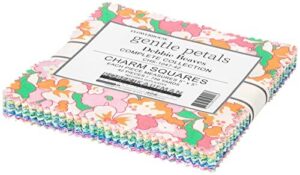
If you want your EPP project to feel cohesive right from the start, the Debbie Beaves Flowerhouse Gentle Petals Charm Pack is a dream pick. It includes 42 pre-cut 5-inch squares of 100% cotton, featuring soft vintage florals with classic 1930s charm. The coordinated palette eliminates the need for color-matching, ensuring a harmonious look.
The prints are stable and the lines crisp, making them ideal for basting around templates. This results in less fussing, more stitching, streamlining your creative process.
| Best For | Quilters and patchwork lovers who want a ready-to-go, color-coordinated fabric set without the hassle of cutting their own squares. |
|---|---|
| Material | 100% cotton |
| Primary Use | Quilting & patchwork |
| Project Scale | Small to medium |
| Pre-cut/Ready | Yes, pre-cut |
| Brand | Robert Kaufman |
| Washable | Yes, pre-wash recommended |
| Additional Features |
|
- 42 pre-cut 5-inch squares save you serious cutting time right out of the gate
- 100% cotton with coordinated florals — no second-guessing which prints go together
- Perfect size for EPP, charm quilts, and small patchwork blocks
- Won’t work for larger pattern pieces — you’re limited to small blocks or accents
- Bigger projects may need extra yardage to round out the palette
- Pre-washing is a must if you want to avoid shrinkage surprises down the line
2. Riley Blake Swiss Dot Cotton Fabric
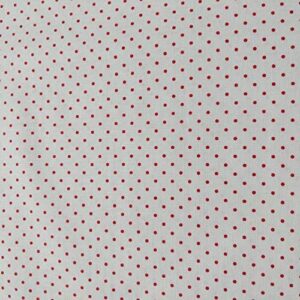
Riley Blake Swiss Dot Cotton Fabric is one of those quiet workhorses you’ll reach for again and again. At $6.55 a yard, it’s 100% quilting-weight cotton — soft, breathable, and easy to press. The crisp white dots sit about half an inch apart, adding visual texture without overwhelming busier prints.
When you’re ready to sew, pairing this fabric with hand stitching techniques that prevent stretch keeps those delicate dot patterns perfectly aligned at the seams.
This natural blender fabric excels as a backdrop for background hexagons or filler pieces. Pair it with bolder florals, and your EPP layout gains rhythm. Its subtle design ensures versatility, making it ideal for projects requiring understated elegance.
| Best For | Quilters, sewists, and crafters who want a soft, versatile cotton fabric that works as a background or blender in apparel, quilts, and home projects. |
|---|---|
| Material | 100% cotton |
| Primary Use | Quilting & apparel |
| Project Scale | Small to large |
| Pre-cut/Ready | Cut by yard |
| Brand | Riley Blake Designs |
| Washable | Yes |
| Additional Features |
|
- 100% cotton — soft, breathable, and easy to work with whether you’re quilting or sewing clothes
- The subtle Swiss-dot pattern adds just enough visual interest without competing with bolder fabrics
- Sold by the yard, so you only buy what you need — great for small projects or sampling before committing
- The dot pattern leans more polka-dot than traditional Swiss dot, which might disappoint if you’re after that classic raised-dot texture
- No fabric width listed, so you’ll want to confirm that before ordering
- Only available in single-count units, which makes bulk buying a bit awkward if you need a lot
3. Aleenes Temporary Fabric Glue Stick
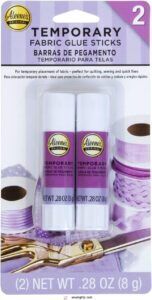
Glue basting changed everything for EPP beginners — and Aleene’s Temporary Fabric Glue Stick is exactly why. This clear acrylic stick holds your fabric edges snugly against paper templates without any mess or fuss.
Each pack includes two 0.28 oz sticks, and the formula dries in about a minute, staying completely clear. No residue, no stiffness — just crisp, flat folds ready to stitch.
When you’re done, it washes out in a regular cycle, clean and simple.
| Best For | EPP beginners and quilters who want a clean, fuss-free way to hold fabric in place while hand-stitching. |
|---|---|
| Material | Acrylic |
| Primary Use | Fabric basting |
| Project Scale | Small to medium |
| Pre-cut/Ready | Ready to use |
| Brand | Sewline |
| Washable | Yes, washes out |
| Additional Features |
|
- Dries clear in about a minute with no sticky residue or stiffness
- Washes out completely in a regular laundry cycle
- Mess-free alternative to basting spray — great for appliqué, binding, and embroidery work
- Only temporary, so it won’t hold up for permanent seams or heavy fabrics
- The 0.28 oz sticks run out fast on bigger projects
- Some users have received sticks that were dry or cracked right out of the package
4. Tulip Size 10 Big Eye Needle
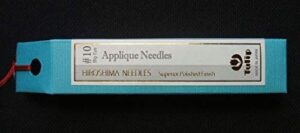
A needle that’s actually fun to thread — that’s the Tulip Size 10 Big Eye. These Japanese-made, nickel-plated needles come six to a pack, and their oversized eye simplifies threading fine threads.
The 0.46 mm shaft is thin and flexible, allowing it to glide through tight seams without distorting fabric. A sharp, polished tip and smooth finish ensure precision during use.
Ideal for delicate EPP shapes like tiny hexagons or fussy-cut diamonds, this needle delivers real control — stitch after precise stitch.
| Best For | Hand sewers who do English paper piecing, appliqué, or quilting and want a needle that’s easier to thread without sacrificing precision. |
|---|---|
| Material | Alloy steel |
| Primary Use | Hand sewing |
| Project Scale | Small to medium |
| Pre-cut/Ready | Ready to use |
| Brand | Sewline |
| Washable | Yes, hand wash |
| Additional Features |
|
- The big eye makes threading fine thread way less of a headache
- Flexible alloy steel glides through tight stitches without snapping
- Sharp, polished tip keeps stitches clean on delicate fabrics
- Too thin for heavy or thick materials — it’ll bend under real pressure
- Some users still need a needle threader despite the larger eye
- Pricier than standard sharps, and shipping can be hit or miss
5. Aurifil Necessities 50wt Cotton Thread
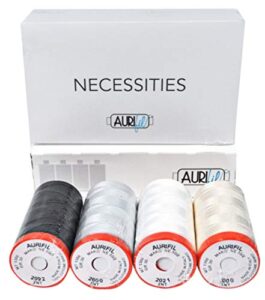
Thread matters more than most beginners realize — and Aurifil Necessities 50wt is the kind that makes every stitch feel intentional. This kit gives you four large spools (1,422 yards each) in all-purpose neutral shades, ensuring coverage for project after project.
The 100% mercerized Egyptian cotton is smooth, strong, and lint-free, producing nearly invisible stitches. For EPP, this translates to flat, crisp seams with minimal thread visibility.
It’s fine enough to disappear into your work — yet sturdy enough to endure long-term use.
| Best For | Quilters and hand-sewers who want a reliable, high-quality neutral thread that works beautifully across a wide range of projects, from EPP to large machine-pieced quilts. |
|---|---|
| Material | 100% Egyptian cotton |
| Primary Use | Quilting & piecing |
| Project Scale | Large projects |
| Pre-cut/Ready | Ready to use |
| Brand | Aurifil |
| Washable | Yes, wash resistant |
| Additional Features |
|
- Four generous 1,422-yard spools give you plenty of thread to tackle big projects without constantly reordering.
- Smooth, lint-free Egyptian cotton means cleaner stitches and less frustration with your machine.
- Strong enough to hold up through washing and heavy use, so your finished pieces actually last.
- Some sewers run into breakage at higher machine speeds, which can slow down your workflow.
- The neutral color kit is limited — if you need anything beyond basic shades, you’ll have to buy extra spools separately.
- At around $12 a spool, it’s pricier than synthetic options, which may add up fast for high-volume projects.
6. Warm Natural Cotton Quilting Batting

Once your thread is sorted, the next layer to think about is batting. The Warm Company’s Natural Cotton Quilting Batting (model 2310W) is a favorite for good reason: it’s **100% U.S.
-grown cotton, free of resins or chemicals, and breathes beautifully**.
At 34 × 45 inches, this batting is perfectly sized for smaller English Paper Piecing (EPP) projects like wall hangings or table toppers. It yields a flatter, vintage look after quilting.
Expect about 2–3% shrinkage on the first wash, so plan accordingly to ensure your finished piece maintains its intended dimensions.
| Best For | Quilters and crafters making small projects like wall hangings, table toppers, or kids’ quilts who want a natural, low‑loft cotton batting that’s soft, breathable, and easy to quilt. |
|---|---|
| Material | 100% natural cotton |
| Primary Use | Quilting & crafts |
| Project Scale | Small projects |
| Pre-cut/Ready | Precut sheet |
| Brand | The Warm Company |
| Washable | Yes, machine washable |
| Additional Features |
|
- 100% U.S.–grown natural cotton, free of chemicals or resins, so it’s a good pick if you prefer more natural materials.
- Craft‑size 34 in × 45 in sheet is convenient for small quilts, EPP projects, and other smaller crafts without needing to cut from a huge roll.
- Needle‑punched with a stabilizing scrim, so it resists shifting and lets you quilt up to 10 inches apart while keeping stitches even.
- Many people find the packaging box much larger than the batting itself, which can feel wasteful and awkward to store.
- The batting is on the thinner side, so it may not be ideal if you want a puffy, high‑loft look or extra warmth.
- Can pucker or slip if not well pinned on both sides or if you’re quilting straight lines without a free‑motion foot, which may mean extra trimming and fixing later.
Prepare Templates and Fabric
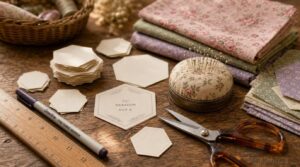
Before you stitch a single piece, you need your templates and fabric ready to go. Getting this step right makes everything that follows so much smoother.
Here’s exactly what you need to do.
Choosing Paper, Cardstock, or Reusable Templates
Your template choice shapes everything — from how clean your edges look to how much you spend over time. Each material has its moment:
- Paper templates — cheapest upfront, great for one-off trials
- Cardstock — sturdier, better cutting accuracy on tricky fabrics
- Reusable acrylic or plastic templates — higher cost, but their durability makes them worthwhile long-term
Consider environmental impact too — reusable templates mean far less waste.
Cutting Accurate Paper Shapes for EPP
Accuracy in cutting is paramount once you’ve selected your template material. Even minor wobbles can compromise your entire block. Template Flattening significantly impacts results, so store paper pieces flat.
Use an OLFA 28 mm Rotary Cutter on an Omnigrid Rotating Cutting Mat for precise, single-pass cuts. Prioritize Sharp Blade Maintenance and steady Pressure Consistency to ensure clean edges.
Always verify Cutline Verification promptly to maintain Edge Fray Control throughout the process.
Adding ¼-inch to ⅜-inch Seam Allowance
Now that your paper shapes are cut cleanly, it’s time to think about seam allowance — that little buffer of fabric that makes everything hold together.
- Use 0.25 inch seam allowances for lighter fabrics to avoid bulk.
- Switch to 0.375 inch seam allowances for heavier fabric weight.
- Consistent seam allowance calculation protects your pattern accuracy across every piece.
Precise seam tools keep your edges honest.
Using Acrylic Templates for Clean Fabric Cuts
Acrylic templates are an innovation for English Paper Piecing. Their transparent edge alignment lets you see exactly where your fabric grain and motifs sit before a single cut.
Glare-free visibility means no squinting under bright lights. For precision cutting, they pair beautifully with rotary cutters—most include blade compatibility guides.
Layer nesting multiple fabrics at once saves real time.
With proper care, template longevity tips are simple: wash gently, store flat.
Rotary Cutting Tips for Small EPP Pieces
Small pieces demand respect — and the right habits. Blade sharpness matters more than you’d think; a dull blade causes edge drift and ragged cuts.
Use a 28mm rotary cutter with your cutting mat and acrylic templates for precision cuts.
Practicing a steady grip technique and slow cutting speed is key — short, deliberate strokes beat long, rushing ones every time.
Fussy Cutting Fabric Motifs for Decorative Blocks
Fussy cutting is where EPP gets truly personal. Center a beloved floral or geometric motif inside your acrylic template — that’s Acrylic Alignment in action. Press lightly with a washable marker to confirm Motif Centering before trimming.
Sharp blades and Fabric Stabilization on your mat keep edges clean. Margin Consistency around every side ensures Stitching Precision when your decorative blocks come together beautifully.
Organizing Prepared Pieces Before Stitching
Think of your workspace as a quilt map — every piece has a home before it’s sewn.
- Use shape sorting trays to separate hexagons, diamonds, and triangles by size
- Add color-coded labels so your layout stays intentional, not guesswork
- Keep a piece count checklist to track what’s ready
- Arrange a flat storage layout to prevent edge distortion
- Grab a portable organization tote for stitching on the go
Baste and Stitch EPP Pieces
This is where the real magic of EPP happens — the basting and stitching.
You’ve got a couple of ways to approach it, and small technique choices here make a big difference in your finished seams.
Here’s exactly what you need to know to get each piece right.
Thread Basting Folded Fabric Around Templates
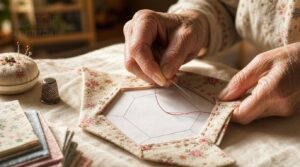
Thread basting is old-school — and honestly, it works beautifully. Fold each fabric edge snugly over your paper template, keeping fold edge tension even all around. Use a contrasting thread color so removal is easy later. A size 10–11 milliner’s needle is perfect here.
| Step | Template Stability Technique | Back Stitch Management |
|---|---|---|
| Fold corners | Crease firmly before stitching | Two anchor stitches per corner |
| Baste edges | Keep stitches off the paper | Running stitch through fabric only |
| Check tension | Tug gently — no gaps | Recheck before whipstitching begins |
Your basting needle size matters more than you’d think — too thick and you’ll distort delicate shapes.
Glue Basting for Faster Preparation
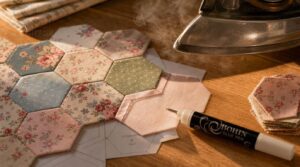
Glue basting is a genuine asset for busy crafters. A quick glue pen — like the SewLine Glue Pen — makes fast glue application a breeze.
Just dab along the seam allowance, fold your fabric over, then heat-set with a warm iron.
The bond holds firmly during stitching, stays residue-free after washing, and nails precision alignment tricks on tricky diamond points every time.
Comparing Thread Basting Vs Glue Basting
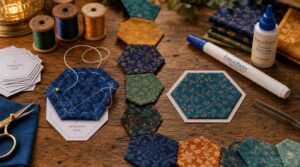
In English Paper Piecing, managing fabric basting — whether using thread or glue — requires matching your method to the moment. Honestly, it depends on your project. Thread basting offers stronger hold strength and zero-residue cleanup, preserving template longevity through repeated handling. Conversely, glue basting excels in setup speed and edge precision, particularly for tricky angles.
Thread basting holds stronger; glue basting moves faster — match your method to your moment
Ultimately, the choice hinges on prioritizing either durability and reusability or efficiency and accuracy. By aligning your technique with the project’s demands, you ensure optimal results in English Paper Piecing.
Keeping Stitches Out of The Paper Template
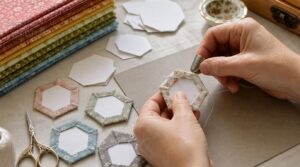
Once you’ve picked your basting method, protect that paper template like it’s precious—because it is. Keep short thread ends to avoid snagging, and always avoid needle penetration through the paper itself. Use a stiff backing and light basting margins that sit just outside the template edges.
A clean work surface helps everything stay flat and crisp.
Sewing Pieces Together With Whipstitch
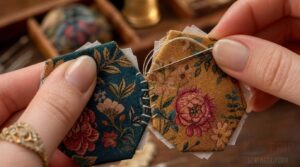
Now comes the satisfying part — actually sewing your pieces together. Whipstitch is the go-to stitch in English Paper Piecing: hold two basted pieces right sides together, then catch a tiny bite of each edge in a smooth diagonal loop. Aim for 10–12 stitches per inch.
Needle choice matters — a size 10 milliner’s needle glides cleanly.
Match your thread to your fabric, keep tension control steady, and maintain consistent stitch density so seams lie perfectly flat.
Using Flat-back Stitch for Invisible Seams
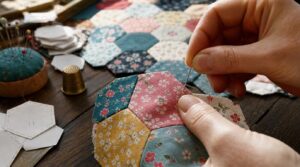
Want stitches that simply disappear? The flat-back stitch is your secret weapon in hand sewing.
- Match thread color exactly to your fabric undertone
- Keep precise stitch length at 18–22 stitches per inch
- Control stitch tension — just snug, never puckered
Your needle enters perpendicular to the seam, catching only the folded edge. Fine polyester thread and careful fabric weight compatibility make invisible stitches feel almost like magic.
Reinforcing Corners and Matching Points Neatly
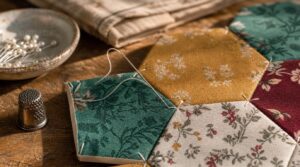
Crisp edges and perfect points don’t happen by accident — they’re built, stitch by stitch.
| Step | What to Do |
|---|---|
| Precise Pin Marking | Mark junction points with erasable pencil before stitching |
| Corner Bead Overlap | Fold a tiny fabric triangle 0.8–1.2mm beyond the corner |
| Even Whipstitch Spacing | Keep 1.5–2mm Stitch Length Consistency throughout |
| Thread Tension Management | Snug — never pulled tight — prevents puckering |
| Corner Catching Method | Add 2–3 extra stitches at every corner seam |
This corner catching method turns invisible stitches into invisible problems, weaving them seamlessly into the fabric itself.
Removing Paper Templates After Assembly
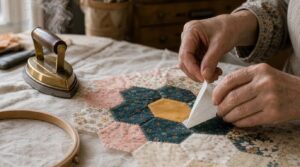
Once your block is stitched, it’s time for the satisfying part — freeing those paper templates. Use the Edge Lifting technique: tilt each template away from the seam (never straight up) and peel slowly.
For glue-basted pieces, Adhesive Softening with warm steam loosens the bond beautifully. Residue cleaning is easy with mild soap.
Store templates flat for reuse — paper versus plastic templates both work wonderfully for quilting.
Finish English Paper Piecing Projects
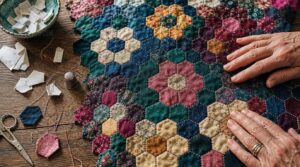
You’ve basted, stitched, and pulled those paper templates free — now comes the fun part. Finishing an EPP project is where all those tiny, careful pieces finally become something real.
Here’s how to take it all the way home.
Creating Beginner-friendly Hexie Flowers
Hexie flowers are the perfect "first project" moment in EPP. Start with a center placement — one hexagon surrounded by six petals. Think about your petal color palette early; contrasting shades make the bloom pop.
Motif orientation matters too — rotate each piece so printed designs face outward evenly.
This beginner-friendly quilting method teaches assembly sequence naturally, and flower size scaling is as simple as choosing larger hexagons.
Joining Small EPP Units Into Larger Blocks
Once your hexie flowers are ready, the real puzzle begins: fitting small units into a cohesive larger block.
Start by joining pairs first, as pairwise unit joining reduces handling and maintains consistent seam tension control. Work outward in rings, checking dimensions every two rows to catch any drift early.
Use a whip stitch with accurate row spacing, and keep paper templates inside until every seam is secured.
Adding EPP Blocks to Quilts and Appliqué Projects
Your finished EPP block deserves a home that shows it off. For clean edge alignment and consistent block spacing, center each piece on your background fabric before committing to stitching. Attachment techniques range from needle-turn appliqué to glue-baste-then-machine-stitch — both work beautifully.
Fabric stability matters too, so choose a firm cotton backing to prevent shifting. Hand stitching keeps delicate edges intact.
Pressing Seams for a Flat Quilt Top
Pressing makes or breaks your quilt top — don’t rush it. Seam direction matters: press toward darker fabric to hide bulk. At intersections, press open to keep things flat.
Always use a pressing cloth to protect delicate fabric, and match your iron temperature to your material.
- Press seams toward darker fabric
- Open intersections to reduce bulk
- Use a pressing cloth always
- Set iron temperature carefully
- Work center outward for flat edges
Preparing The Quilt Top With Batting and Backing
Once your quilt top is pressed flat, it’s time to build your quilt sandwich. Lay your backing wrong side up, ensuring at least 6 inches of Backing Overhang on every side. Center the batting next, followed by your quilt top face up.
Begin Layer Basting from the middle outward. This Batting Alignment technique ensures smoothness for Binding Preparation and enables clean Edge Trimming in later stages.
Using EPP for Coasters, Tote Bags, and Wall Hangings
Your EPP skills don’t stop at quilts. Think coasters — small hexagon clusters stitched into a 4–6-inch unit, layered with batting for durability, and sealed with neat edge finishing.
Add tote bag interfacing behind a 12×14-inch panel to provide structure without bulk. For wall hangings, use sturdy cotton backing to keep larger geometric layouts flat and display-ready.
Design scaling ensures every project feels intentional, balancing creativity with functional craftsmanship.
Storing Templates for Future English Paper Piecing Projects
Good templates are worth protecting. Store yours in acid-free envelopes, then place them flat inside a labeled box. Ensure your labeling system includes shape, size, and count for quick access later. Keep boxes away from light to prevent fading.
Conduct a periodic inventory every 6–12 months to maintain organization. This system ensures removing paper and reusing templates becomes effortless in the future.
Frequently Asked Questions (FAQs)
Can EPP be combined with machine quilting later?
Yes — hand-stitched blocks, machine quilting, and a walking foot work beautifully together. Once your paper-free preparation is complete, a zigzag edge join keeps everything flat for a smooth hybrid quilting approach.
How do you handle fraying edges on silk fabric?
Silk loves to fray — fast. Pre-wash silk first to relax the fibers, then use a narrow rolled hem or French seam finish.
A zigzag edge stitch or silk sealant application keeps edges clean while hand sewing.
What thread colors work best for dark fabrics?
For dark fabrics, reach for dark gray matching or navy blend threads — they disappear into the seam. WonderFil’s InvisaFil 100wt is a dream. Charcoal contrast works beautifully on textured darks.
How many pieces fit in a travel pouch?
Like a well-packed carry-on, a compact 6×9-inch travel pouch holds 4–6 small items. Add clear compartments and you’ll double that — perfect for your portable stitching setup.
Are EPP projects suitable for children to learn?
EPP is wonderfully beginner-friendly for kids. Short sessions naturally build motor skills.
Age-appropriate hexagon patterns teach color concepts.
Fabric-safe glue keeps setup simple.
With supervision and an EPP Starter Kit, they’ll thrive.
Conclusion
Think of every quilt as a quiet argument—that slowness has value, that precision is its own reward.
The English paper piecing method proves that theory beautifully. Each wrapped hexagon, each whipstitched seam, is evidence stitched in fabric.
You’re not just making something pretty. You’re building a skill that compounds—every basted shape sharpening your eye, every finished block deepening your confidence.
Start small. Stay curious. Your needle already knows the way.
- https://englishpaperpiecingjourney.wordpress.com/the-history-of-english-paper-piecing/
- https://faithandfabricdesign.com/2017/04/english-paper-piecing-history-epp.html
- https://www.selvedge.org/blogs/selvedge/textile-traces-english-paper-piecing?srsltid=AfmBOop9-fq7qEgDcVTbrWkeCYLSov5-BwRU8Tc7kbOw-SDPSMQOpQHN
- https://shannon-brinkley.com/blogs/shannon-brinkley-studio-1/an-intro-to-english-paper-piecing-hint-its-easier-than-it-looks
- https://themakersstash.com/the-gentle-craft-of-english-paper-piecing/?srsltid=AfmBOorT3jxw3jsJBpDr9DP1H9lLuR6J2132Yas5tOo0lkMx1AQ0m4Y9