This site is supported by our readers. We may earn a commission, at no cost to you, if you purchase through links.
Fabric scraps, a hot iron, and one afternoon—that’s genuinely all it takes to finish your first appliqué block. Unlike pieced quilting, where tiny seams demand obsessive precision, appliqué lets you cut a shape, fuse it down, and stitch around the edges at your own pace.
Beginner-friendly appliqué quilting patterns lean into this forgiving rhythm, trading complexity for bold, satisfying results you can actually finish. The techniques ahead—from raw-edge fusing to blanket-stitch edging—build on each other logically, so you’ll gain confidence with every block you complete.
Table Of Contents
Key Takeaways
- Raw-edge and fusible-web appliqué are the most beginner-friendly techniques because they skip turned edges entirely, letting you cut, fuse, and stitch at your own pace without chasing perfect seams.
- Starting with large, simple shapes like hearts, stars, or circles builds your confidence fast, reduces bulk at seam intersections, and makes the whole process easier to control from the very first block.
- The right supplies—lightweight quilting cotton, sharp scissors, fusible web, and an open-toe presser foot—do most of the heavy lifting, so investing in a few key tools up-front saves real frustration later.
- The 60-30-10 color rule gives your quilt instant visual balance by splitting your fabric choices into a dominant tone, a supporting mid-tone, and a small punch of accent color, making even scrap-bin projects look intentional.
Best Beginner Appliqué Quilt Patterns
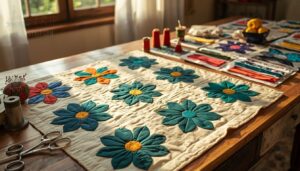
Picking your first pattern is honestly half the fun, and the good news is there’s no shortage of beginner-friendly options to explore.
From cozy geometrics to sweet florals, these quilting designs for baby blankets are a great place to start browsing for something that clicks.
The best ones give you quick, satisfying results while quite building your skills along the way. Here are some great starting points to explore.
Simple Raw-edge Appliqué Patterns
Raw-edge appliqué is one of the most beginner-friendly appliqué quilting options because it skips turned edges entirely. You simply cut, fuse, and stitch — that natural edge curl after washing is part of the raw-edge appliqué aesthetic, not a mistake. For the cleanest edge, consider fusible web stabilization.
- Bold Shape Selection keeps your simple appliqué projects for beginners readable and striking
- Contrast Color Pairings make shapes pop against plain backgrounds
- Light Fabric Choices like cotton prevent puckering
- Minimalist Design Ideas reduce overwhelm while building confidence
Fusible-web Appliqué Patterns
Fusible-web appliqué patterns feel like the natural next step once you’re comfortable with raw-edge work. Brands like Steam-A-Seam simplify this beginner-friendly approach: trace your shape, iron it down, stitch the edge.
Before committing fabric, adhesion testing methods on scraps save headaches. This ensures materials bond correctly and avoids costly mistakes.
Digital pattern libraries offer free appliqué quilt patterns with built-in pattern scaling tips and color palette planning guidance, streamlining your creative process.
Seasonal Appliqué Quilt Blocks
Seasonal appliqué quilt blocks are one of the most rewarding beginner-friendly appliqué quilts to start. Each season brings its own motif symbolism—snowflakes for winter’s stillness, blooms for spring renewal, and harvest gourds for autumn abundance.
Arrange them in a grid arrangement strategy with coordinating sashing hues to build narrative block progression. This lets your seasonal quilt ideas tell a year-long story through color and shape.
Floral and Garden Appliqué Designs
Flowers bring a garden to life, and your quilt can do the same. Floral and garden appliqué designs are perfect for beginner-friendly appliqué quilting because the shapes are forgiving and endlessly customizable. Try these free appliqué quilt patterns to get started:
- Petal layering with roses or peonies for 3D flower depth
- Faux foliage with stems and leaves anchoring each bloom
- Insect accents like bees using garden bugs appliqué patterns
Keep your garden color palettes grounded with a neutral background, letting each floral and butterfly quilt design pop naturally.
Animal Appliqué Patterns for Beginners
Animals make some of the most satisfying beginner-friendly appliqué quilting projects because the shapes are bold and forgiving. Farmyard animals like cows and pigs use large, simple pieces that don’t demand perfect cuts.
Woodland creatures—owls, foxes, and raccoons—work beautifully on pillow fronts.
Try bird silhouettes, fox motifs or a cat motif appliqué quilt idea using free appliqué quilt patterns with step-by-step sewing instructions for animal motif appliqué quilts.
Home Décor Appliqué Projects
Home décor is where appliqué truly shines. Fabric Wall Hangings allow you to transform a 12-by-18-inch cotton canvas into a striking statement piece using just two or three fused shapes.
Seasonal Pillow Designs, Kitchen Towel Accents, and Coastal Runner Projects all follow the same beginner-friendly appliqué quilting steps: fuse, stitch, finish. These approachable techniques make it easy to elevate everyday items with creative flair.
The versatility of appliqué extends beautifully to various home decor projects, especially when paired with free appliqué quilt patterns and detailed step-by-step sewing instructions. This combination ensures even novice crafters can achieve professional-looking results.
Scrap-friendly Appliqué Quilt Ideas
Every fabric scrap you’ve saved is already the start of something beautiful.
Every scrap of fabric you’ve saved is already the start of something beautiful
Scrap Color Pairing works best when mixing printed and solid pieces within each Modular Block Mix, letting Texture Contrast handle the visual impact.
Eco Upcycling through scrap fabric utilization in quilting keeps costs near zero.
Asymmetrical Layouts, guided by free appliqué quilt patterns and step-by-step sewing instructions, make beginner-friendly appliqué quilting feel genuinely creative.
Supplies for Appliqué Quilting
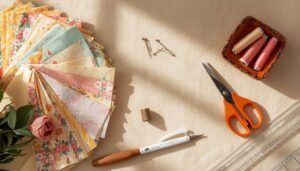
Before you cut a single piece of fabric, it helps to have the right tools within reach. The good news is that most of what you need is affordable and easy to find.
Here’s what to gather before you get started.
Beginner-friendly Cotton Fabrics
Cotton is your best friend in beginner-friendly appliqué quilting, and choosing the right weight makes everything easier.
Lightweight cottons like lawn (60–90 gsm) drape beautifully, while medium-weight cottons like quilting cotton (140–180 gsm) hold crisp edges for precise seams.
Look for these qualities when selecting fabric:
- Pre-shrunk fabrics that won’t surprise you after washing
- Colorfast cottons that keep their color through repeated washes
- Stable weaves offering the right drape and stability for clean cuts
- Smooth textures that feed easily through your machine
Fusible Web for Easy Appliqué
Fusible web is basically double-sided tape for fabric — heat activates the adhesive, bonding your appliqué shapes firmly to the background. Brands like Heat-n-Bond and Wonder Under differ in weight, so always check paper backing alignment before tracing.
Run a test swatch procedure on scrap fabric first to confirm your adhesive heat settings won’t scorch. If edges lift later, simply re-press.
Some reusable fusible options let you reposition pieces before committing.
Sharp Scissors and Cutting Tools
Sharp scissors with stainless steel blades and ergonomic grips reduce hand fatigue during extended cutting sessions. Rotary cutters excel at smooth curves, while specialty embroidery scissors navigate tight corners with precision.
Tool coatings like titanium nitride extend sharpness, minimizing blade maintenance. This ensures consistent performance over time.
For batch projects, the AccuQuilt GO! Cutter paired with the GO Circles die dramatically speeds up fabric cutting techniques, enhancing efficiency for repetitive tasks.
Tracing Tools, Including Erasable Pens
Once your shapes are cut, you need to trace the template accurately onto your fabric or fusible web. A marking pencil works fine for rough shapes, but erasable pens give you cleaner, bolder lines. Fine pen tip sizes — around 0.5 to 0.8 mm — handle small curves easily. Built-in eraser pens let you fix mistakes fast.
Always test a fabric testing swatch first, since some inks reappear in cold conditions.
Thread Choices for Visible Stitching
Test your thread just like you would a marking pen on a scrap first. Colorfastness testing before stitching prevents dye transfer surprises after washing.
For light to medium fabrics, monofilament thread nearly disappears into the surface. Contrast thread colors highlight shapes beautifully when that is your goal.
Match thread weight to fabric — 40 to 60 weight for cottons. Thread tension adjustment keeps stitches flat and clean.
Sewing Machine Feet for Appliqué
Just as the right thread makes your stitches pop, the right foot makes them precise. An Open Toe Foot is your best friend here — its open front gives you a clear view benefit that’s hard to beat when tracing curves.
Check your machine’s foot height compatibility before buying, then lower presser foot pressure on delicate fabrics and adjust stitch length adjustment for tight corners.
Needles for Different Fabric Weights
Your needle choice matters just as much as your foot selection. Think of it as matching the tool to the job — a size 70/10 works beautifully on lightweight cotton, while heavier layers need a 90/14 or 100/16.
Here’s a quick needle size guide for common appliqué fabrics:
- Light cottons and silk: Size 70/10 microtex
- Quilting cotton (medium weight): Size 80/12 sharp
- Canvas or layered denim: Size 100/16 heavy-duty
- Knits or stretch blends: Size 80/12 ballpoint
Needle tip types also affect your stitch quality — sharp points pierce woven fabrics cleanly, preventing skipped stitches. For hand versus machine appliqué, thread tension adjustment and needle compatibility keep everything running smoothly.
Press Cloth, Iron, and Ironing Board
When working with fusible web and heat-activated adhesive, your iron becomes one of the most important tools in your kit. Use a dry iron with adjustable heat settings — medium for cotton blends, high for rigid linens.
A press cloth made from cotton muslin protects your board surface and prevents scorching.
Always let pieces cool fully before handling for the strongest bond.
How to Make Appliqué Quilts
Making an appliqué quilt is more straightforward than it looks, especially when you follow a clear order of steps. Each stage builds on the last, so nothing feels rushed or out of place.
Here’s exactly how to work through the process from start to finish.
Choose a Beginner Appliqué Pattern

Your pattern choice sets the tone for everything that follows. For beginner-friendly appliqué quilting, look for free appliqué quilt patterns with large, simple shapes and step-by-step sewing instructions.
When choosing your pattern, consider:
- Theme suitability — pick designs like hearts or flowers that match your project’s purpose
- Skill progression — start with 2–4 colors for easier color harmony and fabric compatibility
- Pattern sizing — standard 12- or 16-inch blocks simplify assembly
- Beginner Style Appliqué Quilt options — fusible-web designs speed up your process considerably
Wash and Press Your Fabrics

Before you cut a single shape, your fabrics need a cold water wash to remove sizing and prevent shrinkage later. Run a quick colorfastness test — press a damp scrap against white cloth and check for dye transfer.
Then steam iron each piece while slightly damp for smooth, stable fabric preparation.
Let everything cool completely before storing or moving to your next step.
Trace Shapes Onto Fusible Web

Tracing shapes onto fusible web is where your pattern truly comes to life. Trace the template onto the paper side of your fusible web, using a lightbox or bright window for clean paper alignment. Marker choice matters—a fine, non-smearing pen keeps lines crisp.
Remember mirror placement so your design reads correctly once fused.
Add a small edge buffer margin, then cut out the fusible web paper template. Label each piece, attach the web template to your fabric, and confirm scale verification before ironing at the recommended heat setting.
Cut Appliqué Pieces Accurately
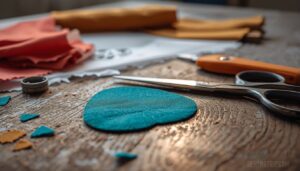
Sharp scissors are your best friend here — and your worst enemy if they’re dull. Once you’ve traced and cut out the fusible web paper template, it’s time to cut out the fabric template with precision.
- Align pieces with the fabric grain alignment for stability
- Use curve cutting techniques and notch placement along curves to reduce bulk
- Make sample test cuts on scraps first
- Check rotary blade adjustment for clean straight edges
Tools like the AccuQuilt Go cutter simplify methods for cutting and preparing appliqué pieces consistently.
Arrange Shapes on Background Fabric
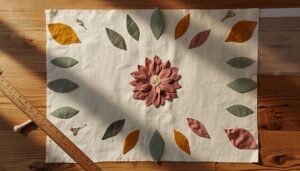
Now comes the satisfying part — seeing your design come to life before a single stitch is made. Begin with Focal Point Placement, positioning your largest shape first, then arrange appliqué pieces outward using Simple Grid Planning.
Maintain Consistent Spacing of ¼–½ inch between pieces, ensure Grain Alignment to prevent distortion, and employ Controlled Overlap at edges. These steps ensure structural integrity and visual harmony.
For precise execution, especially on dark fabrics, utilize transfer paper methods to map your design layout accurately. This technique anchors your planning and guarantees fidelity to the original vision.
Fuse Pieces With an Iron
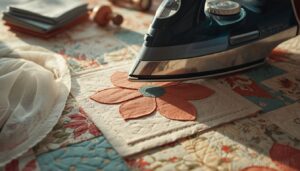
Once your pieces are positioned just right, it’s time to lock them in place. Set your iron to medium-high heat — no steam and press each shape firmly for 5 to 8 seconds. This heat-activated adhesive bonds fast, so let pieces cool fully before touching them.
If an edge lifts, re-pressing with a press cloth prevents adhesive bleed and restores the bond cleanly.
Stitch Around Each Appliqué Shape
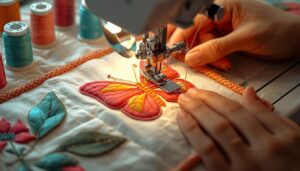
Now that your shapes are fused down, stitching seals everything for good. Your stitch choice shapes the final look:
- Zigzag stitch edge securing prevents fraying on cotton edges
- Satin stitch delivers smooth, polished decorative edging techniques
- Stabilizer underlay keeps fabric from shifting mid-stitch
- Thread color matching ties the whole design together
Watch your stitch tension tips and edge density control — two passes add durability on curves.
A straight stitch foundation for appliqué works beautifully on felt.
Add Borders, Backing, and Quilting
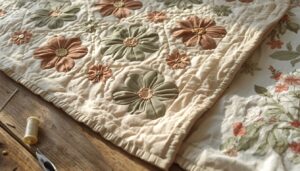
With your appliqué stitched down, it’s time to frame and finish your quilt. Border Cutting starts with strips cut one inch longer than each edge, giving you room to ease and align without stress. Backing Size should extend at least four inches beyond your quilt top on every side.
| Step | Key Detail |
|---|---|
| Basting Techniques | Smooth layers from Center outward before pinning |
| Stitch Density | Aim for 8–10 stitches per inch |
| Free Motion Quilting | Echo your appliqué shapes for added depth |
| Quilt Binding | Cut strips 2.5 inches wide for clean Edge Finishing Techniques |
Easy Appliqué Stitch Techniques
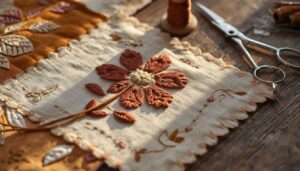
The stitch you choose can completely change the look and feel of your appliqué, so it’s worth knowing your options before you sit down at the machine. Some stitches are quick and functional, while others add a decorative touch that makes your quilt really stand out.
Here are the main techniques beginners use to secure appliqué pieces.
Straight Stitch for Simple Edges
The straight stitch is your most beginner-friendly appliqué quilting tool — clean, simple, and easy to follow. Set your stitch length between 2.0 and 3.0 mm, then sew about 1–2 mm from each shape’s edge.
Match your needle size to your fabric weight, balance your thread tension carefully, and press each edge flat after stitching for a crisp, professional finish.
Zigzag Stitch to Reduce Fraying
A zigzag stitch is your best defense against fraying raw edges in beginner-friendly appliqué quilting. Set your stitch width between 1.0–2.5 mm and stitch length around 1.5 mm, keeping the line just inside the fabric’s edge. Always run test swatches first — different fabrics behave differently. Match your needle size to fabric weight, then finish with a light pressing technique to set the stitch neatly.
- Use a narrower width on lightweight cottons to avoid puckering
- Wider settings work better on polyester blends or thicker appliqué quilt patterns
- Replace your needle regularly for clean, skip-free results
Satin Stitch for Smooth Outlines
Satin stitch gives your appliqué edges a polished, glossy finish that zigzag simply can’t match.
Start with the Edge Outlining Method — trace the shape’s border first, then fill with close parallel stitches for Uniform Stitch Spacing.
Watch your tension control carefully; too tight and you’ll get puckering.
Use fabric stabilization underneath delicate pieces.
Adjust Glossy Finish Adjustments by testing thread sheen on scrap fabric first.
Blanket Stitch for Decorative Edging
Blanket stitch gives your appliqué edges a charming, handcrafted look that truly sets your quilt apart. It loops along each edge, securing the raw fabric while creating a decorative border you’ll actually be proud of. Try these beginner-friendly appliqué quilting variations for your appliqué quilt patterns:
- Closed stitch – tucks the thread into a neat V shape
- Beaded edge – adds subtle shimmer with tiny beads
- Long-short stitch – alternates lengths for texture
- Corner turns – rotate the work slightly, keeping stitches shorter near angles
Use contrasting thread to highlight your decorative stitches beautifully.
Hand Appliqué Versus Machine Appliqué
Hand appliqué offers edge softness and fabric compatibility, particularly for delicate or curved shapes, but it involves a steeper learning curve and time efficiency suffers.
Machine appliqué is beginner-friendly, with higher equipment needs yet delivers faster, consistent, clean results for appliqué quilt patterns.
Both methods require balancing priorities, as each presents distinct trade-offs in execution and outcome.
Raw-edge Appliqué for Beginners
Raw-edge appliqué is one of the most beginner-friendly appliqué quilting methods you can start with today. You simply cut your shape, leaving a 2–4 mm border, and stitch it down — no turning required.
- Cut along the fabric grain for edge stability
- Use practice samplers to test thread tension first
- Sharp cutting techniques keep raw-edge appliqué aesthetic clean and intentional
Needle-turn Appliqué Basics
Needle-turn appliqué is where hand-sewing truly shines. You use your needle tip to fold fabric edges under as you stitch — that’s the needle turn folds technique in action. This method, known as the turned edge tension method, creates clean, flawless borders without raw fraying.
To achieve this, use fine thread blending into your fabric, size 7–9 needles, and thimble assistance to keep your hands comfortable. This ensures stitches invisible from the front, maintaining a polished finish.
Free-motion Appliqué Setup Tips
Free motion appliqué gives you more creative control than needle-turn, but your sewing machine settings make or break the results.
Start by lowering the drop feed and adjusting foot pressure so fabric moves freely under the needle. Attach a dedicated free motion foot, set thread tension slightly looser, and use a stitch regulator if available. Finally, test your stitch length adjustment on scrap fabric first.
Beginner Appliqué Quilting Tips
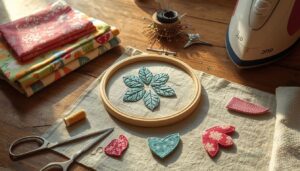
Learning a few smart habits early on makes appliqué quilting so much more enjoyable and less frustrating. These tips won’t just save you time and money — they’ll help your finished projects actually look the way you imagined them.
Here’s what every beginner quilter should keep in mind before picking up the iron or threading the needle.
Start With Large, Simple Shapes
One of the smartest moves beginners can make is starting with large, simple shapes like circles, stars, or hearts. These shapes give you visual balance right away and make color blocking feel natural and effortless. Large pieces also improve shape stability under your machine needle, so fewer things shift or pucker.
Here’s why large shapes work so well:
- They build scale perception skills without overwhelming you with tiny edges.
- They create design rhythm across your quilt through confident repetition.
- A Large Flower Quilt Idea is perfect for practicing fusible-web placement on a bold motif.
- Fewer seam intersections mean faster, cleaner results in beginner-friendly appliqué quilting.
- Step-by-step sewing instructions are easier to follow when each piece is big enough to handle comfortably.
Use Fabric Scraps to Save Money
Those large shapes you just practiced? They’re perfect for raiding your scrap bin. Budget fabric sourcing starts at home — repurposing fabric scraps in quilting can stretch your budget by 20–50% on cost-effective quilting projects.
| Scrap Use | Benefit |
|---|---|
| Color Mixing Scraps | Test palettes for free |
| Scrap Bin Organization | Find pieces faster |
| DIY Scrap Projects | Build skills cheaply |
| Community Scrap Swaps | Expand variety at no cost |
Follow The 60-30-10 Color Rule
Once your scrap bin is sorted, color decisions are next — and the 60-30-10 rule makes color palette selection for appliqué quilts surprisingly straightforward. Dominant hue selection fills 60% of your quilt, contrast balancing accounts for 30%, and accent placement covers the final 10%. This beginner‑friendly appliqué quilting approach keeps everything visually calm without looking flat.
- Assign your dominant hue to large background shapes first
- Apply contrast balancing with a complementary mid-tone across smaller blocks
- Reserve accent placement for borders or tiny motifs only
- Use color proportion testing on fabric swatches before cutting
- Create a swatch mapping card to guide your full assembly
Avoid Heavy or Stiff Fabrics
Fabric weight considerations for appliqué matter more than beginners expect. Heavy fabrics like denim or canvas resist draping and create stiff, bulky seams that fight against your stitching efforts.
For better drape management and minimizing stiffness, choose lightweight alternatives — cotton calico, muslin, or soft quilting cotton around 4 to 5 oz per square yard. These materials ensure smoother handling and reduce bulk.
Material flexibility and weight considerations are critical to keeping curves smooth and shapes clean, preventing distortion during stitching.
Test Fusible Web Before Stitching
Before you iron a single shape onto your quilt top, run a quick compatibility check on a scrap of the same fabric. This temperature setting trial helps you confirm bond flexibility inspection results and avoid adhesive bleed.
Press for 8 to 10 seconds, let it cool, then do an adhesion tug test along the edge — your fusible web for appliqué attachment should hold firm without cracking.
Backstitch to Secure Seams
Every seam you sew deserves a strong finish, and backstitching is how you give it one. Think of it as locking the door behind you — two or three reverse stitches at the start and end keep threads from pulling loose over time.
For beginner-friendly appliqué quilting, keep these step-by-step sewing instructions in mind:
- Start and End Reinforcement: Reverse stitch 2–3 times at the beginning and end of each appliqué seam.
- Stitch Length: Keep stitches even to avoid thread bulk build-up at seam ends.
- Bulk Reduction: Avoid knotting thread ends when backstitching is done correctly — it adds unnecessary thickness.
- Hand vs. Machine: Both hand-sewing and machine appliqué methods work; choose based on your fabric and comfort level.
- Thread Tension: Balanced tension prevents puckering and keeps your appliqué stitch lying flat against the quilt top.
Avoid Trimming Too Close
Trimming too close to your stitching is one of the most common mistakes in appliqué quilting—and it’s easier to do than you’d think. Leaving a small trim margin, about ⅛ inch, protects edge stability, prevents fraying, and maintains seam integrity. Close cuts can cause fraying, puckering, or tiny holes that appear after washing.
Give your edges enough breathing room to maintain their shape and durability. This simple adjustment ensures your quilt retains its structure and appearance over time.
Resize Patterns for Pillows or Totes
One pattern can take you in a dozen directions — a quilt block today, a tote bag tomorrow.
Proportional scaling keeps your design balanced: Increase both width and height by the same percentage using grid-based resizing or digital pattern scaling. Keep seam allowance tweaks consistent throughout.
Before cutting into good fabric, always test fit muslin first to catch sizing surprises early.
Customize Patterns With Colors and Texture
Color is where your pattern truly comes alive. High-contrast pairings make appliqué shapes pop, while warm-cool balance adds depth — warm tones advance, cool ones recede.
Try color blocking to draw the eye toward a central motif, then layer mixed fabric textures like wool against cotton for dimension.
Variegated thread effects catch light beautifully along every stitched edge, making even simple, beginner-friendly appliqué quilting feel intentional and polished.
Frequently Asked Questions (FAQs)
What is the 60 30 10 rule for quilting?
Ever wonder why some quilts feel effortlessly balanced?
The 60-30-10 rule divides your palette into a dominant Hero Fabric Selection at 60%, Supporting Fabric Harmony at 30%, and a punchy Accent Fabric Impact at 10%.
What are the three types of appliqué?
There are three main types: raw-edge appliqué, turned-edge appliqué, and machine-fused appliqué. Each appliqué technique varies in edge finish, skill level, and the stitch choice impact on your final look.
Can appliqué quilts be washed in a machine?
Most appliqué quilts can be machine washed safely. Use a gentle cycle with cold water and mild detergent.
Ensure fusible adhesion and stitch security are solid before washing to prevent damage.
Air dry or tumble dry low for best results.
How do I fix a lifted appliqué piece?
Slide a seam ripper gently under the lifted edge.
Dab fabric glue or a temporary fusible support beneath it.
Press flat with a cloth, then restitch using a slightly inward stitch line.
What age is suitable for learning appliqué quilting?
Most children develop the fine motor readiness for simple appliqué around ages six to eight.
With safety supervision guidelines in place, even younger beginners can start building confidence through age-specific projects like basic shapes on a pillowcase.
How long does a beginner appliqué project take?
A small beginner project generally takes 4 to 6 hours of active sewing time. Prep and fusing add another hour or two, so plan for a full weekend afternoon to finish comfortably.
Can I sell quilts made from free patterns?
It depends on the pattern’s license. Free doesn’t always mean commercial use is allowed.
Always check the designer’s terms, get written permission if needed, and keep records of any licensing agreements before selling.
Conclusion
Every quilt tells a story of small decisions made one shape at a time—and yours starts the moment you pick up those first fabric scraps. Appliqué quilting patterns for beginners offer a forgiving, creative path where each fused petal, stitched edge, and layered block builds real skill. You don’t need flawlessness to finish something beautiful.
You just need a hot iron, a little patience, and the confidence to begin.
- https://kathykwylie.com/2014/11/step-by-step-guide-to-fusible-applique/
- https://www.urbanelementz.com/patterns-books/patterns-applique/applique-patterns-by-theme/flowers-leaves.html
- https://www.instructables.com/Quick-and-Easy-Applique-Using-Fusible-Interfacing/
- https://katecollerandesigns.com/how-to-do-fusible-applique/
- https://www.contrado.com/blog/types-of-applique/