This site is supported by our readers. We may earn a commission, at no cost to you, if you purchase through links.
Tearing paper out of a finished quilt block feels satisfying for about thirty seconds—until you realize you’ve got forty more blocks to go. Traditional foundation paper piecing is precise and beautiful, but that removal step eats time, frays seams, and turns a relaxing craft into a paper-picking marathon.
Freezer paper changes everything. Bond it to your fabric, sew along its folded edge, and the foundation stays put—no removal required, no seam stress. This method eliminates the tedious teardown while maintaining crisp, accurate results.
Foundation piecing without paper removal isn’t a workaround; it’s a smarter system that cuts setup time in half while keeping every point sharp and every seam true. Your next quilt starts here.
Table Of Contents
- Key Takeaways
- What is Paperless Foundation Piecing?
- Tools for Paperless Piecing
- Prepare Your Freezer Paper Template
- Sew a Paperless Quilt Block
- Choosing a Beginner-friendly Block Design
- Cutting Fabric Pieces With Extra Seam Allowance
- Layering Fabric in Reverse Sewing Order
- Glue-basting Each Piece Before Stitching
- Sewing Beside The Folded Freezer Paper Edge
- Pressing Each Seam to Re-adhere The Template
- Checking Fabric Coverage With a Lightbox or Window
- Trimming The Finished Block Accurately
- Accuracy Tips and Design Ideas
- Keeping Fabric Grain Stable on Angled Seams
- Preventing Stretched Edges and Distorted Points
- Using Directional Fabrics Correctly
- Batch Sewing Multiple Blocks With Reusable Templates
- Creating Sharp Points Without Paper Removal
- Trying Color Improvisation and Offset Pieces
- Adapting Traditional Foundation Paper Piecing Patterns
- Reducing Paper Waste in Quilt Block Construction
- Frequently Asked Questions (FAQs)
- Conclusion
Key Takeaways
- Freezer paper replaces removable foundations entirely, bonding to fabric with heat so you never wrestle paper scraps out of finished blocks again.
- Glue-basting before every seam keeps pieces locked in place, so your points land crisp and your seam allowances stay consistent from the first block to the fortieth.
- Reusable templates cut material waste and reprinting time dramatically, turning a one-use paper system into a batch-sewing powerhouse you reach for again and again.
- Mastering a few core tools — freezer paper, washable glue, spray starch, and a 1.8mm stitch length — is all it takes to ditch traditional paper-piecing for good and never look back.
What is Paperless Foundation Piecing?
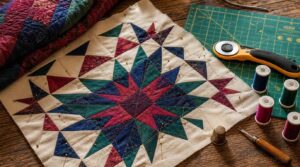
Paperless foundation piecing flips the script on traditional paper piecing — offering the same precision, zero paper removal headaches.
You can skip the ultra-short stitches that traditional paper piecing stitch length guidelines recommend purely to ease paper removal — because with paperless methods, that constraint simply disappears.
Sharon Schamber developed this method over a decade ago, and quilters haven’t looked back since.
Here’s what you need to know to get started.
How Foundation Piecing Without Paper Works
Forget wrestling with paper scraps after every seam — paperless foundation piecing techniques put freezer paper to work as your permanent guide, bonding to fabric with heat so you never tear anything away. This tear-free method keeps your blocks stable from first stitch to final trim.
- Templates printed at 100% scale guarantee exact dimensions every time
- Glue-baste adhesive holds each piece firmly before stitching
- Finished blocks trim cleanly without removing any foundation
Difference Between Paper Piecing and Paperless Piecing
Traditional Foundation Paper Piecing and paperless quilting share the same goal — precision — but take completely different roads to get there. With paper piecing, the paper removal step eats up time and generates waste. The paperless technique skips all that, cutting your setup time dramatically when compared.
| Foundation Paper Piecing | Paperless Technique |
|---|---|
| Tear away after sewing | Template stays put |
| Higher environmental footprint | Less waste, more reuse |
| Glue-baste reliance is minimal | Glue-baste reliance is central |
| Higher cost per block | Stronger cost efficiency |
The no-tear quilting method wins on every count. Using reusable freezer paper cuts material waste and streamlines the piecing process.
Why Freezer Paper Replaces Removable Paper Foundations
Freezer paper changes the game because its waxy coating creates a heat bond strength that grips fabric precisely — eliminating pins and shifting.
This adhesive reusability means you avoid reprinting after every block, delivering real eco-friendly savings and cost-effective production over time.
That’s the heart of NoTear Foundation Paper Piecing: smarter seam precision, less waste, more quilting.
Benefits of a No-tear Quilting Method
No-tear quilting delivers real, tangible wins once you experience the paperless piecing workflow firsthand.
- Improved Fabric Alignment — glue-basting holds pieces stationary, eliminating frustrating mid-seam shifts
- Consistent Seam Allowance — stable templates guide every stitch precisely
- Reduced Thread Wear — fewer do-overs mean less thread wasted
- Faster Block Replication — reusable templates support eco-friendly production while reducing template printing and fabric waste
No-Tear Foundation Paper Piecing simply works.
Best Projects for Paperless Foundation Piecing
Dive into projects that make the paperless piecing workflow genuinely shine. Start small and build confidence fast.
| Project | Why It Works With PPP |
|---|---|
| Cozy Quilt Coasters | Sharp points, small scale — perfect for practicing |
| Pocket-sized Wall Hangings | Reusable templates speed up batch production |
| Baby Blanket Squares | Consistent seams keep sizing uniform across blocks |
| Holiday Greeting Cards | Foundation piecing adds crisp fabric detail instantly |
| Travel-themed Appliqué | Paperless piecing manages curves cleanly |
DIY quilt block creation with PPP rewards every skill level.
Tools for Paperless Piecing
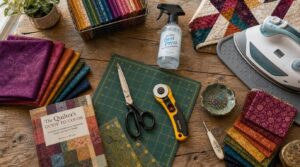
Before you cut a single piece of fabric, gather the right tools — they’re what make paperless piecing feel almost smooth. Nothing slows momentum like hunting for scissors mid-block or realizing your starch is missing.
A quick read on understanding sewing pattern markings can save you from costly cutting mistakes before you ever pick up your shears.
Here’s exactly what you need to get started.
Freezer Paper Templates Printed at 100% Scale
Your template is the backbone of every perfect block, so print it right. Set your printer DPI settings to full quality and always select "actual size" to guarantee true-scale results. Run a true-scale test with a ruler before committing to fabric.
Use ink bleed prevention settings to keep lines crisp. This ensures clean, precise edges for accurate assembly.
For batch template printing and smart storage, keep sheets flat and reusable. Store them carefully to maintain integrity and enable paperless piecing success.
Washable Glue for Glue-basting Fabric
One small bottle changes everything in paperless foundation piecing. Elmer’s Washable School Glue is the go-to glue basting method because it’s safe, flexible, and washes clean. Before you stitch, consider:
- Glue drying time — sets in minutes, so fabric compatibility stays secure
- Heat activation — a quick press bonds pieces firmly
- Safety ventilation — work near open air for comfort
Spray Starch and Stencil Brush for Crisp Folds
Sharp seams don’t happen by accident — spray starch and a stencil brush make them inevitable. Hold your can at the right starch mist distance (6–8 inches) for even coverage, then use stiff brush bristles to press creases into each seam line without shifting fabric. Check fabric type suitability before applying; cotton loves starch, synthetics need a lighter touch.
Allow the starch to dry for 30–60 seconds before pressing. Test readiness by lifting the fabric edge: a clean fold confirms it’s set.
| Step | Key Detail |
|---|---|
| Starch mist distance | 6–8 inches for even coverage |
| Starch drying time | 30–60 seconds before pressing |
| Brush bristle choice | Stiff bristles for controlled crease setting |
| Crisp fold testing | Lift edge — clean fold means it’s ready |
This method ensures every foundation piece gains crisp clean edges and starch sealing that endures through the entire block.
Rotary Cutter, Mat, Ruler, and Scissors
Your cutting toolkit is the unsung hero of every clean PPP block. Get these four tools right, and accuracy becomes second nature.
- Rotary cutter with proper blade safety guards for confident, controlled cuts
- A Mat self-healing surface that rebounds after every pass
- Clear acrylic ruler visibility keeps your seam lines true
- Sharp scissor blade maintenance prevents frayed edges
- Consistent cutting precision tips start with a fresh blade every session
Sewing Machine Settings, Thread, and Needle Choice
Your sewing machine is the engine that powers every crisp seam in paperless quilting technique. Set your stitch length to 1.8 mm and balance thread tension carefully — needle thread tension around 4–5, bobbin tension at 4.0 — so machine quilting seams stay smooth.
Choose a 75/11 embroidery needle, pair it with 50-wt cotton thread, and fit an open-toe presser foot for maximum stitching precision.
Optional Stabilizers for Paper-free Quilt Assembly
Stabilizers open up a whole new level of control in paperless quilting techniques. Woven interfacing adds light fabric stabilization without bulk, while a tearaway stabilizer lifts cleanly after stitching. Water-soluble stabilizer washes away completely, offering a temporary solution. Fusible support bonds with heat, and selecting the appropriate stabilizer weight ensures seams remain flat.
For temporary needs, water-soluble stabilizers provide a washable solution. Choosing the right weight of stabilizer is key to maintaining flat seams.
Pair any stabilizer with glue-baste, spray starch, or freezer paper for enhanced results, combining stabilization with precise fabric control.
Prepare Your Freezer Paper Template
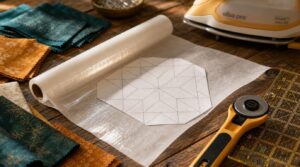
Your freezer paper template is the backbone of every block you’ll build, so getting it right from the start saves you a world of frustration later. There are a few key steps that transform your template from a printed sheet into a precise, reusable sewing guide.
Here’s exactly what to do: Follow these essential steps to ensure accuracy and durability.
Printing and Cutting The Foundation Template
Print your digital layout at exactly 100% scale — never let your printer auto-fit or shrink it. Adjust DPI settings for sharp, clean lines, and add a small border margin around the template before cutting.
Trim along outer dashed lines with clean scissors, preserving all alignment marks.
Do a quick durability test by folding a corner — flimsy paper won’t survive glue-basting in paperless paper piecing.
Ironing Freezer Paper to Create a Reusable Guide
Once your template is cut, it’s time to bond it to your foundation. Ironing freezer paper correctly transforms a flimsy printout into a reusable guide you’ll reach for block after block. Follow these five steps for perfect template alignment every time:
- Wax side positioning — Place the shiny side face-down onto your pressing board.
- Iron pressure control — Press firmly and evenly, avoiding sliding motions.
- Heat duration timing — Hold the iron for 10–20 seconds per section.
- Stacked sheet fusion — Layer multiple freezer sheets to enhance durability.
- Template cooling step — Allow the template to cool completely before repositioning.
Mastering this technique in Paperless Paper Piecing ensures freezer paper becomes second nature in FPP.
Scoring or Folding Seam Lines Before Sewing
With your ironed guide ready, score each seam line using an Add-a-Quarter ruler or similar slim scoring tool — this is where crease precision makes all the difference. Fold firmly along each line so your paperless paper piecing foundation holds a clean, repeatable edge.
Unlike Traditional Foundation Paper Piecing, this tear-free method relies on that crisp fold to guide your needle perfectly every time.
Applying Starch to Strengthen Seam Creases
Starch selection becomes your secret weapon for crease memory that lasts, especially after scoring your seam lines. Mist a thin line of spray starch—like Faultless—along each fold, wait a minute, then press hot and dry. This technique ensures crisp, lasting edges in your foundation.
The starch application locks crisp edges into your freezer paper foundation, enabling tear-free piecing without paper and remarkable precision. Cotton fabrics bond instantly, eliminating post-wash care surprises and ensuring flawless results.
Checking Pattern Scale Before Cutting Fabric
Verifying your printed pattern before cutting fabric is the move that separates confident quilters from frustrated ones. Run a scale ruler test on your freezer paper template — that printed square should measure exactly one inch.
Confirm motif repeat alignment and grainline direction against your fabric before any cutting begins. This ensures your design elements align correctly and your fabric is positioned properly.
This printed pattern verification step keeps your Paperless Paper Piecing accurate and your yardage planning calculation realistic.
Marking Center Lines and Trimming Guides
Marking center lines transforms guesswork into precision — and it starts before your needle ever touches fabric. Score each seam line with your slim ruler, then verify placement using a lightbox. Your marker selection matters: chalk line methods wipe clean, erasable markers remain visible under bright light.
- Use crease scoring for clean seam line marking
- Apply chalk line methods for blue line reference guides
- Check trim gauge alignment before block truing up
- Confirm seam trimming margins match your pattern’s edge
Sew a Paperless Quilt Block
This is where the real magic happens — you’re finally ready to sew your first paperless block from start to finish. Each step builds on the last, so keeping them in order makes the whole process click into place.
Here’s exactly what to do.
Choosing a Beginner-friendly Block Design
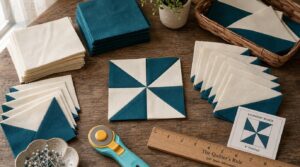
Start simple — your block choice makes or breaks your first Paperless Paper Piecing experience. Square block basics and half-square triangles give you clean, predictable seams that build real confidence fast.
Pinwheel simplicity teaches symmetry without overwhelming you, while two-color contrast keeps your sections easy to track.
A small block size, like a 4-inch Economy Block or Square in a Square, lets you master the technique before scaling up.
Cutting Fabric Pieces With Extra Seam Allowance
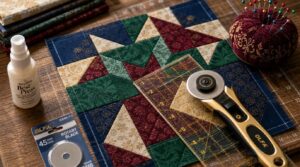
Cut every piece with at least ¼″ extra beyond each template edge — no guessing, no shrinking surprises mid-block. Single-layer cutting with a sharp blade keeps your allowance measurement consistent and your edges clean every time.
- Mark edge lines before cutting for even spacing
- Match allowance to fabric type — heavier cloth needs more
- Use a fresh rotary blade for crisp, accurate cuts
- Pre-starch edges to prevent fraying
- Verify dimensions within 1–2 mm before moving on
Layering Fabric in Reverse Sewing Order
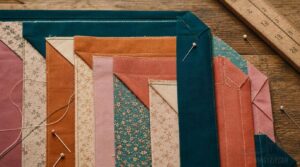
Think of layered fabric piecing without paper scraps like building a sandwich upside down — the bottom-up placement ensures your innermost piece lands exactly where it needs to shine.
Work in the reverse sewing order, staggering seam allowances to minimize bulk and keeping hidden raw edges tucked cleanly beneath each layer.
This bulk-minimizing layering approach is the quiet genius behind faultless Foundation Paper Piecing.
Glue-basting Each Piece Before Stitching
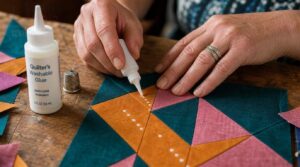
Once your layers are stacked in reverse order, lock them down with glue-baste before stitching. Use Elmer’s washable glue, applying thin, controlled dabs—adhesive thickness control matters, as excess glue warps delicate fabric. The tackiness grips immediately, allowing repositioning if shifts occur.
Speedy glue basting keeps your Paperless Paper Piecing workflow moving, eliminating pin-related slowdowns. Tackiness grips immediately, enabling adjustments, while the method’s efficiency streamlines the process.
Sewing Beside The Folded Freezer Paper Edge
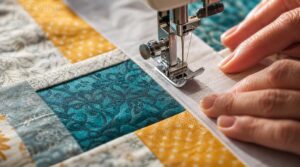
With your pieces glue-basted in place, guide your needle right beside the folded freezer paper edge — not through it. This fold ensures precision as your built-in seam line, so maintaining stitch line proximity keeps your seam allowance consistency flawless every time.
Edge adhesion control holds fabric steady, while the needle clearance technique safeguards your reusable Paperless Paper Piecing foundation for subsequent blocks.
Pressing Each Seam to Re-adhere The Template
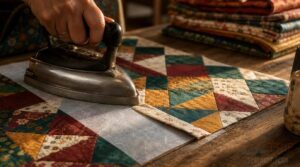
Press each seam with a hot dry iron right after stitching — this re-adheres the freezer paper to your next fabric piece, eliminating the need for pinning.
Set the iron’s temperature to match your fabric’s fiber content, apply even pressure, and work in small sections to ensure precise seam alignment.
This ironing sequence is what makes Paperless Paper Piecing’s template reusability so powerful.
Checking Fabric Coverage With a Lightbox or Window
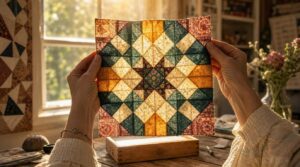
To perform the Fabric Transparency Test, hold your block up to a bright window or lay it over a lightbox — this confirms every piece fully covers its section. Lightbox Illumination works best at 1,000 to 2,000 lux for clear Shade Comparison, while Window Light Consistency ensures an honest reveal under steady daylight.
Either method guarantees no gaps, no guessing.
Trimming The Finished Block Accurately
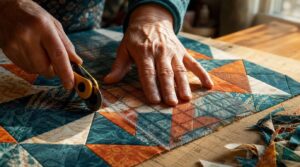
Trimming transforms a good block into a great one. Begin with a Post-Press Distortion Check — ensure pressing hasn’t pulled anything out of square before cutting. This foundational step prevents misalignment in subsequent stages.
Use Non-Slip Ruler Use to lock your square ruler securely, aligning it to Seam Intersection Alignment points for precision. Work methodically through Incremental Trim Cuts, verifying accuracy with Corner-to-Corner Measurement checks. Trust your seam allowance consistency to maintain structural integrity.
When executed properly, Block trueing up preserves your quilt’s perfection. These techniques collectively ensure flawless alignment, flat blocks, and seamless assembly.
Accuracy Tips and Design Ideas
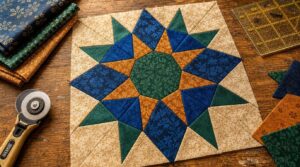
Getting your blocks to look sharp comes down to smart habits and creative moves that make the process more fun.
Paperless paper piecing provides the precision foundation needed to achieve crisp geometry or experiment with bold color choices, ensuring both accuracy and artistic freedom.
As you refine your skills, focus on polishing your technique and pushing your designs further to elevate your craftsmanship.
Keeping Fabric Grain Stable on Angled Seams
Angled seams are where grain chaos loves to sneak in — and in paperless paper piecing, you don’t have the paper layer to bail you out. Keep your grain alignment true by running the lengthwise grain parallel to each seam line, then starch lock it in place before stitching.
In paperless piecing, keep grain aligned and starch-locked before angled seams pull everything off course
A walking foot, stay stitching, and smart notch clipping keep your directional fabric exactly where you need it.
Preventing Stretched Edges and Distorted Points
Stretched edges and distorted points can quietly unravel even your best work — but your tearfree method provides real defenses.
Dial in Edge Tension by combining Starch Reinforcement with Glue‑Baste Uniformity before every seam. A Walking Foot ensures even fabric feed, maintaining consistent seam tension management throughout the process.
Regularly Check Point Alignment and fabric alignment at turned edges; this vigilance ensures precise points practically sew themselves.
Using Directional Fabrics Correctly
Directional fabrics can make or break your block’s visual story. In Paperless Paper Piecing, motif continuity starts before you cut — plan print orientation so every piece flows in the same direction. Use glue-basting to lock fabric alignment during preparation and layering, ensuring stability as you build.
Confirm seam directionality with lightbox inspection to maintain precision. This step guarantees that layered elements align flawlessly, preserving the intended design flow.
Edge matching and tear-free layered fabric stability ensure your prints land exactly where intended. By prioritizing these techniques, your final composition achieves seamless, uninterrupted visual harmony.
Batch Sewing Multiple Blocks With Reusable Templates
Batch sewing transforms your Paperless Paper Piecing practice into a genuine production rhythm. Label each freezer paper layout template clearly with template batch labeling, then commit to sequenced glue-basting so every piece lands consistently.
Timed work stations keep your sewing workflow moving without decision fatigue. A uniform seam allowance across all blocks ensures your batch quality inspection stays straightforward — no guessing, just precise, repeatable results every time.
Creating Sharp Points Without Paper Removal
Sharp points are the crown jewel of precision piecing — and Paperless Paper Piecing delivers them without the paper-removal struggle. Use double-fold sharpening as you stitch, then glue-baste each tip carefully before pressing.
A starch-mist reinforcement stiffens the fold, while a gentle steam set locks everything in place.
Finish with a cool-press lock, then perform a raking-light inspection step by step to confirm every point is needle-crisp.
Trying Color Improvisation and Offset Pieces
Paperless Paper Piecing frees you to experiment with an improvised color palette without reprinting templates every time you change your mind. Now that your points are crisp, let your color instincts loose. Try these improv color placement strategies:
- Anchor with neutrals, then introduce offset color placement for contrast balancing
- Test high-contrast pairs as accent offsets against lighter grounds
- Alternate matte and shiny textures for texture interplay across offset blocks
- Build vibrant visual rhythm by repeating offset colors diagonally
- Vary print scale so each offset reads as its own focal point
Color improvisation and offset pieces in quilting have never felt this freeing.
Adapting Traditional Foundation Paper Piecing Patterns
Adapt it for Paperless Paper Piecing using Ratio Scaling to resize block geometry, then polish with Digital Editing before printing onto freezer paper.
Small Stitch-Length Tweaks keep seams crisp, while practical steps like printing patterns directly onto freezer paper streamline the process.
Hybrid Motifs blend old patterns with new layouts, eliminating traditional paper patterns in sewing processes. This approach reduces fabric waste in quilting by optimizing material use through modernized techniques.
Reducing Paper Waste in Quilt Block Construction
Once you’ve modernized those traditional patterns, keeping the whole process lean is easier than you’d think. Paperless Paper Piecing naturally steers you toward a Zero-Waste Layout — reusable freezer paper templates mean less printing of templates overall, and digital pattern-editing lets you tweak designs digitally without reprinting.
Key strategies include:
- Share files through a Template Sharing Network to cut duplication
- Use eco-friendly adhesives like washable school glue instead of disposable tape
- Explore recycled stabilizer options such as Sulky Totally Stable
- Embrace digital quilting and online quilting instruction without paper
- Focus on eliminating traditional paper patterns in sewing entirely
Frequently Asked Questions (FAQs)
Can I use PPP for curved quilt designs?
Paperless Paper Piecing masters curves beautifully. Use acrylic curve guides with mirror curve templates to achieve precision.
Apply ¼-inch curve starch for crisp folds, and layer with reverse curve layering to create flexible curve patterns, unlocking endless creative design possibilities.
How do I handle very small fabric pieces accurately?
Use magnified placement and micro‑grid cutting to keep tiny pieces accurate.
A temporary adhesive tip holds each scrap still, and needle‑down stitching prevents drift — then confirm coverage with lightbox verification before pressing.
What stitch length works best for intricate blocks?
Set your machine to 8–0 mm for intricate blocks — that tight stitch length basics sweet spot keeps seams crisp, points sharp, and your fabric weight impact minimal across every seam allowance.
How do I store and organize reusable freezer templates?
Keep your freezer paper templates in labeled protective sleeves inside a dedicated binder.
Template filing by project name makes lifecycle tracking simple, and dry storage away from heat keeps every layout template crisp for your next Paperless Paper Piecing session.
Can PPP blocks be combined with traditional piecing methods?
Absolutely — PPP blocks play beautifully with traditional piecing.
Treat each finished PPP block as its own unit, then join them using hybrid seam allowances and standard mixed method layout techniques for a flawless quilt top.
Conclusion
Foundation piecing without paper doesn’t just simplify your process—it transforms how you think about precision quilting altogether. Every sharp point, every clean seam, every perfectly pressed block proves that smarter methods beat harder ones.
Your freezer paper template stays put, your fabric behaves, and your creative momentum never stalls. No more wrestling with materials or losing focus mid-project.
Forty blocks no longer feel like a sentence—they become a project you’re actually excited to finish. The shift from frustration to flow redefines what’s possible in your quilting journey.
- https://babylock.com/11-quilting-tips-for-flawless-foundation-paper-piecing?srsltid=AfmBOor4GkICBTDNisjTk6LWQs-oi-_68xeuLW4AkgbFYKTlrY1W094U
- https://quietplaydesigns.com/blogs/blog/foundation-paper-piecing-tips-part-one?srsltid=AfmBOopcp3B7HVB2Z4JsScyri7ihB8YwLOf6kw6zhRkvyczw0l964jUx
- https://rachelrossi.design/no-tear-foundation-paper-piecing/?srsltid=AfmBOoopLtnc0Xyjiwnk5msNHqnz6rNlYCBvm4oYaVwidw8TKPdO4WgP
- https://www.nationalquilterscircle.com/video/paperless-paper-piecing-technique-015622
- https://artquiltmaker.com/blog/2023/06/no-paper-sewing-fpp/