This site is supported by our readers. We may earn a commission, at no cost to you, if you purchase through links.
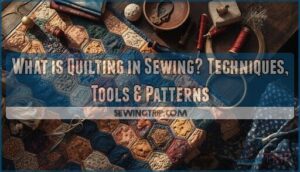
Somewhere between a grandmother’s hands and a museum wall hangs quilting’s peculiar magic—it’s the only fiber art that’s simultaneously kept soldiers warm, marked the Underground Railroad, and sold for six figures at auction.
What is quilting in sewing, exactly? Essentially, it’s the practice of stitching three layers together—a decorative top, an insulating batting, and a backing—into something that outlasts nearly everything else you can make with fabric.
A well-built quilt routinely survives a century of use. The techniques, tools, and patterns behind that durability are more accessible than most beginners expect, and far richer than most experts ever fully exhaust.
Table Of Contents
Key Takeaways
- Quilting joins three distinct layers — a decorative top, a batting middle, and a backing — using stitches that run through all of them, making it fundamentally different from regular sewing.
- The craft spans thousands of years and dozens of cultures, from Egyptian quilted garments around 3400 BCE to Japanese Sashiko and Indian Kantha, each tradition using stitched cloth to carry cultural memory.
- Your tool and material choices — needle size, thread weight, batting type, and machine throat space — directly shape the texture, durability, and character of your finished quilt.
- Quilting isn’t a fading tradition; with a global market hitting roughly $5.5 billion in 2025, it’s a thriving practice drawing younger makers who experiment with patterns and techniques in entirely new ways.
What is Quilting in Sewing?
Quilting is one of those crafts that looks simple on the surface but opens up into a whole world once you start pulling at the threads.
Most beginners find their footing by mastering basic straight-line sewing techniques before the real creative rabbit hole opens up.
Fundamentally, it’s about stitching layers of fabric together to create something padded, textured, and built to last.
Here’s what you need to know to get started.
Definition of Quilting
Quilting is the art of stitching three layers — the quilt top, batting, and backing — into one padded textile. Your Quilt Layering choices, Thread Choices, and Fabric Selection all shape the final feel.
Here are 5 essentials to know:
- The quilt top is your visible canvas
- Batting adds warmth and loft
- Stitch Types define texture and durability
- Quilting Tools guide precision
- A sewing machine speeds up the process
For a deeper look at quilting’s origins and its transformation over time, explore the historical development of quilting.
Purpose and Uses of Quilting
Once you understand what quilting is, you start seeing how many roles it plays. It’s thermal insulation in a winter jacket, Home Decor on your grandmother’s wall, and a Memory Quilt that holds stories no photograph could tell.
| Purpose | Example |
|---|---|
| Warmth | Batting-filled bed quilts |
| Community Support | Quilts for families in need |
| Textile Art | Decorative wall hangings |
| Memory | T-shirt keepsake quilts |
The effectiveness of quilts in providing warmth relies on their advanced insulation materials.
Quilting Vs. Regular Sewing
So what sets quilting apart from regular sewing? It really comes down to fabric layering — quilting always works with three layers, while regular sewing usually joins just two.
Thread choice matters too — quilting thread color ideas and weight guides can help you pick the right 40- or 50-weight cotton to complement those three layers beautifully.
Stitch density matters too; quilting stitches spread across the whole surface, not just seams. You’ll also reach for different quilting tools, sewing machines with wider throats, and specialized thread types than you’d for standard sewing techniques.
History and Evolution of Quilting
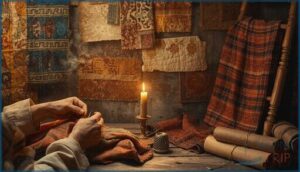
Quilting isn’t a modern hobby that just popped up one day—it’s been around for thousands of years, crossing borders and weaving itself into cultures you mightn’t expect.
From ancient Mesopotamia to medieval Europe, people have been layering and stitching fabric for warmth, protection, and meaning. Here’s a look at how quilting’s story unfolded across time and place.
Early Quilting Traditions
The history of quilting stretches back further than most people realize. Ancient quilting traces to roughly 3400 BCE, evidenced by an ivory carving at the Temple of Osiris showing an Egyptian ruler in a quilted cloak.
By medieval times, historic stitching shaped quilted armor like gambesons, blending function with craft. These early quilting traditions reveal just how deeply this art is woven into human history.
Quilting Across Cultures
Every culture has its own way of stitching stories into cloth. From bold African Quilts blending appliqué and patchwork to meditative Sashiko Stitches reinforcing Japanese workwear, quilting traditions reveal the Cultural Significance of Quilting across time.
Every culture stitches its stories into cloth, from African patchwork to Japanese Sashiko
Hmong Textiles document migration, Indian Kantha repurposes worn saris, and each practice reflects Quilting as Community Practice rooted in survival, memory, and cultural exchange.
- African story quilts combine appliqué and patchwork to record personal and community histories
- Japanese Sashiko uses dense running stitches on indigo cloth for durability and warmth
- Hmong story cloths preserve oral history through stitched scenes of war and migration
- Indian Kantha layers recycled saris with running stitches, creating soft, rippled quilts
- All these Quilting Traditions demonstrate how Textile Arts and Crafts carry cultural memory across generations
Quilting’s Growth in Modern Times
Today, quilting isn’t just your grandmother’s craft — it’s a thriving global movement.
From precise marking techniques to digital pattern tools, resources like this beginner’s guide to using an embroidery machine show just how accessible modern textile crafts have become.
The quilt market reached roughly 5.5 billion dollars in 2025, fueled by modern quilters sharing bold quilting patterns and pioneering quilting techniques across social media.
This evolution of quilting techniques has reshaped the quilting community, drawing younger makers who experiment freely with quilting tools and materials in ways previous generations never imagined.
Key Quilting Techniques and Methods
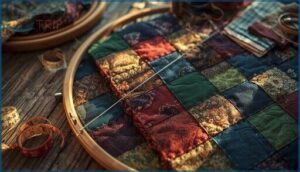
Once you understand what quilting is, the next step is learning how it actually gets done. There’s more than one way to work through a quilt, and each method shapes the final result in its own way.
Here are the key techniques worth knowing.
Hand Quilting Vs. Machine Quilting
Hand quilting gives your work a soft, drapey quality with beautifully irregular stitches — but it’s slow. Machine quilting wins on quilting speed, letting you finish in hours what might take weeks by hand.
Your quilter preference shapes everything: thread tension, fabric choice, and quilting tools all shift depending on which quilting technique you choose. Both paths produce stunning results.
Straight Line and Free Motion Quilting
Think of your sewing machine as a drawing tool — straight line quilting gives you clean, geometric control, while free motion quilting lets you sketch curves and loops across your quilt design.
With the right quilting machines, thread choices, and stitch density, both techniques transform your quilt layering into something textured and intentional. Your fabric selection and quilting patterns shape which method fits best.
Basting, Binding, and Appliqué Techniques
Before a single quilting stitch locks your layers together, basting methods hold everything in place — and your choice here matters more than you’d think.
Pin basting spaces curved safety pins every 3 to 4 inches across your quilt top, while spray basting speeds up fabric preparation considerably.
For finishing, binding strategies like double fold binding protect raw edges, and appliqué techniques — fusible, raw edge, or blind hem — add dimension to your quilt layering beautifully.
Essential Quilting Tools and Materials
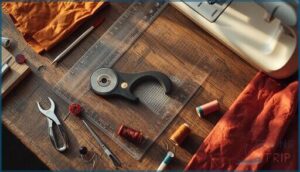
Having the right tools makes quilting so much easier — and a lot more enjoyable.
From the needle in your hand to the machine on your table, every piece of gear plays a role in how your finished quilt looks and feels.
Here’s what you’ll want to have on hand before you start.
Types of Needles and Threads
Your needle and thread choices make or break a quilt. For hand quilting, betweens in sizes 7–8 suit beginners, while experienced quilters favor size 11 or 12 for finer stitches.
For machine needle selection, an 80/12 works beautifully with standard quilting cotton. For thread fiber types, 50-weight cotton keeps seams flat; thread weight impact is real: 40-weight pops visually, 60-weight disappears.
Choosing Fabrics and Batting
Once your threads are sorted, fabric selection shapes everything. Quilting cotton — usually 4 to 4.5 oz per square yard with tight weaves and reliable thread counts — pieces cleanly and behaves predictably. Always prewash to protect colorfastness, especially with deep reds or purples.
For batting, consider your loft options: – Cotton breathes naturally, requires closer quilting lines – Polyester runs lighter, warmer, higher loft – 80/20 blends balance both worlds beautifully
Sewing Machines for Quilting
Your fabric and batting choices set the stage — now your sewing machine carries the performance. For quilting, throat space matters most: domestic machines offer 8–11 inches, while longarms reach 24 inches for king-size work.
| Feature | Why It Matters |
|---|---|
| Stitch Regulation | Keeps free motion stitches even |
| Motor Power | Pushes through thick seams smoothly |
| Automation Features | Saves time with auto-cut and needle threading |
Quilting feet — walking foot for straight lines, free motion foot for curves — transform any capable sewing machine into a quilting machine. For sewing machine selection for quilting, beginners should prioritize these sewing machine accessories over stitch count.
Popular Quilting Patterns and Designs
Quilting patterns are where the real personality of a quilt comes to life. Whether you’re drawn to bold geometric designs or soft, flowing motifs, there’s a style that’ll feel like yours.
Here are some of the most popular patterns and approaches to explore.
Patchwork and Wholecloth Quilts
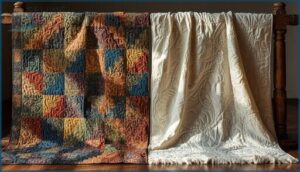
Two distinct paths define quilt top construction: patchwork and wholecloth. Your choice shapes everything — fabric selection, stitch patterns, even quilt finishing.
- Patchwork builds designs from pieced cotton scraps or cuts.
- Wholecloth uses one unbroken textile, letting quilting shine.
- Quilt layering remains identical — top, batting, backing — in both.
Each tradition carries deep textile history and unique fabric crafting possibilities.
Common Quilting Patterns (e.g., Amish, Irish Chain)
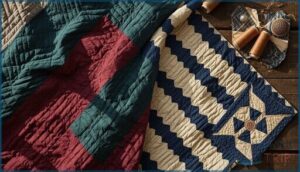
Once you move beyond whole cloth, the real fun begins — choosing a pattern that feels like you.
Amish Style quilts lean on bold solid colors and geometric layouts like Center Diamond or Sunshine and Shadow.
Irish Chain creates striking diagonal paths across your quilt top.
Log Cabin, Nine Patch, and Sampler Quilts each offer their own rhythm, making patchwork endlessly personal.
Marking and Following Quilting Designs
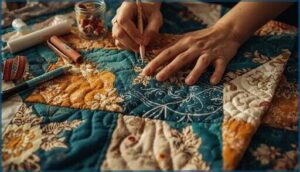
Quilt marking is where your design truly comes to life. Before you ever feed fabric through your sewing machine, transferring paths onto the quilt top — using chalk pencils, erasable pens, or a hera marker — keeps your quilting methods precise and intentional.
Follow those lines steadily, let your quilt blocks guide you, and once you’re done, removing marks is as simple as a quick rinse or a light brush.
Frequently Asked Questions (FAQs)
What is the basic rule of quilting?
The basic rule of quilting is a consistent quarter-inch seam allowance. This single standard keeps your quilt layers aligned, your quilting accuracy sharp, and every block fitting together exactly as the pattern intends.
What are the four stages of quilting?
There are four stages: Quilt Top Preparation (piecing your quilt blocks), the Layering Process (building your quilt sandwich), applying Quilting Techniques to stitch through all layers, then Trimming Methods and Binding Styles to finish the edges.
What is the difference between sewing and quilting?
Sewing joins fabric pieces at the edges. Quilting goes further — layering a quilt top, batting, and backing, then locking all three together with stitching that runs clear through.
What is quilting & how does it work?
At its foundation, quilting joins three layers — a decorative top, a middle batting, and a backing — using stitch patterns that lock everything together into one warm, structured textile.
What is quilting used for?
Quilting goes far beyond the bedroom. From thermal insulation in quilted garments to memory quilts, wall hangings, home decor, bedcovers, and community support, fabric crafting and art expression make quilting endlessly purposeful.
What is machine quilting?
Machine quilting uses a sewing machine to stitch your quilt’s three layers together in one pass.
From straight-line quilting on a domestic machine to free motion and longarm quilting, you’ve got options.
How do you make a quilt?
Patience, planning, and precision — that’s the essence of quilt making. Start with quilt planning, cut your fabric, build your quilt sandwich, sew quilt blocks, then finish with clean binding techniques.
How does a quilting machine work?
A quilting machine works by combining fabric feeding, needle control, and tension systems to stitch through all three quilt layers evenly — giving you clean, consistent results without the guesswork.
What makes a quilting machine different from a sewing machine?
Here’s the thing—it’s all in the details. A quilting machine offers expanded throat space, stronger motor power, stitch regulation, and specialized quilting feet that a standard sewing machine simply wasn’t built to handle.
Can you use any sewing machine for quilting?
Yes, most sewing machines can handle quilting — but results depend on throat space, stitch control, and presser feet like a walking foot.
For beginners, a reliable sewing machine for beginners with basic machine capability goes a long way.
Conclusion
Quilting isn’t merely sewing layers together—it’s inheriting a living conversation between every hand that came before yours. Understanding what’s quilting in sewing means recognizing that each stitch carries both structural purpose and quiet history.
Your first uneven seam and your hundredth precise block belong to the same continuum. The tools change, the patterns multiply, but the essential act remains: you’re not just making something warm. You’re making something that lasts.
- https://www.jozmakesquilts.com/blog-and-tutorials/quilting-101-lesson-quilting
- https://patchwork-europe.eu/en/the-patchwork-what-does-quilting-mean-in-needlework/
- https://stitchinheaven.com/blogs/howdy/quilting-vs-sewing
- https://www.instructables.com/How-to-sew-a-quilt-Quilting-101/
- https://www.merriam-webster.com/dictionary/legend