This site is supported by our readers. We may earn a commission, at no cost to you, if you purchase through links.
Somewhere between knitting and Tunisian crochet lives a craft that most people walk right past—and that’s a shame.
Tunisian crochet produces a dense, structured fabric with a grid-like texture you can’t replicate with a standard hook or a pair of needles.
It looks complex, but the core method comes down to two simple passes per row: pick up loops, then work them back off. One hook does everything.
If you’ve ever wanted fabric that holds its shape, takes color beautifully, and opens the door to a whole new range of stitches, Tunisian crochet is worth your time.
Table Of Contents
- Key Takeaways
- What is Tunisian Crochet?
- Why Learn Tunisian Crochet?
- Essential Tunisian Crochet Tools and Supplies
- Tunisian Crochet Basics for Beginners
- Core Tunisian Crochet Stitches to Know
- Advanced Tunisian Crochet Techniques
- Best Tunisian Crochet Projects for Beginners
- Tips to Improve Your Tunisian Crochet Skills
- Frequently Asked Questions (FAQs)
- Conclusion
Key Takeaways
- Tunisian crochet uses a long hook and a two-pass system — forward to pick up loops, return to close them — creating dense, structured fabric you can’t get from regular crochet or knitting.
- It uses 25–30% more yarn than regular crochet, so plan your stash accordingly before starting a big project.
- Curling is the most common beginner problem, but going up one or two hook sizes and blocking your finished piece fixes it almost every time.
- Most people can learn the basic stitch in under 30 minutes, and within a week of practice, you can comfortably tackle scarves, dishcloths, and small home goods.
What is Tunisian Crochet?
Tunisian crochet is one of those crafts that looks complicated but makes a lot of sense once you see it in action. It sits right in the middle of knitting and crochet, borrowing the best parts of both.
If you’re curious how it all comes together, this Tunisian crochet tutorial for beginners walks you through the technique in a way that finally makes it click.
Here’s what sets it apart.
How It Differs From Traditional Crochet
The biggest difference comes down to how each method treats your stitches. Traditional crochet completes one stitch, then moves on. Tunisian crochet keeps a whole row of live loops on your hook at once — working a forward pass to collect them, then a return pass to close them.
Unlike traditional crochet, Tunisian keeps an entire row of live loops on the hook at once
Here’s what sets it apart:
- Hook Design: Tunisian hooks are longer, often with a cable to hold many loops
- Stitch Construction: Each row takes two passes instead of one
- Fabric Density: The result is thicker and more structured
- Visual Texture: The Tunisian Simple Stitch creates a clean grid of vertical bars
- Crochet Comparison: Your work stays facing you — no turning between rows
For more about the fundamental contrasts in, explore how each method influences stitch style, texture, and project outcomes.
How It Compares to Knitting
Tunisian crochet and knitting look similar on the surface, but they work quite differently. Both build rows of loops—but Tunisian holds them all on a long hook at once, while knitting shifts them between two needles.
| Feature | Tunisian vs Knitting |
|---|---|
| Fabric Thickness | Tunisian runs thicker and denser |
| Yarn Consumption | Tunisian uses 25–30% more yarn |
| Stitch Complexity | Tunisian Knit Stitch mimics knitting closely |
| Crochet Speed | Tunisian can be faster per square inch |
| Texture Comparison | Knitting drapes softer; Tunisian holds shape better |
For a detailed comparison of yarn use and speed differences, practical tests show Tunisian crochet uses slightly more yarn and takes nearly the same time as regular crochet.
Why The Afghan Stitch Name Exists
You might wonder why Afghan stitch and Tunisian crochet sound like two different things. They’re actually the same basic move — the Tunisian Simple Stitch.
American pattern books in the 1960s and 70s called it “Afghan stitch” because crafters used it almost exclusively for blankets. Crochet evolution since then has expanded the full Tunisian family well beyond that one stitch.
Why Learn Tunisian Crochet?
So you’ve heard about Tunisian crochet and you’re wondering if it’s worth picking up. Honestly, there are some really good reasons to give it a shot.
Here’s what makes it worth your time.
Unique Textures and Dense Fabric Benefits
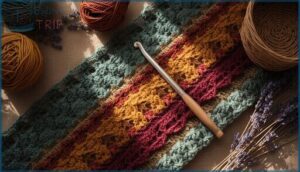
Dense fabric is one of the best things about Tunisian crochet. The fabric density comes from every row working two passes of yarn, trapping air and adding warmth. Stitch patterns like the Tunisian Simple Stitch and Tunisian Full Stitch give you real texture variety.
Here’s what that means for your projects:
- Visual Interest — The woven, grid-like surface looks polished and refined.
- Fabric Textures — From squishy to firm, your yarn choices shape the final feel.
- Color Clarity — Dense stitches keep colorwork crisp with no bleed-through.
Versatility Across Projects and Skill Levels
One of the most freeing things about Tunisian Crochet is how far it stretches. Project Variety here is real — from beginner-friendly Crochet for Beginners dishcloths to fitted garments using sophisticated Tunisian Crochet Techniques.
Skill Progression feels natural because every new stitch builds on the last. Add Yarn Flexibility and rich Stitch Exploration through Crochet Patterns and Tutorials, and Crochet Adaptation never feels forced.
Growing Popularity in The Fiber Arts Community
Scroll through Instagram or TikTok and you’ll spot Tunisian Crochet everywhere. The Fiber Art Community has fully embraced it — Crochet Influencers share reels, host Online Workshops, and run crochet-alongs that pull thousands into the Crochet Community.
Social Media Trends keep it fresh and visible. Finished pieces even show up at Craft Fairs, proving this corner of Textile Crafts and Fiber Arts is anything but niche.
Essential Tunisian Crochet Tools and Supplies
Before you work your first stitch, you need the right tools in your hands.
Tunisian crochet has a short list of must-haves, but each one matters more than you’d think.
Here’s what you’ll need to get started.
Choosing The Right Tunisian Hook
Your hook is the backbone of every Tunisian crochet tutorial you’ll ever follow. Hook size selection matters more here than in regular crochet. Go 0.5–2 mm larger than your yarn label suggests to avoid stiff fabric.
Here’s what to look for:
- Hook Type Comparison: Single-ended hooks suit flat projects; double-ended hooks work for in-the-round techniques.
- Cord Length: Choose cables up to 150 cm for wide blankets.
- Hook Material: Bamboo grips yarn gently; metal lets it glide fast.
- Ergonomic Grips: Cushioned grips reduce hand fatigue during long sessions.
- Yarn and Hook pairing: A 5–6 mm Tunisian crochet hook pairs well with medium-weight yarn for beginners.
Yarn Types and Weights That Work Best
Yarn is where your Tunisian crochet project really starts.
Worsted weight yarn (weight 4) is the sweet spot for beginners — stitches are easy to see, and fabric grows fast.
DK weight works too, giving you a lighter feel with good drape.
For fiber blends and texture options, wool grips beautifully, cotton holds crisp stitch definition, and acrylic keeps things budget-friendly with endless color choices.
Other Notions You Will Need
A few small tools make a big difference in your finished work. Grab these before you start:
- Stitch Markers — locking styles stay put on dense fabric
- Tapestry Needles — blunt tips weave ends without splitting yarn
- Measuring Tools — check gauge and hook sizes against your pattern
- Blocking Supplies — foam mats and T-pins smooth curling edges
Yarn bowls keep your yarn tangle-free while you work.
Tunisian Crochet Basics for Beginners
Starting Tunisian crochet feels easier once you understand a few key mechanics. There’s a clear rhythm to how the stitches build, and it clicks pretty quickly with a little practice.
Here’s what you need to know to get your first rows going.
Foundation Chain and Setup
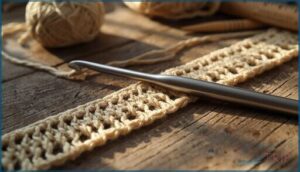
Think of the foundation chain as your blueprint — it sets the final width of your piece. For chain length calculation, make exactly as many chains as stitches you want. No extras needed.
Choose a crochet hook one to two sizes up for easier tension control and a looser foundation stitch. Working into the back bump gives your edge a clean, knitting-style finish.
The Forward Pass and Return Pass Explained
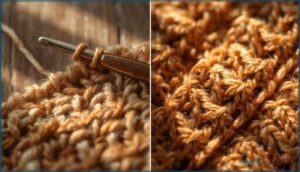
Every Tunisian crochet row works in two passes. On the forward pass, you insert your crochet hook into each stitch, pulling up a loop that stays on the hook — that’s your loop management in action.
Then the return pass works those loops off, two at a time, completing row completion and building fabric texture. Together, both passes make one finished row.
Managing Natural Bias and Curling
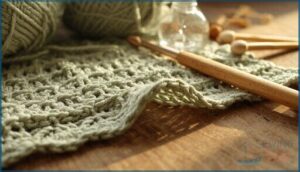
Now that your rows are taking shape, there’s one quirk you’ll notice fast — Tunisian crochet curls. It happens because the return pass adds bulk to the back, pulling the fabric forward.
For bias management and edge control, go up two hook sizes and loosen your tension. Mixing Tunisian Knit Stitch with Tunisian Reverse Stitch also helps. Blocking takes care of the rest for fabric relaxation.
Core Tunisian Crochet Stitches to Know
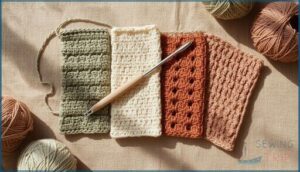
Once you’ve got the basics down, it’s time to build your stitch vocabulary.
Tunisian crochet has a handful of core stitches, and each one gives your fabric a completely different look and feel.
Here are the four you’ll want to learn first.
Tunisian Simple Stitch
The Tunisian Simple Stitch (TSS) is where most beginners find their footing in Tunisian crochet. Your crochet hook picks up loops across a forward pass, then works them off on the return. That two-part rhythm builds fabric density fast.
The result? A woven, grid-like texture with clean vertical bars — ideal stitch patterns for dishcloths, bags, and totes. Yarn selection matters, too: smooth yarns make those texture effects really pop.
Tunisian Knit Stitch
If the Tunisian Simple Stitch is your foundation, the Tunisian Knit Stitch is where things start looking like actual knitting.
You insert your crochet hook between the vertical bars — not under them — and pull up a loop. That small shift in stitch structure creates V-shaped columns on the front, mimicking stockinette. Just know: curl prevention matters here, so block your finished piece.
Tunisian Purl Stitch
Now meet the stitch that flips the texture entirely. With purl stitch basics, you bring the yarn to the front before inserting your crochet hook — that small move creates a horizontal bump across the surface.
The fabric behavior here is distinctly flatter than the Tunisian Simple Stitch or Tunisian Knit Stitch, which makes it ideal for edge finishing. Tension control matters: the extra yarn movement can tighten your loops fast.
Tunisian Full Stitch
Think of the full stitch as Tunisian Simple Stitch’s textured cousin. Instead of working into the vertical bars, your crochet hook goes into the spaces between them — that small shift changes everything.
The fabric density increases, but the result stays soft and flexible. Because Tunisian Full Stitch has no required stitch count multiple, it suits any project width, making it ideal for Tunisian Crochet for Beginners.
Advanced Tunisian Crochet Techniques
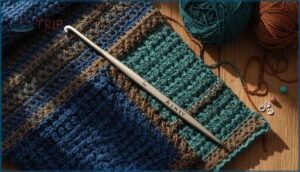
Once you’ve got the basics down, it’s time to push your skills a little further.
Tunisian crochet opens up some really useful techniques that let you shape your work, crochet in the round, and add color with confidence. Here’s what you’ll want to learn next.
How to Increase and Decrease Stitches
Once you move past rectangles, shaping becomes your best friend. A stitch increase on the forward pass widens your fabric — pick up a loop from the horizontal strand between stitches for a clean edge shaping with minimal gaps.
To decrease, try Tss2tog: insert your hook under two vertical bars at once. Keep tension control loose on decreases to avoid puckering.
Working Tunisian Crochet in The Round
Working in the round opens up a whole new world of circular stitches — hats, cowls, and socks become possible. You’ll need Double Ended Hooks with a flexible cable to keep loops from crowding.
Here’s how to set up successfully:
- Use two yarn sources for smooth Yarn Management around the tube.
- Work Spiral Rounds instead of joined rows — no seams.
- Go up one or two Hook Sizes to reduce curling.
- Place a stitch marker at round one to track your Tunisian Crochet Stitches accurately.
Changing Colors and Adding Finishing Touches
Color transforms a finished piece. For clean stripes, switch yarn on the last two loops of your return pass — that’s one of the simplest Color Change Techniques in Tunisian Crochet.
For bolder Tunisian Crochet Patterns, try Tapestry Crochet or Intarsia Tips to build shapes. Finish with a single crochet Binding Methods border for Edge Finishing that tames curl and frames your Crochet Projects beautifully.
Best Tunisian Crochet Projects for Beginners
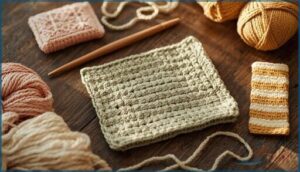
Starting with the right project makes all the difference when you’re learning Tunisian crochet. Some projects are just friendlier to beginners — they let you practice the basics without getting overwhelmed.
Here are a few great ones to get you going.
Simple Scarves and Hand Towels
Scarves and hand towels are the perfect starting point for Tunisian crochet — small enough to finish fast, useful enough to keep you motivated. Tunisian scarf patterns often call for bulky yarn and an 8 mm crochet hook, so each row builds up quickly. Hand towel designs work best in 100% cotton yarn for absorbency and durability.
- Feel the satisfaction of finishing a cozy scarf in just a weekend
- Gift a set of kitchen towels you actually made yourself
- Explore stitch texture options like Tunisian Simple Stitch for that beautiful woven look
Warm Blankets and Throws
Once you’ve got a scarf under your belt, a warm blanket feels like a natural next step.
Tunisian crochet is genuinely great for blanket insulation — those dense stitches leave fewer gaps, so heat stays put. A common throw size is around 42 by 59 inches.
Tunisian Simple Stitch, a good wool or acrylic yarn, and the right crochet hook make fabric durability practically guaranteed.
Home Decor and Accessories
Blankets are just the beginning. Tunisian crochet’s dense, structured fabric makes it a natural fit for DIY Home Decor that actually holds up.
- Wall Hangings – Hang from a dowel and add fringe for texture
- Table Runners – Use cotton yarn for heat-resistant Home Textiles
- Storage Baskets – Thick cord creates firm, shapely bowls
- Colorwork Designs – Try stripes or geometric cushion covers
- Crochet Projects for display – Cross-stitch motifs onto plain Tunisian panels for statement art
Tips to Improve Your Tunisian Crochet Skills
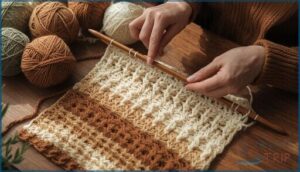
Getting better at Tunisian crochet doesn’t have to feel like a mystery. A few simple habits can make a real difference in how your work looks and feels.
Here are two practical tips to help you grow your skills.
Fixing Common Mistakes and Tension Issues
Tension control is where most Tunisian crochet problems start. If your fabric curls, try going up one or two hook sizes — it gives your loops room to breathe.
For edge management, insert your hook under both loops of every side stitch. Dropped a stitch? Re-insert your Tunisian crochet hook before it runs.
Consistent yarn handling keeps your Tunisian Simple Stitch rows smooth and even.
Practicing With Scrap Yarn
Once your tension feels steady, scrap yarn becomes your best practice partner. Use leftover bits to test the Tunian Simple Stitch, try color experimentation with stripes, or work through yarn joining tips without wasting good yardage.
Scrap yarn management also helps with fabric drape analysis and stitch pattern testing across different crochet hook sizes — all before you commit to a real project.
Frequently Asked Questions (FAQs)
What is special about Tunisian crochet?
Think of it as the best of both worlds — Tunisian crochet is a hybrid craft that uses a unique Afghan hook to build a dense fabric with a knit appearance and structured feel through a forward pass and return pass.
Is Tunisian crochet easier than regular crochet?
It depends on the person. For some beginners, breaking stitches into two steps makes the learning curve gentler.
For others, hook management and fabric behavior add just enough extra challenge to tip the scales.
What is a common mistake in Tunisian crochet?
One sneaky trap catches almost every beginner — curling problems. Your fabric rolls at the edges because of tension issues, poor hook management, and missed edge control from inconsistent stitch counting.
What is the ideal hook size for Tunisian crochet?
Go up 1–2 sizes from your yarn label’s suggestion. For beginners, a 5–6mm Afghan hook works well with most yarn weights, balancing drape vs. density for your project specifics.
Is there a difference between Tunisian and regular crochet?
Yes, and the gap is bigger than you’d expect. Hook Comparison alone tells the story — Tunisian crochet uses a longer hook, different Stitch Differences, denser Fabric Density, and higher Yarn Usage than regular crochet techniques.
How long does it take to learn Tunisian crochet?
Most beginners pick up the basic stitch in under 30 minutes. With a consistent practice schedule, you can feel confident with core Tunisian crochet techniques within a week.
What type of yarn is best for Tunisian crochet projects?
Smooth, worsted weight yarn is your best starting point. It’s easy to grip, shows stitches clearly, and works beautifully across fiber blends — from soft merino to budget-friendly acrylic.
Is Tunisian crochet more difficult than regular crochet?
It depends on your background. If you already knit, the learning curve feels gentle. If you’re new to both crafts, regular crochet is usually the easier starting point.
Can Tunisian crochet be used for amigurumi projects?
Amigurumi toys, crochet dolls, and stuffed animals can all be made with Tunisian crochet. Its fabric density keeps stuffing from poking through, and the tight crochet stitches hold shapes well.
How do you repair mistakes in Tunisian crochet?
Mistakes happen to everyone. The good news? Most fixes are simpler than you’d think.
Frogging rows, correcting dropped loops, and solving tension issues are all skills you’ll build naturally with practice.
Conclusion
It’s no coincidence that once you pick up a Tunisian hook, you don’t want to put it down. The rhythm clicks. The fabric grows.
You start seeing scarves, blankets, and textures you actually want to make. Tunisian crochet gives you a real craft skill—one that builds with every row you complete.
You already have everything you need to start. Cast on your foundation chain and let the stitches speak for themselves.
- https://www.purlsoho.com/create/tunisian-crochet-basics/
- https://theunraveledmitten.com/2020/11/13/tunisian-crochet-tutorial-for-beginners/
- https://hookedonhakelmaschen.com/good-to-know/tunisian-crochet-the-basics/
- https://www.yarnspirations.com/blogs/how-to/tunisian-crochet-ultimate-beginners-guide
- https://hearthookhome.com/tunisian-crochet-in-the-round/