This site is supported by our readers. We may earn a commission, at no cost to you, if you purchase through links.
Pull the wrong number of strands from your embroidery floss, and your cross stitch project can look sparse and threadbare or thick and clumpy. Most stitchers learn this the hard way, discovering too late that their carefully chosen pattern doesn’t match their fabric choice.
The answer to how many threads for cross stitch isn’t one-size-fits-all—it depends on your fabric count, the color of your background, and the stitch style you’re using. Two strands work beautifully on 14-count Aida, but switch to an 11-count fabric or a dark background, and you’ll need to adjust.
Getting this right from the start saves you from ripping out hours of work and transforms your finished piece from amateur to polished.
Table Of Contents
- Key Takeaways
- How Many Threads for Cross Stitch?
- How Fabric Count Affects Thread Selection
- Light Vs. Dark Fabric: Thread Considerations
- Embroidery Floss Types and Strand Usage
- Choosing Threads for Different Stitching Styles
- Factors Influencing Your Strand Count Decision
- Common Mistakes With Thread Count in Cross Stitch
- Frequently Asked Questions (FAQs)
- Conclusion
Key Takeaways
- Your strand count depends on three main factors: fabric count (higher counts need fewer strands), background color (dark fabrics require more coverage), and the specific stitch type you’re using (full crosses versus backstitching need different approaches).
- Two strands work as the standard for 14-count Aida, but you’ll need to adjust up to 4-6 strands for 11-count fabric or down to 1-2 strands for 18-20 count to maintain proper coverage without bulk.
- The most common mistakes are using inconsistent strand counts mid-project (which creates visible texture differences) and choosing too many or too few strands (leaving gaps or creating stiff, bulky stitches that won’t lay flat).
- Always test your strand choice on scrap fabric before starting because getting this right from the beginning saves you from ripping out hours of work and transforms your piece from amateur to polished.
How Many Threads for Cross Stitch?
The number of strands you use in cross stitch isn’t one-size-fits-all—it depends on your fabric count, the color of your material, and the look you’re going for.
For beginners working through their first sampler, a detailed beginner-friendly sewing machine review can help you choose equipment that grows with your skills.
Getting this right makes the difference between a crisp finish and a project that looks sparse or bulky. Let’s break down the standard strand counts and how they affect your stitching.
Standard Strand Counts for Common Fabrics
Choosing the right floss strands starts with understanding your fabric count. For 14-count Aida fabric, you’ll usually use two strands for balanced coverage ratio and stitch tension.
Here’s your quick reference:
- 11-count fabrics: Use 4 strands on light backgrounds, 6 on dark for proper thread weight
- 16 to 18-count: Two strands work beautifully for standard coverage
- 20-count: One or two strands prevent bulk while maintaining fabric density
Your strand choice directly affects how your stitches fill each fabric square. The thickness of your fabric is best understood through the relationship between count and yarn thickness, which helps guide floss selection for ideal results.
Impact of Thread Number on Coverage and Appearance
Once you’ve settled on your strand count, you’ll notice how thread tension and stitch density transform your work.
Three strands boost fabric coverage by about 15 percent on 14-count Aida, creating richer color saturation and minimizing gaps. Too many strands cause fabric distortion and stiffness, while too few leave sparse coverage.
Your thread selection directly controls texture variation and the final look.
How Fabric Count Affects Thread Selection
Fabric count is the single most important factor in choosing your strand count. Think of it this way: higher counts mean more threads per inch, so you’ll need fewer strands to cover each tiny square.
Let’s break down what these numbers actually mean and how they translate to the floss you pull from your skein.
Understanding Fabric Counts (Aida, Linen)
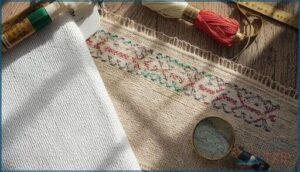
Fabric count tells you how many holes per inch your Aida fabric has—or threads per inch if you’re working with linen or evenweave. Common Aida counts include 11, 14, 16, and 18, each creating different stitch densities and weave patterns.
Higher thread counts generally mean a smoother, more refined surface for detailed stitching, as explained in this guide on fabric considerations for embroidery.
Higher fabric counts mean finer detail but smaller stitches. Understanding fabric types helps you control thread tension and make smart fabric selection choices for your project.
For further insights, read about Aida count and canvas selection to guarantee your fabric matches your stitching needs.
Recommended Strands for 11, 14, 16, 18, 20 Count Fabrics
Once you know your fabric count, you can match the right number of strands for balanced coverage and stitch density. Here’s a quick guide to floss usage and strand selection:
- 11 count fabric – Use 1 strand for airy texture
- 14 count fabric – Use 2 strands for solid coverage
- 16 count fabric – Use 2 strands for neat appearance
- 18 count fabric – Use 2 strands for tight stitching
- 20 count fabric – Use 2 strands to retain detail
These recommendations help you control thread tension and achieve consistent results across different fabric thread counts.
Light Vs. Dark Fabric: Thread Considerations
Fabric color plays a bigger role in thread selection than you might think.
Dark fabrics need more strands to show up clearly, while light fabrics let you get away with fewer.
Here’s what you need to know about adjusting your thread count based on whether you’re working with light or dark fabric.
Adjusting Strands for Fabric Color
Dark fabric behaves differently than light in terms of thread visibility and coverage. You’ll notice that darker bases need fewer strands to prevent bulk, while lighter fabrics handle extra strands without losing their airy feel. Coverage testing on a small swatch helps you nail the balance between color depth control and fabric shine.
| Fabric Color | Recommended Strands |
|---|---|
| White/Off-White | 1-2 for balanced coverage |
| Pink/Pastel | 2 for true color strength |
| Gray/Beige | 2 for midtone saturation |
| Medium Dark | 2 for rich color balance |
| Very Dark | 1 to avoid thread buildup |
When you’re working with pastels, two strands maintain vibrancy without washing out. Dark fabrics shine through with just one strand, keeping your weaving smooth and preventing stiff stitches that don’t lay flat.
Achieving Even Coverage on Dark Fabrics
Getting smooth coverage on navy, charcoal, or black cloth takes a little extra attention. You’ll want to check your fabric texture first—prewash to remove sizing that can create blotchy thread uptake. Maintain steady thread tension throughout each cross to prevent puckering that reveals the dark background underneath.
Higher stitch density keeps fabric from peeking through. Use embroidery floss with opaque dye and consider a light underbase layer on very dark weaves for true color vibrancy.
| Dark Fabric Prep Step | Coverage Benefit |
|---|---|
| Prewash fabric | Removes sizing for uniform thread uptake |
| Test stitch density | Prevents visible gaps between stitches |
| Use full cross stitches | Maximizes color opacity over dark base |
Embroidery Floss Types and Strand Usage
Not all embroidery floss is created equal, and the type you choose can change how you work with strands.
Cotton floss is the go-to standard, but specialty threads bring their own unique qualities to your stitching. Let’s look at how different floss types affect your strand choices and what you need to know about each one.
Six-Strand Cotton Floss Basics
You’ll work mostly with six-strand cotton embroidery floss—think DMC floss as the industry standard. Each skein holds six individual strands twisted together, and you can separate them for different thread thickness needs.
Before stitching, pull apart the strands and recombine the number you need. This strand separation prevents tangling and ensures smoother coverage.
Store your floss away from sunlight to maintain colorfastness and keep colors vibrant over time.
Working With Specialty Threads
Specialty threads like rayon and metallic take your cross stitch beyond standard cotton floss.
Rayon gives you high sheen for vibrant embroidery floss effects, while metallic threads add sparkle but need shorter lengths to prevent fraying.
Fiber blends and color variations create depth, and you can pair thread weight with bead embellishments for stitch enhancement that elevates your design beyond basic DMC floss.
Choosing Threads for Different Stitching Styles
Not all stitches are created equal, and the thread count that works beautifully for your full cross stitches might leave your backstitching looking a bit off.
Different techniques call for different approaches to strand selection. Let’s look at how to adjust your thread choices based on the specific stitch you’re working with.
Full Cross Stitch Vs. Fractional Stitches
Full cross stitches create solid color blocks with complete X shapes, while fractional stitches give you softer shading and realistic detail. Your thread count affects stitch density and coverage control—on 14 count fabric, you’ll use two strands for full stitches but might drop to one for fractional work to avoid crowding.
- Full cross stitches: Best for bold areas with uniform fabric texture and crisp edges
- Fractional stitches: Perfect for gradients and color blending where stitch variation enhances realism
- Thread count matters: Higher counts need fewer strands to maintain proper stitch technique without overstuffing
Backstitching and Outlining Thread Choices
Backstitching creates the crisp lines that bring your design to life—most of the time you’ll reach for one or two strands of embroidery thread.
One strand gives you delicate, precise outlines that won’t overpower light fabrics, while two strands deliver bold definition on darker backgrounds.
Your thread selection affects outline colors and fabric interaction, so match your backstitch techniques to stitch length and thread tension for smooth, professional results.
Factors Influencing Your Strand Count Decision
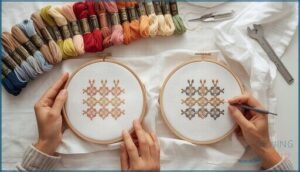
You’ve learned the technical rules for strand count, but choosing the right number of threads isn’t just about following a chart. Several practical factors shape your decision beyond fabric count and color alone.
Let’s look at how your specific project and personal stitching style influence which strand count works best for you.
Design Complexity and Project Type
Intricate portraits and nature scenes often need 20 to 40 color changes and dense stitching techniques, so you’ll want to match your thread count to the project’s demands.
Complex designs with gradual shading benefit from finer strands for smooth transitions, while bold geometric patterns work well with fuller coverage. Your fabric choice and design planning directly shape how embroidery floss performs across thousands of stitches.
Personal Preference and Desired Texture
Beyond design needs, your personal texture preference matters just as much when choosing thread count. Do you want a smooth, barely raised surface? Try one strand on 18 count linen. Prefer a plump look? Two strands on 14 count Aida deliver moderate coverage with satisfying stitch density.
Experiment with fabric feel and color contrast—dark fabrics show gaps more, so bump up your embroidery floss to achieve even texture options.
Common Mistakes With Thread Count in Cross Stitch
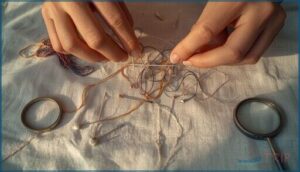
Even experienced stitchers can fall into common traps in the area of thread count. These mistakes might seem small, but they can really affect how your finished piece looks and feels.
Let’s talk about the two biggest pitfalls you’ll want to avoid.
Using Too Many or Too Few Strands
One strand might leave your fabric peeking through like polka dots, while six strands can create knotted chaos at the needle eye. Poor strand balance ruins stitch density and causes fabric distortion you’ll spot from across the room.
Too few strands leave fabric showing through like polka dots, while too many create knotted chaos and visible distortion
Too few strands mean coverage issues and thin, sad-looking stitches. Too many? You’re wrestling with thread tension, fraying embroidery floss, and bulky results that won’t lay flat.
Inconsistent Strand Use Across a Project
Switching between two and three strands mid-project creates visible color shift and texture issues you can’t unsee. Your stitches will show strand variation that causes fabric distortion and uneven coverage problems.
Keep your embroidery floss consistent by:
- Planning your thread count before starting any section
- Documenting which areas use specific strands
- Testing your stitching technique on scrap fabric first
Consistent threads mean professional results.
Frequently Asked Questions (FAQs)
How to know how many strands to use for cross stitch?
Think of strand calculation like adjusting your coffee’s strength—fabric selection sets the base, while thread tension and coverage control fine-tune stitch density.
Your stitching technique determines how many embroidery floss strands create perfect weave.
How many strings should I use for cross stitch?
Your thread selection depends on fabric choice and desired stitch density. For 14-count Aida, use two strands for balanced coverage.
Adjust strand management based on thread tension and color theory needs for ideal results.
How many threads for 18 count cross stitch?
For 18 count Aida fabric, you’ll want to use 2 strands of embroidery thread for balanced stitch density and full coverage.
This fabric count creates even, smooth stitches without bulkiness or gaps showing through.
How much thread do I need for cross stitch?
Thread estimation for cross stitch depends on fabric density, stitch complexity, and color selection. On 14-count Aida using two strands, one skein of embroidery floss usually covers around 1,500–1,800 full crosses.
What does 2 threads mean in cross stitch?
When you separate six-strand embroidery floss, pulling two strands means doubling your coverage control and color saturation.
This balanced stitch density works beautifully on 14-count fabric, giving clean edges without bulkiness.
How many threads to use on 20 count AIDA?
For most cross stitch designs on 20 count Aida, you’ll want to use two strands of embroidery floss. This gives you solid coverage and balanced stitch density without crowding the fabric’s smaller holes.
How many strands of floss for 11 count aida?
For 11 count Aida, use three strands of floss for balanced coverage and clear stitch density control.
Four strands create fuller color visibility, while two strands work best for delicate outlines requiring lighter thread tension.
What is the history of cross stitch?
This needlework’s ancient origins trace back to 6th century BCE Africa and Asia, spreading along trade routes.
European samplers from the 1500s preserved techniques, while modern revivals blend historical patterns with contemporary embroidery styles.
Can cross stitch be done on clothing?
Picture your favorite denim jacket becoming a canvas. You can absolutely cross stitch on clothing using Aida fabric, waste canvas, or stabilizers.
Garment selection matters—stable fabrics like cotton handle needlework beautifully while maintaining stitch visibility and wear resistance.
Are there cross stitch competitions or exhibitions?
Yes, you’ll find cross stitch competitions at state fairs, regional shows, and agricultural exhibitions worldwide.
Judges evaluate technical execution, stitch consistency, and finishing quality. Winners receive ribbons, certificates, or cash prizes based on competition formats.
Conclusion
Think of thread count like seasoning in cooking—too little leaves your dish bland, too much overpowers everything.
Now you know how many threads for cross stitch based on your fabric count, background color, and stitch style. Test your choices on scrap fabric first, then trust your eye.
The right strand count isn’t about following rules blindly—it’s about understanding the variables so your finished piece looks exactly how you envisioned it.
- https://www.better-cross-stitch-patterns.com/floss-coverage.html
- https://0ebbbda4-13eb-4d5d-92f3-fcab1d718e35.usrfiles.com/ugd/0ebbbd_3251763860f543cca31bbdc5cb9b1311.pdf
- https://stitchingsecrets.com/?p=2939
- https://www.crossstitchboutique.com/how-many-strands-for-cross-stitch-complete-guide-2025/
- https://crossstitchstylearte.com/how-to-calculate-the-exact-amount-of-thread-needed-for-any-cross-stitch-project/