This site is supported by our readers. We may earn a commission, at no cost to you, if you purchase through links.
You’re fifteen minutes into a tight deadline when your thread snaps for the third time—and suddenly those extra seconds fumbling with the needle eye feel like an eternity. Threading might seem like the smallest step in any sewing project, but it’s often where beginners stumble and even experienced sewers lose precious time.
The choice between automatic threading vs manual threading isn’t just about convenience—it’s about matching your method to your workflow, skill level, and the type of work you’re tackling. Manual threading offers simplicity and full control, perfect for quick fixes and small batches. Automatic systems promise speed and consistency, especially when you’re cranking out high-volume projects or working with tricky fabrics.
Understanding the real differences in speed, accuracy, cost, and ease of use will help you pick the approach that keeps your projects moving without the frustration.
Table Of Contents
- Key Takeaways
- What is Manual Threading?
- What is Automatic Threading?
- Manual Threading: Pros and Cons
- Automatic Threading: Pros and Cons
- Comparing Threading Speed and Efficiency
- Threading Accuracy and Quality
- User Experience and Accessibility
- Cost and Maintenance Considerations
- Choosing The Right Threading Method
- Frequently Asked Questions (FAQs)
- Conclusion
Key Takeaways
- Manual threading costs less upfront and gives you complete control over delicate fabrics, but it demands solid hand-eye coordination and can rack up labor costs when you’re cranking out high-volume projects.
- Automatic threading slashes setup time by 60-80% and cuts threading errors by 30-60%, making it a game-changer for production environments where consistency and speed trump initial investment.
- Your choice hinges on matching the method to your actual workflow—manual wins for quick repairs and small batches, while automatic systems pay off when you’re dealing with repetitive tasks or physical limitations that make squinting at needle eyes a real pain.
- Speed matters, but accuracy and accessibility often matter more—automatic systems level the playing field for beginners and anyone facing dexterity or vision challenges, while experienced sewers might prefer manual’s tactile feedback on specialty projects.
What is Manual Threading?
Manual threading is the hands-on, traditional way of creating threads—you’re guiding the tools yourself rather than letting a machine do the work. It’s been around forever and still has a solid place in sewing, metalwork, and all kinds of crafting.
If you’re weighing your options, this guide on choosing a machine with an auto-threader breaks down what to look for without losing manual flexibility.
Let’s break down what it actually means, what tools you’ll use, and where it makes the most sense.
Definition and Process
Manual threading puts you in complete control of the threading operation from start to finish. You’ll guide the thread through the needle eye by hand, then use manual dexterity and finger pressure to create each stitch along the threading sequence.
For sewers who prefer a blend of hands-on control and modern convenience, computerized sewing machines with foot pedal options let you regulate speed manually while still accessing programmable stitch patterns.
This hands-on sewing technique lets you feel the thread formation happening as you work, giving you direct influence over stitch quality throughout your project.
To better understand the terminology used in sewing, you can explore language resources to improve your skills.
Common Tools Used
You don’t need fancy threading devices to get started—just a few solid hand tools. Your essential sewing aids include needle threaders for quick eye access, fabric cutters like fine scissors for clean trimming, and a trusty seam ripper.
Keep assorted hand sewing needles, protective thimbles, and thread kits with matching bobbins ready. These threading tools beat any automatic threading tool holders for basic projects.
Ensuring the accuracy of your sewing projects requires attention to methodological rigor in every step.
Typical Applications in Sewing
Once you’ve got those hand tools mastered, where do you actually use them? Manual threading shines in quick repairs, garment alterations, and small-batch projects. You’ll rely on these sewing techniques for precise fabric selection when working with delicate materials, maintaining proper thread tension on basic sewing machines, and handling specialty sewing patterns where stitch quality matters more than sewing efficiency.
| Project Type | Thread Management Need | Best Sewing Accessories |
|---|---|---|
| Garment repairs | Light tension control | Hand needles, seam ripper |
| Alterations | Moderate precision | Thread kits, thimbles |
| Small quilts | Consistent stitching | Needle threaders, scissors |
| Home décor hems | Fabric-specific threads | Assorted needles, cutters |
| Button replacement | Minimal setup | Basic thread, sharp needle |
What is Automatic Threading?

Automatic threading takes the guesswork out of one of sewing’s most frustrating tasks. Instead of squinting and struggling to guide thread through a tiny needle eye, the machine does the work for you with built-in mechanisms that thread in seconds.
Let’s break down how these systems actually work and what types you’ll find on modern sewing machines.
Most machines use either a hook-style mechanism or a needle-threader arm—understanding how automatic threading works makes diagnosing tension or misalignment issues much easier.
Definition and Mechanism
Automatic threading puts control back in your hands by letting the machine do the heavy lifting. When you press a button or flip a lever, a built-in hook or sensor guides the thread through the needle eye and along the thread path control system. This automatic engagement manages needle alignment and the entire threading sequence—from upper thread guides to tension discs—so you can focus on creating, not fumbling with tiny needle eyes.
If you’re ready to ditch the frustration, check out the best sewing machines with automatic needle threaders that make setup effortless for any skill level.
Here’s what happens inside:
- Activation trigger – You press a button or lever to start the automatic threading cycle
- Hook deployment – A small mechanical hook or sensor arm extends to catch and guide your thread
- Path tracing – The system routes thread through guides, tension discs, and needle alignment points automatically
- Confirmation signal – Visual or audible indicators tell you threading’s complete and you’re ready to sew
How Automatic Threaders Work
A motorized system drives the show—using a servo or stepper motor to coordinate needle movement and thread supply in perfect sync. Sensor technology detects fabric thickness and adjusts the threading channels automatically, guiding thread from spool to needle with precision.
Safety features like low-force stops protect your CNC threading machine from damage, while automated threading manages the entire sequence so you can command every stitch.
Pairing these features with proper tension settings and thread quality keeps your stitches consistent and prevents frustrating mid-project snags.
Types of Automatic Threading Systems
You’ll find five powerful threader mechanisms on the market, each engineered for different sewing demands. The heavy hitters include:
- Centralized spindle threaders – perfect for external threading tasks
- Magnetic needle threaders – lightweight servo threaders for precision
- Full-automatic threading modules – integrated systems that handle both internal threading and CNC threading operations
Your threading machine choice determines your command over every project.
Manual Threading: Pros and Cons
Manual threading has its own set of strengths and weaknesses that you’ll want to weigh before choosing your approach. It’s not just about saving money upfront—there’s also the learning curve, how easy it’s to move your tools around, and what kind of upkeep you’re signing up for.
Let’s break down the key pros and cons so you can see if manual threading fits your needs.
Cost-Effectiveness
Manual threading wins on upfront budget planning—you’ll spend far less on tools and equipment compared to industrial automation systems. Your expense reduction is immediate, but here’s where the cost analysis gets interesting: labor costs can flip the script in high-volume production efficiency scenarios.
For economic efficiency in small-scale operations, manual threading delivers solid financial savings. But when you’re cranking out high volumes, those labor hours add up fast—potentially making automatic threading the smarter long-term investment.
| Cost Factor | Manual Threading |
|---|---|
| Initial Investment | Low capital expenditure |
| Ongoing Maintenance | Basic servicing, minimal costs |
| Labor Time | Higher per-unit in Manufacturing |
Skill and Precision Required
You’ll need solid fine motor skills to nail manual threading—studies show thread placement errors jump when your needle-eye alignment drifts past 0.5 mm. Precision benchmarks matter here, especially with thicker fabrics where dexterity training pays off.
Ergonomic assessment reveals something important: after 15 minutes of repetitive threading, your forearm and hand muscles start feeling the strain, affecting your precision engineering accuracy.
Portability and Maintenance
You’ll love that manual threading components stay lightweight and pack easily into portable kits—perfect for taking your craft anywhere. Device durability hinges on smart tool storage and sticking to maintenance schedules.
- Clean threading tool holders regularly to prevent lint affecting thread quality
- Store in protective cases to shield against humidity and rust
- Replace worn tension discs promptly for consistent results
- Use manufacturer-approved lubricants on moving parts
- Keep spare needles and common parts in your portable kit
Automatic Threading: Pros and Cons

Automatic threading has changed the game for a lot of sewers, especially if you’ve ever squinted at a needle for five minutes straight. But like any tool, it comes with trade-offs you need to know about before you commit.
Let’s break down the real advantages and a few honest drawbacks so you can decide if it’s worth it for your projects.
Speed and Efficiency
Regarding production speed, automatic threading delivers serious efficiency gains. You’re looking at 60-80% faster setup times compared to manual threading—that’s huge for your automated workflow.
Thread optimization means high-volume operations can initiate threads in just 1-3 seconds, while manual threading time averages 2-5 minutes per seam.
Your threading tool selection directly impacts production efficiency strategies, especially in industrial automation solutions where every second counts.
Error Reduction and Consistency
Speed matters, but so does getting it right the first time. Automatic threading slashes your error rates through standardized pathways and sensor-driven precision control—you’ll see threading mistake rates drop by 30-60% compared to manual methods. Consistency metrics prove it: these automation benefits deliver repeatable thread quality across every seam, while manual threading depends heavily on your skill level and how tired you’re feeling.
Here’s what automatic threading brings to your error analysis:
- Standardized thread paths eliminate operator variability that plagues manual threading
- Sensor feedback catches improper loops before they become skipped stitches in your seam
- Consistent tension control maintains thread pitch accuracy across high-volume runs
- Reduced fatigue-related errors since the machine manages repetitive motions for you
- Adaptive systems adjust for delicate fabrics without the snags you’d risk manually
Your precision engineering methods really shine here. CNC machining principles apply—when you automate the threading sequence, you’re locking in precision control that manual operations can’t match consistently. That’s especially critical for tight-tolerance work where thread quality can’t fluctuate.
Accessibility and Ease of Use
Beyond accuracy, there’s another win you can’t ignore: how these systems level the playing field. Automatic threading delivers assistive technology that transforms sewing efficiency for everyone—especially if you’re dealing with limited hand dexterity or visual impairments. Manual threading demands steady hands and sharp eyes for those tiny needle eyes, which honestly becomes a real barrier.
Here’s your accessibility breakdown:
| Feature | Automatic Threading | Manual Threading |
|---|---|---|
| Motor Control Required | Minimal—machine manages thread management | High precision needed for threading operation |
| Visual Demand | Low—ergonomic design with large guides | Intense focus on small thread eyes |
| Setup Strain | Reduced repetitive motion | Repeated manual effort increases fatigue |
| User Interface | Accessible controls with accessibility features | Requires steady coordination throughout |
Your ease of use skyrockets when the machine manages thread management automatically. That’s liberation for beginners and seasoned sewers facing physical limitations—you’re not wrestling with stiff threads or straining your eyes anymore!
Comparing Threading Speed and Efficiency
When you’re deciding between automatic and manual threading, speed matters—a lot. The time you spend setting up, switching between tasks, and handling high-volume projects can make or break your workflow.
Let’s look at where each method gains ground and where it might slow you down.
Setup Time Differences

You’ll notice setup time differences right away. Manual threading takes 5 to 15 minutes per session, depending on your fabric and machine. Automatic threading cuts that down to just 1 to 3 minutes! That’s serious time savings and productivity gains.
Fair warning: initial calibration tips for new automatic threading tools might add 2 to 5 minutes upfront, but threading efficiency skyrockets once you’re familiar with the system.
Impact on Project Workflow

When you’re managing projects, threading choice shapes your whole Manufacturing Process. Automatic Threading slashes downtime by up to 25% compared to Manual Threading, giving you serious Productivity Gains. Here’s how it transforms Workflow Optimization:
- Standardized Thread Production cuts variability by 20–35% across your team
- Parallel task scheduling boosts throughput by 10–30%
- Faster changeovers improve Project Scheduling flexibility
- Reduced Labor Costs through 30–50% shorter training times
- Better Efficiency Metrics with real-time CNC Threading data tracking
Time Savings for High-Volume Tasks

When you’re running High Volume operations, Time Optimization becomes mission-critical. Automatic Threading slashes your setup time by 60% in continuous Production runs—that’s minutes down to seconds per unit.
Task Automation maintains constant threading speed regardless of fabric complexity, while Manual Threading scales with difficulty.
The result? Production Efficiency jumps 20–40%, cutting Labor Costs and delivering exceptional Workflow Streamlining across your entire production line.
Threading Accuracy and Quality

Speed matters, but accuracy is where the real difference shows up. When you’re threading a needle—whether by hand or with an automatic system—the quality of that thread placement directly affects your finished work.
Let’s break down how each method performs when precision counts.
Threading Mistake Rates
Threading mistake rates tell you everything about control and precision in your work. Manual threading usually hits error rates between 2-8%, climbing higher when operator fatigue kicks in or you’re working delicate fabrics prone to thread breakage. Automatic threading systems slash that to under 1% in standardized quality control tests—that’s a 60% drop in threading errors overall.
Here’s what drives those numbers:
- Fabric damage increases with manual methods on delicate materials due to needle misalignment
- Error analysis shows automatic systems maintain steady performance across entire shifts
- Thread management becomes more reliable when automated threading tools handle the precision work
- CNC threading and sophisticated machining processes prove automation reduces human variability
Consistency of Results
Repeatability tests prove automatic threading delivers near-identical stitch positioning every single time—that’s precision control you can bank on.
Manual methods? You’ll see higher process variability across operators, with standard deviations showing inconsistent thread pitch and tension control.
Automatic threading keeps error rates below defined thresholds in high-volume production, matching the tight tolerances you’d expect from CNC threading and precision manufacturing environments. Thread quality stays rock-solid consistent.
Suitability for Delicate Fabrics
When you’re working with silk or chiffon, manual threading gives you better control over fabric tension and thread breakage risks—your hands feel exactly what’s happening at the needle.
Automatic systems can work if they’ve got gentle threading modes and proper needle selection, but threading speed matters less than material compatibility here.
Slower, tactile sewing techniques protect delicate fibers better than rushing through setup, even if it costs you some sewing productivity.
User Experience and Accessibility
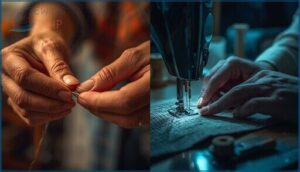
Threading isn’t just about speed or accuracy—it’s about how the method feels when you’re actually using it. Your comfort, skill level, and physical capabilities can make or break your sewing experience.
Let’s look at how manual and automatic threading stack up regarding real-world usability.
Ergonomics and Eye Strain
Ever notice how your neck aches after squinting at that needle for twenty minutes? Manual threading demands sustained forward head posture and close visual work—both culprits behind neck strain and visual fatigue. Poor workspace lighting makes it worse.
Automatic threading cuts this wear-and-tear dramatically, protecting your eye health while boosting sewing productivity. Your posture comfort matters as much as thread tension when choosing sewing machine technology.
Suitability for Beginners Vs. Experts
Manual threading builds skill but demands hand-eye coordination and patience—your learning curve stretches weeks to months. Automatic threading slashes that barrier with straightforward controls and fewer mistakes, perfect when you’re just starting out.
As expertise grows, you’ll value manual’s precision for complex fabrics or automatic’s speed for high-volume thread cutting. Your user preferences and project needs determine which threading tools match your skill levels best.
Adaptability for Physical Limitations
Physical challenges don’t have to stop your crafting momentum! Automatic threading shines as assistive technology when grip strength or motor control creates barriers—you won’t wrestle tiny needles anymore.
Ergonomic designs and adaptive sewing features make threading tools accessible for everyone, transforming inclusive crafting from wishful thinking into reality.
Manual methods demand precise finger coordination, while automatic systems boost sewing efficiency and productivity regardless of your physical abilities.
Cost and Maintenance Considerations

Money matters when you’re choosing between manual and automatic threading—and it’s not just about what you pay upfront. You’ve also got to think about maintenance costs and whether the investment pays off over time.
Let’s break down the real financial picture so you can make a smart choice.
Upfront Investment
When you’re weighing initial costs, automatic threading machines demand a steeper purchase price—often $250+ more than manual setups. Factor in maintenance fees, compatible accessories, and potential extended warranties.
But here’s the flip side: depreciation value and tax benefits can soften that blow, especially in manufacturing and CNC machining applications where industrial automation boosts your bottom line over time.
Ongoing Maintenance Needs
Once you’ve covered upfront costs, let’s talk upkeep. Manual threading tool holders need regular needle replacement, thread quality checks, and tool lubrication to keep things running smooth.
Sewing machine maintenance schedules depend on how much you sew—lint buildup and equipment calibration matter more than you’d think!
Automatic threading and sewing automation cut down on manual fussing, but machine tool maintenance still applies when parts wear out.
Long-Term Value Analysis
Beyond upfront and ongoing costs, you need to think about what happens over the long haul. Automatic threading delivers real productivity gains—up to 50% faster setup and 30-60% fewer mistakes. That boosts quality control and manufacturing process optimization year after year.
Manual threading costs less initially, but operational costs climb as labor hours add up and error rates increase. Your investment returns depend on throughput, labor savings, and how well automation scales with demand.
Choosing The Right Threading Method

So you’ve weighed the pros and cons—now comes the moment of truth. Which threading method actually fits your world?
Let’s break down the key factors that’ll steer you toward the right choice for your specific needs.
Factors to Consider (Project Type, Frequency)
Your project planning shapes everything. If you’re cranking out garment construction runs or quilting batches, automatic threading slashes setup time and boosts workflow optimization. For one-off prototypes or delicate fabric handling, manual threading gives you that precise control. Consider thread selection frequency too—color changes and stitch pattern shifts favor quick-release systems, while long projects need stable tension and consistent thread milling precision.
- Project type determines your fabric handling requirements and threading tolerance
- Frequency influences tool wear, replacement intervals, and cost analysis
- Complexity affects training needs and documentation for batch replication
Matching Method to Sewing Machine Model
Your sewing machine model determines thread compatibility from the start. Check model specifications for threading accessories—some machines include a built-in needle threader or threading hook, while others rely on manual routing.
Automatic threading demands integrated motors and proper machine calibration. Verify your machine’s threading system, needle bar clearance, and sewing efficiency ratings to match the method that delivers consistent performance without fighting your equipment.
Recommendations for Different Users
Match your threading choice to your real-world needs. Manual threading gives you complete thread control—perfect for hobbyists mastering sewing hacks one stitch at a time.
If you’re tackling fabric handling on a budget or working with older tool holders, manual threading is ideal. Production sewers, on the other hand, benefit from automatic threading, which slashes setup time and boosts consistency.
Consider your volume, dexterity, and whether threading tips matter more than speed.
Frequently Asked Questions (FAQs)
Can automatic threading systems handle specialty threads?
Most modern machines manage Thread Compatibility across Specialty Fibers like cotton and polyester beautifully. However, metallic or waxed threads often need manual help—Automatic Adaptation hits Material Limitations with unusual coatings or textures.
Do manual threaders work with all needle sizes?
Most manual needle threaders handle common sizes (US 9–20), but they don’t work universally.
Very thick upholstery or fine specialty needles often exceed manual limits, requiring you to check your threader’s compatibility range before use.
How does thread tension affect each method?
Thread tension directly impacts stitch quality and fabric integrity. Automatic threading maintains consistent tension control, reducing threading errors and fabric distortion.
Manual threading shows higher sensitivity to tension changes, increasing thread breakage risk and affecting sewing efficiency and productivity across threading operations.
Which method is better for industrial production environments?
In industrial production, automated systems dominate. Automatic threading slashes cycle times up to 60%, boosts manufacturing output, and cuts production costs through reduced labor.
It also delivers threading precision within ±1 mm, which is critical for CNC threading and high-volume operations.
Are there hybrid threading systems combining both approaches?
You’ll find hybrid models that blend both worlds. Some machines let you toggle between dual mode options—automatic threading for speed runs, manual threading when delicate fabrics demand precision control.
Combined systems deliver adaptive threading efficiency across varied projects.
Conclusion
The moment you choose between automatic threading vs manual threading, you’re not picking a tool—you’re shaping how smoothly your entire workflow runs.
Manual threading keeps things simple and portable when you need bare-bones reliability. Automatic systems cut frustration and save minutes that stack into hours on bigger projects.
Match your method to your pace, your vision problems (or lack thereof), and the volume you’re tackling. Your deadline—and your sanity—will thank you.
- https://www.linkedin.com/posts/bohdanlukianets_tasks-study-research-activity-7373377539521667072-UTEi
- https://www.gsrthreads.com/
- https://academichelpexpress.blog/2024/08/please-use-the-bulleted-points-and-the-rubric-below-to-guide-your-work-your-pa/
- https://www.onelook.com/?loc=olthes1&w=subpoint
- https://www.sciencedirect.com/science/article/pii/S0749208123000268