This site is supported by our readers. We may earn a commission, at no cost to you, if you purchase through links.
Your sewing machine can do way more than sew straight lines. Most modern machines come loaded with 20, 50, sometimes even 200 different stitch options—and honestly? That’s overwhelming.
But here’s the thing: you really only need to master about a dozen basic machine stitch types to handle 95% of your sewing projects. The straight stitch builds sturdy seams, the zigzag prevents fraying, and the blind hem creates those professional-looking invisible finishes.
Once you understand what each stitch actually does—and when to use it—you’ll stop randomly scrolling through that stitch menu and start choosing the right tool for every job. Whether you’re hemming curtains, reinforcing buttonholes, or adding decorative touches to a quilt, knowing your stitches transforms you from someone who owns a sewing machine into someone who actually uses it with confidence.
Table Of Contents
Key Takeaways
- You only need to master about a dozen basic machine stitches to handle 95% of your sewing projects, with the straight stitch, zigzag, and blind hem forming your essential foundation for professional-quality work.
- The straight stitch requires precise length control (2.5-3.0mm for sturdy seams, 2.0mm for delicates), while zigzag stitches demand width adjustments from 2mm for buttonholes to 5mm for decorative edges, plus looser thread tension to prevent puckering.
- Edge finishing techniques like overcast stitches prevent fraying on woven fabrics using regular machines, while specialty stitches like triple stretch zigzag distribute tension across multiple thread paths for seams that stretch and recover on knits.
- Professional results depend on matching your stitch type to fabric weight and purpose—ladder stitch creates invisible hand-sewn closures, cover stitch produces ready-to-wear hems on knits, and decorative stitches like feather and scallop transform plain fabric into embellished designs.
Essential Straight and Zigzag Stitches
So, let’s start with the stitches you’ll use about 90% of the time—your workhorses. These are the ones that handle everything from basic seams to stretchy fabrics and edge finishing.
If you’re still shopping around, check out what features to look for in a sewing machine to make sure yours can handle these essential stitches.
Master these three, and you’ve got the foundation for nearly every sewing project you’ll tackle.
Once you’re comfortable with these basics, you can start exploring DIY sewing tutorials for clothing alterations to put your new skills into practice.
Straight Stitch and Its Variations
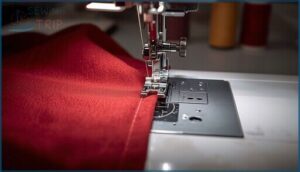
Your straight stitch is the workhorse of every sewing machine—a clean, uninterrupted line that’s essential for basic sewing techniques and most stitch patterns.
Mastering this fundamental technique opens the door to exploring the full range of sewing machine stitch types and their specific functions.
And here’s what you need to master: stitch length control matters. Set it between 2.5 and 3.0 millimeters for sturdy seams, but drop to 2.0 on delicate fabrics to prevent puckering.
For knits and jersey fabrics, you’ll also want to adjust your stitch width settings accordingly—proper stretch stitch configurations keep seams flexible and prevent breakage during wear.
Thread selection and fabric tension work together with proper sewing machine calibration to create perfect seams every time.
Zigzag Stitch Uses and Adjustments
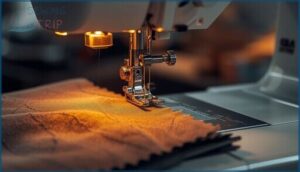
Your zigzag stitch addresses fabric stretch, seam reinforcement, and edge finishing that straight stitch can’t touch.
Adjust stitch length between 1.5 and 3.0 millimeters, then calibrate width from narrow (2mm) for buttonholes to wide (5mm) for decorative edges. And here’s the secret: thread tension needs fine-tuning when you switch from straight stitch—looser tension prevents puckering on your sewing machine’s zigzag settings.
For more information on mastering zigzag techniques and creative uses, explore this resource on zigzag stitch applications and tips.
Triple Stretch and Multi-Step Zigzag
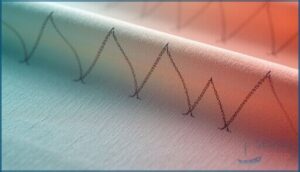
When you need seams that stretch and snap back, the triple stretch zigzag delivers. This zigzag variation uses three micro-stitches per diagonal pass, distributing fabric tension across multiple thread paths instead of one.
Set your stitch width wider than standard zigzag, then reduce top thread tension to prevent puckering. Perfect fabric selection matters here—jersey knits and lightweight stretch fabrics respond beautifully to this multi-step mechanics approach in your sewing techniques arsenal.
For more on how the three-step zigzag stitch works, see details about its construction and uses.
Edge Finishing and Hemming Stitches
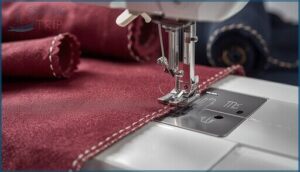
So here’s the thing: raw fabric edges fray, and basic hems can look, well, basic.
But your sewing machine has stitches specifically designed to prevent unraveling and create polished, professional-looking edges.
Let’s look at the key edge finishing and hemming stitches that’ll take your projects from homemade to handmade.
Overcast and Overlock Stitches
Think of overcast and overlock as your fabric’s safety net against fraying. Overcasting stitch wraps edges on your regular machine using an overedge foot, perfect for woven fabrics when you nail the stitch tension.
For woven fabrics like cotton or linen, you can also explore decorative stitch options that combine edge finishing with embellishment using durable presser feet designed for repeated use.
Overlock, though, requires a serger—it trims while binding simultaneously. Both are edge finishing champions, but fabric selection matters: pick overcast techniques for lighter materials, save the powerhouse overlock for stretchy knits. Serger maintenance keeps those professional seams coming.
Blind Hem and Rolled Edge Stitches
Your hems deserve the invisibility cloak treatment. Blind hem stitch catches just a few threads on the right side—press your fold first, then let a blind hem foot guide the nearly-invisible magic. Rolled edge technique transforms delicate silks with compact, enclosed folds using short stitch length adjustment.
Master these edge finishing methods:
- Test stitch settings on fabric scraps before committing
- Match thread color precisely to minimize visibility
- Adjust needle position close to the fold
- Use basting to stabilize shifting edges
- Press after stitching to set the seam
Cover Stitch for Professional Hems
Professional finishing transforms ordinary garments into ready-to-wear quality. Coverstitch creates parallel rows on top with a stretchy chain below—perfect for knit fabric compatibility and hem construction that won’t pop open. Adjust stitch tension carefully, test on scraps, and you’ll master this sewing technique alongside your straight stitch and blind hem stitch fundamentals.
| Setting | Lightweight Knits | Medium Weight Knits |
|---|---|---|
| Stitch Width | Narrow (2-3mm) | Wide (5-6mm) |
| Thread Type | Fine polyester | All-purpose |
| Differential Feed | 1.0-1.2 | 0.8-1.0 |
| Hem Allowance | Double fold ½” | Double fold ¾” |
Decorative and Embellishment Stitches
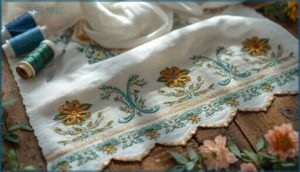
So you’ve mastered the basics, finished your edges like a pro—now it’s time to add some personality to your projects.
Decorative stitches transform plain fabric into something special, whether you’re adding delicate borders, textured fills, or eye-catching patterns. Let’s look at the most useful decorative stitches your machine offers and how to make them work for you.
Feather, Honeycomb, and Scallop Stitches
Want to add serious personality to your projects? Feather Stitch, Honeycomb Patterns, and Scallop Edges bring decorative borders to life through your Sewing Machine Operation. These Embroidery Techniques transform plain seams into statement details—perfect for Embroidery and Quilting enthusiasts following a thorough Sewing Machine Stitches Guide.
- Feather Stitch creates soft, curved arches resembling delicate feathers along fabric edges
- Honeycomb Patterns form interlocking hexagonal grids for controlled, textured filling
- Scallop Stitch produces rounded shell-like arcs that add vintage charm to hems
- Adjust arch height and width to customize your decorative impact
- Practice Sewing Techniques and Stitches on scraps before tackling final pieces
Blanket and Tatami Stitches
Blanket Stitch loops over fabric edges at regular intervals, creating dense decorative borders—perfect for appliqués and Edge Finishing on soft toys.
Meanwhile, Tatami Patterns build solid fills using offset rectangular rows, with adjustable angles controlling texture direction. Both rely on careful Stitch Density and Fabric Selection to prevent puckering.
And here’s the breakthrough: Stitch Customization through length adjustments lets you dial in exactly the look you want!
Using Decorative Stitch Patterns
Think of Decorative Stitches as your creative palette—Pattern Mixing feather with satin stitch builds exceptional Stitch Texture! Your Fabric Choice drives everything: wovens hold dense Embroidery Stitches, while knits need elastic Fancy Stitches like zigzag variations.
Thread Selection matters too—rayon for sheen, cotton for matte finishes. And here’s your power move: master Embellishment Tips by testing each pattern on scraps first!
Specialty and Reinforcement Stitches
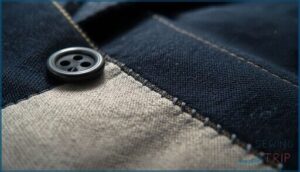
So here’s the thing—some stitches aren’t about looks or basic seams, they’re about solving specific problems and making your sewing bulletproof.
Think buttonholes that won’t unravel, seams that lock themselves in place, and invisible hand-finishing that looks like magic.
These specialty stitches create buttonholes that never fray, seams that lock automatically, and hand-finishing so clean it looks invisible
Let’s break down the workhorses that handle the jobs your standard stitches can’t touch.
Buttonhole and Button Sewing Stitches
Buttonhole construction transforms a simple opening into a functional fastener. Your machine’s Buttonhole Stitch creates those dense, close zigzags—basically a Satin Stitch—around the cut edge, preventing fraying.
And here’s what makes them work:
- Bar tacks (Straight Stitch or Backstitch) anchor each end
- Stretch buttonholes accommodate knit fabrics without puckering
- Decorative loops and button shanks offer alternative closures
Reinforcement techniques guarantee your buttonholes outlast the garment itself.
Lock-a-Matic and Locking Stitches
Beyond buttonholes, your machine’s Locking Stitch creates reinforced seams that won’t unravel. The locking mechanism engages at seam starts and ends, forming a thread interlock that secures straight stitch or zigzag stitch patterns.
Some machines feature auto lock functions—just press once for instant stitch security. It’s smarter than backstitching, creating minimal bulk while maximizing hold on woven fabrics.
Ladder, Pad, and Saddle Stitches
When your sewing machine can’t reach inside a plush toy or close a pillow seam, ladder stitch becomes your go-to hand stitching technique for invisible seams.
You’ll love how pad stitch adds edge reinforcement to interfaced jacket lapels, while saddle stitch—essential for leather crafting—creates those durable, crisscrossed seams on belts and bags that outlast any straight stitch or zigzag stitch your machine produces.
Top Sewing Machine Accessories for Stitching
So here’s the thing—having the right stitching game accessories can make or break your stitching game. I’m talking about the tools that turn frustrating projects into smooth, professional results.
Let me walk you through three essentials that’ll level up your machine work, no matter what stitch you’re tackling.
1. Brother Metal Sewing Machine
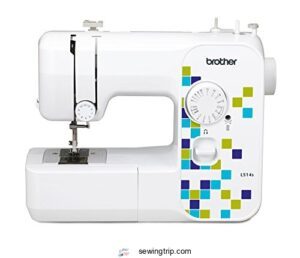
Your machine’s foundation matters more than you might think. The Brother Metal Sewing Machine brings a rugged metal frame that keeps everything steady, even when you’re flying through high-speed seams.
You’ll get 700 to 850 stitches per minute without the wobble. And that 7-point feed system? It advances fabric precisely, so your straight and zigzag stitches stay consistent.
The drop-in bobbin design makes threading a breeze, while the detachable extension table accommodates larger projects without cramping your workspace.
| Best For | Beginners and intermediate sewers who want a reliable, affordable machine that can handle everyday sewing projects without breaking the bank. |
|---|---|
| Material | Metal |
| Brand | Brother |
| Color | White |
| Primary Use | General Sewing |
| Skill Level | Beginner-Friendly |
| Power Source | Corded Electric |
| Additional Features |
|
- Metal chassis keeps the machine stable at high speeds, reducing vibration and improving stitch quality
- Drop-in bobbin system makes setup quick and hassle-free, especially helpful if you’re new to sewing
- Great value for the price with solid performance that punches above its weight class
- Power plug may need an adapter for international use, adding extra cost and inconvenience
- Long-term durability is still uncertain since many users haven’t put it through years of heavy use yet
- At 11.2 pounds, it’s portable but not exactly lightweight if you need to move it around frequently
2. Framad Sewing Machine Presser Foot Set
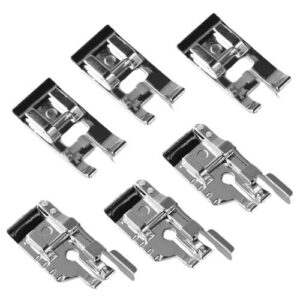
Once your machine is humming, your presser feet become the real workhorse. The Framad Presser Foot Set bundles six specialized feet in one hard storage case, giving you everything from a 1/4″ quilting foot to an invisible zipper foot.
Each piece snaps on with a satisfying click, no wrestling required. And the zinc alloy construction? Built to last through hundreds of projects without cracking.
You’ll handle blind hems, overlock edges, and precise appliqué work without switching machines or compromising stitch quality.
| Best For | Sewists and quilters who want a complete set of specialty presser feet for precision work like quilting, hemming, and edge finishing without buying each attachment separately. |
|---|---|
| Material | Zinc |
| Brand | Generic |
| Color | Silver |
| Primary Use | Specialized Stitching |
| Skill Level | All Levels |
| Power Source | N/A |
| Additional Features |
|
- Includes six specialized feet in one set with a storage case, covering everything from quilting to invisible zippers
- Durable zinc alloy construction that snaps on easily and withstands heavy use
- Compatible with multiple popular brands including Brother, Janome, Singer, and Baby Lock low-shank machines
- Only works with low-shank machines, so you’ll need to verify compatibility before purchasing
- No warranty or customer support information provided
- May not fit all sewing machine models even within compatible brands
3. Gutermann Sewing Thread Set
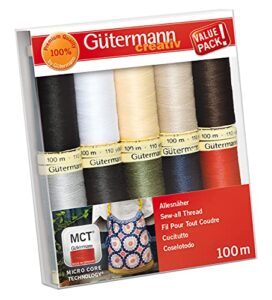
Thread quality makes or breaks every seam you sew, and Gütermann’s 10-spool set covers your essential palette. You get 100 meters of polyester per spool—enough for multiple garments without constant restocking.
The Micro Core Technology builds strong, flexible seams that won’t snap under tension, whether you’re hemming stretchy knits or topstitching denim. And the colorfast dyes? They resist bleeding wash after wash.
These spools fit standard machines without jamming, so you’ll thread needles quickly and keep your momentum going project after project.
| Best For | Sewers who want reliable, professional-quality thread in essential colors for everyday projects like hemming, mending, and garment construction. |
|---|---|
| Material | Polyester |
| Brand | Gütermann |
| Color | Popular |
| Primary Use | Thread Supply |
| Skill Level | All Levels |
| Power Source | N/A |
| Additional Features |
|
- Micro Core Technology creates durable seams that hold up under stress without breaking
- 10 basic colors give you solid coverage for most sewing projects without buying thread individually
- Works smoothly with standard sewing machines and threads through needles easily
- 100m spools run shorter than some users expect, so heavy sewers may need frequent replacements
- Higher price point compared to budget thread options, especially if you sew in bulk
- Hand wash recommendation may limit use for projects that need machine washing
Frequently Asked Questions (FAQs)
What are the 10 basic stitches?
You’ll master ten foundational stitches fast: straight stitch, backstitch, zigzag, overcast, blind hem, buttonhole, stretch stitch, triple straight, ladder stitch, and blanket stitch—each one serving specific fabric needs and construction tasks.
What is the basic stitch on a sewing machine?
The straight stitch is your fundamental sewing machine stitch. It creates a simple, straight line by passing the needle through fabric once, perfect for joining seams and topstitching with adjustable length.
How do I choose the right needle size?
You’ll match needle gauge to fabric weight—lighter materials need sizes 60-70, while heavy denim takes 90- And don’t forget: ballpoint tips prevent snagging on knits!
What tension settings work best for different fabrics?
Getting tension right is like finding the sweet spot—cotton and blends thrive at 3, knits prefer 2, denim needs 4-5, while delicate silk demands ultra-low settings around 2 to prevent puckering.
When should I use a walking foot attachment?
You’ll want a walking foot when you’re stitching thick layers, slippery fabrics, or stretchy knits. It feeds both layers evenly, so your seams don’t shift or pucker as you sew.
How do I prevent thread bunching underneath fabric?
Thread bunching beneath fabric feels like the apocalypse of sewing. You’ll prevent it by balancing your tension, rethreading the machine carefully, and using a fresh needle that matches your fabric weight perfectly.
Whats the difference between woven and knit stitches?
Woven stitches interlock yarns at right angles, creating a stable grid with minimal stretch.
Knit stitches form connected loops that stretch and recover, giving you that soft, flexible feel you need for active wear.
Conclusion
Like a carpenter who knows when to reach for a hammer versus a chisel, you’ll now instinctively choose the right stitch for every fabric challenge. Those intimidating menus? They’re just your toolkit.
Master these basic machine stitch types, and you won’t second-guess your selections anymore. You’ll pull thread, adjust tension, and watch your fabric transform—seam by seam, hem by hem—into finished projects that actually look intentional. That’s when sewing stops feeling random and starts feeling like real skill.
- https://www.digitizingmadeeasy.com/creative-cutwork-embroidery-with-organza/
- https://sherriquiltsalot.com/2020/09/30/almost-everything-you-need-to-know-about-a-walking-foot/
- https://www.diaryofaquilter.com/tips-for-machine-quilting-with-a-walking-foot/
- https://www.pincutsewstudio.com/blog/how-to-install-and-sew-with-a-walking-foot
- https://fieldtexcases.com/blog/walking-foot-complete-guide/