This site is supported by our readers. We may earn a commission, at no cost to you, if you purchase through links.

Your fleet’s speed limiters aren’t just preventing tickets—they’re quietly bleeding fuel costs, degrading driver performance, and leaving you vulnerable to regulatory shifts you haven’t planned for.
Modern speed control technology has evolved far beyond the crude mechanical governors that simply capped maximum velocity, now integrating GPS positioning, adaptive cruise algorithms, and real-time traffic data to balance compliance with operational efficiency.
The systems you choose determine whether your vehicles operate as rigid, inflexible machines or as intelligent assets that respond dynamically to changing conditions, driver behavior patterns, and jurisdictional requirements.
Selecting the right speed control features requires understanding how sensors, actuators, and electronic control units work together to deliver both immediate safety benefits and long-term competitive advantages that extend across fuel economy, maintenance intervals, and insurance premiums.
Table Of Contents
Key Takeaways
- Modern speed control systems deliver measurable competitive advantages beyond regulatory compliance by integrating GPS positioning, adaptive algorithms, and real-time traffic data to optimize fuel efficiency, reduce maintenance costs, and lower insurance premiums across your entire fleet operation.
- Electronic speed limiters and Intelligent Speed Assistance (ISA) represent a fundamental evolution from crude mechanical governors, now coordinating with ECUs, sensors, and actuators to enforce speed limits while maintaining smooth acceleration and responding dynamically to changing road conditions and jurisdictional requirements.
- Speed control sensors function as your vehicle’s central nervous system, capturing velocity measurements at subsecond intervals with ±0.5% to ±1.5% accuracy and feeding critical data through CAN bus networks to enable split-second decisions that coordinate throttle response, braking systems, and collision prevention across multiple safety platforms.
- Selecting the right speed control technology requires evaluating system compatibility with existing vehicle electronics, ensuring alignment with current regulatory standards (EU 2019/2144, US FMVSS 150), and future-proofing your investment against evolving autonomous vehicle requirements while balancing operational cost reduction with measurable improvements in driver safety and compliance enforcement.
What Are Speed Control Features?
Speed control features are the systems that manage and regulate your vehicle’s speed, whether you’re traveling through city traffic or maintaining highway cruising. These technologies range from basic mechanical governors to advanced AI-powered systems that read road conditions in real-time, giving you precise command over acceleration and velocity limits.
If you’re just getting started with these systems, this beginner’s guide to speed control walks through how each technology actually works behind the wheel.
Understanding how these features work—from their core purpose to the sensors and components that make them possible—puts you in the driver’s seat in terms of selecting the right system for your needs.
Definition and Purpose of Speed Control
Speed regulation features give you command over your vehicle’s maximum operating speed through automated or user-configured limits, directly enhancing vehicle safety by preventing dangerous over-speed events.
Adjusting your industrial sewing machine speed control settings properly ensures safer operation and greater precision across different fabric types.
These speed limit devices—ranging from electronic speed limiters to intelligent speed assistance systems—integrate with engine management and speed monitoring architecture, enabling precise driver assistance that aligns your operation with regulatory requirements while maintaining measurable control over acceleration and speed management technology performance.
For practical setup guidance on both mechanical and digital controls, see this complete guide to speed limiter installation and adjustment.
Importance in Modern Vehicles
Today’s driver assistance systems deliver measurable advantages beyond simple speed limitation—you gain reduced driver fatigue on extended highway routes, enforceable compliance with traffic regulations across jurisdictions, and enhanced fuel efficiency through steady cruising speeds that eliminate unnecessary acceleration.
Electronic speed limiters, adaptive cruise control, and intelligent speed assistance work with integrated sensors to coordinate throttle and braking responses, transforming vehicle performance while strengthening road safety and traffic management capabilities.
Modern vehicles increasingly mirror the precision found in variable speed sewing features, where digital controls enable fine-tuned motor adjustments and consistent performance across different operating conditions.
Key Components and Technologies
Your vehicle’s speed control architecture relies on four interconnected technologies working in concert. Sensors provide rotational speed data through magnetic or Hall effect calibration, feeding information to actuators that translate electronic signals into throttle adjustments.
Power electronics modulate current flow while ECU management executes control algorithms that coordinate electronic speed limiters, intelligent speed assistance, and other driver assistance systems for precise vehicle speed limiting.
Types of Speed Control Systems
When you’re selecting speed control technology for your vehicle or fleet, you’ll find that not all systems operate the same way or deliver identical results.
The market offers five primary categories, each built on different principles and designed to address specific operational demands.
Understanding these distinctions puts you in control of choosing the system that aligns with your performance requirements and regulatory obligations.
Mechanical Speed Governors
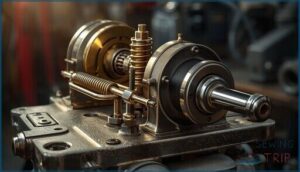
Long before computers took the wheel, your grandfather’s diesel truck relied on a beautifully simple device—a spinning set of weights and springs that physically choked the engine when it tried to run too fast. These mechanical speed governors still dominate heavy equipment today because they deliver superior reliability in harsh environments where electronics fail. Here’s why their governor design remains relevant:
Mechanical speed governors—spinning weights and springs that choke the engine when it runs too fast—still dominate heavy equipment because they outlast electronics in harsh conditions
- Speed regulation without electrical dependency ensures continuous throttle control
- Fuel efficiency improves through consistent engine performance limits
- Physical restriction of fuel flow prevents overspeeding damage
- Centrifugal force activates speed governance automatically
- Zero digital vulnerabilities make them ideal for speed limit devices in rugged conditions
You’ll find these mechanical speed governors controlling everything from industrial generators to commercial fleet vehicles, proving that sometimes the old ways of vehicle speed limiting maintain their edge through sheer dependability and straightforward speed control systems operation.
Electronic Speed Limiters

When your right foot demands power but regulations demand restraint, Electronic Speed Limiters step in with precision you can trust. These digital limiting systems integrate seamlessly with your Electronic Control Unit, reading wheel speed sensors and executing vehicle calibration commands that enforce speed governance without the jerky interruptions of older tech.
| Feature | Benefit |
|---|---|
| ECU Technology integration | Real-time Engine Optimization through throttle modulation |
| Soft-limit programming | Progressive Electronic Throttling maintains smooth acceleration |
| Regional calibration | Automatic Speed Limiters adapt to local Vehicle Speed Limitation laws |
You’re commanding a system that balances compliance with performance.
Intelligent Speed Assistance (ISA)

Precision meets foresight when ISA Technology harnesses GPS mapping, forward cameras, and traffic networks to enforce speed governance automatically. This Intelligent Speed Adaptation system transforms Vehicle Speed Management into a real-time dialogue between your vehicle and the road ahead, reducing average speeds by several kilometers per hour while maintaining smooth acceleration.
- Warning alerts notify you when exceeding posted limits, sharpening driver awareness without intrusive intervention
- Primed braking intervention readies your system for automatic deceleration, bridging manual control with Intelligent Cruise assistance
- Full automatic adaptation integrates with Adaptive Cruise Control and Intelligent Transportation Systems for smooth compliance
- Regulatory compliance satisfies regional mandates while future-proofing your Vehicle Safety infrastructure against evolving Speed Limit Devices requirements
GPS-Based Speed Control Systems

Real-time satellite triangulation enables GPS-Based Speed Control to fuse GPS Mapping with Speed Governance, transforming Vehicle Tracking into proactive intervention. This GPS Integration bridges Vehicle Speed Management with predictive intelligence, positioning your fleet ahead of regulatory curves and operational inefficiencies.
You’ll command Route Optimization through Geofencing Technology that automatically throttles your engine when entering restricted zones, enforcing Speed Limit Devices compliance before manual reaction begins.
Adaptive Cruise Control With Speed Limiting

When Adaptive Cruise Control merges with Speed Limiters, you gain dual-layer Vehicle Speed Control that reacts to both traffic ahead and regulatory thresholds. This ACC Technology employs radar sensors to maintain safe following distances while capping your maximum velocity, advancing Vehicle Safety toward Autonomous Driving benchmarks.
Your command over Speed Management Technology includes:
- Radar-based distance monitoring that adjusts throttle in real-time
- Automatic speed ceiling enforcement aligned with posted limits
- Effortless blending with GPS-Based Speed Control for zone-aware governance
- Driver override capability preserving manual authority during critical maneuvers
- Reduced rear-end collision risk through predictive braking algorithms
This Cruise Control evolution locates your fleet at the intersection of regulatory compliance and operational precision.
Essential Functions of Speed Control Sensors

Speed control sensors act as the nerve center of your vehicle’s performance management system, translating wheel rotation into actionable intelligence that your car’s brain can process.
These sensors don’t just passively collect data—they actively enable your vehicle to make split-second decisions that keep you safe and fine-tune every aspect of engine behavior.
Understanding how these sensors function reveals the hidden mechanics that give you complete command over your vehicle’s capabilities.
Real-Time Speed Data Collection
Your vehicle’s speed sensors capture velocity measurements at subsecond intervals, delivering critical data that shapes every aspect of performance optimization. Modern Vehicle Speed Sensors feed information to Speed Control Systems through CAN bus networks, achieving data latency between 1 and 20 milliseconds. Proper Sensor Calibration ensures Data Accuracy within ±0.5% to ±1.5% of true speed, enabling precise Real-Time Monitoring for both safety systems and Vehicle Telematics platforms.
| Data Collection Parameter | Performance Specification | System Application |
|---|---|---|
| Measurement Interval | Subsecond (millisecond granularity) | Speed Profiling, rapid response |
| Data Accuracy Range | ±0.5% to ±1.5% of true speed | Realtime Vehicle Tracking, cruise control |
| Communication Latency | 1–20 milliseconds | GPS-Based Speed Control, ECU integration |
Integration With ECUs and Engine Management
Think of the ECU Interface as your vehicle’s mission control—it translates Speed Signal data into coordinated action across Engine Management Systems. Your Speed Control Systems rely on CAN bus architecture to communicate speed limit demands and synchronize Variable Throttling with Engine Calibration logic, adjusting fuel delivery and ignition timing in real time.
Here’s what makes this integration powerful:
- Realtime Monitoring facilitates subsecond fault detection across Vehicle Electronics networks
- Diagnostic protocols verify compatibility between Automotive Electronics modules under varying loads
- End-to-end validation ensures stable engagement with minimal latency during speed transitions
Sensor Types: Magnetic, Hall Effect, and Optical
Your Speed Monitoring arsenal includes three core Sensor Technology families—each engineered for distinct operating envelopes. Magnetic Sensors generate voltage through coil induction, delivering rugged contactless measurement. Hall Effect Sensors output proportional signals under magnetic flux, enabling precise wheel-speed tracking in Automotive Sensor Technology. Optical Detection interrupts light beams to capture rotation with noise immunity, though it demands cleaner environments. Sensor Calibration locks accuracy across all platforms.
Role in Safety and Performance Optimization
Beyond raw data capture, your sensors power Collision Prevention by feeding Automotive Safety Features that halt throttle response when you exceed programmed thresholds.
Vehicle Stability systems read these inputs to modulate braking and traction under cornering loads, while Driver Assistance algorithms adjust acceleration curves on wet pavement.
Fleet operators report measurable drops in incident rates once Speed Control Systems sync with stability modules, proving Safety Standards translate directly into Performance Optimization and Driver Safety.
Top 6 Speed Control Products Reviewed
You’ll find a range of speed control solutions designed for different applications and performance requirements. Each product offers distinct features that address specific control needs, from basic motor regulation to sophisticated variable speed adjustment.
The following reviews examine six controllers that deliver reliable speed management across various operating conditions.
1. Cdmall Ac Motor Speed Controller
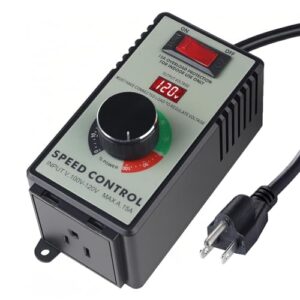
When you need precise control over AC motor performance without the complexity of industrial-grade systems, the Cdmall AC Motor Speed Controller delivers a straightforward solution that bridges the gap between basic switches and professional equipment.
This device offers power management through voltage control capabilities spanning 0-120V, enabling speed regulation for fans, blowers, and similar equipment with AC brushed motors. Its 15A current capacity provides substantial device compatibility, while integrated overload protection prevents system damage.
The LED display gives you real-time visibility into motor efficiency adjustments, transforming basic speed control systems into precision instruments.
| Best For | DIYers and hobbyists who need affordable, straightforward speed control for AC brushed motors in fans, blowers, or greenhouse ventilation systems without getting into complex automation. |
|---|---|
| Max Current | 15A |
| Voltage | 110-120V |
| Display Type | LED |
| Material | Plastic |
| Overload Protection | Yes |
| Motor Type | AC Brushed |
| Additional Features |
|
- LED voltage display lets you see exactly what you’re feeding your motor, making it easy to dial in the right speed for your setup
- Overload protection cuts power automatically if things go sideways, which saves you from frying motors or tripping breakers constantly
- Handles up to 1500W of inductive load, so it works with most residential fans and blowers without needing industrial gear
- Only works with AC brushed motors, so you’re out of luck if your device has modern brushless motors or electronic controls
- Some users report quality inconsistencies and durability concerns, meaning your mileage may vary on how long it lasts
- Not compatible with anything that has circuit boards or capacitors inside, which rules out a lot of newer appliances
2. AC Motor Speed Controller
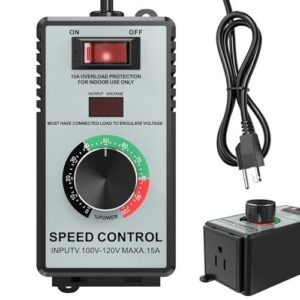
You’ll find the second AC Motor Speed Controller in this lineup combines sturdy 4000W capacity with safety features that make high-power applications accessible to anyone who can turn a knob. Its LED display transforms power management into a visual experience, letting you monitor voltage adjustments in real-time while the precision dial gives you command over motor efficiency like cruise control for your workshop tools.
The integrated overload protection and surge defense create a safety net that prevents equipment damage, while the compact design with belt clip ensures portability that professional controller design rarely achieves in this power class.
| Best For | DIYers and workshop professionals who need precise speed control for AC brushed motors in tools like angle grinders, fans, and soldering irons without the complexity of professional-grade systems. |
|---|---|
| Max Current | 15A |
| Voltage | 120V |
| Display Type | LED |
| Material | Plastic |
| Overload Protection | Yes |
| Motor Type | AC Brushed |
| Additional Features |
|
- High 4000W capacity with real-time LED voltage display gives you complete visual control over power adjustments
- Built-in overload and surge protection prevents equipment damage during heavy-duty applications
- Lightweight 12-ounce design with belt clip makes it easy to carry between workstations
- Not compatible with DC motors, induction motors, or modern electronics with circuit boards
- Power adjustment can lag when turning up the dial quickly
- Limited to AC brushed motors and resistive loads, which excludes many common appliances
3. Vxcicc Variable Speed Motor Controller
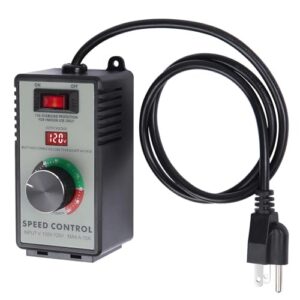
The Vxcicc controller stands out by wrapping 4000W of raw power in a package that prioritizes user control through its high-precision potentiometer and crystal-clear LED readout, giving you the kind of granular voltage adjustment that transforms ordinary motor operation into a finely-tuned performance.
This voltage control system delivers 0-220V adjustable output with 15A maximum current capacity, enabling precise speed regulation across fans, routers, and resistance-load devices while maintaining motor efficiency through automatic overload protection.
Your power management becomes straightforward as the LED display tracks real-time performance, though device compatibility excludes single-phase motors and smart appliances with complex circuitry.
| Best For | DIY enthusiasts and hobbyists who need precise voltage control for variable-speed tools, fans, and resistance-load devices in workshop or home settings. |
|---|---|
| Max Current | 15A |
| Voltage | AC 120-220V |
| Display Type | LED |
| Material | Plastic |
| Overload Protection | Yes |
| Motor Type | AC Motors |
| Additional Features |
|
- Wide voltage adjustment range (0-220V) with high-precision potentiometer gives you excellent control over motor speeds and device performance
- LED display provides clear, real-time visibility of your settings so you always know what’s running
- Overload protection with automatic shut-off prevents damage to both the controller and your connected devices
- Not compatible with single-phase motors or smart appliances with complex circuitry, limiting its versatility
- Plastic construction feels less durable than metal alternatives, especially for heavy-duty industrial applications
- 1500W sustainable power is significantly lower than the 4000W peak rating, which might be misleading for continuous-use scenarios
4. Pemenol Motor Speed Controller

Pemenol’s controller settings deliver speed regulation through multiple input modes—manual potentiometer, external PWM, and built-in safety protocols—handling 1–5 A loads across 110–240 V systems. Power management precision transforms your mechanical speed governors into responsive speed control systems.
You’ll find active response specifications that smooth motor efficiency through ramping functions, reducing heat rise while speed control sensors feed real-time data to prevent overheating during high-demand cycles.
Vehicle speed applications and light industrial contexts benefit from DIN-rail mounting, overload protection, and EMI-shielded wiring that maintains signal integrity throughout speed limiting operations.
| Best For | Hobbyists and light industrial users who need precise, adjustable speed control for small DC motors, fans, and conveyors up to 150W with soft-start protection. |
|---|---|
| Max Current | 15A |
| Voltage | 110-120V |
| Display Type | LED |
| Material | Plastic |
| Overload Protection | Yes |
| Motor Type | AC Resistive |
| Additional Features |
|
- Multiple control options including manual knob, external PWM input, and digital encoder give you flexible speed adjustment from 5V to 24V systems
- Built-in safety features like soft start, power-off memory, and overload protection extend motor life and prevent sudden mechanical stress
- Compact design with straightforward wiring makes it easy to retrofit into existing setups or integrate into new projects
- 150W maximum power limit won’t handle heavy-duty industrial motors or high-demand applications
- Some users report durability concerns and heating issues during extended use at higher loads
- Speed adjustments locked to 1% increments with no custom step settings, which may be too coarse for ultra-precise applications
5. Craftmade Ceiling Fan Wall Control
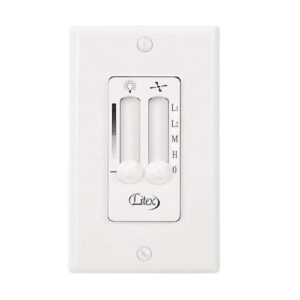
Craftmade’s wall-mounted interface gives you command over fan speed settings and dimming features through a 300W capacity, translating ceiling fan control principles into residential speed control systems with the same precision vehicle speed management demands.
Your wall mount installation connects four-speed selections—low through high, while full-range dimming regulates lighting loads up to a 1.2 amp motor draw, mirroring how cruise control and speed limiters improve energy efficiency.
Button control simplicity delivers the responsiveness adaptive systems provide, placing airflow authority directly in your hands without complex programming overhead.
| Best For | Homeowners looking for straightforward manual control of their ceiling fan speeds and lighting without dealing with remote controls or smart home systems. |
|---|---|
| Max Current | 15A |
| Voltage | DC 5-24V |
| Display Type | Digital |
| Material | Electronic Module |
| Overload Protection | No |
| Motor Type | DC Motors |
| Additional Features |
|
- Four-speed fan control gives you precise airflow adjustment from gentle breeze to full power
- Built-in dimmer lets you set the perfect lighting level up to 300W without needing a separate switch
- Simple button interface makes daily operation easy for everyone in the household
- Requires hardwiring during installation, so you’ll likely need an electrician
- 300W light capacity and 1.2 amp motor limit may not work with larger fans or multiple light fixtures
- Wall-mount only design means you’re stuck with that location once it’s installed
6. Briidea Variable Speed Motor Controller
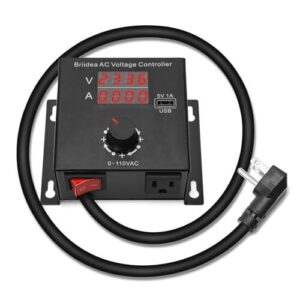
Briidea’s digital controller puts voltage control mastery in your hands through 10-110V adjustable output handling 15A maximum current, while its built-in USB socket delivers fixed 5V charging—power optimization that mirrors how speed control systems and variable speed limiters regulate vehicle speed across changing conditions.
Your metal-cased unit combines surge protection with heat dissipation engineering, though motor efficiency demands attention to the voltage reset quirk and initial dial instability affecting device calibration, much like speed control sensors require precise tuning for consistent speed regulation and speed limiting accuracy.
| Best For | Woodworkers and DIY enthusiasts who need precise speed control for routers, drills, and small planers, plus the convenience of a built-in USB charging port. |
|---|---|
| Max Current | 1.2A |
| Voltage | 120V |
| Display Type | None |
| Material | Wall Mount |
| Overload Protection | No |
| Motor Type | Ceiling Fan |
| Additional Features |
|
- Wide voltage range (10-110V) with digital display lets you dial in exact speeds for different tools and bit sizes
- Built-in surge and spike protection in a durable metal casing keeps your equipment safe during use
- Bonus USB charging socket means you can power up your phone or other devices right at your workstation
- Voltage resets to zero every time you lose power or switch it off, so you’ll need to readjust each session
- First click of the dial jumps voltage to an unstable 30V, which can be jarring if you’re not expecting it
- Some users report quality control issues including defective units and noisy fan bearings
Key Benefits of Advanced Speed Control

Sophisticated speed control isn’t just about keeping your vehicle within posted limits—it’s about transforming how you manage risk, efficiency, and operational control on the road. When you implement these systems effectively, you release measurable advantages that extend far beyond basic compliance.
Let’s examine the core benefits that make modern speed control features essential for both individual drivers and commercial operations.
Enhanced Road and Driver Safety
Speed Management systems act as your vehicle’s safety guardian, delivering measurable accident prevention results through sophisticated vehicle safety technologies. Real-time speed data sharpens your reaction time by 0.5 seconds in urban environments, while collision reduction reaches 20-40% when drivers understand ISA features.
Road safety solutions transform driver behavior through:
- GPS-based controls matching posted limits within ±2 km/h
- Adaptive systems maintaining compliant speeds in 90% of highway scenarios
- ISA implementations lowering average speeds 5-15% across tested fleets
Compliance With Traffic Regulations
Your speed control system becomes your compliance ally when regulatory frameworks demand precision. Vehicle compliance hinges on speed limiters that meet safety standards across US and EU markets, with type-approval tests confirming you won’t breach posted limits.
Traffic enforcement agencies appreciate data logging capabilities that support road safety measures, while software updates require regulatory compliance notifications before deployment—ensuring your fleet aligns with traffic safety regulations seamlessly.
Improved Fleet Management and Efficiency
Beyond regulatory checkpoints, you’ll discover your fleet becomes a precision instrument when GPS-based speed control meets real-time vehicle tracking. Fleet management systems transform raw speed data into actionable intelligence—route planning optimizes delivery windows, driver coaching slashes harsh braking by 40 percent, and fuel savings compound through adaptive routing that cuts consumption 5 to 20 percent.
- Fleet optimization reduces idle time by 15 to 25 percent through telematics adoption
- Variable speed limiters enable predictive maintenance, lowering unscheduled costs 10 to 30 percent
- Fleet management solutions improve on-time delivery performance by 5 to 15 percentage points
Customization and Adaptability
Modern systems empower you with control through driver settings that let you define speed profiles for highway versus urban routes or toggle between Eco and Sport adaptive modes. Fleet management platforms enhance this by layering geofencing boundaries over GPS-based speed control, triggering real-time adjustments when vehicles cross zone lines. Driver assistance technologies further integrate speed limit awareness with variable speed limiters, adapting thresholds without constant manual input. Effective route planning also involves considering vehicle profiles and route optimization techniques to improve overall fleet efficiency.
| Feature | Function | Application |
|---|---|---|
| Driver Settings | Manual speed threshold adjustment | Individual preference tuning |
| Adaptive Modes | Context-responsive calibration | Terrain and load optimization |
| Geofencing | Location-triggered limit changes | Multi-zone fleet operations |
Choosing The Right Speed Control Features

Selecting the right speed control features transforms your fleet from a collection of vehicles into a precision-tuned operation where safety, compliance, and efficiency work in harmony. You’ll need to weigh multiple factors, from how the system integrates with your existing vehicle architecture to whether it meets current regulations and prepares for future requirements.
The following considerations will help you make an informed decision that aligns with your operational goals and technical constraints.
Factors to Consider for Commercial Fleets
When you’re managing a commercial fleet, three critical factors—operational cost, driver safety, and regulatory compliance—will make or break your speed control system selection. GPS-based speed control with real-time vehicle tracking gives you command over fuel efficiency through route optimization, while driver behavior monitoring enforces speed limit compliance.
Integrated fleet management platforms transform vehicle speed data into actionable insights, letting you cut costs while protecting your drivers and meeting regulatory standards.
Compatibility With Vehicle Systems
Your speed control system won’t deliver those cost savings and safety benefits if it can’t talk to your vehicle’s existing electronics—compatibility isn’t the foundation of everything, it’s the entire game. System integration demands ECU compatibility and proper sensor calibration across transmission control systems, which means understanding interface standards before you commit.
- Vehicle networking protocols determine whether your investment becomes power or wasted potential
- Sensor integration failures strand you with automotive technology that can’t communicate
- Vehicle control systems mismatches transform your speed control vision into expensive disappointment
Regulatory Requirements and Future-Proofing
You’ll need to navigate three critical layers: Compliance Standards that align with European Union Regulation 2019/2144, United States FMVSS 150, and China’s GB/T mandates; Regulatory Updates driven by UNECE WP.29 Harmonization Efforts; and Future Proofing strategies that prepare your GPS-Based Speed Control systems for Transportation Safety requirements governing Autonomous Vehicles.
These efforts ensure your investment withstands evolving Speed Limit Enforcement protocols and Safety Protocols.
Maintenance and Troubleshooting Considerations
Vigilance becomes your ally when protecting speed control investments. Maintenance scheduling with regular inspections catches wiring issues and corrosion before they escalate, while power monitoring prevents voltage-induced failures.
You’ll master diagnostic troubleshooting through fault analysis of error codes, using diagnostic tools to pinpoint sensor calibration drift.
Document every action—your records reveal patterns that transform reactive repairs into predictive maintenance and repair best practices.
Frequently Asked Questions (FAQs)
How do speed limiters affect fuel consumption?
Like a thermostat fine-tuning energy use, speed governance directly shapes fuel efficiency by keeping your vehicle speed within engine optimization zones.
This reduces excessive fuel injection and improves emission control while enabling substantial fuel savings through eco-driving practices.
Can speed control systems be manually overridden?
Yes, most Speed Control Systems include Manual Override capabilities—you can disengage automatic limiting through pedal inputs, dashboard switches, or mode selections, though Driver Alerts usually signal when the Speed Limiter re-engages for safety.
What happens when speed sensors fail completely?
Complete sensor failure triggers immediate cruise control deactivation, disables ABS and traction systems, and logs diagnostic fault codes.
Your vehicle’s stability programs lose effectiveness, demanding prompt troubleshooting to restore critical safety functions.
Do speed limiters work in all weather conditions?
Speed limiters demonstrate strong weather resilience through sensor reliability and GPS-based speed control, though rain or snow may challenge speed accuracy.
Vehicle dynamics and road conditions affect performance, yet redundant systems maintain road safety technology across environments.
How often should speed control sensors be calibrated?
Manufacturers usually suggest calibration intervals between one and three years for your speed control sensors. However, harsh operating conditions demand more frequent checks—potentially every six to twelve months—to maintain sensor accuracy and guarantee reliable vehicle speed measurement.
Conclusion
Yesterday’s speed limiters clamped down on velocity alone; today’s best speed control features orchestrate an entire ecosystem of sensors, algorithms, and adaptive responses that transform compliance into competitive advantage.
You’re not just preventing violations—you’re engineering precision into every mile, every gallon, every driver interaction.
The systems you install now determine whether your fleet merely survives regulatory scrutiny or dominates through operational intelligence that compounds savings across fuel, maintenance, and risk mitigation for years ahead.
- https://dictionary.cambridge.org/dictionary/english/captivating
- https://www.sciencedirect.com/science/article/pii/S0749208123000268
- https://www.fordservicecontent.com/Ford_Content/vdirsnet/OwnerManual/Home/Content?variantid=8255&languageCode=en&countryCode=USA&moidRef=G1947153&Uid=G1947199&ProcUid=G1947201&userMarket=nzl&div=f&vFilteringEnabled=False&buildtype=web
- https://www.loubachrodtbmw.com/how-to-select-drive-modes-in-bmw-cars.html
- https://kb.samsara.com/hc/en-us/articles/32677943235725-Configure-Speeding-Settings