This site is supported by our readers. We may earn a commission, at no cost to you, if you purchase through links.
That fabric you fell in love with at the store? It might fight you every step of the way once you start cutting and sewing. Most sewists learn this the hard way—a beautiful drape that won’t hold its shape, a cozy knit that stretches out of control, a shirt that shrinks two sizes after its first wash.
The culprit is almost always fiber content. Choosing fabric by fiber content isn’t just a technicality on the label; it’s the difference between a garment you wear for years and one that ends up in the back of a drawer. Know your fibers, and the fabric starts working with you instead of against you.
Table Of Contents
- Key Takeaways
- What Fiber Content Actually Means on a Label
- Key Properties of Common Fabric Fibers
- How Fiber Content Affects Fabric Behavior
- Choosing Fiber Content for Your Sewing Project
- Care and Maintenance by Fiber Type
- Environmental Impact of Different Fiber Choices
- Frequently Asked Questions (FAQs)
- Conclusion
Key Takeaways
- Fiber content is the single biggest factor in how a fabric behaves — get it wrong, and even the most beautiful material will fight you from the first cut to the final wash.
- Natural fibers like cotton, wool, and linen each have a built-in job: cotton breathes, wool insulates, and linen holds structure — so match the fiber to what the garment actually needs to do.
- Blended fabrics aren’t a compromise; they’re a strategy — combining fibers like cotton and polyester lets you stack benefits like durability, stretch recovery, and easier care in one material.
- Every fiber choice carries an environmental cost, and sustainable options like organic cotton and Tencel prove you don’t have to sacrifice performance to sew with a cleaner conscience.
What Fiber Content Actually Means on a Label
That little label sewn into your fabric bolt tells you more than most people realize.
It covers everything from fiber content to care instructions, and reading fabric labels the right way can save you from a lot of costly mistakes.
Once you know how to read it, you’ll make smarter choices before you ever cut a single piece.
Here’s what you need to understand about fiber content labels.
How to Read a Fabric Content Label
That tiny tag sewn into your garment’s seam holds real power. Fabric content labels follow strict textile standards — U.S. label regulations require fibers listed by descending weight, so the first fiber listed dominates.
A label reading “60% cotton, 40% polyester” tells you exactly what you’re working with. Understanding fabric content means you can predict drape, care instructions, and durability before you cut a single thread.
Natural, Synthetic, and Semi-Synthetic Fiber Categories
Once you understand how labels work, fiber categories make the whole picture click.
Natural fibers — cotton, wool, linen — come straight from plants or animals. Synthetic fibers like polyester and nylon are built from petrochemicals through textile innovation and material science. Semi-synthetic fibers, including Tencel and viscose, start with natural cellulose but get chemically reformed.
Each category carries its own performance story and eco friendly options worth knowing. For more insights into responsible clothing fiber choices, you can explore helpful resources about sustainability.
What Blended Fabrics Mean for Your Project
Blended fabrics combine fiber content for real Performance Tradeoffs you’ll feel. A 50/50 cotton-polyester mix, for instance, shrinks less, stays wrinkle-resistant, and wears longer — all at once.
Here’s what blends mean for your sewing project:
- Comfort Factors — Softness often stays, but breathability can drop
- Durability Impacts — Stress points hold up longer
- Care Routines — Usually simpler, but heat-sensitive
- fabric properties shift — Drape and texture change with every blend
To further understand how fiber blending leads to, it’s helpful to review pioneering examples from the textile industry.
Key Properties of Common Fabric Fibers
Every fiber type brings something different to the table — and knowing what each one does changes how you sew, shop, and plan. Before you cut a single piece, it helps to understand what you’re actually working with.
Here’s a look at the most common fibers and what makes each one worth knowing.
Cotton — Breathability and Everyday Comfort
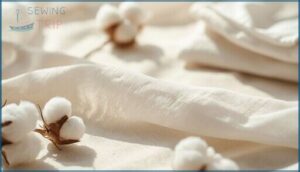
Cotton is the workhorse of natural fibers, and its breathability is the main reason it dominates everyday wardrobes. Its porous structure delivers real airflow benefits, letting heat escape instead of trapping it against your skin.
That same fiber content makes sweat wicking feel seamless — cotton absorbs moisture before you notice it. Its gentle touch suits sensitive skin, and its all-season wear versatility makes fabric selection straightforward.
Wool — Warmth, Moisture, and Texture
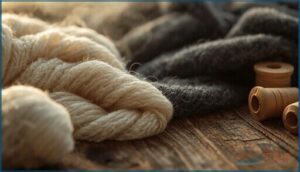
Wool is a powerhouse of thermal regulation, and once you understand its fiber content, you’ll see why. Its crimped structure traps air, delivering natural warmth even when damp — something cotton simply can’t claim.
To keep wool garments looking their best long-term, proper fabric care and washing techniques make all the difference in preserving that natural structure.
Wool insulation works through moisture management too, absorbing moisture vapor inside the fiber rather than on the surface. Fiber softness varies by micron count, so finer merino means real textile durability without the itch.
Linen — Strength and Natural Luster
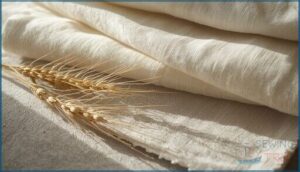
Linen is a quiet powerhouse — flax fibers run long and dense, giving it textile strength that’s roughly three times that of cotton. Its natural luster comes from those smooth, uniform fibers catching light evenly across the weave.
Here’s what linen’s fiber content delivers:
- Fiber durability that survives decades of washing
- Breathability that pulls moisture away fast
- Natural luster — soft sheen, never flashy
- Linen blends that add softness without sacrificing structure
Polyester and Nylon — Durability and Stretch Resistance
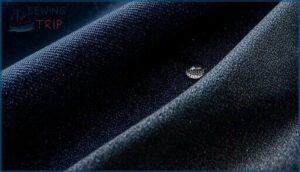
Polyester and nylon are the workhorses of synthetic fibers — built for fabric strength that outlasts most natural options. Polyester resists moisture, holds its shape, and deals with abrasion resistance well in high-friction spots.
Nylon pushes harder, offering exceptional stretch recovery and toughness under pressure. Together, they deliver synthetic durability and moisture management that keeps your garments performing wash after wash.
Acrylic — Wool’s Lightweight Alternative
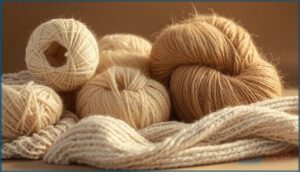
Acrylic is basically wool’s twin. Its fiber structure is engineered to mimic wool’s crimp and loft, so you get solid warmth retention without the weight or the itch. It’s hypoallergenic, machine washable, and budget-friendly — real acrylic benefits for everyday projects.
Just know it pills over time and microfiber shedding is a genuine concern, making sustainable alternatives worth considering.
Rayon and Tencel — Semi-Synthetic Middle Ground

Rayon and Tencel sit right in the middle — born from natural wood pulp but shaped by industrial chemistry. Rayon drapes beautifully but loses up to 50% of its strength when wet, so handle it with care.
Tencel Lyocell is tougher, eco friendly, and uses a closed-loop production process that recovers nearly 99% of its solvents. For sustainable textiles with serious fabric drape, Tencel wins.
How Fiber Content Affects Fabric Behavior
Fiber content doesn’t just describe what a fabric is made of — it determines how that fabric actually behaves in your hands and on the body. Every fiber brings its own set of rules, and knowing them puts you in control before you ever cut a single seam.
Here’s what you need to understand about how different fibers shape the way fabric looks, moves, and holds up over time.
Weight, Drape, and Texture by Fiber Type
Fiber content controls how your fabric moves, feels, and falls — and that affects everything.
- Cotton sits crisp and structured, holding shape without flowing.
- Wool offers cushioned textile softness with smooth drape even at heavy weights.
- Linen delivers firm, architectural hang — great fabric density without floppiness.
- Rayon skims and pools fluidly, making drape analysis simple: it always moves.
Fiber blending shifts all of this.
Stretch and Recovery in Natural Vs. Synthetic Fibers
Drape tells half the story. Stretch and recovery tell the rest.
Cotton’s fabric elasticity tops out around 5–8%, so it bags at the knees by day’s end. Wool does better — natural fibers with crimp bounce back more. Add 2–5% elastane through fiber blending, and stretch recovery jumps dramatically.
| Fiber | Max Stretch | Recovery |
|---|---|---|
| Cotton | 5–8% | Low |
| Wool | 25–35% | Moderate |
| Spandex | 400–500% | High |
Moisture impact matters too — synthetic fibers stay consistent when wet, while natural fibers lose rebound tension. Synthetic alternatives like polyester-elastane blends keep their shape through sweat and movement. Fiber blends give you control.
Colorfastness and How Fibers Hold Dye
Color doesn’t lie — but some fibers hold it better than others. Wool bonds with acid dyes through its protein structure, giving you strong color retention.
Cotton needs reactive dyes or mordant effects to lock color in properly. Synthetics like polyester score 4–5 on fastness ratings through disperse dye diffusion. Understanding fiber affinity and dye binding methods helps you predict dye stability before your project ever hits the wash.
Choosing Fiber Content for Your Sewing Project
Knowing how fibers behave is only half the battle — the other half is matching that knowledge to what you’re actually making.
Every project has its own demands, and the right fiber choice can mean the difference between a garment that lasts and one that disappoints.
Here’s what to think through before you cut a single inch of fabric.
Matching Fiber Properties to Project Purpose
Purpose drives every fabric selection decision you’ll make. Match fiber characteristics to what the garment actually needs to do — not just how it looks on the bolt.
- Cotton or linen for breathable summer wear
- Wool or acrylic for warmth and insulation
- Polyester blends for garment durability in activewear
- Tencel for sustainable materials with soft drape
- Fiber blending when no single fiber fits the job
Skill Level and Fabric Difficulty Considerations
Your skill level shapes your fabric selection as much as any other factor. Beginners gain confidence with stable wovens — quilting cotton, broadcloth, poplin — because fabric handling stays predictable.
Slippery silks and stretchy knits introduce sewing challenges that overwhelm newer hands. Honest skill assessment before you buy saves frustration. Understanding fabric properties first means the fabric selection process works with you, not against you.
Skin Sensitivities and Hypoallergenic Fiber Options
Sensitivity isn’t weakness — it’s information. If your skin reacts to certain fabrics, the culprit is often finishing chemicals or dyes, not the fiber itself.
That said, hypoallergenic fabrics like organic cotton, TENCEL, and bamboo blends genuinely reduce irritation risk for sensitive skin. For allergy prevention, look for OEKO-TEX Standard 100 certification — it screens over 400 harmful substances, giving you real protection against common fabric irritants.
Durability Needs Based on Garment Use
Longevity starts before you cut a single piece. Think about how hard the finished garment will actually work. Kids’ jeans, work pants, and activewear all face serious Garment Stress — constant friction, frequent washing, repeated movement.
That’s why fabric durability and abrasion resistance matter so much. Polyester-cotton blends at 60/40 meet real Durability Standards, offering the wear resistance and textile durability your project actually needs.
Care and Maintenance by Fiber Type
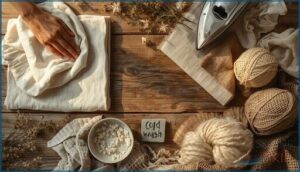
How you care for a garment matters just as much as the fabric you choose to make it from.
Get it wrong once, and your hard work can shrink, fade, or fall apart after a single wash.
Here’s what you need to know about caring for each fiber type.
Washing, Drying, and Ironing Natural Fibers
Natural fibers don’t forgive carelessness. Cotton tolerates warm machine washing around 30–40°C, but push the heat too high and fabric shrinkage sneaks in fast.
Wool demands cool water and gentle handling — hot water felts it permanently. Linen irons best slightly damp on high heat. For drying, flat or air drying protects natural fiber care and locks in breathability longer than any dryer cycle will.
Caring for Synthetics and Blends Without Damage
Synthetics don’t punish you the way wool does, but they’ve rules. For solid synthetic fiber care, wash polyester in warm water on a normal cycle.
Acrylic and nylon need cold water, gentle spin. Follow blend fabric tips by caring for the most delicate fiber in the mix. Cold washing also helps microplastic reduction while protecting fabric durability — that’s a genuine two-for-one.
Shrinkage and Stability After Washing
Every fiber has a memory — and washing is how it forgets. Fabric shrinkage happens because moisture effects cause fibers to relax back toward their natural state. Cotton sees 4–10% dimensional change; rayon can hit 10%. Wash stability depends on fiber, heat, and construction.
- Prewash cotton and linen before cutting
- Cold water reduces fiber relaxation in synthetics
- Tumble drying accelerates shrinkage beyond line drying
- Knit constructions shrink more than woven equivalents
- Blends offer better moisture absorption control and colorfastness
How Proper Care Extends Garment Lifespan
Your clothes last as long as you treat them well — and that’s not luck, it’s fabric maintenance done right. Gentle washing in cold water, smart drying methods like flat-drying knits, and proper fabric storage in cool, ventilated spaces all protect fiber longevity from the inside out.
Master these care techniques, and your garments won’t just survive — they’ll hold their shape, color, and fabric durability season after season.
Environmental Impact of Different Fiber Choices

Every fabric choice you make leaves a mark beyond your sewing room.
Some fibers break down naturally and play nice with the planet, while others come with a heavier cost — microplastics, fossil fuels, and waste that lingers for generations.
Here’s what you need to know about where your fabric actually comes from.
Natural Fibers — Biodegradability and Sustainability
Your fabric choices outlast the garment itself. Natural fibers like wool, linen, and organic cotton are biodegradable materials that return to the earth — wool breaks down up to 95% within 15 weeks in soil.
These sustainable textiles offer real eco friendly fabric benefits:
- Organic cotton uses 90% less water than conventional cotton
- Linen decomposes in as little as two weeks
- GOTS-certified green manufacturing limits harmful chemicals
Synthetics, Microplastics, and Fossil Fuel Reliance
Natural fibers return to the earth — but synthetic fibers come from it in a very different way. Polyester, nylon, and acrylic all trace back to crude oil and natural gas. That’s fossil fuel reliance built right into your wardrobe.
| Synthetic Fiber | Fossil Fuel Impact | Microplastic Pollution Risk |
|---|---|---|
| Polyester | High — petroleum-based polymer | High — sheds up to 1.5M fibers per wash |
| Nylon | High — petrochemical production | Moderate — common in water sediments |
| Acrylic | High — derived from acrylonitrile | Highest — sheds more than most synthetics |
| Recycled Polyester | Lower demand for new oil | Higher shedding than virgin polyester |
| Elastane | Petrochemical-based | Low volume, but non-biodegradable |
Synthetic fiber production also releases microplastics every laundry cycle — sometimes hundreds of thousands of fibers per wash. Those fibers don’t vanish. They slip through wastewater treatment and settle into waterways, soils, and sediments for decades. Environmental sustainability starts with knowing what you’re actually sewing with.
Every synthetic fabric you wash releases microplastics that silently settle into waterways for decades
Eco-Friendly Alternatives Like Organic Cotton and Tencel
Not all eco fabric choices are created equal — but two stand out. Organic cotton skips synthetic pesticides and cuts water use by up to 91% compared to conventional farming. TENCEL Lyocell, made from sustainably harvested wood pulp, runs through a closed-loop system that recycles 99% of its solvent.
Both are biodegradable fibers worth knowing:
- Organic cotton promotes organic farming and healthier waterways
- TENCEL Lyocell is a green textiles leader with minimal chemical waste
- Both qualify as sustainable materials that break down without leaving synthetic residue
How to Make More Sustainable Fiber Choices
Knowing your options is one thing — acting on them is where it counts. Start by choosing sustainable materials with certifications like GOTS or Bluesign, which signal real green manufacturing standards.
Embrace fiber recycling by repurposing scraps and supporting circular economy brands. Prioritize sustainable fabrics that last, care for them gently, and your choices quietly push ecofriendly fashion forward, one seam at a time.
Frequently Asked Questions (FAQs)
Is 60% cotton 40% polyester ok?
Yes, a 60% cotton 40% polyester blend is a solid everyday choice.
Cotton blends like this balance breathability with durability, making blended fabrics practical for garments that face frequent washing without losing shape.
How to determine fiber content of fabric?
Check the label first—it’s required by law.
If there’s no label, a quick burn test, chemical tests, or microscopic exams can reveal fiber content through fabric identification and fiber analysis.
Is 90% cotton 10% elastane good?
A 90% cotton 10% elastane blend is genuinely good for everyday wear. You get soft, breathable natural fibers with enough stretch to move freely, and the elastane keeps garments from bagging out over time.
Is 100% cotton or 50/50 better?
Neither is universally better. For fabric comfort and breathability, 100% cotton wins.
For fabric durability and moisture management, cotton blends hold their own. Your project’s purpose decides which fabric properties actually serve you.
Which fibers work best for hot climates?
Linen and bamboo are your best allies in the heat. Both offer top-tier breathability and moisture management, keeping Summer Textiles cool and comfortable — true Breathable Fabrics built for the fight.
Can fiber content affect garment cost significantly?
Yes, absolutely. The fiber cost is often the biggest cost driver in any garment.
Cashmere and silk fabric can cost ten times more per yard than basic polyester or acrylic alternatives.
How does fiber content impact fabric noise?
Smooth synthetics like nylon create sharp fabric rustle through high fiber friction.
Cotton and wool offer natural sound absorption and noise reduction. Your fiber choice directly shapes textile acoustics and overall fabric performance.
Which fibers are best for outdoor upholstery?
Solution dyed acrylic leads outdoor upholstery for UV protection and weather resistance. Olefin manages moisture well. Avoid cotton — it molds fast. For real durability testing, stick to synthetic outdoor fabric.
Does fiber content influence how fabric photographs?
Absolutely. Fiber content shapes fabric sheen, color depth, texture detail, and drape movement on camera. Polyester’s fiber shine reads vivid; matte cotton softens.
Fabric properties quietly control every image your garment makes.
Conclusion
Every bolt of fabric tells a story before you cut a single thread—the fiber is its first sentence. Choosing fabric by fiber content means you’re reading that story before committing to it, not halfway through when the seams are already set.
Cotton breathes, wool insulates, polyester holds its ground. Each fiber has a role it plays best. Match the fiber to the job, and your finished garment won’t just fit the body—it’ll fit the purpose.