This site is supported by our readers. We may earn a commission, at no cost to you, if you purchase through links.
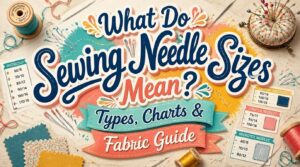
Most sewers never think twice about the numbers printed on a needle package—until something goes wrong. A skipped stitch here, a pulled thread there, fabric puckering along every seam. Nine times out of ten, the culprit isn’t your tension settings or your technique. It’s the needle.
Sewing needle sizes follow a dual system: a metric number paired with an American one. That "80/12" printed on the package means the needle shaft measures 0.80 mm in diameter—and knowing that single fact changes how you shop, sew, and troubleshoot.
Get the size right, and your stitches lock cleanly into the fabric. Get it wrong, and even expensive thread can’t save you.
Table Of Contents
Key Takeaways
- The two numbers on every needle package (like 80/12) reveal the exact shaft diameter in millimeters—0.80 mm in this case—so you can match thickness to fabric weight with precision, not guesswork.
- Using the wrong needle size causes most common sewing problems (skipped stitches, puckering, shredded thread), and swapping to the correct size fixes them faster than adjusting tension or technique.
- Fabric weight is your primary guide: fine fabrics (silk, chiffon) need sizes 60/8–70/10, everyday cottons need 75/11–90/14, and dense materials like denim demand 100/16–110/18.
- Needle type matters as much as size—ballpoint tips protect knit loops, microtex sharp tips pierce dense wovens cleanly, and titanium-coated needles last up to 8× longer for high-volume sewing.
What Do Sewing Needle Sizes Mean?
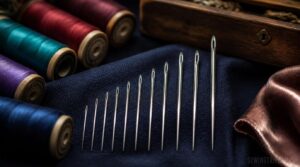
Those two numbers on a needle pack aren’t random — they actually tell you exactly how thick the needle is and where it falls on two different sizing scales. Once you understand the system, choosing the right needle stops feeling like guesswork. Here’s what each part of the label means and why it matters for your sewing.
If you want to take that knowledge further, pairing it with a fabric-to-needle size guide makes it easy to match the right needle to whatever material you’re working with.
Metric and American Numbers
Every needle label carries two numbers — a larger one and a smaller one. That’s the dual labeling system at work. The bigger figure is the metric number, the smaller is the American number. Singer popularized the American sizing scale, ranging from 8 to 20. Metric came later, standardized in 1942, replacing dozens of regional systems with one clear measurement.
- Metric number appears first (e.g., 90)
- American number appears second (e.g., 14)
- Singer shaped the American numbering scale
- Both numbers describe the same needle
- Metric standardization replaced 40+ regional systems
Needle Diameter Explained
The metric number isn’t random — it’s the needle’s shaft diameter in hundredths of a millimeter. A size 80 needle measures exactly 0.80 mm across. Thinner shafts pierce delicate threads cleanly; thicker ones push through dense weaves without snapping.
| Metric Size | Diameter (mm) | Needle Thickness |
|---|---|---|
| 60 | 0.60 mm | Very fine |
| 80 | 0.80 mm | Medium |
| 100 | 1.00 mm | Heavy |
Unlike sewing, medical needle gauge sizes follow an inverse relationship where larger numbers indicate smaller diameters.
Diameter controls everything downstream.
Common Size Conversions
Once you know the diameter, matching the two systems gets simple. The dual numbering system on packaging always lists metric first, American second — that’s what 90/14 or 80/12 means.
Three conversions worth memorizing:
- Metric 60 = American 8 — very fine
- Metric 80 = American 12 — medium
- Metric 100 = American 16 — heavy
Cross-reference these when switching brands — the label changes, the needle doesn’t.
Why Sizing Matters
Wrong needle size doesn’t just break thread — it breaks the garment’s fit and feel.
| Problem | Result |
|---|---|
| Small needle on heavy fabric | Skipped stitches |
| Large needle on light fabric | Visible holes, puckering |
| Mismatched thread-to-eye ratio | Thread shredding |
| Wrong needle type for knit | Snags and runs |
| Dull or bent needle | Uneven tension |
Needle diameter controls everything downstream — stitch quality, fabric weight compatibility, and wearability.
Sewing Needle Size Chart by Fabric Weight
Choosing the right needle size starts with knowing your fabric — get that wrong, and no amount of skill will save your seam. Different fabric weights call for different needle sizes, and the range is wider than most beginners expect. Here’s how the sizing breaks down across the most common fabric categories.
Lightweight Fabrics
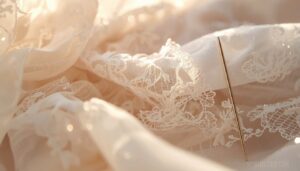
Silk, chiffon, organza, and lace are unforgiving. Push a needle that’s too thick through them, and you’ll see it — visible holes, puckering, fabric that never quite recovers. These materials sit below 150 GSM, with open weave structures that tear easily under a blunt or oversized point. Stick to sizes 60/8 through 70/10.
Delicate fabrics below 150 GSM never forgive an oversized needle — use sizes 60/8 through 70/10 or wear the damage permanently
| Fabric | Needle Size | Needle Type |
|---|---|---|
| Silk | 60/8 | Microtex Sharp |
| Chiffon | 65/9 | Microtex Sharp |
| Organza / Lace | 70/10 | Universal or Sharp |
Medium-weight Fabrics
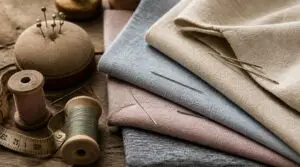
Cotton, linen, chambray, and jersey knits land in the 170–340 GSM sweet spot — structured enough to hold a seam, relaxed enough to drape. Reach for sizes 75/11 to 90/14, and set your stitch length to 2.0–3.0 mm for clean, stable results.
For knits especially, pairing the right needle size with the correct thread weight makes all the difference — this guide to thread weights by fabric type breaks down why a 75/2 polyester thread keeps jersey seams flexible without snapping under stress.
| Fabric | Needle Size | Needle Type |
|---|---|---|
| Cotton / Linen | 80/12 | Universal |
| Jersey Knit | 75/11 | Ballpoint |
| Chambray | 80/12 | Universal |
| Light Denim / Twill | 90/14 | Universal |
| Linen Mix | 80/12 | Microtex |
Heavyweight Fabrics
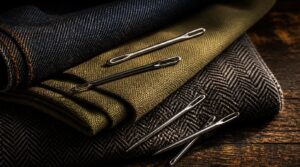
Denim, canvas, and wool suiting — these fabrics fight back. At 340–700 GSM, their dense weave structure demands real force to penetrate cleanly. That’s why you need sizes 100/16 to 110/18. A smaller needle skips stitches. Prewash first to prevent shrinkage and stabilize the weave before cutting.
| Fabric | Needle Size |
|---|---|
| Denim | 100/16 |
| Canvas | 110/18 |
| Wool Suiting | 100/16 |
| Cotton Twill | 100/16 |
| Heavy Fleece | 110/18 |
Upholstery and Thick Fabrics
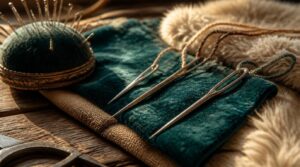
Upholstery fabric is a different beast entirely. With textile density this high — think bouclé, velvet, or heavy canvas — you need 110/18 or larger. A denim needle cuts through woven upholstery; a leather needle works best for faux fur or vinyl.
| Fabric | Needle Size | Needle Type |
|---|---|---|
| Velvet Upholstery | 110/18 | Universal |
| Faux Fur | 110/18 | Leather |
| Heavy Canvas | 110/18 | Denim |
Avoiding Holes and Puckering
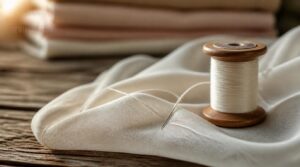
Wrong needle size creates two problems: visible holes or puckering seams. On lightweight fabrics, a 70/10 needle with a slightly increased stitch length reduces fabric compression. Lower your top thread tension, then test on a scrap piece first. A walking foot keeps both layers moving evenly — and a tear-away stabilizer underneath stops slippery fabric from shifting mid-seam.
| Problem | Cause | Fix |
|---|---|---|
| Visible holes | Needle diameter too large | Drop to 70/10 for light fabric |
| Seam puckering | Top tension too high | Lower thread tension gradually |
| Fabric shifting | No stabilizer | Add tear-away stabilizer beneath |
Matching Needle Size to Thread and Stitch Quality
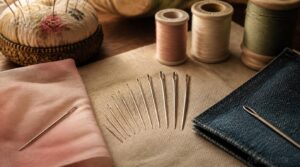
Getting the fabric right is only half the equation — your thread and needle have to work together, too. The wrong pairing leads to frustrating problems like skipped stitches, shredding thread, or seams that just won’t hold. Here’s what to know about matching needle size to thread for clean, reliable results.
Needle Eye and Thread Fit
The eye isn’t just a hole — it’s a precision fit. Thread should fill roughly 40–45% of the eye’s opening, leaving room to move freely without slipping around. Too tight and it shreds; too loose and tension goes haywire.
Run a quick test: hold thread at a 60-degree angle. It should slide through cleanly. Rough eye edges? Replace the needle immediately.
Fine Threads
Fine thread is precise by nature — more contact points, better load distribution, less stress on any single stitch.
- Use sizes 60/8 to 75/11 needles
- Match delicate thread to a narrow needle diameter
- Slide thread at 60 degrees to confirm fit
- Choose the smallest needle that threads freely
Smaller needles minimize holes and keep tension stable.
Heavy Threads
Heavy thread demands a bigger needle — no exceptions. We’re talking 90/14 at minimum, often up to 110/18 for canvas or thick denim.
These threads are built from high-tenacity fibers like bonded nylon or polyester, with tensile strength hitting 60–100 pounds. That bulk needs room to move through the eye cleanly, or tension collapses fast.
Skipped Stitches
Skipped stitches are rarely random. Most trace back to improper threading, a dull or bent needle, or a tension imbalance between upper and bobbin thread — any of which disrupts the hook’s timing and causes it to miss the loop entirely.
Knit fabrics are especially unforgiving. Fabric movement during needle travel creates gaps. Replace your needle first — it fixes more than you’d expect.
Thread Shredding
Thread shredding is the needle’s way of telling you something’s off. The most common culprit? Incorrect needle size creating excess friction — your thread literally gets worn down on every pass. Metallic threads are especially vulnerable, since their stiffness makes them fight the eye instead of gliding through it.
Check your tension first. High top tension paired with a loose bobbin shreds thread fast.
Sewing Machine Needle Types and Size Uses
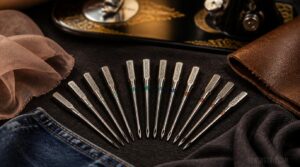
Not all sewing machine needles are built the same — and that difference is exactly what separates a clean stitch from a frustrating mess. The type of needle you choose matters just as much as the size. Here are the main needle types and when to reach for each one.
Universal Needles
Think of the universal needle as your all-purpose kitchen knife — not specialized, but dependably useful. It features a slightly rounded tip that glides through most woven fabrics — cotton, linen, polyester blends — without snagging.
Sizes run from 60/8 to 110/20, and starter packs with 80/12, 90/14, and 100/16 cover nearly every everyday project. If you’re building a beginner kit, start here.
Jersey and Ballpoint Needles
Knit fabrics need a different approach. A ballpoint tip slides between yarn loops instead of piercing them — preventing runs and snags that a sharp needle would cause.
Common sizes include:
- 70/10 for lightweight jersey
- 80/12 for cotton blends
- 90/14 for medium-weight knits
- Stretch variants for high-elastane fabrics
Use these whenever your fabric stretches.
Microtex Sharp Needles
Microtex needles are built for precision. Their very slim, acute tip pierces tightly woven fabrics — silk, satin, microfiber — without distorting the weave. That’s what separates them from universals.
The result? Clean entry, no puckering. Sizes 70/10 and 80/12 handle most lightweight work. Chrome coatings keep the tip sharp longer, so you’re not swapping needles mid-project.
Stretch Needles
Spandex and Lycra will humble a standard needle fast. Stretch needles solve this with a medium ballpoint tip that glides between fibers instead of piercing them — protecting knit loops while keeping stitches consistent.
The deeper scarf above the eye cradles thread during movement, which is what prevents those maddening skipped stitches on elastic seams. Super stretch variants handle ultra-elastic materials and thicker waistbands.
Leather and Denim Needles
Leather and denim are unforgiving — wrong needle, ruined project. Leather needles use a chisel-like blade that cuts cleanly rather than piercing, leaving tidy holes without tearing. Denim needles feature a reinforced shaft and sharper tip to punch through dense weaves without deflecting.
Both pair best with heavy thread. Sizes 90/14 to 110/18 cover most fabric weight scenarios.
Top Sewing Machine Needles to Consider
Knowing which needle type fits your fabric is only half the battle — you still need a reliable brand behind it. A few names consistently rise to the top among sewists of all skill levels. Here are four worth keeping in your kit.
1. Singer Universal Sewing Machine Needles
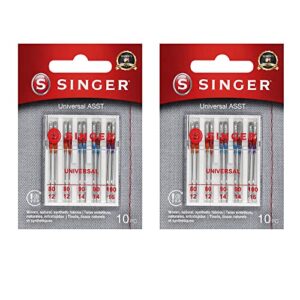
Singer’s Model 4790 is a smart first investment — 20 needles across three sizes, all color-coded by size so you’re not fumbling mid-project trying to read tiny stamped numbers.
The breakdown is practical: four 80/12 needles for lighter cotton and flannel, four 90/14 for your everyday medium-weight projects, and two 100/16 for heavier denim blends. They run on the standard 130/705 H system, which means they slot cleanly into Singer, Brother, Kenmore, and most other home machines.
The slightly rounded universal point works well with both wovens and stable knits without snagging. That’s the quiet strength of a universal needle — it won’t specialize, but it won’t fail you either.
A few users have flagged occasional durability inconsistencies, so keep a backup pack handy for long projects.
| Feature | Details |
|---|---|
| Best For | Home sewists working with everyday wovens |
| Pack Size | 20 needles |
| Sizes | 80/12, 90/14, 100/16 |
| Point Type | Universal |
| Compatibility | Most home machines |
| Best For | Home sewists and hobbyists who work with a variety of everyday woven fabrics and want a versatile, easy-to-use needle set that fits most standard sewing machines. |
|---|---|
| Pack Size | 20 needles |
| Point Type | Universal |
| Compatibility | Most home machines |
| Best Fabric | Everyday wovens |
| Needle Size(s) | 80/12, 90/14, 100/16 |
| Needle System | 130/705 H |
| Additional Features |
|
- Color-coded heads make it easy to grab the right size at a glance, no squinting required
- Works with Singer, Brother, Kenmore, and most other home machines right out of the box
- Three size options in one pack means you’re covered for lightweight to medium-heavy fabrics without buying multiple sets
- Only two 100/16 needles included, which isn’t much if you regularly sew heavier materials
- Some buyers have received packs with missing or pre-broken needles
- Not suited for denim, leather, or other thick and non-woven fabrics
2. SCHMETZ Microtex Sewing Machine Needles
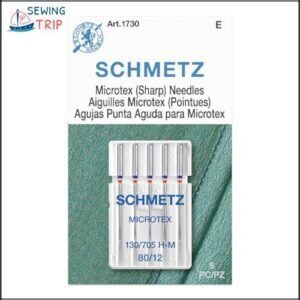
If Singer’s universal needles are your everyday workhorse, SCHMETZ Microtex needles are the precision tool you reach for when the fabric demands better.
The slim, acute point on the 80/12 size does something universal needles can’t — it pierces tightly woven silk, microfiber, and coated synthetics without dragging threads or leaving visible holes. That translates directly into cleaner topstitching and seams that lie flat instead of puckering along the stitch line.
Five needles per card, standard 130/705 H-M system. They’ll fit your machine.
One honest caveat: these aren’t for knits. The sharp point that makes them wonderful on dense wovens can snag stretchy fabrics instead of sliding through.
| Feature | Details |
|---|---|
| Best For | Silk, microfiber, coated synthetics |
| Point Type | Microtex sharp |
| Needle Size | 80/12 |
| Pack Size | 5 needles |
| Compatibility | Most home machines |
| Best For | Sewers working with delicate or tightly woven fabrics like silk, microfiber, and coated synthetics who need clean, precise stitching without distortion or visible holes. |
|---|---|
| Pack Size | 5 needles |
| Point Type | Microtex Sharp |
| Compatibility | Most home machines |
| Best Fabric | Silk, microfiber, synthetics |
| Needle Size(s) | 80/12 |
| Needle System | 130/705 H-M |
| Additional Features |
|
- The ultra-sharp microtex point pierces dense fabrics cleanly, reducing thread snag and fabric distortion compared to standard universal needles
- Works with virtually all home sewing machines (standard 130/705 H-M system), so no compatibility headaches
- Ideal for detailed work — topstitching, quilting, and fine fashion sewing all benefit from the accuracy this needle delivers
- Not suitable for knit or stretchy fabrics, which need a ball-point needle to avoid snagging
- Only one size (80/12) per pack, so projects requiring multiple needle sizes will need additional purchases
- Five needles per card is a small quantity — frequent sewers or high-volume projects will burn through them quickly
3. Schmetz Jersey Sewing Machine Needles
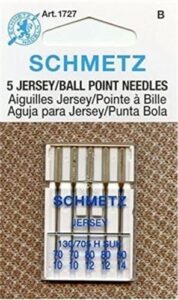
Where the Microtex excels on dense wovens, the Schmetz Jersey needle is built for a completely different conversation — one where the fabric stretches.
The secret is the medium ball point. Instead of piercing fibers, it nudges between the knit loops. That small difference is what keeps jersey, sweatshirt fleece, and tulle free from snags, runs, and those frustrating puckered seams.
The assorted five-pack spans sizes 70/10 through 90/14 — lightweight cotton jersey on one end, heavier bouclé on the other. You’re covered across most knit projects without buying separate cards.
The orange color band on the shank means you won’t accidentally grab the wrong needle mid-project. Quick to spot, impossible to mix up.
Compatible with all major home machines, no adapters needed.
| Feature | Details |
|---|---|
| Best For | Jersey, fleece, tulle, bouclé |
| Point Type | Medium ball point |
| Sizes Included | 70/10 – 90/14 |
| Pack Size | 5 needles |
| Compatibility | All home machines |
| Best For | Sewers working with knit and stretch fabrics like jersey, fleece, tulle, and faux fur who want clean, snag-free stitches without puckering or skipped loops. |
|---|---|
| Pack Size | 5 needles |
| Point Type | Medium Ball Point |
| Compatibility | All home machines |
| Best Fabric | Jersey, fleece, knits |
| Needle Size(s) | 70/10–90/14 |
| Needle System | Standard universal |
| Additional Features |
|
- The medium ball point slides between fibers instead of piercing them, protecting delicate knits from snags, runs, and holes
- The assorted 5-pack covers sizes 70/10 through 90/14, handling everything from lightweight cotton jersey to heavier bouclé in one purchase
- Works with all major home sewing machine brands — Brother, Singer, Juki, Bernina, and more — no adapters or adjustments needed
- Not suitable for tightly woven or non-stretch fabrics like denim or leather, so you’ll need a different needle type for those projects
- Only five needles in the pack means you could run short if your project demands heavy use of a single size
- Getting the best results requires matching the right needle size to your specific fabric weight, which takes a bit of trial and error
4. Titanium Coated Topstitch Sewing Needles
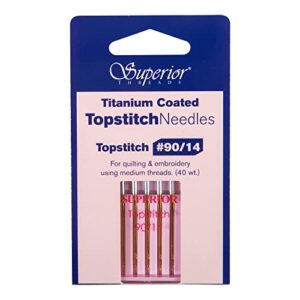
The Jersey needle moves beautifully — but when you’re topstitching through quilt layers or pulling decorative thread, you need something built for endurance.
That’s where titanium-coated topstitch needles earn their place. The titanium-nitride coating — that warm gold finish — isn’t cosmetic. It reduces friction, resists heat buildup, and lasts 5 to 8 times longer than a standard steel needle. For high-volume sewists, that translates to far fewer mid-project interruptions.
The size 90/14 pairs naturally with heavier threads — 40-weight cotton, bold decorative polyester, even metallics. The oversized eye lets thick thread feed smoothly instead of shredding at the point.
Five needles per pack, compatible with any home machine.
| Feature | Details |
|---|---|
| Best For | Quilting, topstitching, decorative thread |
| Point Type | Universal sharp |
| Needle Size | 90/14 |
| Pack Size | 5 needles |
| Fabric Range | Medium to heavy |
| Best For | Quilters, embroiderers, and high-volume sewists who regularly work with heavy fabrics, multiple layers, or specialty threads like metallics and decorative polyester. |
|---|---|
| Pack Size | 5 needles |
| Point Type | Sharp (Titanium-Coated) |
| Compatibility | All standard home machines |
| Best Fabric | Denim, canvas, quilted cotton |
| Needle Size(s) | 90/14 |
| Needle System | Standard universal |
| Additional Features |
|
- The titanium-nitride coating lasts 6–8× longer than standard needles, meaning fewer interruptions mid-project
- The size 90/14 with an oversized eye handles thick and decorative threads smoothly with minimal shredding or snagging
- Works with any standard home sewing machine, so no compatibility headaches
- Higher price per needle than standard steel options, which adds up over time
- A pack of only 5 needles may feel like a short supply for anyone sewing daily or at high volume
- Very thick fabric stacks may still cause breakage unless the material is prepped beforehand
Frequently Asked Questions (FAQs)
What size is a sewing needle?
As they say — the right tool makes all the difference. A sewing needle ranges from 51 mm to 00 mm in shaft diameter, with sizes spanning 60 to 110 for most everyday fabrics.
Why do you need a good needle size for a sewing machine?
The right needle size keeps your stitches clean and your fabric intact. Wrong size means holes, puckering, or skipped stitches — problems that ruin projects fast.
Do sewing machine needles come in different lengths?
Like shoes, needles come in one standard length — about 31 mm — designed to fit your machine’s needle bar. Length rarely varies. What changes is the tip shape and thickness.
How do I choose a needle for my sewing machine?
Match needle to fabric weight. Fine fabrics need sizes 60–70, medium cottons need 80–90, and heavyweights like denim need 100– Your thread thickness and fabric type do the choosing for you.
Is a 29 or 30 gauge needle bigger?
29 gauge is bigger. Gauge works backward — the higher the number, the thinner the needle. A 29G measures about 34 mm wide; 30G is slimmer at 31 mm.
Is a 23 or 18 gauge needle bigger?
The 18 gauge needle is bigger. Lower gauge numbers always mean a larger diameter — 18G measures about 27mm, nearly double the 64mm width of a 23G needle.
Can I use the same needle for all fabrics?
Technically, yes — but you’ll pay for it. Using the wrong needle causes skipped stitches, puckering, and shredded thread. Swap your needle when you switch fabric types. It’s a small step that protects every seam.
Do needle sizes vary between sewing machine brands?
Good news — needle sizes are standardized. A size 80/12 from Singer fits your Brother or Janome machine just the same. The numbers mean the same thing across every brand you’ll find.
How does needle size affect tension settings?
Swap to a larger needle and your fabric suddenly has less resistance — that bigger hole reduces drag, which can loosen stitch balance. A smaller needle grips tighter, often demanding a tension tweak to keep things even.
Are hand sewing and machine needle sizes the same?
Same number, opposite meaning. A size 10 hand needle is actually thicker than a size 10 machine needle — hand sizing runs in reverse, where higher numbers mean finer, not larger.
Conclusion
The smallest thing in your sewing kit holds the most power. Once you understand what sewing needle sizes mean—that slim metric number, that matching American figure—everything clicks. Wrong needle, ruined seam. Right needle, clean stitches. It’s that binary.
Your fabric talks; the needle listens. Stop guessing and start matching size to material deliberately. Keep a few key sizes stocked, swap without hesitation, and the machine stops fighting you. It starts working for you.
- https://www.maggieframes.com/blogs/embroidery-blogs/needle-sizes-explained-a-complete-guide-for-sewing-professionals
- https://www.thethreadexchange.com/miva/merchant.mvc?Screen=CTGY&Category_Code=needle_size_conversion_chart
- https://www.servicethread.com/blog/industrial-sewing-thread-needle-sizes
- https://help.singer.com/en-US/choosing-the-right-singer-machine-needles-389061
- https://www.schmetzneedles.com/pages/sewing-machine-needle-chart