This site is supported by our readers. We may earn a commission, at no cost to you, if you purchase through links.
You’ve spent hours searching for the perfect pattern, only to discover the waist gapes, the sleeves pull, and the hemline hits all wrong—because commercial patterns can’t possibly account for your unique proportions, shoulder slope, or body shape!
Creating custom sewing patterns puts you in complete control, transforming frustrating fitting sessions into garments that glide over your curves exactly as intended, with professional construction and zero compromise.
Once you master the fundamentals of drafting your own blocks, you’ll never again wrestle with ill-fitting store patterns, and you’ll release the creative freedom to design anything from fitted blazers to flowing dresses that celebrate your exact measurements and personal style vision!
Table Of Contents
Key Takeaways
- Custom sewing patterns solve fit problems at the source by accounting for your exact measurements, shoulder slope, and body proportions—eliminating the frustration of gaping waists, pulling sleeves, and awkward hemlines that plague commercial patterns.
- Drafting your own patterns unlocks complete creative freedom to personalize every design element from necklines to dart placement, while also reducing fabric waste and creating garments with professional-level durability.
- Essential tools include precision measuring equipment (quality tape measures and calipers), proper drafting supplies (translucent vellum, French curves, erasable pens), and optional pattern design software like Sewist CAD or CLO 3D for digital accuracy.
- The pattern-making process starts with creating a basic block from your measurements, then transforms through fit adjustments, style modifications, and proper finishing touches like seam allowances and notches—giving you a reusable foundation for unlimited garment designs.
Why Create Custom Sewing Patterns?
You might be wondering why anyone would bother drafting their own sewing patterns when there are thousands of commercial options available at your fingertips!
The truth is, learning to draft your own patterns opens up a world of creative freedom—though if you’re just starting out, browsing through beginner-friendly sewing patterns online can help you understand construction basics before you design from scratch.
The truth is, custom pattern making opens up a world of possibilities that off-the-rack designs simply can’t match, giving you control over every element of your garments from measurements to style details.
Let’s explore the key reasons why creating your own patterns is an absolute revolution for your sewing journey.
Benefits Over Commercial Patterns
Custom fit transforms everything when you move beyond commercial patterns, because custom sewing patterns reflect your exact measurements and eliminate frustrating alterations! You’ll achieve pattern accuracy that commercial options can’t match, reduce fabric waste through fabric efficiency, and create garments with exceptional garment durability.
Custom sewing patterns deliver perfect fit, eliminate alterations, and create durable garments with zero fabric waste
Plus, royalty-free sewing patterns from a sewing pattern designer give you mix-and-match sewing freedom with custom measurements that actually work.
Solving Fit and Style Challenges
When you struggle with gaping necklines, pulling seams, or awkward hemlines, body type analysis through pattern making solves fit issues at the source! A sewing pattern designer accounts for customized fit across shoulder slope, hip curve, and waist shaping, so your custom measurements address:
- Proportional grading for petite, tall, and plus sizes
- High bust and full bust adjustments
- Hip line placement aligned with your natural curve
- Sleeve cap ease for narrow or broad shoulders
- Garment silhouette adapted to your style preferences
Custom sewing patterns match your body, not the other way around!
Creative Freedom and Personalization
Beyond solving fit issues, pattern making unlocks personal style and sewing expression like nothing else! Custom sewing patterns let you choose necklines, sleeve volume, and color blocking that reflect your taste, while design flexibility means you can adjust darts, seam lines, and fabric choices to create garments that truly express who you are.
| Design Element | Personalization Options |
|---|---|
| Silhouette | Altered necklines, volume sleeves, waist definition |
| Fabric Integration | Texture pairing, print direction, stretch accommodation |
| Detail Work | Topstitching, patch pockets, decorative seams |
| Mix and Match Sewing Pattern | Layering options, proportion adjustments, accessory coordination |
Essential Tools and Materials for Pattern Making
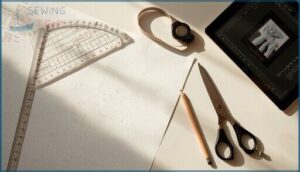
Before you start drafting custom sewing patterns that fit like a dream, you’ll need the right tools in your arsenal! Having quality measuring equipment, proper drafting supplies, and the right software can mean the difference between patterns that require endless adjustments and ones that work beautifully on the first try.
Once you’ve drafted your pattern, a solid pattern alteration guide helps you fine-tune the fit before cutting into your fabric.
Let’s walk through the essential tools and materials you’ll need to create professional-grade custom patterns from the comfort of your own workspace.
Measuring Tools and Equipment
You’ll need precision gauges and measuring scales to capture custom measurements that transform your pattern design into custom-fit clothing! Start with a quality tape measure—25 to 60 feet with nylon coating reduces stretch—then add caliper tools for detailed dimensions. Level instruments verify angles, while a digital caliper switches between metric and imperial units, giving you the accuracy every sewing pattern designer demands for professional results.
For a deeper understanding of the essential, review how each device ensures accurate and reliable measurements.
Pattern Paper and Drafting Supplies
Your pattern making journey relies on the right drafting tools and tracing papers! Grab translucent vellum or grid pattern paper with 1 cm intervals for precision, a clear plastic ruler with seam allowance marks, French curves for smooth armholes and necklines, and erasable pens for clean markings.
For pattern storage, invest in flat boxes or pattern tubes to protect your custom sewing patterns from creases and moisture damage! To explore different options for pattern drafting paper types, review available products designed specifically for tracing and accurate sewing pattern work.
Recommended Pattern Design Software
Digital drafting transforms your pattern design and creation workflow with professional CAD systems that deliver precision you can’t achieve by hand! Here are three standout options for fashion design technology:
- Sewist CAD offers customizable blocks with real-time design elements, creating made-to-measure patterns that fit your unique body measurements perfectly.
- CLO 3D provides realistic 3D simulation and fabric analysis to visualize drape and movement before you cut a single piece of fabric.
- Optitex combines 2D pattern editing with apparel design software features including virtual fitting and fabric behavior testing.
These programs eliminate guesswork, save hours of muslin testing, and give you the creative freedom to experiment with infinite design variations!
Taking Accurate Measurements for Custom Patterns

Getting your measurements right is the foundation of every custom pattern that actually fits! Without accurate numbers, even the most beautiful design won’t drape the way you want it to, and you’ll end up making adjustments that could’ve been avoided from the start.
Here’s what you need to know about measuring yourself properly, recording those numbers like a pro, and putting them to work in your pattern drafting.
Key Body Measurements Explained
Your body tells a story through numbers, and understanding each measurement unlocks perfect garment construction and custom fit clothing. When you’re working with body proportions and measurement techniques for pattern design, you need specific data points that directly influence your sewing accuracy and final garment silhouette.
| Measurement Type | What It Controls in Your Pattern |
|---|---|
| Bust & Chest | Cup placement, dart positioning, bodice shaping |
| Waist & Hip Circles | Skirt curves, pant fit, torso contours |
| Back & Front Lengths | Neckline height, shoulder slope, waist alignment |
| Shoulder & Arm | Sleeve cap ease, armhole depth, upper fit |
| Leg & Inseam | Pant length, thigh room, overall silhouette |
These measurements drive your fit analysis and sewing pattern making success!
Tips for Precise Measuring
Think of measuring techniques as your blueprint for impeccable custom fit clothing—without precision tools and calibration methods, you’re building on shaky ground! Every eighth of an inch matters when you’re after data accuracy in pattern design and sewing pattern making.
- Pull your tape measure taut but never compress the fabric or skin, checking at eye level to eliminate measurement errors
- Zero your calipers before each session and take three readings, averaging them for fitting adjustments that truly work
- Let your body and materials acclimate to room temperature for 15 minutes, because heat distortion silently sabotages your custom measurements
Recording and Using Your Measurements
Your measurement chart is the blueprint that transforms custom measurements into precision drafting—and keeping it organized prevents costly mistakes! Record each body proportions value with the date, the measuring tool used, and your initials to guarantee measurement accuracy for every sewing pattern design you create.
| Measurement Type | Recording Best Practices |
|---|---|
| Bust, Waist, Hip | Note exact inch and eighth-inch readings; include ease preferences for fit analysis |
| Shoulder, Torso | Record slope angles and length; link to your height for made-to-measure accuracy |
| Trial Adjustments | Log pattern making tweaks and sewing calculations separately with fabric type noted |
Keep backup copies for custom fitting reference, and review your chart before every new project to catch any body changes that demand fresh precision!
Step-by-Step Guide to Drafting Custom Patterns
Drafting your first custom pattern might feel like uncharted territory, but it’s absolutely the most confidence-building step you can take toward garments that fit like a dream!
Once you have your measurements in hand, you’ll create a foundational block that becomes the blueprint for every design you imagine, and the process is more straightforward than you think.
Here’s how to draft your custom pattern from start to finish, transforming those numbers into a perfectly fitted piece you’ll be proud to wear.
Creating a Basic Block (Bodice, Skirt, or Pants)
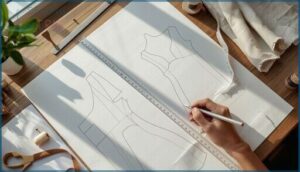
Your basic block is the foundation of all custom sewing patterns, and pattern drafting starts with choosing your garment type—bodice, skirt, or pants.
Using your precise measurements, plot center front lines, bust peak points for bodice construction, or rise measurements for pants, then connect these reference points with smooth curves that follow your body’s natural contours, creating a high-precision template for garment fitting!
Adjusting for Fit and Style Preferences

Once your basic block is drafted, you can transform it through fit adjustments and style modifications that reflect your unique body proportions and creative vision! Enhance garment silhouettes by manipulating dart placement for princess seams or bust darts, adjusting waist position to improve drape over the abdomen, and calculating ease for your fabric’s behavior—whether you’re working with stretchy knits requiring minimal positive ease or structured wovens needing more room for movement and comfort!
- Convert fitted blocks into A-line silhouettes by grading from bust to hip with gradual flare
- Modify sleeve width to balance shoulder lines and change visual proportions
- Adjust neckline depth by offsetting center front curves for tailored style
- Alter hem ease to create your desired fall, from flowy to structured finishes
Adding Seam Allowances, Notches, and Markings
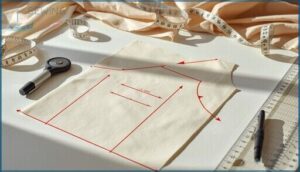
After perfecting your block’s proportions, you’ll transform it into a construction-ready pattern by adding seam allowances, notch placement, and marking techniques that guarantee pattern accuracy!
Add 1.5–2 cm fabric margins along pattern edges for standard seam allowances, adjust for fabric type—narrower for lightweight materials, wider for bulky wovens—and mark alignment points with notches, dots, and grain lines using pattern design software or manual drafting tools for precise sewing pattern making!
Modifying and Refining Your Sewing Patterns
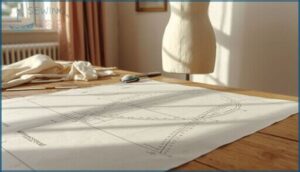
Your basic block is just the beginning—now it’s time to transform it into a pattern library that works for every fabric, every fit, and every future project you have in mind! Mastering pattern modification unlocks unlimited design possibilities, and you’ll never be stuck with a one-size-fits-all approach again.
Here’s how to polish, adapt, and perfect your custom sewing patterns so they deliver professional results every single time.
Pattern Manipulation Techniques (Darts, Seams, Ease)
Mastering dart manipulation, seam adjustment, and ease calculation unlocks your creative power! Here are five essential pattern drafting techniques for garment fitting excellence:
- Pivot darts around the peak to shift fullness without changing intake
- Slash and spread from peak to seam, creating volume where you need it
- Convert darts to pleats or gathers for softer silhouettes
- Relocate bust darts to side seams for smoother lines
- Blend seam transitions after adjustments to maintain natural flow
These sewing techniques transform basic blocks into custom clothing creation dreams!
Adapting Patterns for Different Fabrics
Once your dart manipulation skills are sharp, fabric selection transforms everything! Light cotton demands smaller ease than bulky wool, which needs breathing room at joints for comfortable garment construction.
Check your fiber analysis first: stretchy knits require negative ease in pattern making and design, while stiff silks need stay stitching.
Always align grain for perfect drape, and adjust seam allowances based on fabric weight for professional custom clothing creation!
Scaling and Grading for Multiple Sizes
Precision matters when you scale a base size into a full range! Grade Rule Basics demand uniform increments, so your Size Chart Management tracks bust, waist, and hip shifts across every size for perfect Proportion Control.
Ease Adjustment keeps comfort consistent, while proven Grading Techniques in Pattern Making and Design let you create Custom Clothing and Apparel that fits everyone beautifully through expert Sewing Pattern Design and Garment Construction.
Finalizing and Storing Your Custom Patterns
Your finished pattern deserves proper care! Trace final lines at 300 dpi, then confirm seam allowances and Notation Standards are crystal clear for faultless Sewing Pattern Design.
Store pieces in labeled folders with Digital Storage backups, using Archival Methods like acid-free sleeves and breathable paper for Preservation Techniques that protect your Custom Sewing masterpiece and Patternmaking investment for years of Digital Pattern creation ahead!
Frequently Asked Questions (FAQs)
Is there an AI that can create sewing patterns?
The best tool is always the one that saves you time—and yes, AI-powered pattern generation tools now exist!
These digital drafting platforms transform your measurements into printable sewing patterns instantly, revolutionizing traditional patternmaking.
Can I pay someone to make me a sewing pattern?
You can hire freelance designers who specialize in professional drafting to create fit-based or design-driven custom patterns. Custom pattern costs usually range from $70 to $600, depending on complexity and licensing terms.
Is it legal to sell garments made from patterns?
Yes, you can sell garments made from sewing patterns in most cases, but always check the pattern copyright and commercial licensing terms first, as some designers require royalty-free permissions or restrict resale for fashion label use.
How Do Digital Patterns Compare to Traditional?
Think of digital versus traditional patterns as GPS navigation versus a paper map—both reach your destination, but digital tools simplify pattern efficiency with virtual fitting and fabric simulation, while traditional methods build hands-on mastery through tactile precision.
What Are Common Beginner Pattern Design Mistakes?
Most beginners struggle with color mistakes like low contrast or overly bright palettes, repeat issues such as misaligned anchor points, and design flaws including cluttered motifs that create visual noise across their sewing patterns.
Are Online Pattern Tools Really User-Friendly?
Modern digital drafting platforms transform complex patternmaking into something anyone can master!
Online Sewing Pattern Designer and similar tools offer user-friendly interfaces, built-in online tutorials, pattern ease adjustments, and real-time sewing simulations—making custom sewing technology genuinely accessible.
How Complex Is Learning Pattern Design Software?
Learning pattern drafting software involves mastering tool panels, measurement inputs, and workflow conventions. Guided templates and tutorials flatten the learning curve—practice with real fabric samples accelerates your digital sewing skills!
How do I test fit before cutting fabric?
You’ll need to sew a full-size muslin mockup from inexpensive fabric, try it on, and mark any pulling or bagging areas with chalk.
Then, transfer those fitting adjustments to your pattern paper before cutting.
What are common pattern drafting mistakes to avoid?
Even experienced sewists stumble over fit issues and pattern errors that derail entire projects.
The most critical seam mistakes involve inconsistent allowances, misplaced darts, and ignoring fabric behavior during the drafting process.
Can I create patterns for stretch fabrics?
Yes, you can! Stretch fabric patterns use negative ease and knit drafting techniques to account for fabric stretch, requiring adjustments to seam allowances and elastic seam finishes for a custom fit.
Conclusion
Imagine opening your wardrobe to find nothing but garments that fit like they were made just for you—because they were! Creating custom sewing patterns isn’t just a technical skill, it’s your ticket to absolute creative control, precise fit, and the freedom to design exactly what you envision without settling for close enough.
Once you’ve drafted your first block and experienced that perfect fit, you’ll wonder why you ever struggled with commercial patterns at all!