This site is supported by our readers. We may earn a commission, at no cost to you, if you purchase through links.
The difference between a thread that survives 200 wash cycles and one that fades after twenty isn’t brand loyalty—it’s fiber science. Polyester threads rated at 30–50 pounds tensile strength outlast cotton in high-friction applications, yet cotton’s mercerized variants absorb dye 25% richer, making them irreplaceable for heirloom work where color depth defines the commission. Silk sits in its own category entirely: peerless sheen, 100+ available shades, and a price point that clients either justify or don’t.
Thread choice isn’t an aesthetic decision—it’s a structural one, and the wrong call costs you rework time, client trust, and margin. The embroidery thread sets for professional sewists reviewed here get evaluated on fiber integrity, weight system logic, colorfastness across lots, and machine compatibility—because your toolkit should work as hard as you do.
Table Of Contents
- Key Takeaways
- Key Features of Professional Embroidery Thread Sets
- Thread Material and Fiber Quality (polyester, Cotton, Silk, Nylon, Specialty Threads)
- Thread Weight and Strength Ratings (weight Systems, Durability, Application)
- Color Variety and Shade Consistency (palette Range, Dye Quality, Colorfastness)
- Spool Size and Machine Compatibility (length, Fit, High-speed Performance)
- Choosing The Right Thread Set for Professionals
- Matching Thread Type to Fabric and Project (fabric Compatibility, Stitch Style)
- Evaluating Color Selection for Professional Projects (palette Needs, Shade Matching)
- Specialized Threads for Embroidery and Quilting (metallics, Glow-in-the-dark, Heavy-duty)
- Thread Performance With High-Speed Machines (tensile Strength, Break Resistance)
- Top Embroidery Thread Sets for Professional Sewists
- Budget, Sustainability, and Investment Considerations
- Frequently Asked Questions (FAQs)
- Conclusion
Key Takeaways
- Fiber type isn’t a style choice—polyester dominates high-friction, high-wash applications, but mercerized cotton’s 25% richer dye absorption makes it irreplaceable for heirloom and color-critical work.
- Thread weight follows an inverse numbering system (60wt is finer than 30wt), and mismatching weight to fabric is one of the fastest ways to end up with broken stitches and client callbacks.
- Color consistency across dye lots is as important as the initial palette size—always test colorfastness on reds and deep purples before committing to a full production run.
- At scale, the cost difference between retail and factory-direct polyester can drop from $0.004 to $0.00045 per meter, meaning your thread sourcing strategy directly affects your studio’s margins.
Key Features of Professional Embroidery Thread Sets
Not all thread sets are created equal, and for professional sewists, that gap shows up fast—in broken stitches, faded colors, and frustrated clients.
Cheap thread is often just the beginning—issues like tension problems and skipped stitches can signal it’s time to look into sewing machine tune-up costs and when to schedule one.
Before you commit to a set, there are four core features worth evaluating closely. Here’s what actually separates a professional-grade thread set from everything else.
Thread Material and Fiber Quality (polyester, Cotton, Silk, Nylon, Specialty Threads)
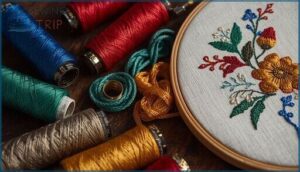
Thread material and fiber quality isn’t a footnote—it’s your foundation. Polyester thread runs cleanly at high speeds with tensile strength between 30–50 pounds and resists bleach and UV degradation, making it the workhorse of professional embroidery. Yarn composition and fabric interaction vary sharply across fibers:
- Polyester – chlorine-resistant, washes at 95°C, excellent fiber durability
- Cotton – mercerized variants dye 25% richer, ideal for matte, heirloom finishes
- Silk – exceptional sheen, 100+ shades, premium thread blending for gradient work
- Specialty – aramid, metallic, and glow threads expand material science applications.
The choice of thread depends on understanding polyester durability for best results.
Thread Weight and Strength Ratings (weight Systems, Durability, Application)
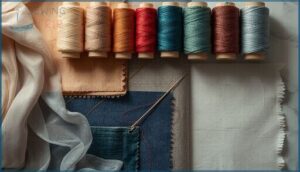
Weight systems tell you everything before a single stitch drops. The inverse numbering trips up plenty of professionals: 30wt is thicker than 40wt, and 60wt is noticeably finer than both. Fabric compatibility drives the decision—60wt for silk, 40wt for quilting cotton, 12–28wt for denim. Thread durability and tensile strength follow the same logic. Understanding thread weight systems is essential for achieving the desired embroidery effect.
| Weight | Tex Range | Best Fabric |
|---|---|---|
| 60wt | Tex 8–25 | Silk, chiffon |
| 40wt | Tex 25–40 | Cotton, linen |
| 30wt | Tex 25–40 | Medium canvas |
| 12–28wt | Tex 40+ | Denim, upholstery |
| Mixed | Tex 27–40 | General embroidery |
Embroidery performance depends on pairing the top thread with the right bobbin—40wt on top, 60wt underneath keeps designs sharp without bulk underneath.
Color Variety and Shade Consistency (palette Range, Dye Quality, Colorfastness)
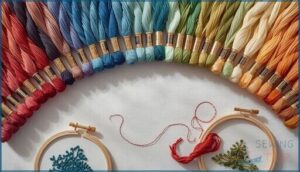
Color gets personal fast—wrong shade on a client’s logo means a rerun nobody wants to bill. Professional embroidery thread sets usually offer 80 to 120 colors per kit, with full catalog lines pushing 400 shades.
Dye quality determines color consistency across lots, while strong colorfastness ensures your work survives repeated laundering.
For shade matching accuracy, always evaluate thread color collections under neutral lighting.
Spool Size and Machine Compatibility (length, Fit, High-speed Performance)
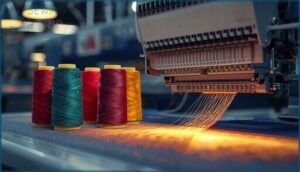
Spool size quietly controls your production floor. A 5,000-meter commercial spool accommodates roughly one million stitches—that’s real run time without interruption. But spool size means nothing if it won’t seat properly on your machine.
- L-type spools (1" diameter) fit most home machines natively; H-type requires adapters
- Compatibility Tests matter: mismatched spool size causes Thread Tension drift at High Speed
- Polyester thread sets hold strength at 800 stitches per minute with proper Machine Fit
Choosing The Right Thread Set for Professionals
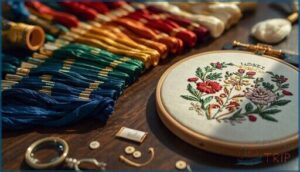
Picking the right thread set isn’t just a preference call—it’s a professional decision that directly affects your output quality, client satisfaction, and machine performance. The wrong match between thread and project can mean broken stitches, mismatched colors, and wasted hours you can’t bill back.
Getting the thread right starts with the fabric—especially with cotton, where choosing thread for cotton fabric can mean the difference between clean seams and a project that falls apart at the first wash.
The wrong thread choice doesn’t just cost you stitches—it costs you clients
Here’s what to weigh before you commit to a set.
Matching Thread Type to Fabric and Project (fabric Compatibility, Stitch Style)
Fabric compatibility isn’t optional—it’s where projects succeed or fail before you’ve stitched a single row. Match polyester embroidery thread to knits and denim for stretch tolerance and wash durability; use rayon on fine wovens when sheen matters more than strength.
Thread weight drives stitch density: 60-weight on sheers, 40-weight for standard fabric selection, 30-weight where material compatibility demands solid fill coverage.
Evaluating Color Selection for Professional Projects (palette Needs, Shade Matching)
Eight shades won’t cut it on a professional job. Palette Building starts with 80 to 120 colors minimum—black, white, neutrals, and a full spectrum—so you’re never improvising mid-project.
Apply the 60-30-10 rule for Color Harmony, verify Shade Consistency across dye lots before committing to quantity, and run Colorfastness Testing on reds and deep purples.
Color Variety and Shade Consistency aren’t luxuries; they’re client deliverables.
Specialized Threads for Embroidery and Quilting (metallics, Glow-in-the-dark, Heavy-duty)
Beyond standard palettes, specialty threads access entirely different creative and functional territory. Premium Metallics—available in 25 colors plus two variegated options—delivers Metallic Effects with a smooth polyester core that minimizes friction and maintains Color Consistency at speed.
Glow-in-the-dark thread offers real Glow Durability, charging in minutes and holding up to 8 hours, making it essential for safety apparel and novelty quilting thread applications.
For Heavy Duty Applications, 30 wt bonded polyester thread manages canvas and upholstery without fraying.
Thread Performance With High-Speed Machines (tensile Strength, Break Resistance)
High-speed machines don’t forgive weak thread—period. Polyester thread withstands top tension in the 120–150 gf range without snapping, while rayon demands closer to 100–120 gf. Push past 800 stitches per minute without adjusting, and breaks multiply fast.
- Break Resistance: Polyester filament holds 1,000–6,000 cN tensile strength
- Thread Tension: Drop top tension 5–10% above 800 SPM
- Fiber Durability: Nylon stretches 30–40% before failure, absorbing sudden spikes
Machine optimization starts with knowing your thread’s limits.
Top Embroidery Thread Sets for Professional Sewists
You’ve weighed the variables — fiber type, weight systems, colorfastness, machine compatibility — and now it’s time to see how that knowledge maps to actual products on the market.
Not every thread set earns its place in a professional studio, but the five below have proven themselves where it counts. Here’s what’s worth your attention in 2026.
1. Sewing Thread Kit With Embroidery Needles
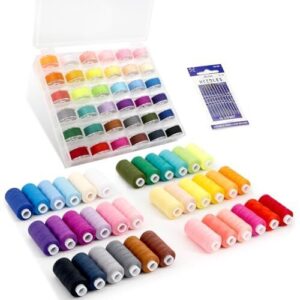
The AILUHONG 82-piece kit punches well above its price point for anyone building out a starter professional kit. You get 36 spools of 100% polyester thread—400 yards each—paired with 36 color-matched prewound bobbins, which alone saves real setup time between projects. Ten embroidery needles round out the package. The clear thread ends make color identification fast.
One honest caveat: a few users flagged loose winding on some bobbins, so inspect before a client-facing job.
| Best For | Beginners and hobbyists who want a well-rounded starter kit, plus seasoned sewers looking for a reliable everyday thread set with great color variety. |
|---|---|
| Material | 100% Polyester |
| Spool Count | 36 spools |
| Thread Length | 400 yards/spool |
| Use Case | Hand & machine sewing |
| Skill Level | Beginner to Pro |
| Color Variety | 36 colors |
| Additional Features |
|
- 36 spools paired with 36 color-matched bobbins saves a ton of setup time between projects
- 400 yards per spool gives you plenty of thread to work with across multiple projects
- Versatile enough for hand sewing, machine work, embroidery, cross-stitch, and more
- Some bobbins arrive with loose winding, which could cause issues mid-project
- Not built for heavy-duty or industrial sewing jobs
- Quality control seems inconsistent, so you may need to inspect pieces before use
2. XCZYN Hair Extension Needle Thread Set
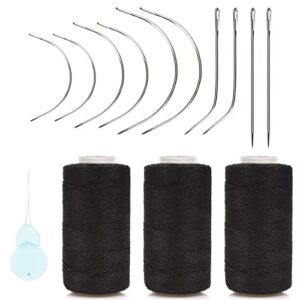
The XCZYN Hair Extension Needle Thread Set is built for one job—and it does that job well. Ten curved needles across five shapes (C-large, C-medium, C-small, J, and I) cover every weaving angle you’ll encounter, from thick wefts to tight corner work.
Three 1,000-yard nylon thread rolls handle extension weight for months without fraying or snapping under tension. If you work in hair extensions or wig construction regularly, this kit earns its shelf space.
| Best For | DIY hair stylists, wig makers, and anyone who regularly works with hair extensions or weaving projects. |
|---|---|
| Material | Nylon & Carbon Steel |
| Spool Count | 3 rolls |
| Thread Length | Not specified |
| Use Case | Hair & leather work |
| Skill Level | Intermediate |
| Color Variety | Black only |
| Additional Features |
|
- Ten curved needles in five shapes mean you’re covered no matter the angle or thickness of your work.
- The nylon thread is tough—1,000 yards per roll that holds up under real tension without fraying.
- Versatile enough to double as a leather or carpet repair kit when you’re not doing hair work.
- The needles are seriously sharp, so you’ll want to stay focused—one slip and your fingers will remind you.
- Not kid-friendly at all; you’ll want to store this somewhere out of reach.
- No thread colors beyond black, which could be limiting depending on your project.
3. Sewing Thread Kit Polyester Set
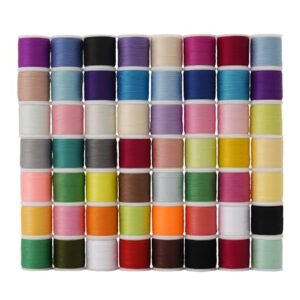
Where the XCZYN manages specialty construction, the LRDCREEE Sewing Thread Kit Polyester Set covers the broad, daily workload.
Fifty-six spools, 100 yards each—5,600 yards total—gives you a working palette of assorted colors in one compact tray.
The 100% polyester construction resists fraying, moisture, and tension breaks across both hand and machine work. It won’t perform miracles on heavy-duty commercial machines, but for quilting, garment repair, and tailoring, it punches well above its price point.
| Best For | Home sewers, beginners, and hobbyists who need a reliable everyday thread kit with a wide color range for quilting, garment repair, and general tailoring. |
|---|---|
| Material | 100% Polyester |
| Spool Count | 56 spools |
| Thread Length | 100 yards/spool |
| Use Case | Hand & machine sewing |
| Skill Level | Beginner to Pro |
| Color Variety | Assorted colors |
| Additional Features |
|
- 56 spools and 5,600 yards total means you’re covered for just about any color you’ll ever need
- Polyester construction holds up well against fraying and moisture for hand and machine work
- Great value for the price—works well for quilting, repairs, and tailoring projects
- Some users reported thread breaking during machine sewing, so it may struggle with heavier fabrics
- Spools lack a notch, which can make unspooling a bit frustrating
- Not ideal for heavy-duty or commercial machine sewing
4. Sewing Thread Set
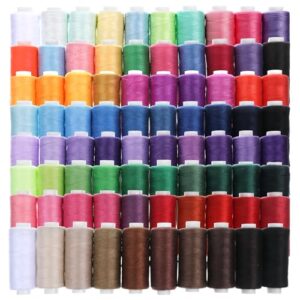
Scale up from 56 spools to 80, and the math starts working differently. This Sewing Thread Set gives you 400 yards per spool—more than four times the yield of the LRDCREEE—across a full 80-color palette, all in high-strength polyester that holds under real tension.
At 2.29 pounds packed into a single bag, it’s organized enough for studio use without demanding dedicated storage. Hand stitching, quilting, serging—this set manages the rotation without slowing you down.
| Best For | Sewists and quilters who need a wide color range and plenty of thread for ongoing home or studio projects. |
|---|---|
| Material | Polyester |
| Spool Count | 80 spools |
| Thread Length | 400 yards/spool |
| Use Case | Hand & machine sewing |
| Skill Level | Beginner to Pro |
| Color Variety | 80 colors |
| Additional Features |
|
- 80 colors and 400 yards per spool means you’re rarely hunting for a match or running out mid-project
- High-strength polyester holds up well across hand stitching, quilting, and serging
- Compact, organized packaging makes it easy to grab and go without taking over your workspace
- Thread can look a bit fuzzy compared to premium brands, which might matter for detailed work
- Not the best pick for fine silks or delicate heirloom sewing
- Quality isn’t quite on par with buying individual spools from top-tier thread brands
5. Gutermann Sew All Thread Set
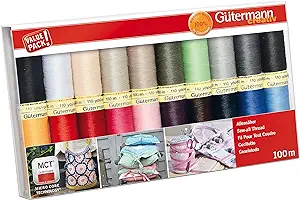
When 80 colors aren’t enough, Gutermann’s Sew-All line spans over 400 Pantone-matched shades—so color matching stops being a compromise.
The 20-spool set runs 100m per spool of microfilament polyester built with Micro Core Technology: lower lint, higher tensile strength, consistent performance at high machine speeds. It manages wovens, knits, topstitching, and quilting without adjustment.
Pair it with a NM 70–90 universal needle and you’re working with thread engineered to hold seams under real professional demand.
| Best For | Home sewers and quilters who want a reliable, everyday thread set that works across fabrics and techniques without constantly switching spools. |
|---|---|
| Material | Microfilament Polyester |
| Spool Count | 20 spools |
| Thread Length | 100m/spool |
| Use Case | Hand & machine sewing |
| Skill Level | Intermediate to Pro |
| Color Variety | 20 basic colors |
| Additional Features |
|
- 20 spools of microfilament polyester means less lint and stronger seams, whether you’re machine sewing or stitching by hand
- Works across wovens, knits, quilting, and decorative stitches without needing to swap out thread
- Can handle hot washes up to 95°C, so your seams hold up even after heavy laundering
- Only comes in basic colors, so if your project needs something bright or specific, you might come up short
- Not the best fit for very heavy or thick fabrics that need a beefier thread
- You’ll need a NM 70–90 universal needle to get the best results — worth knowing before you start
Budget, Sustainability, and Investment Considerations
Choosing the right thread set isn’t just about performance—it’s about where your money actually goes. Whether you’re stocking a full studio or sourcing responsibly, the financial and environmental calculus matters more than most sewists admit.
Here’s what to weigh before you buy.
Cost Analysis of Premium Thread Sets (price Comparison, Bulk Savings)
Thread pricing isn’t guesswork—it’s math. A single premium rayon spool runs roughly $0.004 per meter at retail, but bulk thread purchases through wholesale rates can drop that to $0.0016. Cost analysis of premium thread sets reveals real leverage: tiered bulk discounts release 10–15% off at $250+, and factory-direct wholesale rates hit $0.45 per 1,000 meters at scale.
| Source | Price Per Meter | Bulk Discounts |
|---|---|---|
| Retail (premium rayon) | ~$0.004 | Minimal |
| Closeout/overstock | ~$0.0016 | Moderate |
| Wholesale distributor | ~$0.002–$0.003 | 10–15% at $250+ |
| Factory-direct (polyester) | ~$0.00045 | Negotiated tiers |
| Metallic specialty | ~$0.010 | Limited |
Price negotiation and cost savings compound fast when your shop runs millions of stitches annually.
Longevity and Value for Professional Use (durability, Thread Yield)
Every spool you buy is either an asset or a liability, and the math turns on thread durability, stitch yield, and colorfastness together. A 5,000-meter cone delivering close to one million stitches dramatically improves cost efficiency versus small-spool alternatives.
Premium polyester’s break resistance and thread strength hold through 95°C wash cycles, so color longevity protects your brand reputation while thread performance keeps machines running, not stalling.
Sustainable and Eco-friendly Thread Options (organic, Recycled Fibers)
Sustainability isn’t a trend anymore—it’s a client expectation. Eco Thread options now deliver genuine performance alongside Green Materials credentials:
- Organic Fibers — GOTS-certified cotton with excellent colorfastness for skin-contact projects
- Recycled Yarns — Polyneon Green’s 100% GRS-certified polyester thread in 108 colors
- Biodegradable Textiles — TENCEL Lyocell offering silky finish with closed-loop production
- Bamboo — antibacterial, moisture-wicking thread durability for premium embroidery thread applications
Financing Options for Bulk Purchases (wholesale, Dealer Programs)
Scaling your thread inventory doesn’t have to drain your operating capital. Most wholesalers offer net 30 Wholesale Terms once you’re approved, with net 60 or net 90 Credit Options available for established accounts. Bulk Discounts kick in around $250 and climb to 35–40% off at $1,000+. Payment Plans through Affirm or Sezzle spread bulk thread purchases over 3–6 months interest-free.
| Financing Models | Threshold | Benefit |
|---|---|---|
| Net 30 Wholesale | Credit approval | 30-day deferred payment |
| Volume Bulk Discounts | $250–$1,000+ orders | 10–40% off wholesale supplies |
| BNPL Plans | Under ~$1,000 | Interest-free installments |
Frequently Asked Questions (FAQs)
What brand of thread does Bernina recommend?
Bernina recommends Mettler Quality threads—a Bernina Partnership spanning over 125 years. Known for Thread Durability and machine compatibility, Mettler’s polyester thread delivers consistent thread performance.
This has earned the brand strong Professional Endorsements and Brand Reliability across professional thread sets worldwide.
What brand of thread does the embroidery library use?
Embroidery Library doesn’t sell its own thread—instead, it publishes conversion charts mapping every color to Madeira, Isacord, Hemingworth, and a dozen other brands, so your fiber choice and color matching stay completely flexible.
How should embroidery thread be stored long-term?
Store threads in airtight containers at 65–75°F, keep humidity between 45–55%, block all light exposure, and organize spools upright on labeled bobbins—these four habits protect thread durability and performance for years.
Can embroidery thread be used for hand stitching?
Absolutely—embroidery thread manages hand stitching beautifully. Six-strand cotton embroidery floss lets you adjust stitch visibility by splitting strands, while polyester embroidery thread delivers enhanced thread durability and thread tension control for demanding hand sewing projects.
How do you fix thread tension problems mid-project?
Mid-project thread tension issues demand immediate action: raise the presser foot, re-thread completely, and run a quick FOX test on scrap stabilizer.
Adjust your upper tension dial in 5 increments until balance returns.
What causes thread to fray or snap while sewing?
Ironically, the machine’s not the problem—you’re. Thread snaps from tension mismatches, dull needles causing fabric friction, wrong fiber composition for the project, and speed settings that exceed your thread strength’s breakage patterns threshold.
How do you match thread sheen to fabric finish?
Test your thread sheen on actual fabric under natural daylight—pair trilobal polyester with satin, matte threads with linen or denim.
Luster comparison through stitched swatches ensures accurate color harmony before committing to your final thread sets.
Conclusion
Thread doesn’t lie. Every skipped stitch, every color that bleeds at first wash, every spool that snaps mid-run on a commercial machine tells you exactly what your materials are worth.
The embroidery thread sets for professional sewists reviewed here weren’t evaluated for casual appeal—they were measured against the standards your clients hold you to. Choose based on fiber integrity, not packaging.
Your reputation is stitched, quite literally, into every yard you run.
- https://northshorecrafts.com/what-kind-of-thread-is-used-for-embroidery/
- https://www.hooptalent.com/blogs/news/ultimate-guide-to-choosing-the-best-embroidery-thread-kit-for-machine-embroidery
- https://www.megadigitizing.com/blog/top-10-machine-embroidery-thread-brands/
- https://www.sewingmachinefun.com/embroidery-thread-calculations/
- https://www.czsewingthread.com/blog/understanding-thread-weight-what-do-30-40-and-50-mean.html