This site is supported by our readers. We may earn a commission, at no cost to you, if you purchase through links.
Your first few stitches won’t be perfect, and that’s exactly the point. Sewing practice sheets exist because even experienced sewers once struggled to guide a needle in a straight line or maintain consistent stitch spacing.
The difference between someone who gives up after one wonky seam and someone who completes their first wearable garment isn’t talent—it’s deliberate practice on paper before touching precious fabric. When you master basic stitches through repetition on practice sheets, you’re training your hands to move with precision and building the muscle memory that makes sewing feel natural rather than intimidating.
This step-by-step guide walks you through essential hand and machine stitches, helping you develop the control and confidence that transform frustrating thread tangles into clean, professional-looking seams.
Table Of Contents
- Key Takeaways
- Why Practicing First Sewing Stitches Matters
- Essential Tools for Stitch Practice
- Basic Hand Sewing Stitches to Master
- Practicing Stitches on Sewing Machines
- Step-by-Step Guide to Your First Stitch Practice
- Troubleshooting Common Beginner Stitch Issues
- Next Steps After Mastering First Stitches
- Frequently Asked Questions (FAQs)
- Conclusion
Key Takeaways
- Practicing stitches on paper or practice sheets first builds muscle memory and confidence without the fear of wasting fabric, transforming your mindset from “don’t mess up” to “let’s experiment.”
- Mastering four basic hand stitches—running stitch, backstitch, whip stitch, and slip stitch—gives you the foundation to handle most beginner projects and repairs with consistent spacing and proper tension.
- Starting with 15-30 minute practice sessions, 4-5 days per week for 2-4 weeks develops functional competency in basic stitches through repetition rather than innate talent.
- Transitioning from practice sheets to forgiving fabrics like muslin, then progressing to simple projects like pillow covers or coasters, builds real-world skills while maintaining the control you developed during practice.
Why Practicing First Sewing Stitches Matters
Think of practicing your first stitches like learning to write before penning a letter. You wouldn’t jump straight into crafting something special without knowing how to control your hand.
Start with simple samplers on scrap fabric to build muscle memory and confidence with learning decorative stitch techniques before moving on to your actual projects.
Before you start working with fabric, building a strong foundation makes everything that follows easier and less frustrating.
Building Confidence Before Sewing on Fabric
Fear of ruining fabric keeps many beginners from ever starting—that’s where sewing practice sheets step in. When you learn to sew on paper first, your sewing mindset shifts from “don’t mess up” to “let’s experiment.
Sewing practice sheets shift your mindset from fear of ruining fabric to fearless experimentation
These confidence boosters let you build sewing basics without wasting material, making beginner sewing projects feel less intimidating when you finally move to fabric prep and real skill building.
Developing Control and Accuracy
Once you’re comfortable, the real win is mastering hand-eye coordination and motor skills. Using sewing practice sheets, you’ll train your fingers to follow straight lines and curved lines without second-guessing.
Your thread tension stays balanced, fabric stabilization becomes second nature, and stitch consistency improves with every pass. Pivoting corners smoothly? That’s control you can actually see and feel with each sewing stitch.
Reducing Beginner Mistakes
That control means fewer common pitfalls down the road. When you follow stitch guidance on practice sheets, you’re building error prevention into your muscle memory.
You’ll sidestep issues like:
- Choosing the wrong needle or thread weight for your fabric selection
- Skipping essential machine calibration steps before starting
- Rushing through hand sewing for beginners without steady practice routines
- Missing key sewing techniques for beginners that prevent puckering and skipped stitches
Essential Tools for Stitch Practice
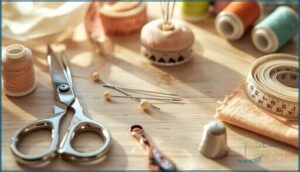
You don’t need a fully stocked sewing room to start practicing your first stitches. A few basic tools and a little setup can make all the difference between frustration and smooth progress.
Let’s walk through the essentials that will set you up for success.
Choosing The Right Needle and Thread
You can’t build a sturdy house without the right foundation, and the same goes for sewing.
Match your needle sizes to your fabric weight—universal needles work for most wovens, while ballpoint varieties prevent runs in knits.
Pair thread types with your project: cotton for natural fibers, polyester for strength.
Getting this thread and needle selection right prevents frustration and improves stitch quality from day one.
Setting Up a Comfortable Sewing Space
Your sewing workspace can make or break your first stitching experience. Position your chair so elbows rest naturally at 90 degrees—usually 28 to 30 inches high for most tables.
Add at least 1000 lumens of task lighting directly over your work area to spot every stitch. Keep thread, needles, and tools within arm’s reach using labeled containers. This ergonomic setup prevents fatigue and sharpens your focus.
Using Printable Sewing Practice Sheets
Download a free PDF practice sheet and print it on standard 8.5 by 11 inch paper—you’ll master sewing stitches without wasting fabric. These sewing practice sheets offer straight-line grids, curves, and corner guides that build real needle control.
Start with basic lines, then progress to zigzag patterns as your skill improves. Paper practice means you can print fresh copies anytime.
For additional help, explore these sewing practice exercises PDF designed for both beginners and those looking to improve their technique.
Basic Hand Sewing Stitches to Master
You don’t need fancy techniques to start sewing by hand. Just four basic stitches will get you through most beginner projects and repairs.
Let’s break down each one so you can practice with confidence.
Running Stitch Technique
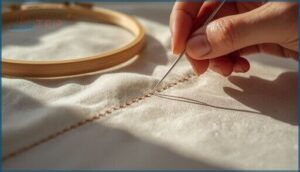
The running stitch is your foundation—simple, quick, and perfect for sewing for beginners. Thread your needle, knot the end, and push it up through the fabric. Then weave in and out in a straight line, keeping your stitches small and even.
Here’s what makes a good running stitch:
- Stitch length control: Keep stitches 1 to 3 millimeters on lightweight fabrics
- Needle selection: Use a sharp universal needle sized 9 to 16
- Thread management: Cut thread to moderate length to prevent tangling
- Fabric tension: Hold fabric gently to avoid puckering
- Sewing rhythm: Maintain steady, consistent hand movement
Your beginner sewing skills grow with each stitch. Practice on scrap fabric first, focusing on even spacing. You’ll notice your hand sewing stitches becoming more uniform as you develop a natural rhythm. Don’t worry if your first attempts look wobbly—that’s completely normal and part of learning basic sewing stitches.
Backstitch for Strong Seams
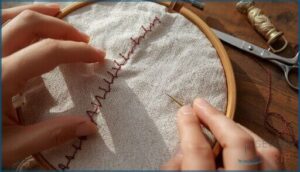
When you need seam reinforcement that won’t pull apart, backstitch is your go-to stitch. This powerful technique creates a continuous thread line that locks into the fabric weave, giving you about 25 percent more strength than running stitches.
Here’s how backstitch builds durability:
| Element | Best Practice |
|---|---|
| Stitch length | 1.5 to 2.0 millimeters for woven fabrics |
| Thread tension | Adjust slightly for knits to prevent fabric distortion |
| Needle choice | Sharp needle for even penetration |
| Thread type | Polyester blends resist abrasion best |
| Stitch density | Consistent spacing prevents weak spots |
Start by bringing your needle up through the fabric, then insert it backward about 2 millimeters behind where it emerged. Come up again ahead of your first stitch, creating overlapping threads. This backstitch variation works beautifully for hand sewing for beginners because you can see exactly how each stitch locks the previous one.
Your sewing stitches will look neat on both sides when you maintain even rhythm. Keep thread tension steady but not tight—pulling too hard causes puckering. Practice on scrap fabric until your beginner sewing hands develop muscle memory for consistent stitch length.
Whip Stitch for Edges
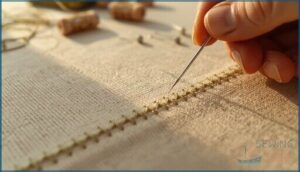
When raw edges need protection, whip stitch wraps thread diagonally over the fabric’s edge to prevent fraying. This basic sewing technique works beautifully for hand sewing for beginners learning edge finishing on felt, appliqué, or lightweight fabrics.
Follow these sewing edge tips for success:
- Space stitches 1 to 2 millimeters apart for neat edges
- Match thread to fabric choice for invisible results
- Keep stitch tension slightly loose to prevent puckering
- Use fine needles (size 9 to 12) on delicate materials
Whip stitch variations include visible decorative edges or hidden seams depending on your project needs.
Basting and Slip Stitches
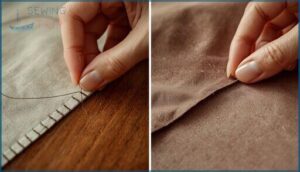
Temporary holds and invisible hems rely on two essential hand sewing for beginners techniques. Basting stitch uses long, loose stitches (6 to 12 millimeters) to secure layers before final seam finishing—perfect for fittings or adjustments.
Slip stitch hides completely inside fabric folds, creating invisible edge control on hems and openings. Master stitch tension here: basting needs room to remove easily, while slip stitches require tightness that disappears into your fabric choice.
Practicing Stitches on Sewing Machines
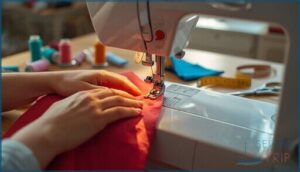
Once you’ve got the feel for hand stitching, it’s time to make friends with your sewing machine. Don’t worry if it seems intimidating at first—every expert started exactly where you’re now.
Let’s break down the core skills you need to build solid machine-sewing habits from day one.
Threading and Tension Basics
Before your sewing machine can create beautiful stitches, you need to master thread tension and needle selection. Think of thread tension as a tug-of-war between the needle thread and bobbin—both sides must pull equally for balanced stitches.
Here’s what transforms your sewing from frustrating to faultless:
- Match your sewing needle size to fabric weight so thread flows smoothly without snags
- Thread the machine carefully from front to back, checking each guide along the path
- Seat the bobbin correctly in its case—clockwise or counterclockwise matters for your model
- Test tension on scrap fabric first, adjusting until stitches lay flat on both sides
Sewing Straight Lines
Once you’ve got threading and tension down, your first real test is the straight stitch—the foundation of all beginner stitches.
Grab your sewing practice sheets and line up the fabric edge with the seam allowance markings on your needle plate. These visual guides keep your stitch quality consistent while building muscle memory.
Try sewing along printed lines first—fabric choice comes next once you’ve got machine calibration and control working together smoothly. For more tips on maintaining accuracy, check out this guide to using needle plate reference points.
Sewing Curves and Corners
Lines are one thing—curves and corners reveal whether you’ve truly got control. Print practice sheets with gentle radius curves, then tighten the curves as your pivoting techniques improve.
Slow down before each corner turning, stop with the needle down, lift the presser foot, and rotate your fabric smoothly. Watch your seam allowance stay consistent while curve stitching trains your hands to guide rather than force the fabric through tight corners.
Stitch Length and Consistency
Once you can handle turns, the next skill is nailing stitch length—your machine’s dial controls how far the needle travels between punctures. Start with 2 to 3 millimeters for most fabrics and check your seam allowance with a ruler.
- Match thread quality to fabric weight for consistent spacing and fabric tension.
- Keep your needle sharp through regular needle maintenance to prevent dragging.
- Practice stitch calibration on scrap material before each project.
Sewing precision improves when you pair the right basic sewing techniques with steady feed speed.
Step-by-Step Guide to Your First Stitch Practice
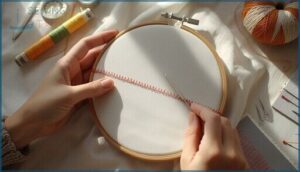
You’re ready to put everything you’ve learned into action. This section walks you through your first practice session from start to finish, breaking it down into simple steps that build your skills one at a time.
Let’s get your hands moving and build that muscle memory.
Preparing Your Practice Sheet
Before you start stitching, you’ll want to set up your practice sheet properly. Download and print a sewing practice sheet on Letter or A4 paper, then place it over light-colored fabric so your stitches show clearly.
Here’s what your sheet layout should include:
| Element | Purpose | What to Look For |
|---|---|---|
| Grid Patterns (1 cm squares) | Measure stitch distance precisely | Clearly visible lines for accuracy |
| Stitch Guides with labels | Practice specific techniques | Rows marked with stitch type and length |
| Practice Metrics | Track your progress | Scales showing millimeters and tolerance targets |
The grid helps you develop control while the margin gives you space for notes and self-assessment after each row.
Stitching Without Thread
Before you reach for thread, try threadless techniques to sharpen needle control and stitch precision. Practicing without thread lets you focus purely on hand eye coordination—where your needle enters, how your fingers guide each puncture, and whether your spacing stays consistent.
- Hold the needle near the eye with two fingers to minimize wobble and improve alignment
- Insert from the top and pull toward your palm to reduce fabric snagging
- Practice puncture angles of 30 to 45 degrees for clean holes without distortion
Sewing With Thread
Once you’ve mastered threadless techniques, it’s time to add thread. Choose cotton thread in neutral gray or beige for basic practice—it works well on many fabrics and helps you see stitch direction clearly.
Thread your needle, leaving a 6-inch tail, then tie a small knot at the end. Pull thread evenly from the spool to prevent tangles, and practice running stitch with 2 to 3 mm spacing on your sheet.
Evaluating Your Stitch Quality
After you finish your first rows, turn the paper over and inspect your work—that’s where the real learning happens. Check these five markers of quality:
- Stitch tension should lie flat without puckering or loops underneath
- Stitch density stays consistent across the entire row
- Thread quality shows no fraying or breakage along the seam
- Seam strength holds under gentle pulling without gaps
- Fabric choice compatibility translates well from paper to cloth
This sewing stitches tutorial builds foundational sewing skills through honest evaluation.
Troubleshooting Common Beginner Stitch Issues
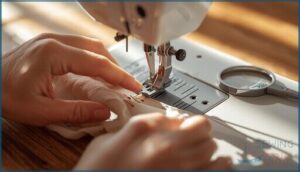
Even the best beginners hit bumps when they’re learning their first stitches. Your machine might throw a tantrum with loose loops, skipped stitches, or thread that snaps mid-seam.
Let’s walk through the most common problems and how to fix them so you can get back to practicing with confidence.
Fixing Uneven or Loose Stitches
When your stitches look wobbly or slack, don’t panic—this is fixable. Check that your fabric choice, needle selection, and thread work together smoothly.
Re-thread both upper and bobbin carefully with the presser foot down. Test your stitch length and sewing speed on scrap fabric first. A fresh needle often solves uneven beginner stitches instantly, sharpening your sewing techniques for beginners.
Adjusting Tension and Needle Size
Thread tension and needle selection work like partners—when they’re balanced, your sewing machine hums along beautifully. Proper machine calibration and fabric compatibility make all the difference in stitch regulation.
Here’s your quick adjustment checklist:
- Tweak tension dial 1–2 numbers at a time and test on scrap fabric
- Match needle size to fabric weight for clean stitches
- Check thread weight matches your needle choice
- Verify threading path seats correctly in tension discs
These sewing techniques transform frustrating loops into smooth, even stitches.
Preventing Thread Breakage
Once you’ve balanced needle selection and thread tension, you’re ready to tackle breakage prevention. Switching to finer thread or using a fresh needle stops most snaps before they start.
Check your fabric choice matches your needle, then slow your stitch length and sewing speed. These sewing tips and tricks keep beginner stitches smooth, while proper threading through guides prevents mid-stitch disasters.
Next Steps After Mastering First Stitches
You’ve nailed the basics on paper, and now it’s time to take those fresh skills somewhere real.
The jump from practice sheets to actual fabric might feel big, but you’re more ready than you think.
Here’s how to build on what you’ve learned and keep moving forward with confidence.
Transitioning to Fabric Practice
Once you’ve mastered beginner stitches on Sewing Practice Sheets, you’re ready for real Fabric Selection. Start with muslin—it’s forgiving and helps you nail Thread Tension and Stitch Quality.
Set up your Sewing Machine with matching thread, test on scrap fabric first, and mark a straight baseline for Fabric Preparation. Practice hand sewing techniques alongside machine work, and you’ll build the control needed for Sewing Projects for beginners.
Simple Beginner Sewing Projects
Now that you’re comfortable with fabric, it’s time to pick your first real project. Start with simple DIY projects that build confidence without overwhelming you. Beginner kits offer pre-cut fabric selection and sewing patterns to guide you through learning to sew.
Try these sewing projects for beginners:
- Envelope pillow cover – practice straight seams and an invisible closure
- Fabric coasters – master even edge finishing on small squares
- Drawstring tote bag – reinforce topstitching consistency
Continuing Skill Improvement
Your skill building doesn’t stop after those first projects. Set weekly goals—like mastering four stitches—to keep practice routines focused. Spend 15 to 30 minutes per session repeating each stitch 20 to 30 times for real stitch mastery and sewing efficiency.
| Practice Focus | Target Result |
|---|---|
| Visual inspection | Even spacing, straight lines |
| Video hand movements | Better grip, improved posture |
| Practice log | Track speed and quality gains |
Space your sessions a few days apart for better technique refining. Review your work honestly—self-critique beats mindless repetition. As control improves, test new stitches on scrap fabric before moving to real sewing projects.
Frequently Asked Questions (FAQs)
Can stitching be self-taught?
Yes, you can absolutely teach yourself stitching. With structured practice strategies and good tutorials, most beginners grasp hand sewing fundamentals within hours.
Consistent practice builds the skill development needed for true stitch mastery.
How often should beginners practice sewing stitches?
Think of daily practice schedules as gentle nudges toward mastery.
Beginners should aim for 15 to 30 minutes, 5 days a week, building basic sewing skills and stitch frequency without overwhelming tender hand muscles.
Can you practice stitches on any paper?
Regular printer paper works, but it tears easily with long stitches.
Heavier cardstock or textured paper gives better needle selection and stitch tension control.
Match your needle size to paper thickness for cleaner practice.
What fabrics are easiest for first projects?
Like choosing training wheels before a real bike, picking cotton muslin, broadcloth fabric, or felt materials sets you up for success.
These fabric types for beginners show stitches clearly and forgive small mistakes.
How long does mastering basic stitches take?
Most beginners reach functional competency with basic hand sewing stitches in 2 to 4 weeks of regular practice.
Your skill acquisition pace depends on consistency—short sessions 4 days weekly accelerate your sewing techniques mastery.
Should you learn hand or machine stitching first?
Start with hand sewing fundamentals to build hand-eye coordination and stitch priority awareness.
Once you’ve developed needlework control and understand sewing techniques, moving to machine basics becomes easier with a gentler learning curve.
Conclusion
The moment your stitches start looking consistent is the same moment sewing stops feeling overwhelming—and that’s no accident.
Your first sewing stitches practice transforms shaky beginnings into steady hands through simple repetition.
Each line you trace builds the precision that separates a frustrating hobby from a lifelong skill.
Pick up your needle, follow the guides, and trust that every awkward stitch today is preparing you for the beautiful seams you’ll create tomorrow.
- https://www.thesprucecrafts.com/working-the-running-stitch-1177571
- https://www.instructables.com/Handsewing-the-Case-Using-the-Backstitch/
- https://www.wikihow.com/Whipstitch
- https://threadistry.com/blog/how-sew-straight-lines/
- https://crazylittleprojects.com/learn-to-sew-series-lesson-1-how-to-sew-a-straight-line/