This site is supported by our readers. We may earn a commission, at no cost to you, if you purchase through links.
Your first running stitch probably wandered across the fabric like a drunk bee, stitches uneven and tension all over the map. That’s the thing about hand sewing—your brain knows what looks right, but your hands haven’t learned the language yet.
Hand stitch practice patterns fix that disconnect by giving your fingers a structured path to follow, turning those wobbly attempts into clean, confident stitches through deliberate repetition. These printable guides map out straight lines, gentle curves, and tricky corners that train your muscle memory without wasting good fabric on trial and error.
Think of them as sheet music for your needle: the notes are already written, so you can focus entirely on mastering the rhythm, spacing, and tension that separate beginner stitching from work that actually holds up.
Table Of Contents
Key Takeaways
- Hand stitch practice patterns are printable templates that build muscle memory by guiding your needle through structured shapes and lines, letting you master tension, spacing, and rhythm without wasting fabric on trial and error.
- Five essential stitches—running stitch, backstitch, blanket stitch, whip stitch, and slip stitch—form the foundation of hand sewing, and deliberate practice on these core techniques will carry you through nearly every project you’ll encounter.
- Smart workspace setup with proper lighting, ergonomic seating, and organized tools prevents physical strain and speeds up skill development, while starting with simple straight lines and circles before advancing to curves and corners prevents frustration and builds genuine confidence.
- Tracking your progress through stitch logs and reusing practice sheets by placing them in clear protectors turns random practice into measurable skill growth while honoring both your craft development and sustainable material use.
What Are Hand Stitch Practice Patterns?
Hand stitch practice patterns are printed or drawn templates that guide your needle through specific shapes, lines, and curves so you can build muscle memory without wasting fabric. They’re like training wheels for your stitching hand, giving you a clear path to follow while you learn tension, spacing, and rhythm.
Once you’re comfortable with these patterns, you can graduate to simple practice projects for stitching that put your skills to work on real fabric items.
Hand stitch practice patterns are your training wheels for building muscle memory through guided shapes and lines without wasting fabric
Let’s break down what these patterns are, why they work, and how they’ll transform your stitching from shaky to steady.
Definition and Purpose
A hand stitch practice pattern is your printable layout that shows exactly where to place stitches on fabric or paper. These sewing practice sheets train precision, hand control, and muscle memory through structured progression from simple to complex shapes.
Pattern design gives you reference marks for alignment and spacing, building sewing fundamentals that turn hand sewing techniques into consistent, confident sewing skills.
Common Types of Practice Patterns
Practice patterns fall into three main categories that build your command over the craft:
- Straight line and geometric grids sharpen rhythm and spacing through running stitch and back stitch variations
- Curved and corner templates train you to navigate arcs and angles without puckering
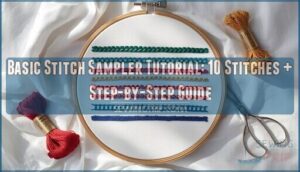
- Decorative stitch samplers introduce French knots, stem stitch, and satin stitch across printable practice sheets
These sewing worksheets transform raw motion into reliable technique.
How Practice Patterns Improve Sewing Skills
Repetition strengthens fabric control by training your fingers to maintain even tension across each seam.
Pattern mastery emerges as grid layouts guide stitch accuracy along curves and corners, building hand dexterity through deliberate needle placement.
Sewing practice sheets establish a consistent sewing rhythm that reduces wrist fatigue and reveals your natural pace, transforming hand stitching from uncertain pokes into confident, reliable hand sewing techniques for any project.
Essential Hand Stitch Techniques to Practice
You don’t need a mountain of stitches to build serious hand sewing skills. A handful of essential techniques, practiced until they feel like second nature, will carry you through most projects you’ll ever tackle.
Let’s walk through the core stitches that deserve your attention and practice time.
Running Stitch Basics
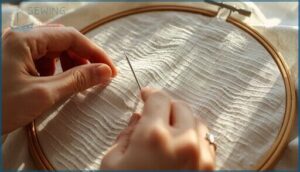
If you’ve ever watched thread dance across fabric in one smooth motion, you’re witnessing the running stitch—the backbone of hand sewing techniques. This simple forward weave teaches stitch length control and thread tension tips that ground every other technique.
Once you’ve nailed the basics, you can tackle techniques for sewing intricate designs flawlessly with confidence and precision.
Choose stable woven fabrics and a sharp needle for your practice routine, then focus on spacing those stitches evenly, two to four millimeters apart, building the rhythm that transforms hesitant stitching into confident hand sewing.
The timeless versatility of the running stitch is illustrated by its role in global embroidery traditions, where it acts as the foundation for techniques like Kantha and Sashiko.
Mastering The Back Stitch
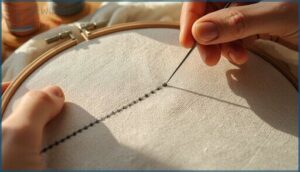
A backstitch builds the strongest seam in your hand sewing arsenal because each pass overlaps the last, locking thread into a continuous line that won’t unravel.
Focus your needle placement techniques about an eighth inch behind your previous exit point, then push forward through the fabric, mastering thread tension management and stitch length control that turn sewing practice sheets into real-world durability.
For an in-depth look at the stitch’s versatility and historical uses, explore these backstitching hand sewing tutorials.
Practicing Blanket and Whip Stitches
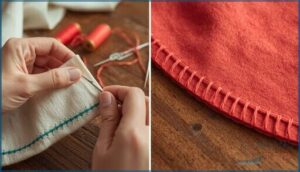
Two foundational edge finishing techniques—the blanket stitch and whip stitch—anchor your hand sewing vocabulary once you control stitch tension and fabric choice.
Practice both on your sewing practice sheets with deliberate thread selection:
- Loop your blanket stitch over paper edges to form neat horizontal bars
- Wrap diagonal whip stitches around curves for quick joins
- Switch contrasting thread colors to track spacing errors
- Keep consistent tension to prevent puckering
- Use sewing tools like fine embroidery needles for precise entry points
These stitching drills cement embroidery patterns and sewing skills that translate directly to felt, fleece, and wool projects.
Learning Slip and Cross Stitches
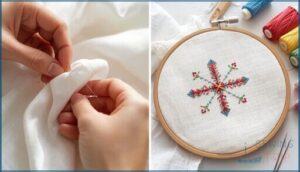
Slip stitches vanish into fabric folds when you catch tiny bites from front to back, creating invisible hems that showcase skilled hand sewing control.
Cross stitch patterns demand even tension and careful thread management across Aida fabric grids. Practice both on your sewing practice sheets to master fabric choice guide principles, then combine slip and cross stitching techniques to finish embroidery panels with hidden seams and perfect backs.
How to Use Printable Stitch Practice Sheets

You don’t need expensive fabric to build your stitching skills—printable practice sheets let you train your hands without wasting a single scrap.
Getting the most out of these sheets means knowing how to download, adjust, and save them for repeated use. Here’s how to set yourself up with practice templates that work exactly the way you need them to.
Downloading and Printing PDF Patterns
Your first task is to locate the download link in your email or account, then save the printable PDF to a dedicated folder for easy digital storage.
When you’re ready to print, open your PDF file and check your printer settings carefully—select actual size or 100% scale to avoid printing errors that shrink or distort the pattern. Print one test page first to confirm accuracy.
Customizing Sheet Size and Layout
You’ll find Page Scaling and Grid Options in your Printer Settings—adjust these to enlarge or reduce pattern density based on your comfort level.
Margin Control shapes how much breathing room surrounds your printable practice area, while Custom Templates lock in your preferred Print Settings for all future Printable Practice Sheets.
Printing PDFs becomes faster once you’ve dialed in these Printable PDFs preferences, turning raw files into reliable Printable guides session after session.
Saving and Reusing Practice Templates
Once you’ve mastered Printing PDFs, smart Template Organization through Digital Storage and Cloud Backup keeps your Printable Practice Sheets accessible anywhere—no more hunting for that download you printed last month.
- Archive Management with File Encryption protects your custom Printable PDFs from accidental deletion
- Version tags let you track which patterns you’ve outgrown
- Offline folders store frequently used Printing Guides for quick access
- Batch renaming streamlines your digital library by stitch type
- Automatic syncing ensures every device holds your latest templates
Step-by-Step Guide to Practicing Hand Stitches
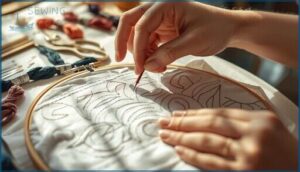
You’ve got your practice sheets printed, and now it’s time to actually stitch. Setting yourself up the right way makes everything easier, from following those curved lines to maneuvering tight corners without frustration.
Let’s walk through exactly how to turn those printed patterns into real skill-building practice.
Setting Up Your Workspace
Before you thread your needle, set yourself up for victory with a workspace that won’t fight you. Bright Task Lighting shows every stitch clearly, while Ergonomic Chairs keep your shoulders relaxed during long sessions. Workspace Organization matters—keep Sewing Practice Sheets, needles, and thread within arm’s reach on a stable Sewing Station.
| Setup Element | What You Need | Why It Works |
|---|---|---|
| Lighting | LED lamp, 4000-5000 lumens | Reveals true thread colors, prevents eye strain |
| Seating | Chair with back support, feet flat | Protects your spine during Hand Sewing sessions |
| Surface | Elbow-height table, non-slip mat | Stops fabric from sliding mid-stitch |
| Storage Solutions | Clear bins, labeled trays | Speeds up Sewing for Beginners setup time |
Keep your work surface light-colored so dropped needles don’t vanish into the void. Position your elbows at 90 degrees and your neck upright—Sewing Skills Development happens faster when your body isn’t screaming for relief. Sewing Education starts with smart setup, and this foundation turns practice into progress without the battle scars.
Following Pattern Lines and Shapes
Your workspace is ready—now keep your stitches within 1-2 millimeters of those printed Sewing Lines. Line Accuracy comes from watching the guide mark beside your needle, not the needle itself.
Straight Lines build rhythm, Curved Lines teach pivot control, and Zig Zag Lines sharpen quick turns.
Use high-contrast Visual Guides on Sewing Practice Sheets, then run Repetition Drills on the same Shape Tracing path until your hand moves without thought.
Tips for Stitching Curves and Corners
Curves and corners separate confident hand sewers from timid ones. Curve Stitching demands shorter stitch length—around 2 to 3 millimeters—so your seam bends smoothly instead of forming sharp angles. Corner Pivots need a marked dot where seam allowances meet, plus trimmed fabric at the tip.
Fabric Control means easing fabric with your fingertips, not yanking the whole edge:
- Clip concave seam allowances so inner curves spread flat
- Notch convex curves to remove bulk from outer bends
- Turn work frequently to keep stitches perpendicular
Using Tools Like Seam Guides
Tools transform clumsy stitches into ruler-straight seams. Magnetic attachments clamp to your practice surface, giving you a raised fence for sewing guides—perfect when your hand sewing practice sheets demand crisp edges.
Sewing gauges with sliding markers let you measure identical seam allowances without constant rechecking. Diagonal tapes mark angles, adjustable guides adapt to any width, and all these sewing techniques work on paper before you touch fabric.
Tips for Building Hand Stitching Confidence

You don’t build confidence by accident—you build it by showing up, choosing your starting point wisely, and watching yourself improve stitch by stitch.
The key is knowing where to begin, how to progress without frustration, and how to practice smart instead of wasteful. Here’s how to turn nervous thread fumbling into the kind of control that sets you free to create anything you want.
Starting With Simple Shapes
Beginner stitchers often feel overwhelmed, but starting with basic shapes on printable sewing practice sheets builds instant confidence. Shape selection matters—circles, straight lines, and squares teach fundamental stitch control without the pressure of expensive fabric preparation.
- Straight lines develop even spacing and rhythm in hand sewing
- Circles train your eye for curve mastery and smooth turns
- Squares build corner techniques through precise pivots
- Zigzags strengthen direction changes and control
- Mixed shapes prepare you for real sewing techniques and stitching skills
Advancing to Complex Patterns
Confidence unlocks complex samplers where pattern complexity challenges your stitching skills beyond basic shapes.
Multi-direction stars and scrolls demand curve mastery through tight pivots and thread tension control.
Layered designs combine running stitch with back stitch along traced paths, building stitch variation while embroidery patterns teach you to stack satin fills over outlined shapes.
These sewing practice sheets transform hand sewing from mechanical repetition into deliberate mastery of refined sewing techniques.
Minimizing Waste With Paper Practice
Printable sewing practice sheets let you learn to sew without squandering yards of fabric, but sustainable printing takes waste reduction further.
Choose eco friendly papers with recycled content, print draft mode to stretch ink, and place completed sheets in standard recycling practices.
Reuse each hand sewing template by slipping it inside a clear protector, then stitch with an unthreaded needle—paper reuse that honors both craft and planet.
Tracking Progress and Skill Development
Every stitch you complete deserves a stitch log. Keep a simple stitch log noting date, practice time, and pattern type—progress tracking that reveals which shapes still challenge you and which now feel automatic.
Set clear skill goals like eight even stitches per inch, then measure your rows against old samples. Skill assessment turns random sewing practice exercises into deliberate mastery, and hand sewing practice sheets become proof your hands are learning.
Frequently Asked Questions (FAQs)
What thread weight works best for practice stitching?
A 50-weight all-purpose polyester or cotton thread gives you smooth control and clear stitch visibility on most fabrics.
While a 40-weight thread creates bolder lines that help you judge spacing and needle sizes.
How do you transfer patterns onto fabric properly?
Transfer patterns using tracing methods like light boxes for cotton, iron transfers for bold lines, carbon paper for temporary guides, stick sheets on dark fabric, or fabric markers.
Each tool suits different hand sewing practice sheets and embroidery patterns.
Can practice sheets help with embroidery skill building?
Like training wheels that vanish once balance clicks, practice sheets sharpen stitch accuracy, thread control, and needle handling through focused embroidery patterns, building stitching skills methodically while minimizing fabric waste—essential practice routines for confident embroidery.
What needle types are recommended for different stitches?
Your needle types depend on the stitch and fabric pairing. For embroidery and backstitch, use sharps in sizes 7–
Ballpoint needles suit knits, while tapestry needles handle cross stitch on Aida cloth beautifully.
How long should daily practice sessions typically last?
Most adults thrive with 20 to 40 minutes of daily practice, enough to build sewing fundamentals without straining your hands.
Beginners should start shorter—around 10 to 20 minutes—then extend session length as stitching pace and fatigue management improve.
Conclusion
Your needle doesn’t care about precision—it just needs direction, and hand stitch practice patterns give you exactly that. Each line you follow builds the quiet confidence that turns hesitation into second nature, until your stitches fall into place without overthinking.
The pattern fades, the muscle memory stays, and suddenly you’re stitching curves and corners like you’ve been doing it for years. That’s not talent—that’s what happens when your hands finally learn to speak the same language as your eyes.
- https://youtube.com/hellosewing
- https://loveknitting.net/?arsae=https%3A%2F%2Flove-handmade.net%2F25-things-to-make-with-cardboard-2%2F
- https://www.sewncompany.com/handsewingtutorials/tag/backstitch
- https://www.adventuresofadiymom.com/2024/01/double-running-stitch-embroidery-how-to.html
- https://needleandthread.com/