
This site is supported by our readers. We may earn a commission, at no cost to you, if you purchase through links.

Most homeowners couldn’t point to where their sewer line runs — not even close. That’s fine until you’re planning a deck, digging a garden bed, or staring at a slow drain that won’t clear.
Your sewer lateral — the pipe connecting your home to the city main — sits somewhere between 18 and 48 inches underground, running from your foundation straight toward the street. Hit it with a shovel and you’re looking at $1,400 to $5,300 in repairs, minimum.
The good news: finding it isn’t guesswork. Between municipal records, indoor cleanouts, and a free call to 811, you can map the line accurately before a single tool breaks ground.
Table Of Contents
Key Takeaways
- Before digging anything, pull your property blueprints and as-built drawings from the local building department — they’ll show you exactly where your sewer lateral runs and how deep it sits.
- Call 811 for free utility marking, but confirm separately whether your private sewer lateral is included, since public locating services don’t always cover it.
- PVC pipes don’t respond to standard electromagnetic locators, so if your home was built in the last few decades, you’ll need a sewer camera with a transmitter to trace the line accurately.
- A professional camera inspection runs $300–$900 upfront — far cheaper than the $1,400–$5,300 repair bill you’d face after accidentally hitting the line with a shovel.
Find It With Records and Cleanouts

Before you touch a shovel, the smartest move is track down what already exists on paper. Your property has a paper trail — blueprints, municipal maps, as-built drawings — that can tell you exactly where your sewer line runs and how deep it sits.
Utility companies and local municipalities often archive these records digitally, so searching sewer line documentation before you dig can save you from costly surprises underground.
Start with these five records-based steps to build a clear picture before you ever set foot in the yard.
Check Property Blueprints
Your home blueprints are the fastest starting point. Most property records offices hold construction drawings filed with original permits, and many municipalities offer digitized plan sets searchable by address.
When requesting documents, bring your parcel number to speed things up. Look for:
- Original construction drawings
- Permit revision sets from additions or remodels
- Assessor sketches tied to tax records
Cross-reference any plan against current measurements to catch discrepancies before you dig. Understanding the differences between original plans online can help you navigate the process.
Review As-built Drawings
Blueprints show what was planned — as-built drawings show what was actually built.
Utility deviation tracking is the key difference: if a plumber shifted the sewer line three feet to avoid a footing, that change lives here, not in the original plans.
Your local building department maintains these records, and they’re worth requesting before you touch a shovel.
Search Municipal Sewer Maps
Once your as-built drawings give you a rough idea of the route, municipal sewer maps can fill in the bigger picture. Most city public works departments host a GIS web viewer where you can search your address and pull up sanitary sewer layers — pipe sizes, materials, and manhole locations included.
If online access is restricted, call the office and request a printed copy.
Confirm Sewer or Septic
Before tracing any line, confirm whether your property connects to a municipal sewer or runs on a septic system — they work completely differently.
Three quick checks:
- Look for a sewer cleanout cap near your foundation.
- Check your water bill for a sewer service charge.
- Search property records for a septic tank permit.
A septic system uses an underground tank and drainfield with no street connection.
Note Pipe Depth Details
Depth isn’t a minor detail — it shapes every dig you’ll make. Most residential sewer lines sit 18 to 48 inches below grade, depending on your frost line.
| Factor | Shallow (18–24 in.) | Deep (36–48 in.) |
|---|---|---|
| Climate | Warm/mild regions | Cold/freezing zones |
| Soil load | Light foot traffic | Driveways, vehicles |
| Pipe material | PVC standard install | Cast iron or clay |
Invert elevation — the pipe’s bottom inside — determines slope and flow. Verify depth through your as-built drawings before any trenching.
Locate Indoor Sewer Cleanouts
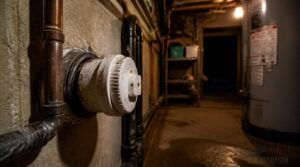
Indoor cleanouts are your first clue to tracing where your sewer line runs beneath the house. Most homes have at least one tucked away in a spot you might not think to look. Start checking in these five places.
Check Basement Walls
The basement is one of the first places to look for an indoor sewer cleanout point. Walk the perimeter of your basement walls and scan for a 4-inch capped pipe — it usually sits near the main drain stack.
Efflorescence, damp spots, or mold growth nearby can actually help you spot areas where drainage system components are concentrated.
These warning signs often point to deeper structural issues that, like unexpected costs in any project, are easier to manage when you understand domestic sewing machine price trends and budget planning before committing to repairs.
Inspect Crawl Space Exits
Under your home’s floor, a crawl space often hides a sewer line access point worth finding. Look for a 4-inch capped pipe near any exit opening — the entry height should clear at least 16 inches.
Check these before you search:
- Confirm the exit is free of debris
- Look for a moisture barrier along the floor
- Check that the threshold seal isn’t cracked
- Bring a flashlight — lighting here is rarely reliable
A damp or poorly sealed crawl space exit can obscure sewer line identification, so clear the area first.
Look Near Utility Rooms
Your utility room is one of the best places to start. The main sewer line often enters the foundation nearby, which means the indoor sewer cleanout point usually is within a few feet of the washer hookup or utility sink.
Check along the walls behind appliances. That capped pipe isn’t always obvious, but it’s usually close to where your home plumbing concentrates.
Identify Capped Four-inch Pipes
What you’re looking for is a 4-inch capped pipe — usually PVC, white or gray, with a square nut on top. That’s your sewer cleanout.
The cap is either threaded or socket-style: threaded caps screw off for access, while socket caps are cemented on permanently.
Check that the cap sits flush and shows no cracking, since a loose or damaged seal can let in debris.
Follow The Main Drain
The drain doesn’t run randomly — it follows a deliberate downhill path, sloping 1 to 2 percent toward the exterior. Start at the cleanout and walk that angle toward the foundation wall.
Every fixture in the house — sinks, toilets, tubs — feeds into this same route.
Trace it, and you’ve practically mapped your sewer line location before stepping outside.
Trace The Line Outdoors
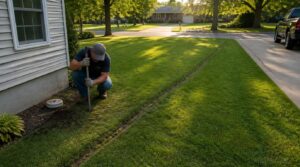
Once you’ve located your indoor cleanout, it’s time to take the search outside. The sewer line leaves your home through the foundation and travels toward the street, and there are clear signs along the way that can help you trace its path. Here’s what to look for as you walk your yard.
Find Exterior Cleanout Caps
Exterior cleanout caps are your sewer access points — small capped pipes, usually 3 to 6 inches wide, made of metal or durable plastic with weather-resistant finishes. Most use threaded caps with gaskets to seal out pests and sewer gas.
Check for a buried sewer cleanout by scanning for slight ground depressions, which often mark where a trench was backfilled during original installation.
Start Near Foundation Wall
Once you’ve spotted that exterior cleanout cap, the foundation wall is your next reference point. The sewer line almost always exits the house right there, just below grade, before angling toward the street.
Watch for soil moisture or discoloration along the wall — a subtle sign the pipe runs beneath. That path sets your gravity flow slope toward the street.
Follow Toward The Street
From the foundation, the sewer line traces a straight path toward the street, sloping roughly 1–3% downhill to maintain gravity flow.
Watch for these markers along the route:
- Slight soil mounding from original backfill
- Utility flags left by locating services
- Undisturbed grass following a narrow strip
- Property line markers near the curb
- Manholes indicating the municipal sewer main connection point
Watch for Yard Depressions
Markers above ground often point to what’s hidden below. A yard depression along your sewer line’s path usually means the original trench backfill has slowly settled over time.
| Sign | What It Means |
|---|---|
| Pooling water after rain | Poor drainage, possible pipe leak |
| Lush grass strip | Nutrients from sewer line seepage |
| Gradual lawn sink | Soil compaction failure below |
| Soggy soil between storms | Subsurface saturation or blockage |
Note Nearby Manholes
Near your property line, manholes mark where private laterals meet the municipal system. That connection tells you which direction your sewer line runs toward the street.
- Manhole covers weigh 90–150 pounds and need specialized tools to lift
- Many sit within the public right-of-way, not your yard
- Access requires confined space safety procedures
- Ownership usually belongs to the utility provider, not you
Use them for sewer mapping, not entry.
Call 811 Before Digging

Before you put a shovel in the ground, calling 811 is one step you don’t want to skip. It’s a free service that gets utility lines marked so you’re not digging blind. Here’s what the process looks like from start to finish.
Request Utility Marking Service
Dial 811 before any shovel breaks ground — it’s free and triggers utility locating from local utility companies who flag buried lines with color-coded paint or flags.
| Color | Utility Type | What It Means for You |
|---|---|---|
| Red | Electric power | Avoid all digging nearby |
| Yellow | Gas or oil | High-risk zone |
| Blue | Potable water | Shift your dig path |
| Purple | Reclaimed water | Check irrigation depth |
| Orange | Telecom lines | Confirm with provider |
Subsurface utility location through 811 covers public lines. Private sewer coverage often requires a separate locator — confirm this when you call.
Mark Planned Digging Areas
Before the locator arrives, grab white marking paint and outline your dig zone clearly.
- Mark a 5-foot radius around any single dig point
- Use a 10-foot wide corridor for linear trench work
- Keep lines 2–4 inches wide for visibility on soil or pavement
- Log the date, boundaries, and who placed each mark
This premark plan tells the locator exactly where to focus — protecting your crew before any excavation begins.
Wait for Locator Flags
After you dial 811, crews usually arrive within a few business days and place utility flags along the sewer line marking path. Don’t touch them.
| Flag Color | What It Marks |
|---|---|
| Green | Sewer and drain lines |
| Red | Electrical lines |
| Yellow | Gas lines |
| Orange | Telecom cables |
Flag durability varies — most hold up one to three weeks. Weather or foot traffic can knock them over, so recheck before digging. Photograph the layout for your private line marking records.
Verify Private Sewer Coverage
Your homeowners policy probably won’t cover accidental sewer line damage unless you’ve added a private sewer line rider. That endorsement usually covers excavation, pipe repair or replacement, and sometimes yard restoration — but check for exclusions around pipe material, like clay or cast iron.
Deductibles on riders often differ from your main policy, so compare both before you dig.
Avoid Unmarked Excavation
Digging without confirmed marks is how a routine yard project turns into a sewage disaster. Don’t break ground until every utility — including your private sewer lateral — is flagged and accounted for.
If marks fade or get disturbed, stop and request a remark before continuing. Within the tolerance zone, switch to hand digging.
That one step can save you thousands.
Use Sewer Locating Tools
When records and visual clues aren’t enough, specialized tools can take the guesswork out of finding your sewer line. Each one works a little differently depending on your pipe material, soil type, and how deep the line runs.
Here are the main tools you can use to get a clear picture of exactly where that line is.
Sewer Camera With Transmitter
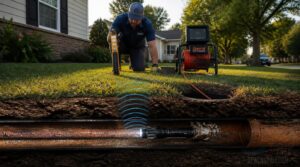
A sewer camera with transmitter is one of the most reliable ways to trace a buried line. The camera travels through the pipe while a 512 Hz transmitter broadcasts its location upward.
You hold a receiver above ground to pinpoint depth in real time.
The self-leveling housing keeps the view steady, and cables reach up to 230 feet.
Handheld Pipe Locator

A handheld pipe locator complements the camera by tracing the line from above ground. It sends an electromagnetic signal through the pipe and reads it back with a handheld wand.
Follow these steps:
- Calibrate signal against a known pipe section before tracing
- Adjust frequency to reduce electromagnetic interference from nearby utilities
- Sweep perpendicular to the expected line for consistent inductive tracing
- Read depth carefully — accuracy sits within 6–12 inches
- Swap batteries every 4–8 hours to maintain reliable pipe detection
Ground-penetrating Radar

When electromagnetic signals can’t find a PVC sewer line, ground-penetrating radar (GPR) fills the gap. It emits short pulses into the ground and reads reflections off dielectric property contrasts between the pipe and surrounding soil.
| GPR Factor | What It Means |
|---|---|
| High-frequency antenna (500+ MHz) | Sharper detail, shallower depth |
| Low-frequency antenna (below 250 MHz) | Greater depth, less resolution |
| Hyperbolic reflections | Signal pattern that pinpoints buried pipe |
| Signal attenuation | Wet or clay soil weakens accuracy |
A trained operator reads the radargram and marks the line above ground — no guessing required.
Probe Only Soft Soil

GPR gives you the big picture, but a steel soil probe lets you confirm what’s beneath your feet before you dig.
Push it straight down with steady pressure — in soft or moist ground, it sinks 2 to 6 inches easily. That smooth penetration signals a backfilled trench, often where your sewer line runs. Stop immediately if you hit resistance or anything solid.
Mark The Detected Path

Once your sewer line locator signals a hit, mark the spot right away — don’t trust your memory.
Use standardized color coding (commonly orange for sewer) with spray paint or numbered flags that hold up to rain.
Space each marker consistently so your sewer line diagram stays readable and accurate for whoever digs or inspects the line next.
Call a Sewer Professional
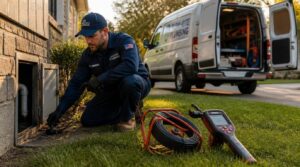
Sometimes the tools and records only get you so far, and that’s when calling a licensed plumber makes the most sense. A professional can locate your line accurately and safely, whether you’re dealing with unclear paperwork, a tricky PVC pipe, or a backup that won’t quit. Here are the situations where bringing in a pro is the right call.
When Records Are Unclear
Old records lie. Historical document ambiguity, agency naming inconsistencies, and missing configuration dates can leave you guessing about your line’s true path.
When cross-referencing utility filings still doesn’t resolve the confusion, a licensed plumber can step in with a sewer line locator or camera to verify field conditions directly. That’s when professional sewer line inspection stops being optional:
- Pipe material stays unknown
- Depth remains unconfirmed
- Private lines get misidentified
- Damage risk climbs fast
For PVC Sewer Lines
PVC pipes are invisible to electromagnetic locators — they don’t conduct signal. That’s the problem. Since most modern homes use 4- to 6-inch PVC for gravity-flow sewer lines, standard pipe locators often miss them entirely.
A professional uses a sewer camera with a built-in transmitter inserted through the cleanout, then tracks the signal above ground — the only reliable method for PVC.
Before Major Landscaping
Are you planning to put in a patio, add a garden bed, or plant some trees? Locate your sewer line first.
Tree roots are drawn to pipes like a heat-seeking missile — once inside, they cause blockages and breaks.
A professional can map the line’s exact path so your landscaping layout avoids the root zone entirely, protecting both your yard and your pipes.
If Backups Appear
Sewage backing up into your fixtures is a clear sign the sewer line needs immediate attention.
Stop using water right away to avoid overflow, then contact a licensed plumber for emergency diagnosis.
Watch for these warning signs:
- Multiple drains slowing at once
- Sewage smell near floor drains
- Gurgling sounds after flushing
Septic system failures can also trigger backups — a full tank or failing drain field needs prompt professional inspection.
Compare Inspection Costs
Costs vary more than most homeowners expect. A sewer camera inspection runs $300–$900, while records retrieval adds $150–$400 depending on complexity. Professional locating tools like ground-penetrating radar push costs toward $1,200.
That’s still far less than the $1,400–$5,300 you’d face for sewer line repair after accidental damage. Getting a precise quote upfront keeps the sewer line replacement conversation from becoming an emergency one.
A precise inspection quote upfront costs far less than emergency sewer repair
Frequently Asked Questions (FAQs)
How do you find a sewer line?
Finding a sewer line can feel like searching for buried treasure — except the stakes are far higher. Check for cleanouts, trace from the foundation, use a pipe locator, or pull your property blueprints.
How do you find a sewer line without digging?
You can find a sewer line without digging by using a sewer camera with transmitter, a pipe locator, or ground-penetrating radar to map the underground path from the surface.
How do I know if my property has a sewer line?
Like a hidden vein running beneath your yard, your property either connects to a municipal sewer line or relies on a private septic system — and your property tax bill or utility statement usually reveals which one.
How do I find out if a sewer line is buried?
Yes — a sewer line is almost always buried. Soil settling signs, like slight yard depressions, often mark where a trench was backfilled. Sewer line depth varies, but pipes usually run several feet underground.
How deep is the sewer line in my yard?
As they say, what’s buried runs deep. Most residential sewer lines sit 18 to 30 inches below the surface, but in colder climates, frost line requirements push that depth to four or even six feet.
What tool is used to find underground sewer lines?
Sewer camera with transmitter, electromagnetic pipe locator, and ground-penetrating radar are the main tools. A camera confirms pipe routing from inside; GPR detects non-conductive PVC where electromagnetic signals fall short.
How do I access the sewer line on my property?
Start at the cleanout. That capped 4-inch pipe in your basement or near the foundation is your direct access point to the main sewer line — no digging required.
Where is the sewer line located in a house?
The main sewer line runs from your home’s lowest drains — usually in the basement or crawl space — through the foundation wall and underground toward the street, connecting to the municipal system.
How do you mark a sewer line?
Once the line is detected, place surface markers — flags or spray paint — along the traced route at regular intervals. This gives you a clear, visible map of the sewer path before any digging begins.
How to figure out where the sewer line is?
You know your home’s layout, but underground is another story. Follow pipe paths from cleanouts, check blueprints, trace yard depressions, and use utility detection tools to pinpoint your sewer line’s route before digging.
Conclusion
Sewer lines stay silent until something goes wrong. Knowing how to find the sewer line on your property puts you ahead of that moment — before the shovel, before the bill, before the regret.
Pull your records first. Trace the cleanouts. Call 811.
If the path still isn’t clear, a professional camera inspection costs far less than a broken pipe.
The work takes a few hours. The protection lasts the life of your home.
- https://www.gp-radar.com/article/how-to-find-a-sewer-line-underground
- https://www.cityoffrederickmd.gov/DocumentCenter/View/3023
- https://www.portland.gov/bes/connecting-sewer/understanding-sewer-connection
- https://www.tnstandard.com/locating-underground-sewer-line-safely-and-accurately
- https://www.wvsdca.gov/190/Learn-about-property-line-cleanout-proce