This site is supported by our readers. We may earn a commission, at no cost to you, if you purchase through links.
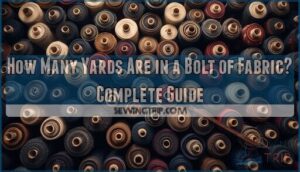
Walk into any fabric store, and you’ll see those tidy cylinders standing upright like soldiers—bolts of fabric, each hiding a mystery yardage that determines whether you’re buying smart or scrambling back for more mid-project. I learned this the hard way after confidently purchasing what I thought was “plenty” of navy cotton, only to run short three pattern pieces from the finish line.
The truth is, bolt yardage isn’t some universal standard carved in stone. A quilting cotton bolt carries 15 yards, while wool might pack 60, and silk plays by entirely different rules based on weight alone.
Knowing these numbers before you cut saves you from expensive mistakes, wasted trips, and the soul-crushing experience of hunting for discontinued fabric to finish what you started.
Table Of Contents
Key Takeaways
- Fabric bolt yardage varies dramatically by material type—quilting cotton typically holds 15 yards retail, while wool can pack 60 yards, and assuming universal standards will leave you scrambling mid-project for discontinued fabric.
- Heavier fabrics and wider widths reduce the total yardage on a bolt because density and width directly control how much material fits around the standard cardboard core.
- Always add 10-15% extra yardage beyond your pattern requirements to account for shrinkage (natural fibers can shrink 3-10%), cutting errors, seam allowances, and pattern matching on directional prints.
- Wholesale purchases slash fabric costs 30-70% compared to retail pricing, but you’ll need a business tax ID and must commit to minimum orders of 5-25 yards to access those bulk discounts.
What is a Bolt of Fabric?
If you’ve ever walked into a fabric store and felt a little lost staring at those massive rolls of cloth, you’re not alone. A fabric bolt is the industry’s standard way of storing and shipping fabric, but there’s more to it than just a big roll.
Let’s break down what a bolt actually is, how it works in your sewing projects, and what you need to know before you start measuring.
If you’re also wondering whether a serger is something you need alongside your regular machine, understanding the difference between a serger and a sewing machine can help you decide what’s worth the investment.
Definition and Purpose
A fabric bolt is a continuous length of cloth rolled around a sturdy core—your textile unit for storage, handling, and retail sales. Think of it as the industry’s standardized package, designed to keep fabric wrinkle-free during transport while simplifying yardage calculations.
The core materials, usually cardboard or plastic, maintain tension and prevent distortion. Bolt measurements vary, but this format dominates fabric storage across mills and sewing shops worldwide.
The use of fabric bolts also aids in fabric quality control by preventing creases and wrinkles.
How Bolts Are Used in Sewing
You’ll encounter bolts in retail stores standing upright on shelves, ready for staff to pull them to the cutting table. There, they unroll your requested yardage across a measuring grid—usually on tables stretching six to eight feet.
At home, many sewists replicate this system by wrapping purchased fabric around boards, creating mini bolts for organized fabric storage in their sewing workstations.
These sewing room organization ideas help you design a layout where every tool and material has a dedicated, easy-to-reach spot.
Typical Appearance and Structure
Most bolts you’ll spot in fabric stores look like tightly wound cylinders, about three to four inches thick, wrapped around a sturdy cardboard or plastic core. Understanding fabric quality standards is essential for selecting the right fabric. The fabric core keeps those layers from shifting during transport, maintaining roll stability you can count on.
Here’s what you’ll notice when examining bolt dimensions:
- Fabric layers wrap tightly around core materials, usually cardboard or reinforced plastic tubes
- Bolt length varies by fabric type, but most measure 12 to 18 inches across
- Fabric width determines how compact the roll appears—wider fabrics create bulkier cylinders
- Yardage remains hidden until you check the manufacturer’s label or ask staff to verify
How Many Yards Are in a Bolt of Fabric?

Here’s the short answer: most fabric bolts contain between 10 and 100 yards, depending on what you’re buying. I’ve seen 15-yard bolts become the industry standard for everyday cotton, but don’t assume that’s universal across all fabrics.
Buying fabric in larger quantities can save you serious money—check out these practical tips for cutting costs on sewing projects before your next purchase.
Let’s break down the typical ranges, what you’ll find for common materials, and why manufacturers can’t seem to agree on a single number.
Average Yardage Ranges
You’ll find yardage variance all over the map—retail bolts often hold just 10 to 15 yards, while wholesale rolls stretch from 35 to 90 yards depending on fabric density and width. Bolt length isn’t standardized, so always check the label before buying.
Standard yardage estimates mean nothing without knowing your supplier’s practices and the specific fabric yardage calculation methods they use.
Different seam allowances affect how much fabric you actually need—mastering your seam technique helps you account for these differences when calculating yardage.
| Fabric Category | Retail Range | Wholesale Range |
|---|---|---|
| Lightweight Sheers | 20–30 yards | 35–70 yards |
| Medium Cotton | 10–15 yards | 45–55 yards |
| Heavy Upholstery | 10–15 yards | 40–50 yards |
| Canvas/Décor | ~39 yards | 40–60 yards |
| Specialty Fabrics | 3–50 yards | Varies widely |
Standard Yardage for Common Fabrics
Quilting cotton usually arrives on 15-yard bolts at your local shop, though wholesale suppliers stock 20 to 30-yard rolls. Apparel fabrics like polyester blends run 20 to 30 yards, while upholstery and home décor stretch to 50 or 60 yards—fabric density and bolt storage constraints dictate these ranges. Lightweight tulle? Expect 10 to 50 yards.
Measurement tools reveal the truth, but fabric classification matters more than guessing.
Variations by Manufacturer
Beyond fabric type, manufacturer variance drives what you’ll find on the cutting table. One mill ships 10-yard bolts, while another prefers 50-yard rolls—supply chain decisions and regional standards dictate these choices.
Canadian suppliers often stock 40 to 80 meters, U.S. mills favor 15 or 100-yard units, and textile manufacturing practices shift by workshop tradition, making fabric sourcing unpredictable without checking each bolt’s label.
Factors Affecting Bolt Yardage
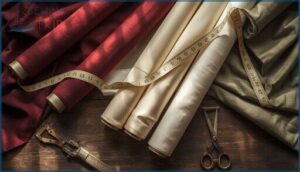
You can’t just walk into a fabric store and assume every bolt holds the same amount of yardage. The truth is, several variables determine how much fabric actually winds up on that cardboard core.
Let’s break down the three key factors that control what you’re really getting when you buy a bolt.
Fabric Type and Weight
Here’s the thing: heavier fabric types mean fewer yards on your bolt. Lightweight cottons at 100–170 GSM might yield 100 yards, while heavyweight canvas at 350+ GSM usually tops out around 39 yards.
Fabric density and thickness variance directly control how much material fits on a standard core. Check the weight classes before assuming yardage—material selection impacts your entire project budget.
Fabric Width
Wider fabric widths reduce the yardage you’ll need, but they also affect what’s actually on the bolt. Standard quilting cotton at 44–45 inches usually carries more linear yards than upholstery fabric at 58–60 inches on the same core diameter. Apparel fabrics range from 43–58 inches, while specialty bolt sizes like 108-inch quilt backing come in shorter lengths—textile standards prioritize width variations over uniform bolt length across fabric classification.
Intended Use and Manufacturing Practices
Manufacturing practices shape bolt length more than you’d expect. Mass apparel production demands 50–100 yard rolls to feed spreading machines without interruption, while retail shops repackage those same industrial rolls into manageable 20–30 yard bolts.
Upholstery fabric sourcing targets 40–60 yards for pattern matching across sofas, and government specs cap institutional yardage between 100–150 yards for quality control and fabric measurement consistency.
Standard Bolt Sizes by Fabric Type
Not all fabrics play by the same rules regarding bolt sizing. Cotton arrives on your cutting table in completely different quantities than silk, and canvas won’t match what you’d expect from tulle.
Here’s what you’ll actually find when you’re standing in the fabric store, broken down by the materials you’re most likely to work with.
Cotton and Cotton Blends

Cotton and Cotton Blends are the workhorses of the fabric world, and their bolt yardage swings wider than you’d think. Here’s what you’ll actually find when you’re standing at the cutting table:
- Quilting cottons clock in at 15 yards per bolt in most retail shops—your standard fabric measurement for those 44-inch-wide prints.
- Lightweight cottons like batiste can stretch to 40 yards or more on wholesale bolts, thanks to their thinner weave.
- Cotton muslins often arrive on 25 to 50 yard bolts, giving you plenty for backgrounds.
- Cotton flannels usually measure 20 yards per bolt due to their napped, bulkier construction.
- Heavy cotton canvas maxes out around 39 yards—the weight limits how much fabric wraps around that core.
Thread counts, textile finishes, and fabric dyes don’t change these numbers, but cotton blends and different cotton weaves do affect how manufacturers package their bolts.
Silk, Satin, and Synthetics

Silk and satin bolts break all the rules you just learned with cotton. Traditional silk bolts hover around 40 yards, but modern retail cuts that down to 20 or 30 yards—momme weight decides everything.
Lightweight chiffons can stretch longer, while heavy duchesse satins quit around 15 yards because textile density won’t let manufacturers wind more without creating an unwieldy roll.
Polyester bridal satins? Those hit 60 to 70 yards on wholesale bolts, proving synthetic blends laugh at weight restrictions.
Wool, Canvas, and Heavy Fabrics
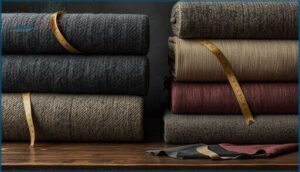
Heavy fabrics flip the script entirely. Wool bolts traditionally clock in at 100 yards, but modern suitings cut that to 30–60 yards because bulk matters more than fabric thickness alone.
Canvas weaves land around 39 yards per bolt, while upholstery-grade materials push 50–60 yards despite their heft.
Industrial applications demand these shorter runs—you can’t wrestle a 200-pound bolt through your workspace without regretting every fabric measurement decision you’ve ever made.
Specialty Fabrics (Lace, Tulle, Etc.)

Specialty sheers refuse to play by normal rules. Lace applications and tulle decor bolts stretch to 40 yards when you’re working with 54-inch widths for event backdrops, while narrow craft rolls shrink to 10 yards. Sequin mesh and netting materials land around 10 yards because fabric embellishments add weight and cost—sheer textiles don’t always mean light inventory.
- Check bolt labels before buying; specialty yardage varies wildly between decorative and wholesale formats
- Wider tulle bolts (54 inches) usually offer more yardage than narrow craft rolls
- Embellished fabrics like sequin mesh come in shorter lengths due to material expense
How to Check Yardage on a Fabric Bolt
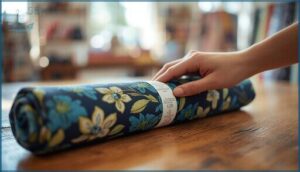
You don’t have to guess how much fabric is on a bolt. Most fabric stores make it easy to check the yardage before you buy, whether you ask someone or inspect the bolt yourself.
Here’s how to find out exactly what you’re getting.
Asking Store Employees
Don’t hesitate to lean on staff assistance when you’re standing at the cutting counter. Most fabric store employees undergo employee training specifically to handle yardage queries, and they’re equipped to read bolt labels, verify remaining fabric, and clarify minimum cuts.
Their customer support extends beyond just measuring—they’ll help translate your project needs into accurate yardage requirements. When buying fabric, asking questions isn’t amateur; it’s smart practice that prevents costly mistakes in your fabric buying guide journey.
Inspecting Layers and Core
When you’re verifying a bolt of fabric in person, core inspection and layer evaluation become your best tools. Check the roll’s edges for telescoping—those telltale shifts signal uneven winding quality that distorts actual yardage.
Look for ripples, creases, or fabric defects across visible layers, as these prevent even spreading and reduce usable yards in a bolt. Roll verification isn’t just measuring the core; it’s evaluating how tightly those layers wound around it, ensuring your fabric measurement matches what you’ll actually get.
Calculating Fabric Needs for Projects

You can’t just eyeball fabric yardage and hope for the best—I learned that the hard way after running short on three separate quilt projects. Calculating your needs correctly means accounting for width, layout challenges, and the inevitable shrinkage that’ll catch you off guard if you’re not careful.
Calculating fabric needs requires accounting for width, layout challenges, and shrinkage—eyeballing yardage guarantees you’ll run short
Here’s what you need to factor in before you cut a single inch.
Considering Fabric Width
Fabric width is the unsung hero of yardage calculation—ignore it, and you’ll buy too much or scramble for more. A 45-inch bolt requires different yardage than a 54-inch bolt for the same project.
Wider fabrics let you fit more pieces across, slashing total yardage needs.
Always check bolt sizes and width variations before calculating; fabric efficiency depends on matching width to your pattern’s demands.
Pattern Layout and Directional Prints
Directional prints demand every pattern piece face the same way—no shortcuts. Fabric orientation and print matching eat yardage because layout efficiency tanks when you can’t flip pieces head-to-toe. Grainline control matters, but so does keeping those birds upright.
I’ve watched directional cuts from a single fabric bolt waste six extra yards on a coat. Plan for 20–30% more yardage than your pattern suggests, especially with stripes or border designs.
Allowing for Shrinkage and Seam Allowances
Your yardage calculations fall apart if you ignore shrinkage rates and seam allowances. Cotton and linen can shrink 3–10%, so I add 10% extra for natural fibers—always.
Seam allowances consume fabric at every edge; quilting fabrics use 1/4 inch, garments take 5/8 inch.
Fabric stretch and cutting efficiency matter less than planning for what you’ll lose in the wash and at the seams.
Tips for Buying The Right Bolt Yardage

You’ve measured, calculated, and checked the pattern twice—now comes the part where you actually buy the fabric. This is where I’ve seen even experienced sewers stumble, ending up with too little yardage or paying retail prices for fabric they could’ve gotten wholesale.
Let’s talk through the practical side of purchasing bolts so you don’t repeat the mistakes I made in my early workshop days.
Wholesale Vs. Retail Purchases
When you’re ready to source fabric in serious quantities, wholesale markets flip the pricing models entirely. Retail charges you full price per yard—often six to twenty dollars on the West Coast—while wholesale slashes costs to three to fifteen dollars through bulk discounts.
You’ll usually buy a full bolt of fabric (10 to 15 yards minimum), but those cost savings add up fast when you’re sourcing textile quantities for production runs instead of one-off projects.
Planning for Extra Yardage
You’ll want to add 10 to 15 percent beyond pattern requirements for fabric shrinkage, cutting errors, and pattern matching on directional prints. Quilting margins demand even more—six inches per side for home machines, twelve for longarm work.
That yardage buffer transforms a fabric bolt purchase from risky gamble into smart sewing project planning, giving you textile quantities that actually survive real-world fabric measurement challenges.
Avoiding Common Buying Mistakes
Smart shopping means inspecting fabric quality before you cut—loose weaves and thin spots waste yardage. Test shrinkage on a marked square first, because cotton can shrink several percent and ruin your measurements. Always check bolt labels for actual width, not just yardage estimation.
Impulse purchases without a project plan lead to stash accumulation, not finished garments, so confirm fiber content and fabric inspection needs upfront.
Frequently Asked Questions (FAQs)
What is the average length of a bolt of fabric?
Most bolts hold 40 to 60 yards, though you’ll find significant variance by fabric type. Wholesale bolts usually pack more yardage than retail versions, while specialty fabrics break these standard roll dimensions entirely.
What is the manufacturer’s minimum?
The manufacturer’s minimum is the smallest cut retailers will sell from a fabric bolt, usually ranging from 5 to 1 yard for apparel fabrics, though specialty materials may require more.
How do I buy fabric wholesale?
You’ll need a business tax ID or resale certificate to access wholesale pricing and trade accounts. Most vendors require minimum orders of 5–25 yards, with better per-yard rates on bulk orders.
How do retail prices compare to wholesale prices?
Cutting through the fabric markup maze: wholesale discounts slash prices 30% to 70% below retail costs. Bulk savings reward volume buyers, while retail overhead—displays, inventory, service—drives yardage measurement pricing higher for single-yard shoppers.
What are fat quarter sets?
You’ll find fat quarter sets as coordinated fabric bundles—each piece measuring 18 by 22 inches—grouped by color families or themes.
Quilters love these assortments because they optimize print orientation while giving you variety without committing to full yardage.
Can you order custom yardage on bolts?
Yes, you can request custom yardage on fabric bolts from most suppliers.
Expect lead times of one to three weeks and potential premium pricing or minimum order requirements, usually five to ten yards minimum.
How are fabric bolts stored in warehouses?
Like rows of spools in an industrial loom, fabric bolts rest horizontally on warehouse racks, grouped by width and type.
Pallet management systems secure bulk yardage, while inventory control ensures fabric handling preserves each roll’s integrity.
Do fabric bolts expire or degrade over time?
Fabric bolts don’t expire, but fiber degradation happens with moisture or poor fabric storage. Natural fibers lose strength faster than synthetics.
Proper fabric care and maintenance preserves fabric quality, extending shelf life during the aging process.
What happens to partial bolts at stores?
Most fabric stores tuck partial bolts into clearance sections at reduced prices. You’ll find remnants sold by remaining yardage or as-is, with inventory systems tracking exact amounts for customer requests and project planning.
Are fabric bolt cores recyclable or reusable?
Most cardboard cores from fabric bolts are recyclable through standard programs, and you can repurpose them for storing ribbon, yarn, or organizing craft supplies—just check your local recycling guidelines first.
Conclusion
The next time you’re standing in that fabric aisle, reaching for a bolt, you won’t be guessing anymore. Understanding how many yards are in a bolt of fabric transforms you from hopeful shopper to informed buyer. You’ll know that cotton runs 15 yards, wool stretches to 60, and silk depends entirely on weight.
No more frantic returns. No more discontinued nightmares. Just confident purchasing, accurate project planning, and finished pieces that don’t run short three yards from victory.
- https://cottonfabric.com/blog/post/the-answer-to-your-fabric-buying-questions-how-many-yards-in-a-bolt-of-fabric
- https://www.efavormart.com/collections/fabric-bolts
- https://www.oreateai.com/blog/how-many-yards-is-in-a-bolt-of-fabric/fbb08f22823fe290c5489afc04498e56
- https://naturesfabrics.com/blogs/all-things-sewing/how-many-yards-on-a-bolt-of-fabric
- https://www.picocleaners.com/blog/the-12-different-types-of-fabric/