This site is supported by our readers. We may earn a commission, at no cost to you, if you purchase through links.
A sewing room can turn on you fast. One week, your fabric stacks look charming; the next, your rotary cutter is hiding under three mystery projects and a pile of scraps with big opinions.
Good sewing room organization ideas don’t need a custom studio or matching containers; they need clear zones, smart storage, and a setup that helps you move from cutting to stitching without losing steam.
When fabric sits where you can see it, tools stay sorted and patterns stop wandering; the whole room works harder for you.
That’s when sewing feels easier, safer, and a lot more fun.
Table Of Contents
- Key Takeaways
- Declutter by Category First
- Fabric and Pattern Storage
- Organize Tools and Notions
- Improve Layout and Lighting
- Top 10 Sewing Room Organizers
- 1. Blulu Clear Acrylic Floating Shelf
- 2. Kathfly Clear Acrylic Floating Shelves
- 3. Blibly Polyester Thread Bobbins Kit
- 4. Simthread Polyester Embroidery Thread Set
- 5. Amazon Basics Metal Pegboard Wall Organizer
- 6. Jinei Pegboard Organizer Bins and Cups
- 7. OSCHF Wooden Cube Bookcase
- 8. VIRETH HAUS Woven Storage Baskets
- 9. HOMCOM Foldable Wall Writing Desk Storage
- 10. ShellKingdom Foldable Fabric Storage Cubes
- Frequently Asked Questions (FAQs)
- Conclusion
Key Takeaways
- The article’s main point is that a sewing room works best when you create clear zones for cutting, sewing, and pressing, so your space supports a smooth workflow instead of slowing you down.
- The most effective first step is to declutter by category using keep, donate, and toss piles, then group fabric, tools, patterns, and projects by purpose, so storage choices stay simple and useful.
- Easy-to-see storage like clear bins, labeled folders, pegboards, drawer dividers, thread racks, and rolling carts helps you find supplies fast, protect materials, and keep daily tools within reach.
- layout and lighting matter just as much as storage, especially in small rooms, because wall storage, fold-down stations, natural light, and strong task lighting make sewing safer, easier, and less tiring.
Declutter by Category First
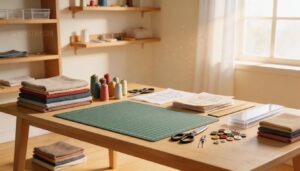
Before you buy a single bin or shift a table, clear the room by category so you can see what you really have. That first pass makes every storage decision easier and keeps the space from getting messy again.
If you need a simple setup, this budget-friendly fabric organization guide covers bins, labels, and lighting that actually help.
The next tips show you how to sort things in a simple, workable way.
Use Keep, Donate, and Toss Piles
Start by using three labeled bins: keep, donate, toss. This Pile Placement Strategy keeps clear work areas, while Decision Timing Rules stop overthinking.
Add a Visual Tally System to track progress, plus Donation Scheduling so items leave quickly. Follow Toss Safety Protocol for sharps.
These sewing room decluttering strategies, decluttering tips, labeling systems for craft supplies, sort by category, and DIY storage ideas.
Group Fabric, Tools, Patterns, and Projects
Once the toss pile is gone, sort what stays by job, not by whim:
- fabric organization by type, color coding system, and Seasonal Rotation
- tool organization by task
- pattern organization with Pattern Digitization and a Digital Inventory
- projects using Project Color Coding for project management for quilters
That simple map protects fabric with Fabric Preservation Techniques.
Create One Container for Current Works-in-progress
After sorting fabric, tools, patterns, and projects, give your current projects one home: a semi-transparent work-in-progress box with a clear front, Magnetic Lid, Internal Tray, Portable Handle, Checklist Pocket, and three Project Compartments.
It beats scattered clear bins, pairs with a label maker, facilitates project management for quilters, and turns DIY storage hacks into something calm, neat, and dependable today.
Store Daily-use Supplies Within Easy Reach
Once your project box is set, keep everyday tools close, so sewing stays smooth, not scavenger-hunt messy.
- Magnetic Strip, pegboard tool wall
- Arms Reach Bins, Desk Caddies
- Quick Grab Pockets, Portable Tray
- slim vertical trolley, underdesk pullout fabric bins, multitiered rolling cart, wall-mounted storage ideas for small sewing spaces
Keep scissors, chalk, pins, and snips where your hands expect them.
Label Every Bin, Drawer, and Basket
Although labels seem small, Consistent Label Fonts, Color-Coded Labeling, and Eye-Level Label Placement make bins easier to scan. A simple Labeling Inventory System facilitates labeling and categorizing sewing supplies, while label maker usage in craft rooms keeps wording uniform.
Add Laminated Label Durability, plus labeling and storage strategies, or labeling techniques using vinyl and cutting machines for labels that last.
Start With One Small Organizing Task
Start small, because one tidy corner calms the room fast and gives a win before clutter talks you out of it.
Start with one small corner; a quick win can quiet the clutter and calm the whole room
- Try Timer Sessions.
- Use a Micro Task Checklist.
- Follow the One Item Rule.
- Take Progress Photo Documentation.
- Do a Quick Surface Clear, then quick reset, labeling and storage strategies, small space sewing, DIY sewing storage projects, organizing sewing supplies.
Fabric and Pattern Storage
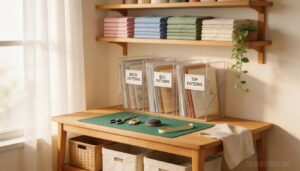
Once your room is decluttered, fabric and patterns need a setup that makes sense for how you actually sew. The right storage keeps things easy to see, easy to grab, and easy to put away again.
Here are a few simple ideas to help you set up that system.
Fold Fabric by Size, Type, or Color
Use Size-based folding so pieces match your shelves, then try Width-first stacking for steady piles.
Add Type-specific folding to keep wovens, knits, and delicate fabrics in line.
Finish with Color gradient stacking, Grain direction marking, folded fat quarters, color-coded bins, and fabric swatch banners for calm, easy fabric organization.
Use Clear Bins for Fast Fabric Access
Clear bins make fabric organization systems feel calm and fast, thanks to Transparent Bin Visibility and Quick Bin Retrieval. Uniform sizes help you spot color, grab fabric fast, and stack without wobble.
- Use Eye-Level Bin Placement
- Choose Bin Size Optimization
- Build Stacked Bin Organization
- Mix clear bins, clear storage drawers, clear vinyl pouches for fabric storage solutions.
Store Fat Quarters and Precuts Separately
Keep folded fat quarters in color coded bins by color family, your fat quarter rainbow wall, and give precuts their own Precut type grouping. That simple Fat quarter hierarchy protects bundle sizes and keeps planning easy.
Add Interleaving tissue, use Front-to-back rotation, and track it all in a Digital inventory. Precuts and Fabric Storage Systems make fabric storage solutions stick better.
File Patterns in Labeled Folders or Boxes
Patterns can vanish like socks in a dryer unless you give them a home.
For organizing sewing patterns, use labeled folders or clear-front boxes by type and size, with Alphanumeric Indexing and a Master Index Sheet. Add contents lists, tiny labeled drawers for extras, Digital Backup Integration, a Seasonal Rotation System, and Pattern Audit Schedule to keep pattern filing and labeling strategies reliable, making everything easy to find.
Use Shelving, Cubes, and Under-table Storage
Once folders and boxes are handled, look up and down. Check Shelf Load Capacity, use Adjustable Shelf Brackets, and Floating Shelf Reinforcement for floating acrylic shelves.
Try IKEA Kallax cubes, Modular Cube Configurations, and cube storage for sewing room organization. Add Under-Table Pull-Outs, a slim vertical trolley, or a hidden linen closet to stash bulk fabric without crowding your workspace.
Keep Scraps Sorted in Dedicated Containers
After shelves and cubes do the heavy lifting, give fabric cuttings a home: use scrap fabric bins or clear storage drawers with Scrap Bin Color Coding. Plastic bins with Ventilated Bin Lids help prevent musty surprises.
Add a Micro Scrap Bin, build in Seasonal Scrap Rotation, and favor Scrap Bin Mobility, so color-coded bins stay easy to sort and grab.
Organize Tools and Notions
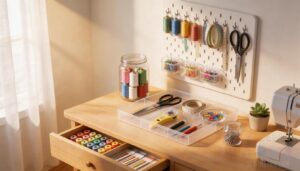
When tools and notions have a home, sewing feels easier and a lot less messy. You can grab what you need fast, keep tiny supplies from wandering off, and make better use of every inch of space.
Here are some simple storage ideas that help keep the little stuff tidy and close at hand.
Use Pegboards for Scissors, Rulers, and Hoops
Because tools multiply quickly, pegboards bring instant order: use a peg board for tool storage with Hook Spacing Guidelines, Color-Coded Pegs, and Magnetic Scissor Clips.
Add Vertical Ruler Racks so rulers stay flat, plus Foam Hoop Protectors on larger hooks.
This pegboard wall organizer makes pegboard wall usage in sewing rooms easy, with smart tool hanging solutions every single day.
Sort Pins, Needles, Bobbins, and Feet by Type
Once your pegboard is working, group like items together off the wall too: use Pin Material Segregation, Needle Type Grouping, a Bobbin Size Catalog, and Foot Shape Sorting for sewing machine feet.
Keep needles in Magnetic Storage Solutions or a pin cushion and storage case.
Separate bobbin thread and pin storage, so every swap stays quick, calm, and mistake-free daily.
Add Drawer Dividers for Small Sewing Supplies
Add small drawer dividers, and your sewing supplies stop roaming like loose change. Choose drawer dividers for sewing accessories with Acrylic Visibility, Adjustable Widths, and Non‑Slip Bases, so pins, clips, bobbins, and gauges stay put.
Modular Interlocking designs fit odd drawers, while Stackable Layers create extra sections.
Group sewing accessories by use, keep favorites up front, and label each space.
Store Buttons, Clips, and Trims in Jars
Because tiny supplies love to wander, corral them in clear containers. Transparent Jar Benefits are simple: you see color and size fast.
Use Magnetic Jar Labels, DIY Jar Dividers, and Stackable Jar Racks.
Try a mason jar notions rack, glass jars on wooden ledges, trim jars, glass jug button storage, buttons and embellishment sorting, plus Seasonal Trim Rotation for overflow.
Mount Thread Racks for Color-coded Storage
Because thread chaos sneaks up fast, thread racks give you instant control.
Use Vertical Bar Spacing around 1.5 to 2.5 inches, add Quick Release Pegs, and sort shades with Color Gradient Coding for easy color-coded thread organization.
Mounted Thread Storage works on walls, Under Shelf Mounts, or Ceiling Rack Options, pairing neatly with wall-mounted sewing storage ideas and color-coded bins.
Use Rolling Carts for Portable Tool Organization
Need tools that move with you? A rolling cart keeps scissors, feet, and notions right where you need them.
Choose portable rolling carts for sewing supplies with Swivel Wheels, Lockable Brakes, and an Aluminum Frame. Telescoping grips help on days, while Ball Bearing Slides keep drawers smooth.
Think multitiered rolling cart usage, three-tier rolling cart, or mobile sewing cart. Implementing central locking systems can further protect your tools from loss.
Improve Layout and Lighting
A well-set-up sewing room makes every project feel easier from the start. A smart layout and lighting choices can help you move better, see clearly, and use your space without crowding it.
Here are simple ways to set up your room so it works with you, not against you.
Create Sewing, Cutting, and Pressing Zones
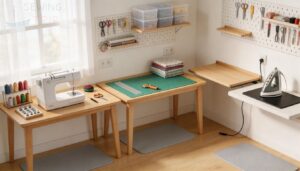
Chaos shrinks fast when each task gets its own home:
- window-side sewing table
- Rotary Cutter Station
- fold-down wall-mounted cutting station
- Heat-Resistant Press Mat
- sewing machine feet nearby
Use Zone Power Outlets, Anti-Fatigue Mats, and Zone Index Boards to define each spot for busy rooms. These wall-mounted storage ideas for small sewing spaces double as smart DIY sewing organization ideas too.
Arrange Furniture for Smooth Workflow
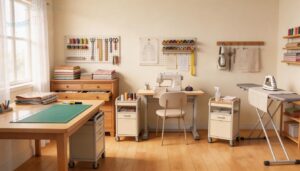
Start by arranging stations so you move left to right and keep prep, stitching, and pressing close without tangles.
| Goal | Placement | Benefit |
|---|---|---|
| Zoning Workstations | Aisle Clearance 36" | efficient sewing workspace design |
| Table Height | Rolling Carts | optimizing small workshop layouts for efficiency |
| Repurposing furniture for sewing supplies | Wall-mounted Racks | vertical storage solutions, space-saving ideas for craft rooms |
Use Wall Storage to Free Floor Space

After you set your workflow, lift storage up the walls.
Use pegboards, floating acrylic shelves, Hanging Rails, and Wall-Mounted Cabinets with Adjustable Shelf Brackets; add Magnetic Boards and Corner Wall Storage for true vertical storage solutions.
My favorite wall-mounted sewing storage ideas, especially wall-mounted storage ideas for small sewing spaces, bring:
- calm
- control
- breathing room without stealing an inch below.
Add Fold-down Stations for Small Rooms
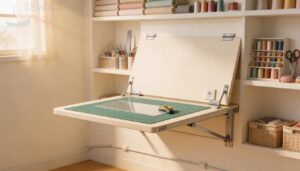
After using the walls, add a fold-down wall-mounted cutting station with sturdy Fold-down Mechanics, Safety Features, Cable Management, and Integrated Power.
Adjustable Height helps if you alternate tasks.
It opens fast, folds almost flat, and fits portable cutting stations for small spaces, wall-mounted sewing storage ideas, wall-mounted storage ideas for small sewing spaces, and space-saving ideas for craft rooms.
Place The Sewing Table Near Natural Light
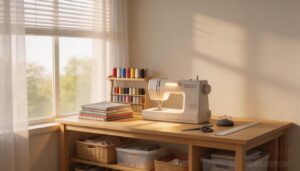
After that fold-down station, place your windowside sewing table where Window Orientation enhances Eye Comfort and Color Accuracy. North or east light usually works best, with Glare Reduction from sheers or blinds.
Build in Seasonal Light Adjustment as sun shifts, and treat lighting considerations for sewing, lighting for sewing, space planning, and your sewing room makeover as one connected plan.
Use Task Lighting to Reduce Eye Strain
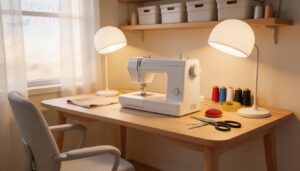
Window light helps, but steady task lamps save your eyes when daylight shifts. For smart sewing room organization, think home office ergonomics and practical lighting considerations for sewing:
- Color Temperature
- CRI Index
- Adjustable Brightness
- Cross Illumination
- Matte Diffusers
Good lighting for sewing also powers a budget-friendly sewing room makeover, keeping colors true and shadows low through long, detail-heavy stitching sessions.
Top 10 Sewing Room Organizers
The right organizer can make your sewing room feel completely different — less chaotic, more like a place you actually want to spend time in. Some products genuinely earn their spot on the shelf, and these ten are worth knowing about.
Here’s what made the cut.
1. Blulu Clear Acrylic Floating Shelf
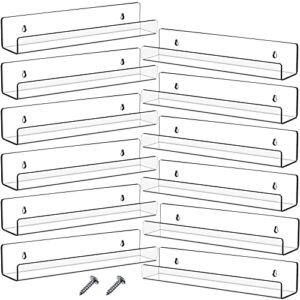
Want storage that barely looks like storage? The Blulu clear acrylic floating shelf keeps sewing essentials visible without making your wall feel crowded.
Each shelf is 14 inches long with a slim lip, so it works well for pattern booklets, mini jars, clips, or lightweight thread cones.
You get 16 shelves in one pack, which makes it easy to build vertical storage.
Just swap the included anchors for sturdier ones, remove the protective film fully, and keep heavier items off.
| Best For | People who want low-profile wall storage for lightweight sewing supplies, craft items, or small décor without making the space look busy. |
|---|---|
| Material | Clear acrylic |
| Format | Floating shelves |
| Placement | Wall-mounted |
| Color | Clear |
| Count | 16 shelves |
| Best Use | Wall display storage |
| Additional Features |
|
- Clear acrylic keeps supplies visible and gives the wall a clean, barely-there look.
- Comes with 16 shelves, so it’s easy to create a custom layout or use them across multiple rooms.
- Slim front lip helps keep lightweight items like clips, mini jars, and small booklets from sliding off.
- The protective film can be hard to remove and may make the shelves look cloudy until it’s fully peeled off.
- Included anchors are not the strongest, so better hardware is a smart upgrade.
- These shelves are best for light items only and may scratch or show wear over time.
2. Kathfly Clear Acrylic Floating Shelves
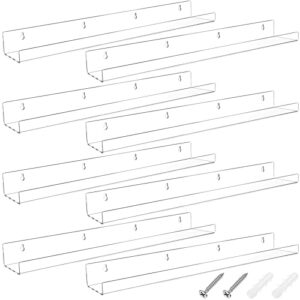
These Kathfly clear acrylic floating shelves are great when you need storage without the visual bulk. Each shelf is about 24 inches long and 3.5 inches deep, with a small front lip that helps jars, clips, and pattern booklets stay put.
The clear finish keeps your wall feeling open, which matters in a tight sewing room.
I’d use them for light items only and swap in sturdier anchors if your wall is tricky or your supplies are heavier than expected.
| Best For | Sewers, crafters, and other small-space organizers who want clean-looking wall storage for lightweight supplies without making the room feel crowded. |
|---|---|
| Material | Clear acrylic |
| Format | Floating shelves |
| Placement | Wall-mounted |
| Color | Clear |
| Count | 8 shelves |
| Best Use | Wall display storage |
| Additional Features |
|
- Clear acrylic design keeps the room looking open while letting you see stored items at a glance.
- Long, narrow shelves work well for lightweight sewing and craft supplies like jars, clips, booklets, photos, and small tools.
- Includes pre-drilled mounting holes, screws, and anchors for a quick, straightforward install.
- Best suited for light items since the load capacity is not specified and acrylic can crack under too much stress.
- Included wall anchors may not be strong enough for heavier supplies or all wall types.
- Acrylic can scratch or turn cloudy over time if cleaned with rough or abrasive materials.
3. Blibly Polyester Thread Bobbins Kit
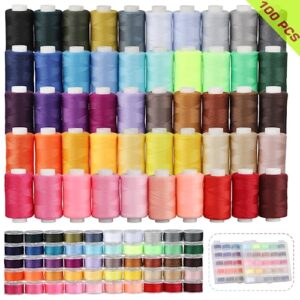
Color-ready storage can be a real time-saver, and the Blibly Polyester Thread Bobbins Kit proves it.
You get 50 polyester thread spools, about 500 yards each, plus 50 matching pre-wound bobbins in a tidy case, so setup feels much less fussy.
It works with most home machines, though not Singer Futura embroidery models.
I like it for beginners, quick repairs, and small-space sewing rooms, because the color range is broad, the bobbins stay organized, and you skip constant rewinding too.
| Best For | Beginners, hobby sewists, students, and anyone who wants a budget-friendly thread set with lots of colors and ready-to-use bobbins for everyday sewing and craft projects. |
|---|---|
| Material | Polyester thread |
| Format | Thread kit |
| Placement | Tabletop storage |
| Color | Multicolor |
| Count | 50 spools + 50 bobbins |
| Best Use | General sewing |
| Additional Features |
|
- Includes 50 thread spools and 50 matching pre-wound bobbins, which saves time and keeps colors organized.
- Works for both hand sewing and most domestic sewing machines, making it a flexible starter kit.
- Offers good value for the price, with a wide color range that suits repairs, apparel, home décor, and crafts.
- Some bobbin colors may not match perfectly, and a few may not pair exactly with the thread shade.
- The thread can feel slightly thick and fuzzy, which may cause snagging or tension issues on some machines.
- Not compatible with Singer Futura embroidery machines, and some higher-speed machines may see more breakage.
4. Simthread Polyester Embroidery Thread Set
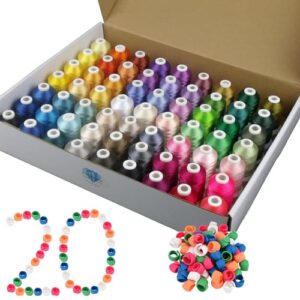
Need a thread set that keeps pace with your ideas? Simthread gives you 63 pre-colored polyester embroidery spools, each labeled with the matching Brother number, plus 20 reusable holders to keep the rainbow from turning into a jumble.
Each spool carries 550 yards of 40-weight trilobal polyester, so you get strong, glossy stitches with less breakage.
It’s especially handy if you embroider garments or gifts, since the thread is made to stay bright through washing, rubbing, and regular wear, too.
| Best For | Crafters and embroidery hobbyists who want a big, Brother-labeled color range, durable polyester thread, and better spool organization for frequent machine or hand embroidery projects. |
|---|---|
| Material | Polyester thread |
| Format | Embroidery thread set |
| Placement | Tabletop storage |
| Color | Multicolor |
| Count | 63 spools + 20 holders |
| Best Use | Machine embroidery |
| Additional Features |
|
- Includes 63 colors with matching Brother thread numbers, which makes color picking and machine coordination much easier.
- Each spool has 550 yards of 40-weight trilobal polyester, offering a nice mix of strength, sheen, and lower breakage during detailed stitching.
- Good for wearable projects because the thread is designed to hold its color through washing, rubbing, and regular use.
- Some users may find the thread quite thin, which can affect handling or the look of certain stitch styles.
- The random extra accessories may not be the ones you actually need for your specific projects.
- The large 63-spool set can feel bulky and pricier than necessary if you only need a small handful of colors.
5. Amazon Basics Metal Pegboard Wall Organizer
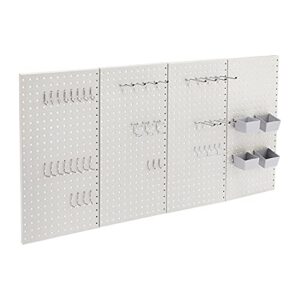
Wall space is gold in a sewing room, and this Amazon Basics metal pegboard helps you spend it wisely. The 48-piece kit gives you four steel panels, four storage bins, and 40 hooks, enough to lift scissors, rulers, hoops, and everyday tools off your table fast.
The gray, rust-resistant finish holds up well, and the layout is flexible. Just keep heavier items light to medium weight, since some hooks can wobble and drywall installs may need sturdier screws for security.
| Best For | Sewers, crafters, and DIY users who want an affordable wall organizer for light- to medium-weight tools and supplies in a small workspace. |
|---|---|
| Material | Steel |
| Format | Pegboard kit |
| Placement | Wall-mounted |
| Color | Gray |
| Count | 48-piece kit |
| Best Use | Tool organization |
| Additional Features |
|
- Durable steel panels with a rust- and scratch-resistant finish hold up better over time than many plastic organizers.
- Flexible 48-piece kit includes four panels, four bins, and 40 assorted hooks for customizing storage around your workflow.
- Helps clear table and counter space fast by moving scissors, rulers, hoops, and other everyday items onto the wall.
- Some hooks, especially single-prong styles, can feel loose or wobbly during use.
- Drywall installation may need longer screws for a more secure hold, especially because the panels sit slightly off the wall.
- Best for light- to medium-weight items only, so it is not a great fit for heavy tools or bulky equipment.
6. Jinei Pegboard Organizer Bins and Cups
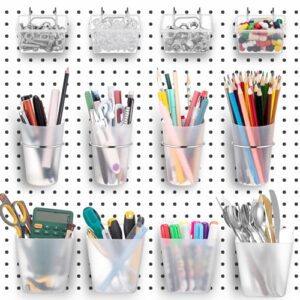
Small tools have a sneaky way of taking over, and that’s where Jinei pegboard bins earn their keep. This 24-piece set gives you 12 translucent cups and bins plus 12 metal hooks, so bobbins, needles, clips, and chalk pencils stay visible and close by.
They fit standard pegboards with 1-inch spacing, snap on without tools, and can be moved as your setup changes.
Just save them for lighter supplies, since heavy items can stress the plastic over time if overloaded.
| Best For | People who want an easy way to sort and keep light hardware, craft supplies, or small office items visible on a standard pegboard in a garage, workshop, craft room, or studio. |
|---|---|
| Material | Plastic and metal |
| Format | Pegboard bin set |
| Placement | Pegboard-mounted |
| Color | Translucent |
| Count | 24-piece set |
| Best Use | Small-item sorting |
| Additional Features |
|
- Includes a useful mix of 12 bins and cups plus 12 metal hooks for flexible storage.
- Translucent plastic makes it easy to see screws, nails, clips, and other small items at a glance.
- Fits standard 1-inch spaced pegboards and installs without tools, so it is simple to move and reconfigure.
- Pegboard is not included, so you need an existing compatible board.
- Plastic bins are better for lighter items and may crack or deform if overloaded.
- Setup can take a bit of time, and some bins may have slight color variation.
7. OSCHF Wooden Cube Bookcase
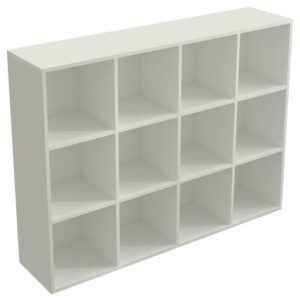
If pegboard bins handle the stuff, the OSCHF wooden cube bookcase takes care of the bulky middle ground.
You get a sturdy 3-tier unit with 12 compartments, including four lower cubes with doors, so you can hide mess and display the bits you like. At 118.3 cm wide and just 28.4 cm deep, it gives you storage without eating the room.
Use open cubes for fabric and books, closed ones for spare supplies, and anchor it if kids are around.
| Best For | People who want a sturdy, space-efficient cube bookcase for organizing books, bins, toys, linens, or office supplies in bedrooms, living rooms, kids’ rooms, closets, or home offices. |
|---|---|
| Material | Engineered wood |
| Format | Cube organizer |
| Placement | Floor-standing |
| Color | Warm white |
| Count | 12 cubes |
| Best Use | Bulk room storage |
| Additional Features |
|
- Sturdy full-size board frame helps reduce wobble and supports up to 240 lb total.
- Twelve 11-inch cubes give you flexible storage for books, baskets, toys, shoes, and décor.
- Melamine-coated engineered wood is water-resistant, scratch-resistant, and easy to wipe clean.
- Instructions can be a little confusing, so assembly may take extra attention.
- The included screwdriver is short, and a larger screwdriver or drill may make setup easier.
- The unit may look smaller in person than expected, so it’s worth double-checking the measurements before buying.
8. VIRETH HAUS Woven Storage Baskets
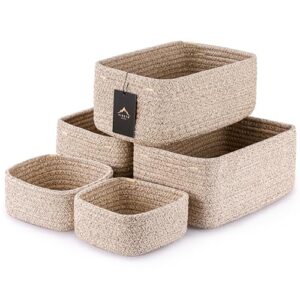
If the cube bookcase grips the big stuff, VIRETH HAUS woven storage baskets tidy up the loose ends. This five-piece set gives you three medium baskets and two small ones, all in soft cotton with hidden side grips, so they’re easy to grab without scraping shelves.
Use them for clips, trims, socks, cords, or project leftovers. They look calm, not cluttered, and the cream or black finish blends in nicely.
Just remember, they’re best for lightweight supplies, not heavy tools.
| Best For | People who want soft, attractive baskets to organize small everyday items like baby supplies, cords, socks, pantry goods, or craft clutter without making shelves look busy. |
|---|---|
| Material | Cotton fiber |
| Format | Basket set |
| Placement | Shelf or tabletop |
| Color | Cream or black |
| Count | 5 baskets |
| Best Use | Soft-item sorting |
| Additional Features |
|
- Five-piece set gives you a useful mix of sizes for sorting smaller household items.
- Soft cotton build with hidden side handles makes the baskets easy to move and gentle on shelves and surfaces.
- Neutral cream or black finish works well with farmhouse, boho, modern, or minimalist spaces.
- They ship flat, so they may need time, steaming, or light ironing to fully take shape.
- The soft textile construction is not ideal for heavy, bulky, or sharp-edged items.
- The small baskets have limited capacity, so larger storage jobs may need more than one set.
9. HOMCOM Foldable Wall Writing Desk Storage
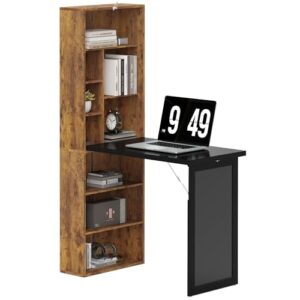
Once the soft baskets corral your loose bits, this HOMCOM foldable wall desk gives you a real workstation without eating the room. Closed, it sits just 7.7 inches deep, so it’s a smart pick for tight sewing corners.
Open it up, and you get a sturdy surface that holds up to 110 pounds, plus cubbies and adjustable shelves for patterns, thread, and tools. The front chalkboard is handy too, perfect for measurements, to-dos, or a quick cutting list close by.
| Best For | People in small apartments, dorms, or craft rooms who want a fold-out desk with built-in storage that disappears when not in use. |
|---|---|
| Material | Engineered wood |
| Format | Fold-out desk |
| Placement | Wall-mounted |
| Color | Black |
| Count | 1 desk unit |
| Best Use | Compact sewing station |
| Additional Features |
|
- Folds flat to just 7.7 inches deep, so it saves a lot of floor space in tight rooms.
- Work surface supports up to 110 lb and includes cubbies plus adjustable shelving for supplies and small equipment.
- Front chalkboard adds a handy spot for notes, measurements, reminders, or project lists.
- Shelves are fairly shallow, so larger binders, baskets, or bulkier supplies may not fit well.
- The compact size can feel smaller than expected, especially for taller users or bigger projects.
- MDF finish can show dust and fingerprints easily and is not ideal around harsh chemicals like acetone.
10. ShellKingdom Foldable Fabric Storage Cubes
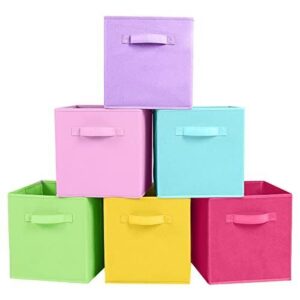
ShellKingdom fabric cubes can catch the overflow without making your room feel crowded. They fit standard cubbies, collapse flat when you don’t need them, and the side pulls make pull-out access easy.
I like them for scraps, fat quarters, patterns, or extra notions you want sorted, but still portable. The six-color set helps you organize by category at a glance, though they’re best for moderate loads, not anything sharp or especially heavy over many months.
| Best For | People who want an easy, colorful way to organize light to medium household, craft, nursery, or office items inside standard cube shelves. |
|---|---|
| Material | Non-woven fabric |
| Format | Storage cubes |
| Placement | Shelf or cubby |
| Color | Multicolor |
| Count | 6 cubes |
| Best Use | Cube shelf organization |
| Additional Features |
|
- Fits standard cube storage units and folds flat when not in use, so it is easy to store.
- Side handles make the bins simple to pull out of shelves, cubbies, closets, or desks.
- Six different colors help with quick visual sorting for clothes, toys, craft supplies, or office accessories.
- The slightly rectangular shape may leave small gaps in perfectly square cube compartments.
- Colors may look a bit darker, and the bins may feel slightly smaller, than some product photos suggest.
- Best for moderate loads only, since heavy or sharp items could wear out the fabric, handles, or cardboard support over time.
Frequently Asked Questions (FAQs)
How can I makeover my sewing room on a budget?
Start with a five-minute purge, then sort everything into keep, donate, and toss.
Use clear, labeled bins, wall storage, and a rolling cart to save space, cut clutter, and stretch every dollar further fast today.
How to organize a multi-craft room?
Sort supplies by craft category first, then use keep, donate, and toss piles to cut clutter.
Give each craft a labeled zone, keep daily tools within reach, and store active projects together in one container.
How to organize sewing room for kids?
Keep kids’ sewing spaces simple and safe: use clear low bins, labeled pegboards, woven baskets, and child-height surfaces.
Create easy zones for fabric, tools, and scraps, add light, and make cleanup quick with picture labels.
Best lighting options for small sewing room?
Good lighting makes a small sewing room feel twice as big—poor lighting makes it feel like a cave.
Aim for a 6500K daylight LED bulb with a CRI above 90 for accurate color matching. For added control, try adjustable brightness lighting to customize illumination for different tasks.
How to make a sewing room portable?
Choose rolling carts, foldable tables, and clear latching bins, then pack tools in foam-lined cases and fabrics in labeled totes.
Add clip-on LED lights, anti-slip liners, and lockable wheels so setup moves and works anywhere.
How to integrate technology in sewing room?
Measure twice, cut once: add smart machines with auto tension and app pattern transfers, use cloud boards and digital inventory, then finish with high-CRI task lights, cable management, and voice reminders to keep sewing smoother.
Eco-friendly organization solutions for sewing rooms?
Eco-friendly storage starts with bamboo or organic-cotton bins and modular bamboo shelves.
reusable jars, recycled-steel hooks, and foldable fabric cubes, then label everything clearly so supplies stay visible, tidy, and for longer daily use.
How do I organize sewing machine attachments and feet?
Keep attachments in a divided, labeled box, grouped by type and compatibility.
Park everyday files in an open tray near your machine, stash rarely used ones behind, and add a cabinet-door index for stress-free grabbing.
How can I prevent fabric from fading in storage?
Fade-fighting fabric care starts in darkness: store textiles in bins away from sunlight and heat, keep humidity near 40 to 50 percent, wrap them in acid-free tissue or breathable muslin, and inspect quarterly for fading.
Should I organize buttons by color or size?
Go with a hybrid system if you can: sort buttons by color first, then by size inside each color.
It gives you quick visual matching and precise picking, especially for repairs, garment sewing, and collections.
Conclusion
Imagine your sewing room as a serene oasis, where creativity flows and every tool has its home. With these sewing room organization ideas, you can transform your space into a haven where projects unfold with ease. Clear zones, smart storage, and a thoughtful layout come together to make sewing room organization ideas a reality.
Your newfound sense of calm and control will make every stitch a joy, and your sewing dreams will take shape with precision and purpose, always.
- https://sewcanshe.com/20-free-patterns-with-vinyl-for-sewing-bags-see-through-style/
- https://www.instagram.com/p/Cx8rgQ3xpUc/
- https://www.honeybearlane.com/2013/10/craft-room-reveal.html
- https://seekatesew.com/sew-sewing-room-tour/
- https://spunkyjunky.blogspot.com/2011/01/tutorial-tuesday-5-dollar-ribbon.html