This site is supported by our readers. We may earn a commission, at no cost to you, if you purchase through links.
A rotary cutter gliding across fabric feels smooth—until your mat starts to look like a battlefield of grooves and faded lines.
If you’ve ever wrestled with slipping rulers, inaccurate cuts, or a mat that warps like a pancake on a hot skillet, you know how much the right surface matters.
Choosing a fabric cutting mat isn’t just about picking something green and gridded; it’s about finding a tool that keeps your projects sharp, your workspace safe, and your workflow steady.
The right mat can turn frustration into precision, helping you cut with confidence and care every time.
Table Of Contents
Key Takeaways
- A self-healing, multi-layer PVC mat with non-slip backing and clear grid lines isn’t just a nice-to-have—it’s what keeps your cuts accurate and your blades lasting longer.
- Mat size and thickness should match your actual projects: a 5–6mm thick, 18×24-inch mat hits the sweet spot for most home sewing and quilting work.
- How you care for your mat matters as much as what you buy—store it flat, rotate it regularly, and clean it with mild soap or a vinegar soak to prevent warping and uneven wear.
- When your mat shows deep grooves, faded grid lines, or starts dulling your blade after just 10–20 cuts, it’s time to replace it—no amount of cleaning will fix a mat past its prime.
Key Features to Consider in Cutting Mats
When you’re choosing a fabric cutting mat, a few key features can make all the difference in your projects.
From size to self-healing properties, understanding what to look for starts with knowing your projects—this guide to rotary cutters and mats for sewing breaks it down clearly.
It’s worth knowing what to look for before you buy.
Let’s walk through the most important details you should consider.
Self-healing Surface Technology
Precision matters, and a self-healing cutting mat is your best ally for clean, accurate cuts. Its layered PVC surface absorbs shallow blade strokes, then springs back—so grooves fade and fabric stays flat. This Healing Mechanism protects blades, boosts Mat Longevity, and keeps Surface Durability high.
A self-healing cutting mat absorbs every blade stroke and springs back, protecting your blades and keeping fabric perfectly flat
- Cuts disappear for smooth, uninterrupted work
- Blade Protection reduces replacement costs
- Material Quality and Durability guarantee lasting performance
This also helps to extend blade life.
Grid Lines and Measurement Markings
Good grid lines are what turn a cutting mat into a real workhorse. Look for clear Grid Patterns in both inches and centimeters, plus Angle Guides at 30, 45, and 60 degrees for bias cuts.
Strong Line Visibility and Scale Accuracy mean fewer measuring mistakes. On a Self‑Healing cutting mat, crisp Measurement Markings stay readable long‑term, keeping your cuts consistently spot‑on.
Non-slip Backing and Stability
Even the sharpest rotary cutter can’t save you if your mat keeps sliding around. That’s where nonslip backing truly earns its place. Look for these stabilizing features:
- Foam Backing or Silicone Grip underneath for Work Surface Protection
- Double‑Sided Stability with Weight‑Based Stability from heavier multi-ply mats
- Rotating Lock mechanisms for Material Handling and Safety at any angle
A solid NonSlip Base means your hands stay focused — not chasing a shifting mat. Choosing a self‑healing cutting mat ensures the surface closes after cuts, prolonging durability.
Durable Material Composition
When your mat stays put, you can focus on what really matters—material composition. Multi-layer PVC with a high-density core resists deep grooves, while a surface polymer blend keeps cuts smooth. Thermal UV stability and edge bonding strength mean your mat won’t warp or peel.
Here’s a quick look at how these features stack up:
| Feature | Benefit | Feeling |
|---|---|---|
| Multi-layer PVC | Lasts longer | Confident |
| High-density Core | Stays flat | Secure |
| Surface Polymer Blend | Smooth cuts | Satisfied |
| Thermal UV Stability | No warping | Relieved |
| Edge Bonding Strength | No peeling | Protected |
Choosing The Right Cutting Mat Size
Choosing the right cutting mat size makes all the difference in how smoothly your projects come together.
It’s about finding a mat that fits your workspace and serves your creative needs.
Let’s look at the main factors to help you narrow down your options.
From budget and brand reputation to stitch versatility, these are the details that separate a frustrating buy from a mechanical sewing machine that truly holds its value.
Common Mat Sizes for Sewing and Quilting
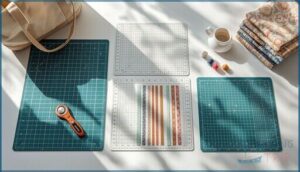
Ever wondered why cutting mat size and thickness matter so much in sewing and quilting? Mini travel mats, like 9×12 inches, slip easily into your tote.
Block cutting dimensions—12×18 or 18×24—keep fabric steady for precise strips. Strip length options, garment layout sizes, and rotating mat standards (8×8 or 12×12) help you match your mat to every project’s demands.
Workspace Considerations
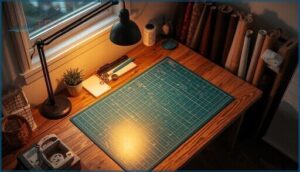
With workspace setup, think beyond just Cutting Mat Size and Thickness.
Table Height matters—aim for elbow level to protect your back.
Lighting Quality shapes visibility, so add a lamp if needed.
Ventilation Needs help with mat odors, especially in small rooms.
Storage Layout and Surface Stability keep mats flat and safe, weaving ergonomic design and productivity into your workstation organization.
Matching Mat Size to Project Needs

For any sewing or quilting project, matching Cutting Mat Size and Thickness to your needs is key. Think about Project Scale Guidance—are you cutting tiny patchwork or full garment pieces? Consider Fabric Type Compatibility and Pattern Length Planning. Here are three practical tips:
- Use case: Choose based on project size.
- Quilting Block Dimensions: Match mat to block.
- Multi‑Mat Configurations: Combine mats for flexibility.
Understanding Cutting Mat Thickness and Material
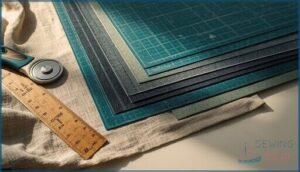
When you’re choosing a cutting mat, thickness and material make a real difference in how well it holds up and feels to use.
Not all mats are created equal, especially regarding durability and comfort.
Here’s what to look for as you compare your options.
Recommended Thickness for Durability
Thickness is the quiet backbone of any self-healing cutting mat — and it shapes everything from blade compatibility to warp resistance.
A 5–6mm mat hits the sweet spot for most sewing projects, balancing healing speed, durability, and the portability tradeoff you’ll face hauling it to workshops.
For cost efficiency in cutting mat selection, here’s how thickness stacks up:
| Thickness | Durability & Healing Speed | Best Use |
|---|---|---|
| 3mm | Faster wear, slower healing | Travel, light trimming |
| 5mm | Strong blade compatibility, quick recovery | Home studio, classes |
| 6mm | Best warp resistance, long lifespan | Busy workspaces |
| 7mm+ | Deep gouge resistance, slower healing | Heavy-duty cutting |
| Under 3mm | Prone to nicking blades quickly | Not recommended |
Material Quality and Longevity
Material quality is the anchor of cutting mat selection—think of polymer layering and multi‑layer construction as your insurance against deep blade scars. High PVC density boosts self‑healing vinyl performance, while UV resistance and thermal stability keep mats flat and reliable.
For your use case, prioritize mats with sturdy cores and layered surfaces; they’ll outlast basic vinyl and stay accurate.
Odor and Comfort During Use
Ever noticed how a mat’s scent can linger on your fabric, even after washing? Odor Control and Scent Transfer matter, especially with thick PVC mats.
For comfort, look for Ergonomic Design, non‑slip backing, and Self‑Healing Vinyl. If you’re sensitive, choose Phthalate‑Free, CA65 compliant mats. Here’s what to prioritize:
- Odor Control and Scent Transfer
- Comfort Factors and User Ergonomics
- Mat Maintenance and Material Quality
Maintaining and Caring for Your Cutting Mat
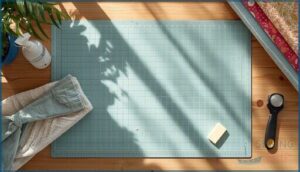
A good cutting mat is an investment, and like any tool you rely on, it needs little attention to stay in top shape. The way you clean, store, and use it makes a real difference in how long it lasts.
Here’s what you need to know to keep yours cutting smoothly for years to come.
Cleaning Methods for Long-lasting Mats
Keeping your cutting mat in top shape calls for a bit of routine care. Start by rolling away loose threads with a lint roller, then tackle stubborn fibers using specialized fiber removal tools.
For deeper cleaning, a Vinegar Soak or Mild Soap Scrub works wonders on selfhealing vinyl. Always finish with proper drying techniques—thoroughly towel dry, then air dry flat for lasting material quality.
Storage Tips to Prevent Warping
Once your mat is clean, smart storage keeps it working for you. Store cutting mats flat—never upright—so edges don’t curl. Crafting storage and organization matter:
- Control humidity (30–50%) to avoid warping.
- Maintain steady temperature—no hot windows or cold garages.
- Place a flat weight on top, allowing gentle air circulation beneath for reliable workstation setup and organization.
Rotating Mats to Avoid Uneven Wear
Even with proper storage, your self-healing cutting mat wears unevenly if you always cut in the same spot.
Think of wear distribution like rotating tires — turning your mat a quarter turn each session spreads the load across all four quadrants.
Use grid lines to track your rotation frequency, mark orientation underneath with a pencil, and consider a turntable for trimming blocks with your rotary cutter.
Signs It’s Time to Replace Your Mat
Rotation helps, but sometimes a mat simply reaches the end of its life. Here’s how to know when it’s time to let go:
- Deep grooves steer your blade off course, skewing cuts by degrees
- Faded grids make accurate seam allowances nearly impossible
- Blade dulling happens after just 10–20 cuts instead of the usual 50–100
- Lint buildup blocks your self healing cutting mat from closing properly
- Warped edges rock during cutting, shifting fabric unpredictably
When thickness and wear compromise your use case, replace it.
Top Fabric Cutting Mats for Sewing Projects
With so many cutting mats out there, it helps to know which ones truly stand up to daily sewing.
I’ve gathered a handful of top choices that balance durability, accuracy, and ease of use.
Here’s a look at some reliable mats that can make your projects smoother from start to finish.
1. Olfa 17×24 Folding Cutting Mat
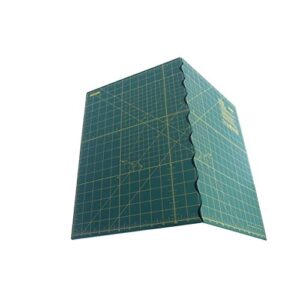
The OLFA FCM-17×24 is a smart pick if you want portability without sacrificing workspace. It unfolds to a generous 17" x 24" cutting surface, then folds down to half that size — making it easy to tuck into a bag for class or a sewing retreat.
The wavy fold line flattens out completely, so you won’t catch fabric threads or lose accuracy when cutting over it.
At 2.5mm thick with a self-healing surface and non-slip backing, it’s built to last.
| Best For | Quilters, sewers, and crafters who need a reliable cutting mat they can easily take to classes, retreats, or small workspaces. |
|---|---|
| Material | Crystal |
| Size | 6 oz capacity |
| Thickness | Not specified |
| Color | Crystal |
| Weight | Not specified |
| Best Use | Cold drinks |
| Additional Features |
|
- Self-healing surface holds up well over time, even with heavy rotary cutter use
- Folds in half for easy transport without losing cutting accuracy when unfolded
- Grid lines make measuring and squaring up fabric quick and easy
- One-sided only, so you can’t flip it when one side gets worn
- Can have a noticeable chemical smell right out of the box
- At 17" x 24", it’s a tight fit for larger quilting projects
2. Fiskars Rotating Self Healing Cutting Mat
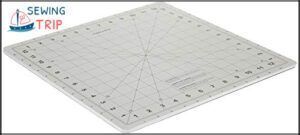
Precision meets convenience with the Fiskars Rotating Self Healing Cutting Mat. You’ll appreciate its 360-degree rotation, which lets you trim quilt blocks or applique shapes without shifting your fabric—especially useful for projects needing angled cuts.
The multi-layered PVC surface heals after every blade pass, so you won’t find deep grooves slowing you down. Its compact 8" x 8" platform fits easily in a tote, and the clear measurement grid, including bias lines, makes accurate cutting straightforward for patchwork, sewing, and travel.
| Best For | Quilters, sewers, and crafters who need accurate angle cuts and want a portable mat that protects their work surface. |
|---|---|
| Material | Self-healing composite |
| Size | 17″ x 24″ |
| Thickness | 2.5mm |
| Color | Green/Yellow |
| Weight | 0.65 kg |
| Best Use | Quilting & crafts |
| Additional Features |
|
- Self-healing surface holds up to repeated cuts without leaving grooves that mess up your work
- Rotates 360 degrees so you can cut at any angle without moving your fabric
- Compact and light enough to toss in a bag for classes or travel
- The actual gridded cutting area is 12"x12", not the full 14" the size suggests
- Rotation can feel less smooth compared to pricier mats on the market
- The gray color isn’t everyone’s favorite
3. OLFA Self Healing Rotary Cutting Mat
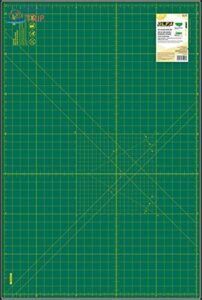
When you need a workhorse mat for daily sewing, the OLFA Self Healing Rotary Cutting Mat stands out. Its triple-layer surface quietly reseals after each rotary cut, so you won’t battle rough spots or dust traps.
The double-sided design gives you both a solid green area and a yellow grid for precise measurements, making it easy to switch between tasks.
At 24" x 36" and 1.5mm thick, it’s built for garment and quilt projects, protecting your workspace and extending blade life.
| Best For | Quilters, sewists, and crafters who use rotary cutters regularly and need a large, reliable cutting surface for precise fabric work. |
|---|---|
| Material | Plastic |
| Size | 14″ x 14″ |
| Thickness | 0.25″ |
| Color | Gray |
| Weight | 1.8 lbs |
| Best Use | Quilting & sewing |
| Additional Features |
|
- Self-healing surface reseals after cuts, keeping things smooth and extending the life of your rotary blades
- Double-sided design — grid lines on one side for precise measuring, clean surface on the other for general cutting
- Generous 24" x 36" size handles big quilting and garment projects with ease
- Not compatible with fixed blade utility knives, so it’s rotary cutters only
- Can show cut marks over time despite the self-healing feature, and it’s on the thinner side at 1.5mm
- Needs to be stored flat and away from sunlight, or it may warp
4. Adir Professional Self Healing Cutting Mat
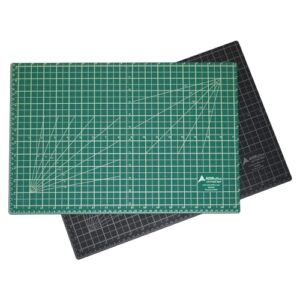
If you want a mat that pulls double duty, the Adir Professional Self Healing Cutting Mat is worth a serious look. At 36 by 48 inches and 3mm thick, it’s one of the largest options available — roomy enough for full garment layouts or big quilt projects.
The dual-color design gives you a green side for general cutting and a black reverse for working with lighter fabrics.
Angle guides at 45 and 60 degrees make diagonal cuts much more accurate and less stressful.
| Best For | Artists, quilters, and hobbyists who need a large, versatile cutting surface for fabric, leather, paper, and other materials. |
|---|---|
| Material | Self-healing composite |
| Size | 24″ x 36″ |
| Thickness | 1.5mm |
| Color | Green/Yellow |
| Weight | 2.3 lbs |
| Best Use | Quilting & sewing |
| Additional Features |
|
- Huge 36×48" surface gives you plenty of room for big projects like garment layouts or quilts
- Dual-color design with angle guides makes precise cuts easier on both light and dark materials
- Self-healing 3mm vinyl holds up well over time without showing every cut mark
- Some customers received damaged or wrong-size mats, so quality control can be hit or miss
- The print on the black side is tough to read, especially in low light
- Solvents like lacquer thinner can wipe out the printed grid — so keep chemicals away from it
5. ALVIN Self Healing Cutting Mat 36×48 Green Black
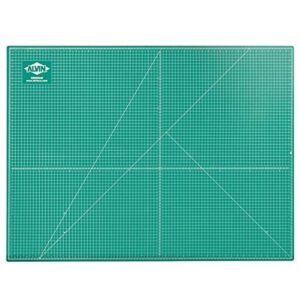
The ALVIN Self Healing Cutting Mat gives you serious real estate to work with — 36 by 48 inches of smooth, self‑healing vinyl that accommodates everything from garment layouts to large quilt panels without flinching.
The double‑sided green and black design means you’re never fighting glare or losing contrast on lighter fabrics.
At 3mm thick with a 0.5‑inch grid, 45 and 60‑degree angle guides, and a non‑stick surface that shrugs off spills, it’s built for the kind of daily use that would wreck a cheaper mat fast.
| Best For | Quilters, crafters, and graphic artists who need a large, durable work surface for daily cutting projects. |
|---|---|
| Material | PVC |
| Size | 36″ x 48″ |
| Thickness | 3mm |
| Color | Black/Green |
| Weight | 2 lbs |
| Best Use | Multi-purpose crafts |
| Additional Features |
|
- Huge 36×48 workspace — plenty of room for big fabric layouts or quilt panels
- Double-sided green and black surface cuts down on glare and keeps contrast sharp
- Built-in grid with 45 and 60-degree guides makes accurate cuts way easier
- Deep cuts won’t always heal fully, so heavy daily use can leave permanent marks
- Pricier than your average cutting mat
- Some users notice a chemical smell right out of the box
6. G+ True A1 Double Sided Cutting Mat
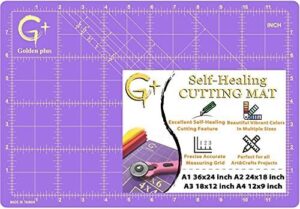
The G+ True A1 mat pulls double duty in the best way. At 24 by 36 inches, it’s large enough for garment layouts and quilt blocks, and flipping it over gives you a fresh surface with metric centimeter grids on one side and imperial inch markings on the other. That’s genuinely useful when you’re switching between patterns.
The 3-ply PVC construction self-heals quickly, the non-slip backing keeps things steady, and the eco-friendly, odorless formula means you can work for hours without any discomfort.
| Best For | Sewists, quilters, and crafters who need a large, reliable cutting surface for both metric and imperial projects. |
|---|---|
| Material | Vinyl |
| Size | 48″ x 36″ |
| Thickness | 3mm |
| Color | Green/Black |
| Weight | 9 lbs |
| Best Use | Graphic arts & crafts |
| Additional Features |
|
- Big 24 x 36" surface gives you plenty of room for garment layouts and quilt blocks
- Double-sided with grid and diagonal lines, so you can flip it over for a fresh cutting surface
- Self-healing and non-slip, which means it holds up well and stays put while you work
- May arrive folded or curled from shipping, so you might need to flatten it out before use
- Only comes in one size, which could be limiting if you need something smaller or larger
- The slightly textured surface won’t work for everyone depending on the project
Frequently Asked Questions (FAQs)
What to look for in a cutting mat?
cutting mat as your silent partner — it either helps you work clean or fights you every step.
Look for a self-healing surface, clear grid lines, non-slip backing, and solid thickness.
What is a good size for a cutting mat?
For most sewing and quilting projects, an 18 by 24 inch mat hits the sweet spot. It’s large enough for folded fabric cuts, yet compact enough to fit a standard sewing desk comfortably.
Can I use a cutting mat outdoors?
You can, but keep it brief.
Heat warps the surface, UV fades the grid lines, and moisture makes fabric slip.
A shaded table for a short session is fine — just bring it back inside after.
Are cutting mats safe for children to use?
Cutting mats are safe for children when you choose non-toxic, PVC-free options and supervise use, especially with rotary cutters.
For example, lab-tested mats suit kids as young as three, but proper technique and adult oversight are essential.
Do cutting mats work with all blade types?
Not exactly.
Self-healing mats work best with sharp rotary cutters and craft knives held at 90 degrees. Serrated blades tear the surface permanently, and scissors can slice straight through — both cause damage that no mat can recover from.
Can cutting mats be used for paper crafting?
You can absolutely use fabric cutting mats for paper crafting.
Their self-healing surfaces handle repeated cuts from craft knives or rotary blades, and the grid lines make card-making, scrapbooking, or trimming paper layouts much easier and more precise.
How do I remove stubborn stains from my mat?
surface prep — lift lint, blot gently, then treat grease with dish soap, ink with rubbing alcohol, and stubborn marks with a damp Magic Eraser.
Always rinse and air-dry flat.
Conclusion
Think of your cutting mat as the foundation of a house—everything you build rests on it. Knowing how to choose a fabric cutting mat means investing in accuracy, safety, and projects that actually turn out the way you imagined.
The right size, thickness, and care routine keep your workspace reliable cut after cut.
Treat your mat well, and it’ll quietly do its job, letting your creativity take center stage every single time.
- https://rhinocuttingmat.co.uk/self-healing-cutting-mat-and-why-do-you-need-one/
- https://floormatreview.com/self-healing-cutting-mats-how-do-they-work/
- https://crystalrubber.co.uk/blogs/news/cutting-mats-guide
- https://www.dahle.com/cutting-mats
- https://www.fibre2fashion.com/industry-article/8312/self-healing-cutting-mats?amp=true