This site is supported by our readers. We may earn a commission, at no cost to you, if you purchase through links.
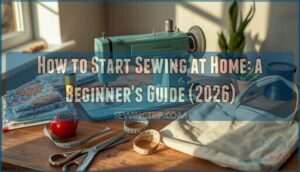
Your grandma’s sewing machine has been gathering dust in the basement for three years—and honestly, it intimidates you a little. That whirring contraption with its mysterious dials and that tiny threading pathway seems designed to mock beginners.
But here’s the truth nobody tells you: starting to sew at home doesn’t require mastering a complex machine on day one, and you definitely don’t need a craft room that looks like a fabric store exploded. What you need is about $50 worth of basic supplies, one simple project that won’t make you want to throw scissors, and the willingness to mess up a few seams before you nail them.
Once you’ve got those three things locked down, you’ll discover that sewing isn’t some mystical skill reserved for crafty Pinterest moms—it’s actually a pretty straightforward way to fix what’s broken, create what you want, and stop paying someone else forty bucks to hem your jeans.
Table Of Contents
Key Takeaways
- You only need about $50 in basic supplies (fabric shears, cotton-poly thread, pins, measuring tape, and fabric markers) plus one beginner-friendly machine to start sewing—no craft room explosion required.
- Cotton fabric is your best friend as a beginner because it’s stable, forgiving, and won’t fight you at every seam, unlike slippery satins or stretchy jerseys that’ll frustrate you into quitting.
- Prewashing fabric isn’t optional—it prevents up to 10% shrinkage that can ruin hours of work, removes skin-irritating chemicals, and reveals the fabric’s true behavior before you make that first cut.
- Master three foundation stitches (straight stitch at 2.5-3.5mm, zigzag for seam reinforcement, and backstitch for locking seam ends) on scrap fabric first, then jump into simple projects like envelope pillow covers that skip zippers entirely.
Essential Sewing Tools for Beginners
You don’t need a million tools to start sewing—just a handful of essentials that’ll actually make your life easier.
Once you’ve got the basics down, you can try beginner-friendly hand stitches that work for repairs, hems, and simple projects.
Think of it like cooking: sure, you could fill your kitchen with gadgets, but really you just need a good knife, a cutting board, and a decent pan.
Here’s what belongs in your starter kit and why each piece matters.
Must-Have Sewing Supplies
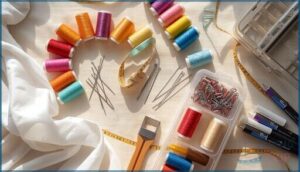
Your creative arsenal starts with thread—grab an all-purpose cotton-poly blend in weights 40 and 50 for adaptable weaving and garment seams. Add a full-size sewing needle pack (sharps in sizes 3–12), plus a few extra bobbins for quick thread changes on your sewing machine.
Toss in steel pins, a 60-inch measuring tape, and fabric markers that wash out easily. Store everything in a clear plastic box so sewing notions stay visible and ready when inspiration strikes.
Choosing Quality Fabric Shears and Seam Rippers
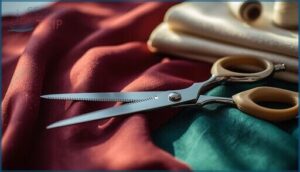
Your first fabric shears can feel like choosing a lightsaber—because cheap ones will betray you mid-cut. Look for stainless steel blade materials that resist rust through at least 100 cutting cycles. Micro-serrated edges grip slippery silks without sliding, while ergonomic grips prevent that hand-cramp misery during long sessions.
Quality fabric shears with stainless steel blades and ergonomic grips transform cutting from frustrating struggle into precise, comfortable craftsmanship
Here’s what transforms beginners into confident cutters:
- High-carbon blades stay sharp longer on cotton and wool blends
- Hollow-ground edges slice through fabric like butter
- Ambidextrous designs work for lefties breaking free from righty tyranny
- Sharp seam rippers undo mistakes without punishing the fabric
Keep those shears sacred—paper is their kryptonite. When choosing your first tool, consider helpful advice on.
Pins, Measuring Tools, and Fabric Markers
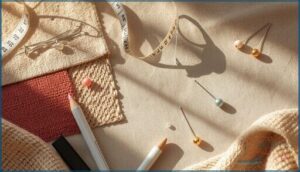
With your shears primed, you need pins, measuring tape, and fabric markers to hold everything steady. Glass-head pins won’t melt under heat—ball-head varieties protect delicate knits from snagging.
A 60-inch measuring tape marked in both inches and centimeters handles curves and hems. Water-soluble fabric markers vanish after stitching, while chalk brushes away cleanly. Test markers on scraps first—nobody wants surprise stains after finishing their masterpiece.
How to Choose Your First Sewing Machine
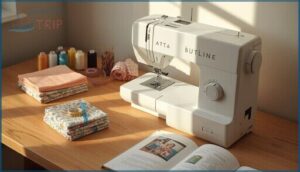
Your first sewing machine doesn’t need to do everything—it just needs to do the basics well while you’re learning the ropes. The right choice depends on how you like to learn, what you want to make, and how much tinkering you’re willing to do when things go sideways.
Let’s break down what actually matters when you’re standing in that aisle (or scrolling through pages) trying to pick your first machine.
An easy-to-use sewing machine gives you room to grow without overwhelming you with features you won’t touch for months.
Key Features for Beginners
Your first sewing machine doesn’t need to be fancy—it just needs to work with you, not against you. Look for machines under 10 pounds so you can move them around your sewing space without throwing out your back.
A built-in stitch library with at least straight, zigzag, and backstitch will cover most beginner projects. Speed control is non-negotiable—you’ll want to slow things down while mastering basic sewing techniques.
Bright LED lighting helps you see what you’re doing, and a drop-in bobbin system means less frustration when you’re learning to sew.
Mechanical Vs. Computerized Machines
You’re staring at two paths: mechanical machines with their honest dials and gears, or computerized models flashing touchscreens at you like a spaceship dashboard. Here’s the real machine comparison—mechanical units give you direct control over thread tension and sewing speed through physical adjustments, letting you feel exactly what’s happening under the needle.
They’re bulletproof for sewing for beginners because there’s less to break. Computerized machines? They’ll hold your hand with automatic settings and remember your favorite stitches, but when something goes sideways with sewing machine operation, you might need a technician instead of a screwdriver.
Stitch quality stays solid on both—it’s about motor types and your skill, not bells and whistles. Choose based on whether you want straightforward reliability or tech-assisted convenience.
Basic Maintenance and Troubleshooting Tips
Regular sewing machine maintenance beats emergency repairs every time—trust me on this. Wipe feed dogs daily, replace needles after four to eight hours of use, and check thread tension after every bobbin change to keep stitch quality consistent. When sewing machine troubleshooting becomes necessary, rethread your entire machine first since that fixes most hiccups with sewing machine operation.
Key sewing tools and supplies to monitor:
- Apply machine oil only to recommended points per your manual
- Clean lint from the bobbin area monthly for smooth bobbin care
- Test tension on scrap fabric before starting any fabric prep
Consistent care transforms sewing for beginners into confident creating.
Preparing Fabric for Your First Project
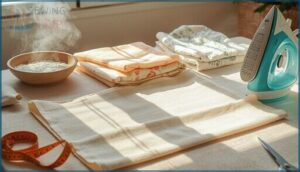
You can’t just grab any fabric off the shelf and start cutting—not if you want your first project to actually turn out.
The right prep work makes the difference between a finished piece you’re proud to show off and one that shrinks, puckers, or falls apart after the first wash. Let’s walk through the three essential steps that’ll set you up for success before you make that first cut.
Selecting Beginner-Friendly Fabrics
Choosing your fabric is where many beginners freeze—but think of it as picking your first surfboard, not performing open-heart surgery. Cotton fabric is the perfect gateway because it’s stable, forgiving, and won’t fight you at every seam. You’ll want fabrics that stay put while you’re learning to control your machine, and cotton blends deliver that security while remaining budget-friendly.
Smart fabric choices that set you up for success:
- Cotton poplin – Plain weave patterns create stability that resists fraying and forgives beginner mistakes
- Quilting cotton – Medium weight (around 120–150 g/m²) manipulates easily and presses flat with minimal effort
- Chambray – Looks impressive but behaves beautifully, hiding small seam imperfections in its texture
- Cotton flannel – Soft fiber choices add grip so fabric doesn’t slip during cutting
- Linen blends – Breathable weave patterns that iron flat despite initial wrinkles
Skip slippery satins and stretchy jerseys until you’ve nailed the basics.
Washing and Ironing Fabric Before Use
Prewashing isn’t optional—it’s your shield against fabric shrinkage that can ruin hours of careful stitching. Those fresh-from-the-bolt fabrics carry manufacturing chemicals that irritate skin and mask true color, so toss them in the wash before you cut a single piece. Prewash benefits include revealing early shrinkage (sometimes up to 10%) and preventing dye transfer during your fabric crafting journey.
| Fabric Preparation Step | Method | Why It Matters |
|---|---|---|
| Prewash | Warm water, mild detergent | Removes chemicals, prevents shrinkage |
| Fabric softening | Skip for cotton fabric | Maintains natural stiffness for structure |
| Ironing tips | Press while damp, correct heat | Creates smooth base for accurate cutting |
| Steaming techniques | Gentle alternative for delicates | Refreshes without direct heat contact. |
Your fabric selection just became predictable and stable—exactly what you need in this sewing for beginners guide.
Cutting and Marking Fabric Accurately
Imagine chopping vegetables with a butter knife—that’s what dull scissors do to your fabric, creating frayed edges that sabotage even the simplest project. Fabric shears dedicated solely to fabric (never paper!) give you clean cuts that respect the fabric grain, which runs parallel to the selvage and keeps your pieces from twisting after you wash them. Your cutting tools deserve a permanent spot in your sewing tools and supplies lineup, alongside a measuring tape for double-checking dimensions and marking methods like tailor’s chalk that vanish when you need them gone.
- Pin your pattern along the true grain to prevent seams from puckering and hems from hanging crooked
- Maintain consistent seam allowance (usually 5/8 inch) by measuring twice before each cut
- Use fabric stabilization techniques on stretchy materials to keep edges from wiggling during fabric preparation
- Keep rotary cutters perpendicular to your cutting mat for straight, confident lines
- Mark notches and dots immediately after cutting for stress-free fabric selection and assembly later
Basic Sewing Techniques Every Beginner Should Learn
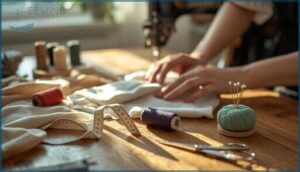
Before you tackle your first big project, you need a solid foundation in the techniques that’ll save you from frustration—and a lot of wasted fabric. Think of these skills as your sewing toolkit: once you’ve got them down, you can build almost anything.
Let’s start with the three fundamental techniques that every beginner should practice until they feel like second nature.
Threading a Needle and Tying Knots
Threading a needle feels like a rite of passage—once you nail it, you’re officially a sewist. Cut about 18 inches of thread, moisten the tip (no shame in that old trick), and guide it through the needle eye with steady hands. Pull 2 to 3 inches through to prevent tangling as you start. Now tie a simple square knot at the longer end for security, or use a double knot if your fabric’s slippery.
Polyester thread resists stretch and works beautifully for most projects, while cotton thread suits natural fibers perfectly.
| Element | Beginner-Friendly Choice | Why It Matters |
| Needle sizes | Medium (size 7-9) | Sharp eye accepts standard threads easily |
| Knot variants | Square or double knot | Creates secure starting point without bulk |
| Thread types | Polyester or cotton | Matches fabric weight and prevents seam failure |
| Threading tools | Built-in needle threader | Aligns thread entry for smoother passage |
Master these hand sewing techniques, and you’ll gain freedom to repair, create, and customize anything.
Practicing Straight, Zigzag, and Backstitch
Once you’ve threaded your needle like a pro, it’s time to build muscle memory with the three stitches that’ll liberate you from store-bought everything.
Start with the straight stitch—set your stitch length between 2.5 and 3.5 millimeters for sturdy seams. Guide your fabric gently without pulling, letting the machine handle thread control while you focus on alignment. Next, try a zigzag stitch with 2 to 4 millimeters width—perfect for seam reinforcement and preventing frayed edges. Finally, master the backstitch by reversing 2 to 3 stitches at each seam end for rock-solid locking.
Practice these hand sewing techniques and machine calibration on scrap fabric first—you’ll nail fabric tension faster than you think.
Understanding Seam Allowance and Pattern Markings
Now that you’ve mastered those foundational stitches, let’s crack the code on seam allowance and pattern markings—the secret language of garment construction.
That 5/8-inch seam allowance on most sewing patterns isn’t random—it gives you seam flexibility for adjustments and prevents fabric grain distortion.
Pattern markings like notches guide notch alignment so sleeves actually fit armholes. Transfer those dots and lines with your sewing tools before cutting, and you’ll nail sewing pattern alterations without second-guessing every seam.
Easy Sewing Projects to Build Your Skills
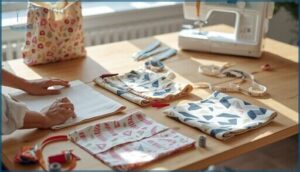
You’ve learned the basics—now it’s time to actually make something. The best way to build confidence is by choosing beginner-friendly projects that let you practice straight seams, accurate cutting, and following simple patterns without overwhelming yourself.
These four projects will take you from nervous first-timer to “hey, I actually made this” in no time.
Envelope Pillow Cover Tutorial
You’re about to break free from store-bought home decor—envelope pillow covers are your gateway to personalized, confident sewing. This beginner-friendly project skips zippers entirely, using overlapping back panels that create a clean closure while you master essential sewing techniques.
Here’s how to nail your first pillow cover:
- Fabric Selection – Cotton or linen works beautifully for beginners, giving you stability without wrestling stretchy material through your sewing machine
- Cutting Basics – Add 1/2 inch seam allowance around a 16×16 or 18×18 inch pillow form for perfect sizing
- Hem First – Press and stitch back panel edges before assembly for that polished look
- Corner Finishing – Trim excess fabric at corners, then use a turning tool to create crisp angles
- Final Assembly – Pin raw edges precisely, sew the perimeter, and flip right-side out
Your custom home decor ideas start here! For extra measurement help, refer to these useful.
DIY Scissor Holder Pattern
Now that you’ve conquered pillow covers, let’s tackle a scissor holder that protects your blades and tames workspace chaos in under an hour. Most scissor holder designs use a rectangular base with side wings—denim or canvas work brilliantly for fabric selection tips thanks to high abrasion resistance.
This scissor holder design accommodates everything from tiny embroidery scissors to 8-inch shears, while pattern template variations and sewing technique hacks like reinforced corner triangles prevent fraying. This DIY home decor staple doubles as a customized gift and sharpens your straight-seam skills beautifully.
Simple Coaster and Placemat Set
A coaster and placemat set proves you can create practical home decor while mastering straight-seam accuracy—think of it as your fabric selection bootcamp. Grab 6-ounce cotton for stability, layer with light batting for cushioning, then practice those sewing techniques on a forgiving canvas.
- Cut coasters to 6×6 inches and placemats to 12×18 inches using your rotary cutter
- Add fusible interfacing between layers to prevent stretching during assembly
- Topstitch around edges at 1/4 inch for that polished, professional finish
- Experiment with coordinating prints to build a cohesive set
Your sewing machine will love this beginner-friendly project—and your coffee table will thank you.
Tips for Following Beginner Patterns
Read the entire pattern envelope before cutting a single thread—this fifteen-minute investment prevents hours of seam ripping later.
Pattern reading teaches you to spot notches, grain lines, and seam precision markers that guide fabric layout.
Beginner sewing patterns include stitch guidance and notion management lists, so treat each instruction sheet like a roadmap.
These sewing techniques and sewing tips and tricks turn frustration into finished garment construction you’ll actually wear.
Frequently Asked Questions (FAQs)
How do you learn sewing if you’re a beginner?
You’ll build real skills through online tutorials and sewing communities—hands-on practice beats theory every time.
Start with beginner patterns, join local sewing classes for fabric basics, and watch those techniques click into place.
How do you start a sewing project if you’re a beginner?
Start with a pillow cover or simple coaster—cotton’s forgiving and stable.
Set up your sewing space with tools nearby, practice straight stitches on scraps first, then follow your beginner pattern step-by-step.
Can You Learn to sew on your own?
Here’s the beautiful paradox—learning to sew alone means you’re never really solo. Online tutorials, practice schedules, and the sewing community transform self-learning into a guided adventure for beginners.
Can a beginner sew clothes?
Absolutely—you can tackle clothing construction once you’ve nailed basic sewing techniques. Choose forgiving fabric and simple sewing patterns with elastic waists, then practice garment fitting through easy alterations before advancing to complex clothing design.
How do I start sewing?
Think of sewing basics as your creative launchpad—gather quality fabric shears, a beginner-friendly sewing machine, thread types, and measuring tools.
Set up your sewing space, prep fabric properly, then dive into easy learning-to-sew techniques and beginner tips.
How do I learn to sew clothes?
Master garment construction by practicing on simple skirts with elastic waistbands—cotton wovens forgive mistakes beautifully.
Learn sewing patterns through beginner-friendly tutorials, then tackle garment fitting and clothing design as your sewing techniques improve naturally.
How do I find my correct measurements?
Use a flexible measuring tape over fitted clothing—not bulky layers. Record your bust measurement at its fullest point, natural waist at the narrowest, hip measurement at the widest, and inseam from crotch to ankle for accurate garment construction.
Whats the best way to organize patterns?
Keep sewing patterns flat in labeled binders with clear sleeves, or store envelopes vertically in magazine holders sorted by garment type.
Digital filing works too—scan patterns and organize folders by category for instant access.
How do I fix tension issues?
Your machine’s stitches look like a tangled mess—but tension problems usually start with one culprit: thread quality or bobbins installation.
Balance upper thread tension with clean bobbin placement, and test on scrap fabric first.
Where can I find free beginner patterns?
You’ll find free patterns for beginners on sites like Mood Fabrics, BurdaStyle, and SewCanShe—each offering printable PDFs with step-by-step tutorials that make your first sewing project ideas less intimidating and more fun.
Conclusion
Picture yourself three months from now—stitching a hem while watching Netflix, whipping up a last-minute gift in an hour, or fixing that torn jacket pocket instead of tossing it.
That’s what happens when you learn how to start sewing at home. You won’t master everything immediately, but you’ll gain something better: the freedom to create, repair, and customize without asking permission or paying someone else.
Your machine’s waiting—thread it up.