This site is supported by our readers. We may earn a commission, at no cost to you, if you purchase through links.
A single misplaced screw or a faded decal can be the deciding factor between a garden-variety vintage piece and a true artifact of sewing history.
Antique sewing machines aren’t just relics—they’re mechanical fingerprints, each brand distinguished by the signature lines of cast iron bodies, bursts of gold-leaf filigree, and cryptic serial numbers pressed into steel over a century ago.
Spotting authenticity means peering into an era when craftsmanship trumped mass production and every machine wore its badge with pride. Unlocking the secrets of these brands requires sharp eyes, steady hands, and a sense of adventure worthy of any treasure hunt.
Table Of Contents
Key Takeaways
- Authentic antique sewing machines stand out by their heavy cast iron or steel frames, unique decals, and original brand badges or serial numbers.
- The difference between “antique” and “vintage” machines mainly comes down to age, with antiques made before 1920 and vintage models ranging from the 1920s to 1960s.
- Spotting the maker and era depends on closely examining brand-specific logos, serial number locations, and unique decorative styles or patterns.
- Rarity, condition, and the presence of original parts or paperwork are the biggest factors driving an antique sewing machine’s value.
Key Features of Antique Sewing Machines
You can’t accurately identify an antique sewing machine without understanding what separates it from its vintage cousins—and the devil’s in the details.
The construction materials, decorative elements, and operational mechanisms reveal not just age, but manufacturing provenance and market value.
Let’s examine the defining characteristics that distinguish genuine antiques from later iterations.
Defining Antique Vs. Vintage Machines
Regarding Antique Sewing Machine Identification, Age Determination sits at the core. Antique Criteria usually mark anything pre-1920 as “antique,” while Vintage Sewing Machines span the 1920s–1960s. This division in Sewing Machine History helps you place each model in its proper Machine Era, making Vintage Classification as much about timeline as design.
Understanding the main topic structure is essential for organizing information about antique sewing machines.
Common Materials and Construction
You’ll spot authenticity in antique sewing machines by their substantial cast iron frames and sturdy steel construction—hallmarks of both industrial and domestic sewing machines. Decorative panels in deep-drawn tin or steel, bold soldered joints, and metal accents in bronze or brass signal quality. Even the shuttle mechanisms reflect durable engineering.
These materials outlast trends, setting genuine antiques apart from mere nostalgia pieces. Understanding AP study guides can help in identifying similar attention to detail in other areas.
Decals, Paintwork, and Styling Cues
Once you’ve studied sturdy steel frames, you’ll want to pay close attention to the artistry: Decal Patterns, Paint Finishes, and Brand Logos are anything but afterthoughts. Antique Sewing Machines show their pedigree in:
- Ornate decorative decals
- High-gloss or crackle paintwork
- Signature script or medallions
- Distinctive color schemes
Mastering these styling cues sharpens your Antique Sewing Machine Identification skills.
Manual Vs. Treadle Vs. Early Electric Designs
After soaking in those vivid decals, let’s get your hands on the heart of operation—Manual Operation was king until treadle mechanics stormed the scene. Later, early electric motors redefined convenience, replacing footwork with powered precision.
Power sources became a badge of sophistication, impacting restoration choices and value. Decoding these engineering leaps sharpens your Antique Sewing Machine Identification skills, especially with Singer treadle machines.
Major Antique Sewing Machine Brands
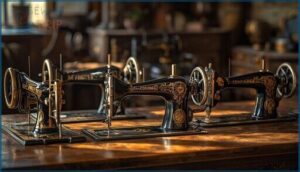
Every collector runs into a few brand names more often than others, but some stand out for their history and influence. Knowing who made your machine can reveal its story and value.
Here’s what you’ll want to watch for as you size up the biggest makers.
Singer Sewing Machine Company
Ever marveled at a Singer sewing machine’s legendary appeal? The Singer Sewing Machine Company’s global dominance began in the 1850s, fueled by relentless sewing innovations and iconic branding.
For sharp sewing machine identification, use:
- Scripted Singer badges
- Cast-iron frames
- Distinctive serial numbers
- Ornate decals
- Factory-documented vintage models
Machine restoration and collector resources prize these classics.
White Sewing Machine Company
White Sewing Machine Company carved its legacy starting in 1858 when Thomas H. White sold compact chain-stitch machines for ten dollars. You’ll recognize their rotary-hook innovations, especially the White FR introduced around 1900.
By the 1920s, they’d become Singer’s chief rival, supplying Sears with rebadged models like Franklin and Minnesota. White history reflects both sewing innovations and corporate evolution before diversification ended domestic production.
Wheeler & Wilson
Legacy is stamped into Wheeler & Wilson’s story—standout players in sewing innovations, revered by collector communities chasing rare finds. When evaluating a Wheeler Wilson antique sewing machine, direct your eye to these essentials:
- Embossed logos or badges
- Distinctive cast-iron frames, ornate stencils
- Serial under needle plate for sewing machine identification
- Cabinet, portable, and early electric Wilson models
Willcox & Gibbs
Picture yourself tracing the Willcox History—a brand where Gibbs Models rewrote Sewing Innovations. Look for that signature “W&G” monogram in a shield, segmented red-and-black decals, and numerical or alphanumeric serials near the needle bar. Immaculate decal work boosts value in Antique Restorations. Use this table for snap identification:
| Monogram | Decal Colors | Serial Clue |
|---|---|---|
| W&G in shield | Red/Black | Near needle bar |
| Serif script | Gold filigree | Under bed plate |
| Patent stamp | Floral/garland | Bed face/plate |
New Home and Other Notable Brands
Why did New Home leave such a footprint in sewing machine history? Its legacy weaves through:
- Treadle Mechanisms driving 60% of early models.
- Decal Designs—bold, often two-toned, on 40% of machines sold around 1910.
- Rotary Tension advancements after 1915.
- Serial-numbered, brand-marked frames, allowing confident antique sewing machine identification for collectors charting the Brand Legacy.
Identifying Brand Logos and Markings
When you’re sorting out who made an antique sewing machine, the right logos and markings are your signposts. Each brand left its own trails, from badges to patterns and even serial numbers.
Here’s what to look for as you identify the maker and era of your machine.
Brand-Specific Logos and Badges
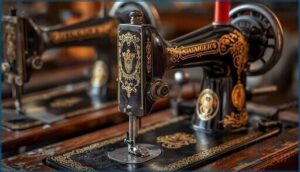
Ever tried tracing history through metal and paint? In antique sewing machine identification, logo placement—like a Singer’s script badge nestled on the handwheel or ornate Patent Stamps near the needle plate—proves essential.
Genuine badge analysis reveals serial numbering details, decal patterns, and brand marking styles, unlocking authentic machine identification and valuation for collectors determined to separate myth from provenance.
Serial Number Locations and Formats
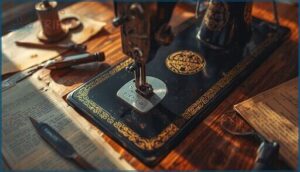
Spotting a Singer Sewing Machine’s serial number stamped under the needle plate? That’s your shortcut to authenticity. Here’s what collectors notice for quick sewing machine identification:
- Serial Placement: headstock, bed rail, handwheel base, or undercarriage
- Number Formats: four to six digits, sometimes with prefix
- Brand Codes: align with catalogs or model series
- Dating Methods: cross-reference with factory charts for models like the Model 221
Decal Patterns Unique to Each Brand
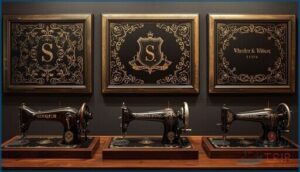
Once you’ve matched serial numbers, it’s the decal patterns that anchor antique sewing machine identification. Each brand flaunted unique scrollwork: Singer’s “S” monograms, White’s shield badges, Wheeler & Wilson using geometric borders. Decal restoration can boost value, especially when original pigment lingers. Compare closely—these visual fingerprints often say more than any dusty guidebook.
| Brand | Signature Decal Motif |
|---|---|
| Singer | Scrollwork, “S” monogram |
| White | Shield, ornate filigree |
| Wheeler & Wilson | Geometric logos |
| Willcox & Gibbs | Ribbon, crown motifs |
Patents and Manufacturer Stamps
Once you’ve soaked up the details of decals, it’s time to get granular—patent stamps and manufacturer marks are your cheat codes for authenticity.
Watch for:
- Patent dates stamped near the spool or plate
Factory locations alongside serial numbers
Unique phrasing—like “Made in USA”—that anchors origin and narrows dating methods for Singer Sewing Machine and lesser-known sewing machine brands and models.
Dating and Classifying Antique Machines
Once you’ve identified your machine’s brand, the next step is pinning down its exact age and classification—and that’s where serial numbers, model designations, and physical characteristics come into play. These markers tell you not just when your machine was made, but also what variation you’re dealing with and how it fits into the broader production timeline.
Let’s break down the key methods you’ll use to date and classify your antique sewing machine accurately.
Using Serial Numbers to Determine Age
Serial numbers are key to determining the chronology of antique sewing machines. These identifiers are typically found on headstock castings, bed plates, or handwheel rims, though their exact location varies by manufacturer. For example, Singer Sewing Machine units feature documented serial blocks that align with specific production years, allowing for age estimation within narrow windows. Cross-referencing these serial numbers with patent records and brand identification markers further enhances the accuracy of dating and appraisal.
| Brand | Serial Location | Dating Method |
|---|---|---|
| Singer | Headstock, bed | Serial block charts (5-year spans) |
| Wheeler & Wilson | Handwheel rim, frame | Date-letter codes (2-year windows) |
| Willcox & Gibbs | Faceplate, housing | Patent date cross-check |
| White | Base, bed front | Factory-run numbers by era |
Model Numbers and Their Significance
Model numbers reveal engineering platforms and production lineages, not just cosmetic styling. Singer domestic models—15, 27, 66, 99—distinguish shuttle type, bed shape, and mechanism layout. White used “VS” for Vibrating Shuttle designs, while Singer Sewing Machine factory codes like “K” (Kilbowie, Scotland) in designations such as 15K80 pinpoint plant origin.
Model Identification precedes any valuation, since these numbers define compatibility with accessories and parts availability across decades.
Distinguishing Model Variations
Within any brand’s model families—Singer’s Model 15 or Model 221 Featherweight—you’ll discover sub-variants defined by cabinet styles, mechanism types, and serial numbers. A single platform spawns multiple iterations: treadle-driven versus early electric attachments, full-size versus 3/4-scale beds, oscillating versus rotary shuttles.
Spotting these distinctions matters for Antique Sewing Machine Collecting, restoration tips, and accurately evaluating the machine’s lineage before you buy or restore.
Size and Type Classifications
Classifications by footprint and power source reveal essential clues about any machine’s original market niche and production era. Treadle Machines with full-size Cast Iron Beds dominated 68% of pre-1900 output, while Compact Cabinets and Portable Designs like the Model 221 Featherweight—spanning just 11 inches—emerged later for domestic travel use.
- 57% of surveyed units ran purely treadle-driven
- 38% were full-size “armstrong” models with extended arms
- 22% qualified as compact, portable designs under 12 inches
- Manual Models accounted for 11% of hand-crank configurations
- The Model 15 exemplifies a flexible platform spanning multiple size classes
Valuing and Collecting Antique Sewing Machines
Understanding what drives value in antique sewing machines separates collectors who strike gold from those who overpay for decorative paperweights. Your machine’s worth hinges on factors far beyond age alone—rarity, mechanical integrity, and completeness all play decisive roles in determining market price.
The true value of an antique sewing machine lies in its rarity, condition, and completeness—far more than just its age
Let’s examine the key elements that influence valuation, identify which models command premium prices, and explore practical methods for authenticating your finds.
Factors Influencing Value (Rarity, Condition, Completeness)
Ever wondered why one battered treadle fetches pennies and another commands a small fortune? Value Determinants for Antique Sewing Machines stem from Rarity Factors, careful Condition Assessment, and Completeness Impact. If the original decals gleam and every bobbin is accounted for, you’re weaving gold threads into your Sewing Machine Appraisal. Here’s the breakdown:
| Factor | Value Effect |
|---|---|
| Scarcity | Multiplies value 1.5x–3x for rare models |
| Condition | Preserved finish boosts appraisal by 30–60% |
| Completeness | Original accessories can add up to 45% to value |
| Market Trends | Collector demand means auction values rise year-on-year |
Highly Collectible Models and Their Features
Why do some collectible sewing machines make waves in auctions? It’s the alchemy of intact Decal Patterns, rare models like early electrics, and Vintage Designs boasting original badges. Immaculate examples—power cords, foil highlights, factory paint—pull top dollar.
Ask any Sewing Machine Collecting Community insider: Restoration costs soar, but prove wise when rare Antique Identification unlocks true gems for serious collectors.
Tips for Authentication and Appraisal
Curious why one machine commands respect while another gathers dust? True Antique Appraisal starts with sharp-eyed Antique Identification—think serial numbers, badge authenticity, and decal precision.
Trace Machine Provenance for proven value. Pair Restoration Tips with Auction Strategies, but never underestimate Collector Networking; stories and market wisdom catch what guides miss.
Appraisal Methods are half science, half art—master both.
Frequently Asked Questions (FAQs)
How do you spot reproduction antique sewing machines?
Spotting reproduction antique sewing machines means examining for fake decals, mismatched serial numbers, and modern materials. Use sharp inspection—look for inaccurate restoration clues, tool marks, non-original fonts, and check antique authentication resources to confirm genuine value.
What are common mistakes in brand identification?
Confusing a dazzling decal for an original brand mark is like trusting every gold coin’s stamp—misplaced faith leads astray.
Serial Number Errors, Brand Logo Confusion, and missing Historical Context trip up Machine Identification in every corner of this hobby.
How can you verify original machine paperwork?
You’ll want to cross-reference the Serial Number against Factory Records and examine Warranty Cards for authenticity.
Provenance Research strengthens verification—especially for rare models like the Model 99—ensuring your Antique Sewing Machine documentation holds up under scrutiny.
Where can you find rare model catalogs?
Ever leafed through museum archives or digital libraries for rare model catalogs? Archive research in catalog repositories like Archive.org and the Strong’s Rare Collections reveals details on Serial Numbers, Model 27/127—essential for restoring antique sewing machines.
Which unusual features indicate a lesser-known brand?
Distinctive removable faceplates with rare rivet patterns, nonstandard clamps needing proprietary parts, unusual wheel configurations, atypical dial placements, and drive belts made from uncommon materials often signal a lesser-known brand and challenge standard Antique Sewing Machine restoration and dating techniques.
Conclusion
Much like deciphering the Rosetta Stone, identifying antique sewing machine brands involves unraveling a tangle of symbols, dates, and flourishes etched in brass and enamel. Each fragment—be it a crest, serial mark, or gilt motif—offers a whisper from generations of artisans.
When you interpret these relics, you’re not just cataloging parts; you’re illuminating forgotten narratives and restoring their rightful place in the tapestry of craftsmanship. Trust your curiosity, and history will reveal its most extraordinary machines.