This site is supported by our readers. We may earn a commission, at no cost to you, if you purchase through links.
A dull needle doesn’t announce itself—it just quietly ruins your work.
Skipped stitches, snagged fabric, thread that keeps snapping mid‑seam: these aren’t machine problems.
Nine times out of ten, they trace back to a needle you should’ve swapped out hours ago.
Most sewists change needles when something breaks. Professionals change them on a schedule, because they know a needle degrades long before it fails visibly.
The flat spot, the microscopic burr, the barely‑bent tip—your fabric feels all of it before you do.
Getting your machine needle replacement timing, technique, and selection right changes everything about how your machine performs.
Table Of Contents
Key Takeaways
- Needles degrade long before they visibly fail, so swap them on a schedule — every 8–10 hours for most fabrics, every 4–6 hours for denim — not just when something breaks.
- Skipped stitches, thread shredding, unusual noises, and fabric snags are all your needle’s way of telling you it’s done; catching these early saves your project and your machine.
- Matching needle type and size to your specific fabric and thread isn’t optional — the wrong combination quietly ruins stitch quality, tension balance, and even machine components over time.
- Consistent needle care, including proper insertion, correct disposal, and never reusing a compromised needle, directly protects your machine’s timing, reduces motor strain, and extends its overall lifespan.
How Often to Replace Machine Needles
Most sewers don’t think about their needle until something goes wrong — and by then, the damage is already done.
A quick look at how to choose the right sewing needle can save you from skipped stitches, snags, and frustrating do-overs.
Knowing when to swap it out depends on a few key factors that are easy to track once you know what to look for.
Here’s what shapes how often you should be reaching for a fresh one.
Recommended Replacement Frequency for Different Projects
Think of your needle like a razor blade — it doesn’t announce when it’s done, it just starts doing damage.
For most sewing projects, a consistent needle change schedule keeps your work clean and your machine happy:
- Woven garment schedule — replace after 8–10 hours; cotton shirts and silk blouses stay snag‑free this way.
- Knit fabric timing and denim project intervals — knits every 8 hours, denim every 4–6 hours.
- Quilting stitch cycles and embroidery hour limits — swap after each major quilt layer or every 6 hours of dense embroidery work.
regular needle changes every 8 hours help prevent fabric damage.
Impact of Fabric Type on Needle Lifespan
Not all fabrics are created equal — and your needle feels every difference. Fabric friction effects hit hardest with dense materials: canvas wears needles roughly three times faster than cotton, while denim demands a swap every 4–6 hours. Stretch stress impact is real too — elastane knits put 50% more mechanical strain on needle shafts than woven fabrics. Synthetic abrasiveness is sneaky; polyester threads alone double wear rate. For delicate material wear, silk and organza degrade microtex points within hours.
- Woven vs. knit durability — interlock knits extend ballpoint needle life to 10 hours; twill cuts that to four.
Fabric compatibility and smart fabric selection make needle maintenance far less guesswork. Using heavy-duty needles for high-density fabrics can greatly reduce breakage.
Benefits of Regular Needle Changes for Stitch Quality
fresh needle does more than just pierce fabric — it quietly transforms your results. Sharp points improve fabric penetration, reducing skipped stitches and protecting thread integrity.
Stitch consistency improves noticeably, tension balance stays even, and seam appearance looks genuinely polished. Smart needle maintenance is simply good sewing machine maintenance.
Swap regularly, and your needle types will finally work with your fabric instead of against it.
Professional Maintenance Schedules for Needle Replacement
Professional shops don’t guess when to swap needles — they build systems around it. Machine Usage Timers track active hours, triggering Preventive Maintenance Alerts at the 8–16 hour mark for industrial machines, while lighter home setups follow every 8–10 hours. Shift Change Protocol means every new operator starts with a verified needle, no exceptions.
- Needle Inventory Audits confirm stock matches usage logs weekly
- Log Review Frequency catches patterns before problems surface
- Needle Types get matched to fabric at every shift start
- Sewing Machine Maintenance records document each Needle Replacement by machine number
That kind of Needle Care keeps Machine Repair calls rare and production humming smoothly.
Signs Your Needle Needs Replacing
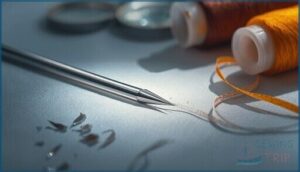
Your needle won’t always announce its retirement — but it does leave clues. Learning to read those signals early can save your project, your fabric, and your machine from unnecessary grief.
Watch for skipped stitches or snagging fabric — they’re often the first sign it’s time to swap in a fresh needle, especially when doing precise work like parallel topstitching with a twin needle.
Here’s what to watch for.
Thread Breaking or Shredding
Thread breaking is almost always your sewing machine needle confessing its past its prime.
Dull needle effects wear down thread fibers fast — friction from a worn tip can weaken thread by up to 50%.
Small eye friction shreds specialty threads stitch by stitch.
Bent needle damage and thread path misalignment make it worse.
Don’t ignore it; needle replacement fixes this immediately.
Skipped Stitches and Stitch Inconsistencies
Skipped stitches are your machine’s way of waving a red flag. Bent needle effects shift the eye just enough that the hook can’t catch the thread loop — and sideways bends alone cause consistent skips in straight stitching. Here’s what to watch for:
- Gaps in seam lines — wrong needle size leaves loops the hook simply misses
- Uneven stitch length — fabric feeding issues from a damaged tip
- Puckering despite correct settings — tension imbalance triggered by incorrect needle type
- Skipped stitches on knits — universal needles pierce instead of parting fibers
Needle replacement solves most of this immediately.
Unusual Noises During Sewing
Your machine doesn’t stay silent when something’s wrong. Sewing machine troubleshooting starts with simply listening.
A sharp needle plate ping on every stitch means the needle is striking metal — stop immediately. A hook timing knock points to alignment trouble, while a bobbin rattle usually means lint buildup or a loose case.
Fabric pull squeak and thread tension buzz both signal the wrong needle type. Needle replacement fixes most of these quickly.
Fabric Snags and Visual Needle Inspection
A single burr on your needle point can silently wreck an entire project before you notice. That tiny rough patch catches fabric threads mid‑stitch, leaving snags, pulls, and skipped stitches trailing along your work.
- Fingernail drag test — drag the point lightly across your nail; any scratching signals damage
- Stocking snag test — pull the needle slowly over fine stocking material; a damaged point grabs threads instantly
- Flat surface bend check — lay the needle flat; rocking means it’s bent
- Burr detection — run your fingertip gently over the point, feeling for rough spots
Catch these issues early through regular needle maintenance; fabric damage, broken thread, and inconsistent stitches simply stop being your problem.
Choosing The Right Needle for Your Project
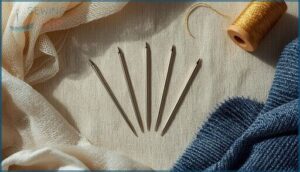
Picking the right needle is honestly half the battle — the wrong one can ruin a seam before you even finish the first pass.
Every fabric and thread combination has a needle that works best with it, and knowing which to reach for saves you a lot of frustration.
Here’s what to think about when making your choice.
Needle Size and Type for Fabric and Thread
Picking the right needle is like choosing the right tool from your kit — size and type both matter.
The metric sizing guide is straightforward: a size 80/12 manages everyday cotton and polyester blends, while denim needle selection calls for a sturdier 100/16 or 110/18.
Lightweight silk? Drop down to 60/8–70/10.
Thread weight matching is equally critical — heavier thread needs a larger eye.
For knits, ballpoint vs universal isn’t a debate: always go ballpoint.
Specialty twin needles work beautifully for parallel topstitching on compatible fabrics.
Embroidery Needle Selection Tips
Embroidery needle selection is its own discipline — and getting it wrong shows up fast in your finished work. For standard embroidery threads, a 75/11 or 80/12 hits the sweet spot between stitch density impact and clean piercing. Metallic thread needles need a longer, polished eye to reduce shredding. Needle material types matter too — titanium coatings outlast chrome on dense designs. Always confirm hoop compatibility before you start, and treat thread‑needle match as non‑negotiable.
- Use 75/11 for standard rayon or polyester embroidery threads
- Switch to metallic thread needles with enlarged eyes for foil or glow threads
- Choose titanium needle material types for heavy‑density or coated fabrics
- Verify cap frames — cap frames often need shorter‑shaft needle sizes
- Adjust needle selection based on stitch density impact across your design
Matching Needle to Fabric and Thread Combinations
Choosing the right fabric-thread pairing is where needle selection moves from guesswork to control. Needle size charts make this straightforward: silk and chiffon need a 65/9 with fine 60‑weight thread, while denim or canvas call for a 90/14 with heavier 30‑weight.
Thread compatibility and fabric compatibility work together — mismatching either one causes the best stitch quality to suffer quickly. Material-specific needles matched to your thread type keep everything running cleanly.
Specialty Needles for Complex Materials
Some fabrics simply won’t behave with a standard needle — and that’s not a flaw in your technique. It’s a materials problem.
Needle selection gets specific here, and the right match makes a real difference:
- Titanium Coated needles outlast chrome by 3–5x, keeping the point sharp through abrasive technical fabrics
- Nonstick Coated needles glide through vinyl, oilcloth, and laminated cotton without gumming up
- Topstitch Metallic needles feature a wider eye and deeper groove that protect delicate metallic threads from shredding
- Stretch Jersey needles use a medium ball point to preserve knit loops and prevent skipped stitches
For Microtex Heavy woven fabrics or leather crafting, needle size and fabric compatibility together determine whether your seam holds or your material tears.
Safe and Effective Needle Replacement Techniques
Replacing a needle sounds simple — and it’s once you know what you’re doing. But small missteps can throw off your whole machine.
Here’s get right every time.
Correct Needle Insertion and Orientation
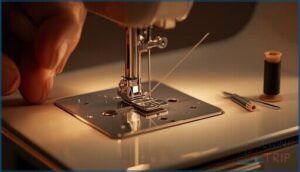
Getting your sewing machine needle seated correctly is half the battle won before you even sew a stitch.
For most home machines, flat side direction means the flat faces the back — that’s non‑negotiable.
Groove alignment matters just as much: the long groove must follow your thread path orientation so the thread rides protected through the fabric.
Push the needle firmly up until it stops — insertion depth is everything.
A needle change done right means no skipped stitches, no mystery.
Proper Tightening and Securing Methods
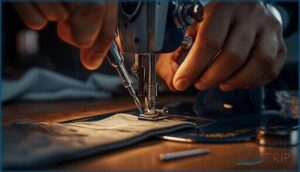
Now that your needle is seated and oriented, securing it correctly is what locks everything in place. Hand tightening technique comes first — finger‑tighten the needle clamp screw until it feels snug, then add just an eighth‑to‑quarter turn with a small screwdriver. That’s all it needs. Over‑cranking risks screw tip wear, stripped threads, and a clamp that won’t hold reliably.
After tightening, do a quick needle clamp inspection: tug the needle gently downward and rotate the handwheel through a few cycles, watching for wobble.
Disposal of Old or Damaged Needles
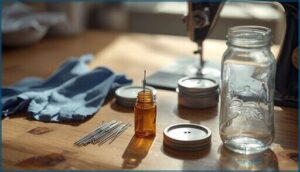
Disposing of old needles properly is a small step that protects everyone — including your household trash handler. Skip the bare garbage bag and reach for puncture‑proof containers instead: prescription bottles, metal tins, or screw‑top jars all work well for household storage methods.
- Drop used needles into a labeled pill bottle with a drilled lid
- Mark containers clearly: SHARPS — don’t RECYCLE
- Seal tightly once three‑quarters full before final disposal steps
- Check local pharmacies or hazardous waste centers for recycling needle metal responsibly
Avoiding Reuse of Compromised Needles
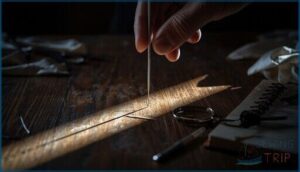
Once a needle shows any sign of compromise, it’s done — full stop. Needle damage isn’t always visible, but microscopic burrs wreak havoc on delicate fabrics and disrupt fabric compatibility with your chosen materials.
That’s why sharp inspection before every session matters as much as any other sewing machine repair habit.
Keep a safety log for wear tracking, noting hours used per needle.
Smart needle maintenance means treating needle disposal as final.
Never reuse a pulled needle — your sewing machine needle, your sewing safety, and your finished seams all depend on it.
Needle Care for Better Sewing Machine Performance
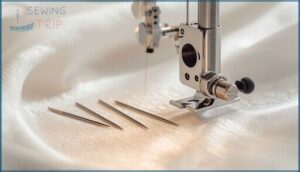
How you care for your needle matters more than most sewers realize — it affects everything from thread tension to how long your machine stays in good shape.
Small habits around needle maintenance can prevent a surprising number of frustrating problems down the line. Here’s what proper needle care actually does for your machine’s performance.
Impact on Machine Tension and Stitch Consistency
Your needle is the silent conductor of every stitch — and when it’s off, your whole tension system struggles to keep up. A worn eye creates drag that mimics a tight tension dial. A bent needle shifts hook timing by a fraction of a millimeter, causing sporadic loose stitches that feel impossible to dial out. Needle size matters too — switching from 80/12 to 90/14 without adjusting tension disks can raise effective top tension noticeably.
A bent needle shifts hook timing by a fraction of a millimeter, and no tension dial can save you
Watch for these five tension red flags:
- Loose upper threads — poor hook timing from needle positioning issues
- Tight bobbin stitches — needle flexibility problems disrupting loop formation
- Puckered seams — blunt point sharpness dragging instead of piercing
- Thread shredding — eye drag effects fraying delicate fibers
- Skipped stitches — mismatched needle types breaking stitch quality rhythm
Reducing Wear on Machine Components
Every worn needle is quietly grinding away at your machine from the inside out. Think of it as friction reduction tactics in reverse — a dull point generates roughly 30 percent more resistance against your hook assembly, bobbin case, and feed dogs than a fresh one does.
That cumulative stress adds up fast.
Sharp needles are your first line of hook protection, passing cleanly through the needle plate without nicking or scratching internal surfaces.
Prioritizing consistent needle replacement every 8–10 hours is straightforward sewing machine maintenance that keeps every moving part — from bobbin case care to feed dog preservation — working exactly as it should.
Preventing Machine Jams and Timing Issues
A bent needle is basically a tiny wrench thrown into your machine’s gears. Even a 1–2 mm shift in needle alignment disrupts the precise timing between your needle bar and bobbin hook — causing immediate jams.
Regular needle change routines, combined with throat plate cleanliness and machine lubrication schedule checks, keep that synchronization locked in. Don’t wait for a metallic click to act; consistent sewing machine maintenance prevents the costly calibration calls.
Extending Overall Equipment Lifespan Through Needle Care
Think of your sewing machine as a long-term investment — and needle maintenance is the return policy that actually pays off.
- Motor Strain Reduction: Fresh needles cut motor overload by up to 50%, preventing heat buildup in windings.
- Component Wear Prevention: Correct needle size and type minimize feed dog and bobbin case abrasion.
- Storage Optimization: Dry, labeled containers protect needle sharpness between projects.
- Cleaning Protocols: Weekly lint removal and proper lubrication strategies keep timing precise and components stress‑free.
Frequently Asked Questions (FAQs)
Can different needle brands affect machine performance?
As the old saying goes, you get what you pay for.
Yes, needle brand absolutely affects sewing machine performance — through blade thickness effects, scarf groove quality, eye size variation, and coating material differences that cheaper options simply can’t match.
Should needles be stored in specific conditions?
Yes — store sewing machine needles in airtight containers at 60–75°F.
Humidity control matters: silica gel packets prevent rust, while avoiding damp basements and hot attics keeps moisture prevention simple and your needle maintenance reliable.
How do universal needles compare to specialty?
Universal needles are your everyday workhorse — decent across most wovens and knits.
Specialty needles, though pricier, nail fabric compatibility where universals fall short, delivering cleaner stitch quality on denim, stretch, or silk.
What causes needle eyes to become enlarged?
Thread abrasion, heat wear, and manufacturing defects are the main culprits.
Heavy or metallic threads grind the eye’s edges, while high-speed friction softens the metal. Impact deflection and corrosion damage finish the job.
Can machine oil affect needle longevity?
Machine oil cuts both ways.
Proper lubrication reduces friction and heat buildup — key drivers of Heat‑Induced Needle Wear.
But Oil Residue Buildup and Lint‑Oil Abrasion accelerate dulling, while Corrosion From Improper Lubrication quietly destroys needle metal.
Can I use industrial needles in home machines?
No — industrial needles have a fully round shank, while home machines need a flat-sided shank for proper clamp fit.
That shank compatibility mismatch risks machine damage, skipped stitches, and voided warranties fast.
How do I store sewing needles properly?
Keep needles in labeled needle cases, magnetic holders, pin cushions, or needle books sorted by type.
Store them in airtight containers with silica gel packets for rust prevention, and always dry your hands before handling.
What causes a needle to break mid-project?
A needle breaks for four main reasons: incorrect size for your fabric, a loose clamp, a bent needle from thick layers, or pin interference mid-seam.
Does needle brand affect overall sewing performance?
Yes, brand matters more than most people think.
Better manufacturing tolerances, groove quality effects, and eye precision benefits all add up — directly shaping your sewing performance, stitch consistency, and how long each needle actually lasts.
How do I thread a needle on my machine?
Raise your presser foot first — that opens the tension discs.
Set spool orientation correctly, bring thread through the take-up lever, and use the needle threader hook.
Prep your thread end cleanly for smooth passage.
Conclusion
A single neglected needle can silently unravel a thousand hours of careful sewing.
Every machine needle replacement tip covered here—from timing your swaps to matching needle type to fabric—adds up to one thing: a machine that performs the way it’s supposed to, every single time.
The needle is the smallest part doing the heaviest work. Respect that, change it on schedule, choose it deliberately, and your stitches will tell the difference before you even finish the seam.
- https://quiltingthread.com/blogs/quilting-essentials/how-often-should-you-change-your-sewing-needle
- https://kittysewing.com/how-to-tell-if-your-sewing-machine-needle-is-dull/
- https://www.truedigitizing.com/blog/sewing-machine-needle-chart
- https://dsinternational.com/blogs/news-tips/how-to-change-a-sewing-machine-needle-a-step-by-step-guide
- https://sewingsociety.com/9-ways-you-can-get-seriously-injured-while-sewing-2/