This site is supported by our readers. We may earn a commission, at no cost to you, if you purchase through links.
A single wrong machine purchase can fracture a quilting guild faster than a dropped bobbin mid-project.
Guilds share equipment across dozens of members, different skill levels, and marathon sewing sessions—demands that expose every weakness in a machine’s design within weeks.
Throat space, motor stamina, and stitch consistency aren’t just spec sheet numbers here; they’re the difference between a machine that becomes the guild’s workhorse and one that collects dust in the corner.
The nine quilting machines for quilting guilds reviewed here were evaluated against exactly those pressures, from the Juki TL2000Qi’s 1,500-stitch-per-minute precision to the Singer Quantum Stylist’s 600-stitch library.
Table Of Contents
- Key Takeaways
- Essential Features for Guild Quilting Machines
- Types of Quilting Machines for Guilds
- Factors to Consider When Buying for Guilds
- Top Quilting Machines for Quilting Guilds
- 1. Juki Computerized Sewing Machine
- 2. Brother High Speed Sewing Machine
- 3. Singer Quantum Stylist Sewing Machine
- 4. Brother Sewing And Quilting Machine
- 5. Juki Straight Stitch Sewing Machine
- 6. Janome Sewing And Quilting Machine
- 7. Bernette Sewing And Quilting Machine
- 8. Brother Computerized Sewing Machine
- 9. Singer Patchwork Quilting Sewing Machine
- Comparing Quilting Machine Features
- Maximizing Value for Quilting Guilds
- Frequently Asked Questions (FAQs)
- Conclusion
Key Takeaways
- Throat space, motor power, and stitch consistency are the three specs that separate a guild workhorse from a machine that collects dust within weeks.
- Shared machines need automation features like automatic needle threaders, drop-in bobbins, and adjustable speed sliders so members at every skill level can sit down and get to work without a learning curve.
- Your budget shapes the machine type—domestic models start around $500, midarms run $2,000–$8,000, and longarms can exceed $30,000—so guild funding strategies like raffle quilts or dealer financing matter as much as the spec sheet.
- A consistent maintenance schedule—cleaning after every bobbin change, swapping needles every 8–10 hours, and annual professional servicing—is what keeps a shared machine running reliably for 10 to 20 years.
Essential Features for Guild Quilting Machines
Picking the right quilting machine for a guild isn’t the same as buying one for your home studio. A shared machine needs to handle heavy rotation, different skill levels, and projects of all sizes without missing a beat.
If you’re weighing your options, understanding how quilting machines differ from regular sewing machines can help your guild avoid buying something that struggles under daily, heavy-duty use.
Here are the key features worth looking at before your guild commits to anything.
Throat Space and Workspace
Throat space is the single measurement that decides how manageable a large quilt actually feels. Domestic sewing machines offer roughly 6 to 9 inches — workable, but you’ll reroll constantly.
Midarm quilting machines jump to 12–17 inches, while longarms hit 18–24. Pair any machine with a no-front-leg extension table for true workspace ergonomics, and quilt maneuverability improves immediately.
Table stability matters too — a level surface keeps borders straight. Many quilters prefer machines with a large throat space for quilting, as it allows for easier handling of bigger projects.
Stitch Quality and Options
Workspace sets the stage, but stitch quality seals the deal. A good guild machine needs solid stitch regulation — consistent stitch precision keeps results even when different members take turns.
Look for at least 50 utility plus 30 decorative stitches for real stitch versatility. Thread balance, free-motion capability, and reliable stitch options make every quilt look intentional, not accidental.
For an in-depth explanation of consistent stitch regulation techniques, quilters can review guidance on how different machines support stitch quality.
Speed and Motor Power
Stitch regulation only works if the motor power can keep up. In a guild setting, speed capabilities and motor power aren’t extras — they’re what separates a smooth session from a frustrating one.
Here’s what to watch for:
- Longarm quilting machines hit 1,800–3,500 stitches per minute for performance optimization on large charity quilts.
- Domestic sewing machine motors drawing 1.0–1.5 amps handle shared, all-day use without stalling.
- Stitch regulation automatically adjusts motor speed, keeping stitch options consistent regardless of who’s at the controls.
- Speed limits via dial or slider let beginners work comfortably while experienced members push faster on open areas.
- Low power consumption models around 60 watts struggle with thick batting — check the watt rating before committing.
Durability and Frame Construction
Motor power gets your quilt moving — but frame construction keeps everything steady. Metal frame construction absorbs vibration during high-speed passes, protecting stitch precision across all those layers.
Steel and thick aluminum rails pass durability and stability tests that cheaper frames fail fast. Rail durability matters when dozens of members share the machine.
Wear resistance on rollers and loading points extends years of reliable use.
Ease of Use and Automation
A shared machine needs to work for everyone — beginners included. Automatic needle threaders, auto tensioning, and user-friendly controls cut setup time dramatically.
Speed capabilities are capped with slider controls so new members don’t feel overwhelmed. Smart navigation through touchscreen menus makes stitch options easy to find.
Easy threading paths, automatic stitching modes, and generous throat space mean less fumbling and more quilting.
Types of Quilting Machines for Guilds
Not all quilting machines are built the same, and for a guild, that difference really matters.
The right type depends on how your group works, what projects you tackle, and how many hands will be on the machine. Here’s a breakdown of the main types to help you figure out what fits best.
Mechanical Vs. Computerized Models
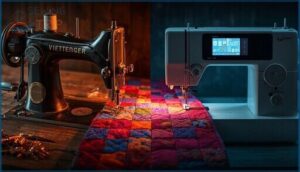
Mechanical sewing machine models give you raw control through physical dials — ideal for experienced guild members who trust their hands.
Computerized sewing machines offer electronic assistance, stitch regulation, and speed consistency through LCD controls, boosting quilting accuracy for newer members. Mechanical models top out around 30 stitches; computerized quilting machine options often include 500-plus.
Machine control style shapes every quilting technique your guild attempts.
Longarm Vs. Midarm Machines
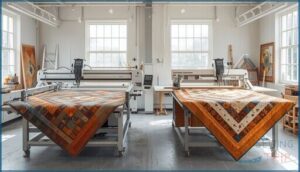
Size is everything in this machine comparison. Longarm quilting machines offer 20–26 inches of throat space on frames up to 14 feet long — serious real estate for king-sized guild projects.
Midarm machines give you 12–18 inches and fit a 5–6 foot table. Guild budgeting shapes the choice: longarms start near $10,000, while midarm quilting machines run $2,000–$8,000. Automation levels and quilting space needs should drive your final call.
Straight-Stitch Vs. Multi-Stitch Options
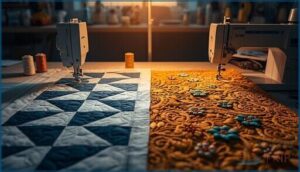
Think of it as a fork in the road for your guild’s sewing machine lineup. Straight-stitch quilting machines hit around 1,500 stitches per minute, delivering sewing precision and consistent thread control for piecing and straight-line quilting.
Multi-stitch models expand your stitch options, adding quilt texture through decorative patterns — but run slower. Match stitch complexity to your project goals, not just your wish list.
Frame-Mounted Vs. Tabletop Machines
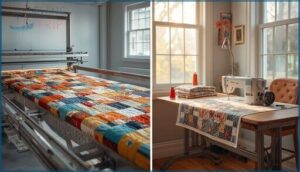
Frame-mounted systems need 10 to 14 feet of dedicated space, but they deliver stitch consistency and quilt maneuverability that tabletop machines can’t match on large charity quilts.
Tabletop machines win on machine portability and user ergonomics — easier to store, less intimidating for new members. Your quilting machine selection comes down to volume. High output? Go frame-mounted. Flexibility first? Tabletop fits most guild rooms.
Factors to Consider When Buying for Guilds
Buying a machine for a guild budget isn’t the same as buying one for yourself. You’re balancing the needs of many people, a shared budget, and long-term wear that a solo quilter never has to think about.
A guild machine must serve many hands, one budget, and years of wear no solo quilter ever faces
A few key factors will make or break that decision.
Budget and Cost-Effectiveness
Budget planning isn’t glamorous, but it’s what keeps your guild running. Quilting machine price ranges vary widely — entry-level domestic models start around $500, while new longarm systems can exceed $30,000. A solid cost analysis helps your guild avoid surprises.
Smart funding options to explore:
- Collect annual dues into a dedicated equipment fund
- Run raffle quilts for financial savings
- Share ownership with a local quilt shop
- Use dealer financing to spread payments over time
- Buy used machines for budget computerized options at half the price
Maintenance and Shared Use
Shared machines take real commitment. A solid maintenance schedule prevents most headaches — lint removal after every bobbin change, needle swaps every eight hours of stitching, and professional servicing every one to two years. User logs and shared protocols keep things fair.
| Shared Use Practice | Why It Matters |
|---|---|
| Machine cleaning after each session | Prevents jams and skipped stitches |
| Equipment safety sign-out checklist | Flags issues before they worsen |
Brand Reliability and Support
Maintenance habits protect your investment — but brand reputation determines whether help arrives when something still goes wrong. Brother quilting machines consistently earn strong customer reviews for easy-to-use controls and reliable service networks.
Singer holds up well under heavy use. Check warranty coverage carefully: some brands cover parts for five or more years. Quilting machine comparison sites and quilting machine reviews surface real technical assistance experiences before you buy.
Top Quilting Machines for Quilting Guilds
Finding the right machine for your guild doesn’t have to be overwhelming. These nine options cover a solid range of budgets, features, and skill levels — so there’s something here for every group.
Here’s what made the cut.
1. Juki Computerized Sewing Machine
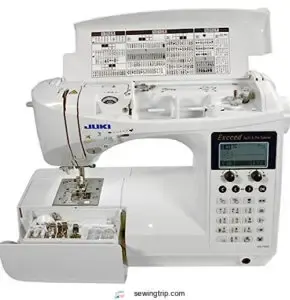
The Juki HZL DX7 punches well above its weight for guild use. You get 287 built-in stitches, a 12-inch throat space, and a top speed of 1,050 stitches per minute — enough to power through a charity quilt without breaking a sweat.
Automatic thread trimming and a needle threader mean less downtime between members. The box feed system keeps stitches even on thick batting. At 33 pounds, it’s sturdy and stable, exactly what shared machines need.
| Best For | Anyone from beginners to experienced sewists who want a reliable, feature-packed machine for quilting, garment sewing, and everyday projects. |
|---|---|
| Built-in Stitches | 255 |
| Needle Threader | Automatic |
| Bobbin System | Top drop-in |
| Machine Weight | 30 lbs |
| Extension Table | No |
| Free Motion Quilting | Yes |
| Additional Features |
|
- 255 built-in stitches cover everything from basic hemming to decorative work and stretchy fabrics
- The automatic needle threader and thread cutter save time and keep your workflow moving
- Knee lift and LCD screen make it easy to adjust settings without putting down your work
- The computerized features can feel like a lot to take in at first, especially for new users
- Struggles with very thick materials like multiple layers of denim
- Some users have run into issues with the needle threader and bobbin winder over time
2. Brother High Speed Sewing Machine
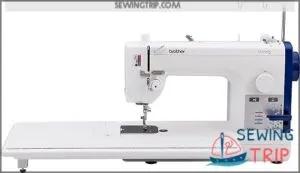
If the Juki is your powerhouse multitasker, the Brother PQ1600S is your straight-line workhorse. It hits 1,500 stitches per minute and won’t flinch through thick batting or layered denim.
The 5.7″ x 8.7″ needle-to-arm space, large extension table, and drop feed for free motion quilting make it guild-ready. A knee lifter, push-button thread cutter, and preset needle stop keep things moving during busy sew days.
At 24 pounds with a metal frame, it’s built to last.
| Best For | Serious quilters and sewists who need a fast, reliable machine for large projects like quilts, weighted blankets, and free motion work. |
|---|---|
| Built-in Stitches | 1 (straight) |
| Needle Threader | Manual |
| Bobbin System | Side loading |
| Machine Weight | 24 lbs |
| Extension Table | Yes |
| Free Motion Quilting | Yes |
| Additional Features |
|
- Blazing fast at 1,500 stitches per minute — great for powering through big projects without losing your mind
- Extra large workspace gives you real room to maneuver heavy quilts and thick fabrics
- Handy features like the knee lifter, push-button thread cutter, and preset needle stop make long sew days way less tiring
- No bobbin runout alert, so you might not notice when you’ve run out of thread mid-seam
- The needle threader is fiddly and the thread tension dial is hard to read at a glance
- Not beginner-friendly — this machine is built for people who already know what they’re doing
3. Singer Quantum Stylist Sewing Machine
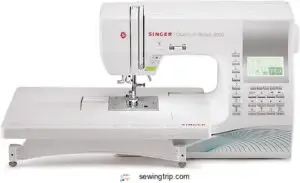
The Singer Quantum Stylist 9960 is the adaptable middle child of guild machines — not a longarm, but far from basic. You get 600 built-in stitches, a 6.4 throat space, and an extension table that actually accommodates quilt weight.
The speed slider caps at 850 stitches per minute, so newer members won’t feel rushed. Add the automatic needle threader, built-in thread cutter, and programmable needle-down function, and you’ve got a machine that keeps up without slowing anyone else down.
| Best For | Sewers of all skill levels who want a versatile machine for quilting, garment making, and home décor projects without jumping to a commercial-grade setup. |
|---|---|
| Built-in Stitches | 600 |
| Needle Threader | Automatic |
| Bobbin System | Top drop-in |
| Machine Weight | 14.6 lbs |
| Extension Table | No |
| Free Motion Quilting | Yes |
| Additional Features |
|
- 600 stitches and 13 buttonhole styles give you serious creative range without needing a second machine
- The automatic needle threader and drop-in bobbin make setup quick and frustration-free
- Adjustable speed and a start/stop button are great if you’re still building confidence at the machine
- The throat plate runs small, which can be limiting on bigger quilting projects
- Not built for commercial use, so heavy daily workloads may wear it down faster than expected
- Takes some time to learn — you’ll want to actually read the manual to get the most out of it
4. Brother Sewing And Quilting Machine
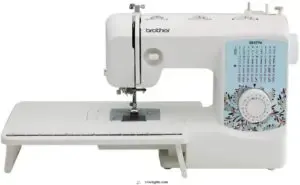
The Brother XR3774 is a dependable workhorse for guilds that need a reliable everyday machine without a hefty price tag. It packs 37 built-in stitches, an automatic needle threader, and a drop-in top bobbin — all features that reduce setup friction during busy guild nights.
The wide table gives you extra support for quilt blocks, and at 15 pounds, it’s easy to carry to meetings. Just know it can struggle with thick fleece layers and runs a bit noisy at speed.
| Best For | Quilters and sewists of all skill levels who want a solid, affordable machine for guild meetings, everyday projects, and light quilting work. |
|---|---|
| Built-in Stitches | 37 |
| Needle Threader | Automatic |
| Bobbin System | Drop-in top |
| Machine Weight | 15 lbs |
| Extension Table | Yes (wide table) |
| Free Motion Quilting | Yes |
| Additional Features |
|
- 37 built-in stitches plus an automatic needle threader make it easy to jump right into a project without fussing over setup.
- The wide table gives great support for quilt blocks, and at 15 pounds it’s genuinely easy to haul to guild night.
- One-step buttonholes and a drop-in bobbin keep things simple — great whether you’re a beginner or just want less hassle.
- It can get pretty noisy at higher speeds, which might be distracting in a quiet sewing space.
- Thick fabrics like fleece or minky can give it trouble, so it’s not the best pick for heavy-duty projects.
- The bottom grips don’t hold super well during fast sewing, and some users have had hiccups with the needle threader and bobbin system.
5. Juki Straight Stitch Sewing Machine
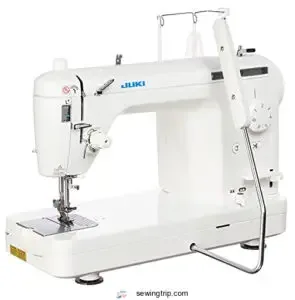
When your guild wants speed and precision without the bells and whistles, the Juki TL2000Qi delivers. It sews one stitch — straight — and does it at up to 1,500 SPM. That’s roughly twice as fast as most home machines.
The aluminum die cast frame keeps vibration low, even at full speed. You get a knee lifter, automatic needle threader, automatic thread cutter, and an extension table for large quilts. It requires oiling after each use, but for serious piecing and quilting days, it’s hard to beat.
| Best For | Quilters and sewists who need serious speed and precision for piecing, free motion quilting, and heavy-duty projects. |
|---|---|
| Built-in Stitches | 185 |
| Needle Threader | Automatic |
| Bobbin System | Drop-in top |
| Machine Weight | 10.1 lbs |
| Extension Table | Yes (wide table) |
| Free Motion Quilting | Yes |
| Additional Features |
|
- Screaming fast at 1,500 SPM — great for long quilting sessions where speed actually matters
- Aluminum frame keeps things smooth and steady, even when you’re pushing it hard
- Knee lifter and auto thread cutter make the whole process feel effortless
- Straight stitch only — if you need zigzag or decorative stitches, look elsewhere
- Needs oiling after every use, which adds a small but real maintenance commitment
- The heel thread cutter on the foot pedal is easy to hit by accident until you get used to it
6. Janome Sewing And Quilting Machine
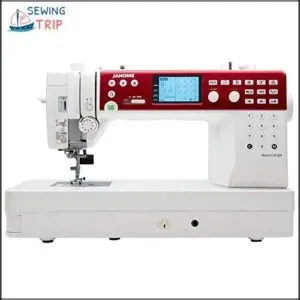
The Janome MC6650 is built for quilters who want serious capability in a tabletop machine. At $1,999, it’s an investment — but the specs back it up.
You get a 10-inch continuous metal flatbed, 172 stitches, and a motor pushing 1,000 SPM. The one-push needle plate conversion and high-quality needle threader save real time during guild sessions.
At 24.2 pounds, it stays put under pressure. Thick layers, denim, quilting cotton — it processes all of it without stalling.
| Best For | Quilters and sewists — beginner or experienced — who want a workhorse machine that can handle everything from delicate dressmaking to heavy denim and quilting projects. |
|---|---|
| Built-in Stitches | 1 (straight) |
| Needle Threader | Automatic |
| Bobbin System | Top loading |
| Machine Weight | 25.4 lbs |
| Extension Table | Yes |
| Free Motion Quilting | Yes |
| Additional Features |
|
- 172 built-in stitches and a 10-inch metal flatbed give you serious creative range without needing to upgrade anytime soon.
- Features like the one-push needle plate conversion, automatic thread cutter, and built-in needle threader cut down on setup time so you can focus on actually sewing.
- Solid metal construction at 24.2 pounds means it stays stable under pressure — no rattling or shifting when you’re pushing through thick layers.
- At $1,999, it’s a significant investment that might be hard to justify for casual or occasional sewers.
- Some users have run into stitch-skipping and thread cutter issues, which can mean downtime waiting on repairs or servicing.
- The instruction booklet reportedly falls short — not the most beginner-friendly intro to a machine with this many features.
7. Bernette Sewing And Quilting Machine
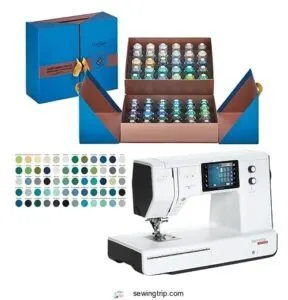
The Bernette b77 punches well above its weight for guild use. You get 500 built-in stitches, a 5-inch color touchscreen, and about 9 inches of throat space — enough room to wrestle a lap quilt without a fight.
The dual feed system keeps batting from shifting mid-seam, and 1,000 SPM means faster piecing days. Eight presser feet are included. The drop-in bobbin makes quick changeovers easy when multiple members share the machine in one session.
| Best For | Hobbyist sewers and quilters — from beginners to experienced crafters — who want a feature-rich machine that handles everything from delicate chiffon to thicker layered projects. |
|---|---|
| Built-in Stitches | 172 |
| Needle Threader | Built-in |
| Bobbin System | Top-loading rotary |
| Machine Weight | 24.2 lbs |
| Extension Table | No |
| Free Motion Quilting | Yes |
| Additional Features |
|
- Comes loaded with accessories right out of the box, including a 60-piece thread bundle, 8 presser feet, and an extension table — great value from day one.
- The dual feed system and automatic thread cutter make quilting and layered projects way less frustrating.
- Works with a wide range of fabrics, so you’re not stuck sewing just one type of project.
- A handful of users ran into thread tension issues and the occasional error message, which can interrupt your workflow.
- Customer support from Bernette has been hit or miss, so you may be on your own if something goes wrong.
- Not built for heavy-duty or industrial work — if you’re pushing serious volume, this probably isn’t your machine.
8. Brother Computerized Sewing Machine
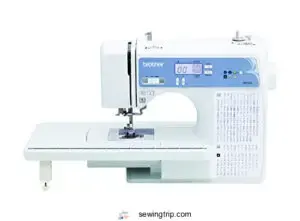
The XR9550 is a solid workhorse for guilds that don’t need bells and whistles — just reliable results. You get 165 built-in stitches, an automatic needle threader, and a drop-in bobbin that speeds up changeovers when members are rotating through.
The drop feed switches you into free motion mode without swapping machines. At 10.1 pounds, it moves easily between meeting spaces. One heads-up: it doesn’t include a quarter-inch presser foot, so your guild may want to grab one separately.
| Best For | Sewing and quilting enthusiasts of all skill levels who want a reliable, versatile machine for garments, quilts, and decorative projects. |
|---|---|
| Built-in Stitches | Preset patterns |
| Needle Threader | Automatic |
| Bobbin System | Standard |
| Machine Weight | 30.6 lbs |
| Extension Table | Yes (large) |
| Free Motion Quilting | Yes |
| Additional Features |
|
- 165 built-in stitches plus drop feed for free motion quilting gives you a ton of creative range without needing multiple machines.
- The automatic needle threader and drop-in bobbin make setup quick — great when you’re jumping between projects.
- At 10.1 pounds with a wide table and free arm, it’s easy to move around and handles everything from cuffs to full quilts.
- Doesn’t come with a quarter-inch presser foot, which is pretty much essential for quilting — you’ll need to buy one separately.
- Can get noisy during longer sessions, which might be a drawback in shared spaces.
- Locked to 120 volts, so if you travel or sew abroad, using it could void the warranty.
9. Singer Patchwork Quilting Sewing Machine
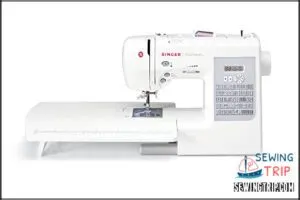
Singer steps things up with the Patchwork 7285Q — a machine built for quilters who want real options without a steep learning curve. You get 100 built-in stitches, 15 dedicated to quilting, plus a walking foot and quarter-inch foot right out of the box.
The 5.5-inch throat space accommodates small to medium projects comfortably, and the extension table keeps large quilt tops from dragging. At 15.7 pounds, it’s portable enough for guild nights.
| Best For | Quilters of all skill levels who want a feature-packed machine that’s easy to pick up and grow with. |
|---|---|
| Built-in Stitches | 165 |
| Needle Threader | Automatic |
| Bobbin System | Drop-in top |
| Machine Weight | 10.1 lbs |
| Extension Table | Yes (wide table) |
| Free Motion Quilting | Yes |
| Additional Features |
|
- 100 built-in stitches with 15 dedicated quilting stitches gives you plenty to work with right away
- Comes with a walking foot and quarter-inch foot out of the box — no extra shopping needed
- The extension table and start/stop button make handling big projects a lot less stressful
- Some users ran into locking and jamming issues that were tough to sort out
- The plastic bobbin basket feels like a weak spot on an otherwise solid machine
- Customer service and the manual don’t offer much help when error codes pop up
Comparing Quilting Machine Features
Not all quilting machines are built the same, and for a guild, the differences really matter.
A few key features will determine whether a machine works hard for your members or just collects dust. Here’s what to look at before you commit.
Workspace Size and Table Attachments
Workspace matters more than most quilters expect. A cramped bed lets heavy charity quilts drag and pull stitches uneven.
Table extensions — usually 18×24 up to 23.5×35 inches — solve that fast. Workspace optimization starts with matching extension table attachment methods to your quilting machine’s free arm.
Proper quilt support systems, knee lift clearance, frame configurations, and adequate throat space keep your guild’s projects moving smoothly.
Built-in Needle Threaders and Thread Cutters
Good thread management starts the moment you sit down. Built-in needle threaders take seconds — a real win when your guild shares one machine across a dozen members.
- Automatic needle threader reduces eye strain for older quilters
- Automatic cutting trims both top and bobbin threads cleanly
- Sewing efficiency improves with fewer scissors stops per session
- Needle threading stays consistent using sizes 80/12 or 90/14
- Thread tension stays stable when cutters trim short, even tails
Adjustable Speed and Stitch Settings
Speed control and stitch regulation go hand in hand for guild work. A speed slider lets beginners cap at slow, while experienced members push full throttle — same machine, different comfort zones.
Stitch length adjusts in 0.1mm increments, so piecing at 2.0mm stays sharp every time.
| Setting | Common Range | Guild Use |
|---|---|---|
| Speed Control | Slow to full | Skill-level flexibility |
| Stitch Length | 0.5–5.0mm | Piecing vs. basting |
| Stitch Width | Up to 7mm | Decorative borders |
User Interface and Display Type
Touchscreen Displays make a real difference when a dozen guild members share one quilting machine. A 7-inch full-color screen groups stitch regulation, needle position, and lighting into simple menus — no digging through manuals.
- Interface Design uses high-contrast icons for quick reading
- Menu Navigation includes a clear home button to prevent confusion
- Graphic Controls pair with ergonomic grips for hands-on adjustments
- Display Screens tilt to suit different heights at the frame
- Computerized Sewing machines save named presets for charity or show quilts
Maximizing Value for Quilting Guilds
Getting the most from a shared machine takes more than just picking the right model. How your guild invests, trains, and maintains it will decide whether that machine pays off for years or collects dust.
Here’s what to focus on.
Assessing Long-Term Investment
A solid cost analysis starts with the full picture, not just the price tag. Guild budgeting should factor in machine depreciation, routine supplies, and service visits annually.
Longevity planning matters too — quality longarm quilting machines run 10 to 20 years with proper care. Compare investment strategies across quilting machine reviews and prioritize sewing machine durability. Quilting machine comparison pays off long-term.
Training Members for Machine Use
Every new member starts with a safety orientation — needle hazards, pinch points, emergency stops. From there, training moves into hands-on practice: loading frames, threading the quilting machine, and running slow passes on muslin before touching a real project.
Skill building follows a clear path, from edge-to-edge patterns to free motion quilting techniques. Member certification sign-offs keep everyone accountable and confident.
Maintenance Scheduling and Care
A shared machine breaks down fast without a maintenance plan. Clean the bobbin area at every bobbin change — that’s your first line of bobbins maintenance.
Replace needles every 8–10 hours of quilting. Log each oiling for machine lubrication, thread management checks, and quilt cleaning tasks.
Schedule a professional tune-up annually. Consistent sewing machine maintenance keeps throat space, the automatic needle threader, and sewing machine technology performing reliably for every member.
Frequently Asked Questions (FAQs)
What is the most trouble-free sewing machine?
For machine reliability and sewing efficiency, Bernina, Janome, Juki, and Brother top most quilting machine comparison lists. They offer quilting precision, solid thread management, automatic needle threaders, and user experience features that hold up through years of heavy use.
What is a quilting guild?
Think of a quilting guild as your quilt community home base. It’s an organized sewing group where quilting enthusiasts of all levels share fabric, skills, and quilting resources — a living quilting guide built on real human connection.
Can guilds rent machines instead of buying?
Yes, guilds can rent longarm machines by the hour — usually around $20/hour — at local quilt shops. It’s a smart way to manage guild budgets without the full equipment investment.
What insurance options exist for guild equipment?
As the old saying goes, don’t leave your valuables unprotected.
Commercial Coverage Policies, such as Inland Marine, Scheduled Riders, and Umbrella Policies, all protect your quilting community’s sewing machines and equipment from theft, damage, and liability.
How do guilds handle machine scheduling conflicts?
Most guilds rely on shared booking systems and fair use policies to keep machine access running smoothly.
A centralized calendar, clear time limits, and a waitlist handle most conflicts before they start.
Are there grant programs for guild equipment purchases?
Funding options exist, and some feel like hidden treasure. Grant eligibility often hinges on nonprofit status and community programs.
Brandywine Valley Quilters awards up to $1, Equipment budgeting matters when filing guild applications.
How many members can a shared machine support?
One shared sewing machine comfortably accommodates 10 to 25 members with smart user rotation and scheduled blocks.
Beyond 30, resource allocation breaks down fast.
Guild sizing and membership limits matter more than people expect.
Conclusion
Like a well-pieced quilting machine, the right machine holds everything together. Choosing the best quilting machines for quilting guilds means matching motor stamina, throat space, and stitch reliability to real shared-use demands—not wishlist features nobody uses.
The Juki TL2000Qi excels at speed. The Brother and Janome models excel at variety. Your guild’s best pick depends on who’s sitting down next. Choose for the whole group, maintain consistently, and the machine earns its place every session.