This site is supported by our readers. We may earn a commission, at no cost to you, if you purchase through links.

You line up your rotary cutter, ready to slice a perfect curve—then watch it veer off like a car on ice. Sound familiar? Curved edges separate confident quilters from frustrated ones, but here’s the secret: it’s not about having a steady hand.
It’s about choosing the right blade size, prepping your fabric like a pro, and mastering a few game-changing rotary cutter techniques for curved edges that transform wobbly arcs into crisp, swoon-worthy lines. Whether you’re tackling tight circles for appliqué or gentle waves for a Drunkard’s Path block, the right approach turns tricky curves into your signature move.
Table Of Contents
Key Takeaways
- Your blade size matters more than a steady hand—28mm blades nail tight curves, 45mm handles medium arcs, and 60mm powers through gentle sweeps across multiple layers.
- Sharp tools and proper fabric prep (pressing flat, adding interfacing to wobbly materials, and aligning grainlines) transform tricky curves into smooth, professional cuts every time.
- Slow, controlled cutting motions with consistent pressure beat rushing—lock your blade after each pass, use guides like French curves for accuracy, and clip or notch seams to prevent puckering.
- Tool maintenance extends your success—clean and oil your rotary cutter after every project, press curves with moderate heat to prevent distortion, and replace dull blades before tackling intricate work.
Essential Tools for Cutting Curves
Cutting smooth curves starts with having the right gear in your hands. You’ll need more than just a rotary cutter—the tools you choose make all the difference between frustration and perfect curves.
Before tackling curves, make sure you’ve mastered how to cut straight lines with a rotary cutter—it builds the control and confidence you’ll need for smooth, precise curve work.
Let’s look at what belongs in your toolkit for cutting precision that’ll make your curves sing.
Choosing The Right Rotary Cutter Blade Size
Blade size selection makes or breaks your curved cutting game. The right rotary cutter blade size transforms tricky curves into smooth, confident cuts.
- 45 mm blades deliver exceptional edge quality on standard cotton layers and medium curves
- 28 mm or 18 mm blades give you laser-sharp control on tight sewing curved shapes
- 60 mm blades boost cutter efficiency when tackling fabric thickness in multi-layer stacks
Match blade durability to your project’s demands for impeccable rotary cutting techniques. For more on choosing the right blade, see this guide to.
Benefits of Self-Healing Cutting Mats
Your rotary cutter deserves a partner that can keep up. A self-healing mat closes its own cuts between blade passes, delivering workspace safety and lasting mat durability.
This resealing action protects your blade from hard surfaces while boosting cutting efficiency on fabric cutting projects.
Plus, mat maintenance stays simple—just wipe clean and rotate regularly. For further details on mat advantages and upkeep, explore these cutting mat best practices.
Your rotary cutting setup isn’t complete without one.
Using Acrylic Rulers and French Curves
Clear acrylic rulers bring blade guidance and curve accuracy to your fabric. These 3–4 mm thick tools feature high-contrast grids—down to one-eighth inch—so you can align every arc with cutting precision.
French curves offer multiple radii along one edge, perfect for curved piecing in armholes or necklines. Non-slip strips lock them down, ensuring edge smoothing and consistent quilting techniques every time you roll your rotary cutter.
Supporting Tools for Precision (e.g., Singer Sewing Machine Oil)
Once you’ve nailed your guides, keep your rotary cutter gliding smooth with blade maintenance and oil application. Singer Sewing Machine Oil—a light mineral lubricant—minimizes friction on metal parts and extends blade life. A few drops on the pivot point work wonders:
- Wipe the blade with a lint-free cloth after every session.
- Apply oil sparingly to the pivot screw for smoother rotation.
- Clean your cutting mat with mild soap to remove fabric dust.
- Sharpen or replace dull blades before tackling intricate sewing techniques.
Regular tool sharpening and mat cleaning transform your quilting tools into precision instruments.
Sharp tools also make it easier to follow sewing pattern shortcut methods that require clean, accurate cuts through multiple fabric layers.
Preparing Fabric for Curved Cutting
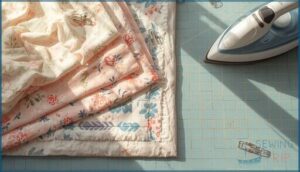
Your fabric prep work sets the stage for every smooth curve you’ll cut. Think of it this way: wrinkled, slippery, or unstable fabric is like trying to draw a perfect circle on a crumpled napkin.
Let’s walk through the essential prep steps that’ll transform your fabric into a cutting-ready dream.
Pressing and Smoothing Techniques
Smooth fabric is the secret sauce for clean curves. Press from the center outward with straight strokes and gentle lifts—no back-and-forth ironing that distorts your edges.
Use a press cloth to protect delicate fibers, and dial in the right steam settings for perfect fabric relaxation. Let your material cool flat after curve smoothing to set the shape and prevent spring-back before cutting.
Stabilizing Fabrics With Interfacing
Wobbly fabric is your curve-cutting enemy—that’s where interfacing saves the day! Lock down stretchy or slippery materials before you touch that rotary cutter.
Five interfacing types to transform your fabric preparation:
- Fusible woven – Bonds with heat, maintains drape for edge reinforcement
- Nonwoven – Adds crisp stability for precise sewing curves
- Knit – Preserves stretch while preventing distortion
- Lightweight – Perfect for delicate fabrics needing gentle support
- Medium-weight – Reinforces high-stress curves and seams beautifully
Match your stabilizer materials to fabric weight for quilting tips and tricks that actually work.
Selecting Suitable Fabrics for Curves
Fabric weight makes or breaks your success with sewing curved fabrics. Aim for six to eighteen ounces per yard—ponte knit gives structure without bulk, while lightweight silks drape like a dream over curved seams.
Check fiber content and stretch recovery too! Cotton blends offer comfort, polyester blends hold their shape, and stable knits with twenty to forty percent stretch contouring beautifully.
Surface texture matters—matte finishes minimize bumps along curves better than shiny satins.
Layering Fabric for Consistent Results
Think of layering fabric like building a sandwich—order matters for precision cutting and curve accuracy! Stack your lightest material closest to the cutting mat to minimize shifting, then work up through heavier weights for edge stability.
Master these stacking techniques:
- Align grainlines across all layers to maintain drape consistency
- Let stacked fabrics rest flat five to ten minutes before cutting curves
- Secure layers with pattern weights along the curve to prevent drift
Compatible material selection keeps your rotary cutter gliding smoothly through multiple layers without distortion.
Safe Rotary Cutter Handling for Curves
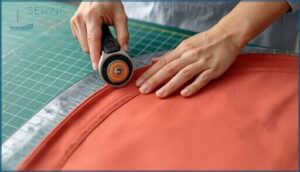
Cutting curves with a rotary cutter is exciting work, but safety comes first every single time.
You need a solid grip, smart hand placement, and a workspace that won’t trip you up.
Let’s walk through the essential safety practices that’ll keep your fingers safe and your cutting confident.
Proper Grip and Pressure Application
Your rotary cutter becomes an extension of your hand when you master proper grip techniques. Place your middle finger’s pad on the underside of the ergonomic handle for stable leverage, while your thumb rests along the top edge—this combo gives you blade guidance magic.
For pressure control and smooth cutting curves, distribute most force through your last three fingers. Keep your wrist alignment neutral to prevent blade deflection during those tight turns.
Finger Placement and Hand Safety
Your fingers are your most valuable sewing tools—protect them like gold! Smart Hand Positioning keeps your cutting hand safe while giving you total Blade Control over those Sewing Curves.
- Keep guiding fingers on the ruler edge, never on the cutting line, for solid Sewing Safety Tips
- Position knuckles above the blade path to avoid contact during directional turns
- Wear Cut Resistance Safety Gloves during extended sessions for extra finger guard protection
- Align your palm with the Ergonomic Handle while keeping your opposite hand behind the blade line
Workspace Organization and Safety Practices
A tidy setup is your secret weapon for Injury Prevention and smooth curves. Position your SelfHealing Mat on a flat surface with Workspace Lighting overhead—bright and cool for crisp visibility. Keep your Rotary Cutter and Crafting Essentials within 18 inches for quick grabs.
Use non-slip pads to anchor Ergonomic Workspaces, and clear scrap fabric after each cut. Smart Tool Storage and Safety Protocols mean fewer mishaps and smoother Sewing Safety every time!
Blade Locking and Storage Tips
Lock your Blade Security after every single cut—that click confirms peace of mind. Store your Rotary Cutter in a protective case with the Safety Features engaged to prevent accidental nicks.
Dedicated Storage Solutions keep Blade Sizes organized and Blade Protection solid. Reliable Locking Mechanisms transform Sewing Tools and equipment into safer companions, so Rotary Cutter Techniques and Sewing Safety Tips work together beautifully!
Techniques for Smooth Curved Cuts
Mastering curves with a rotary cutter isn’t about rushing—it’s about rhythm and control.
Mastering curves with a rotary cutter demands rhythm and control, not speed
The right approach transforms wobbly edges into smooth, professional lines that make your projects shine.
Let’s explore the key techniques that’ll give you confidence and precision every time you cut a curve.
Slow, Controlled Cutting Motions
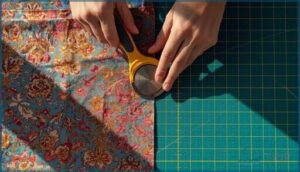
Master blade control by slowing down—let your rotary cutter glide at a steady pace that matches the curve’s arc. Cutting speed directly impacts curve precision, so use short passes instead of long sweeps.
Keep your hand stability rock-solid by resting your pinky on the mat, and maintain consistent pressure throughout the motion. These cutting techniques for curves transform wobbly lines into smooth, professional arcs every time.
Using Guides for Consistent Curves
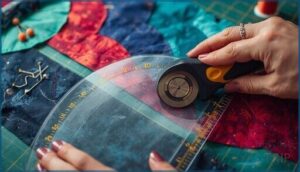
Once you’ve nailed the motion, grab a French curve or flexible ruler to lock in curve templates for perfect radius control. Align your guide along the marked path, then let your rotary cutter track that edge for spot-on cutting accuracy.
These cutting techniques for curves plus smart quilting tools and accessories make repeatable arcs a breeze.
Adjusting Blade Size for Tight or Gentle Curves
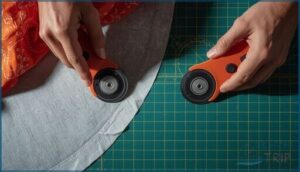
Flexibility is your secret weapon when sewing curved fabrics—blade size selection transforms tricky arcs into seamless rotary cutting.
For tight curves under 3 inches, switch to a 28mm rotary cutter to boost maneuverability and edge smoothness. Gentle curves? A 45mm blade maintains cutting speed while fabric tension stays balanced.
Match your blade to the curve geometry, and you’ll see crisper radii with every pass. Smart cutting techniques for curves start here.
Cutting Multiple Layers on Curved Lines
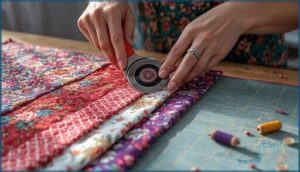
Precision in fabric stacking makes all the difference when you’re cutting curves through multiple layers. Align layers carefully with right sides down, then secure with spray adhesive or basting stitches for perfect multi layer stability.
Use slow, steady passes with light to moderate pressure—your rotary cutter glides smoothest that way. This curved cutting approach delivers clean edge finishing every time.
Finishing and Maintaining Curved Edges
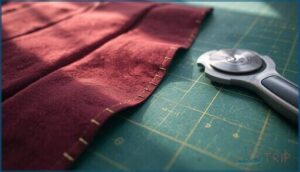
Once you’ve cut those beautiful curves, the real work begins.
The finishing touches make the difference between a sloppy project and one that looks professionally made.
From clipping seams to keeping your blade sharp, these final steps will help your curves look crisp and stay that way.
Clipping and Notching Curved Seams
Clipping and notching curved seams transforms your cutting techniques for curves into polished edge finishing. Think of clips as tiny relief valves that let concave curves breathe, while notches trim away bulk on convex shapes.
Here’s your game plan for sewing curved fabrics with confidence:
- Clip concave curves every 1/2 inch for curve smoothing without cutting through stitches
- Notch convex curves with small V-shapes to reduce rippling and improve seam reinforcement
- Keep clip depth at least 2mm from the stitching line to maintain strength
- Space notch placement evenly around dome-shaped curves for consistent results
- Press curved seam sewing carefully to set your beautiful, flat finish
Pressing Curves to Prevent Distortion
Pressing curves locks in your hard-earned accuracy! Set your iron between 150 and 180 degrees for fabric relaxation without scorching. Use a press cloth and bone-dry tools to protect those edges.
Start at the center and work outward with light passes—no heavy-handed mashing here. A pressing ham keeps gentle arcs smooth. Let curves cool completely so fibers can set.
These curve pressing tips and heat control methods guarantee your sewing curved fabrics stays distortion-free and professional.
Cleaning and Oiling Rotary Cutter Blades
Your rotary cutter craves attention after each project! Clean blades after every session using a lint-free cloth with mild soap, then dry completely.
Here’s your blade maintenance routine:
- Oil Application: Drop light sewing machine oil at the pivot point, then wipe excess to avoid fabric transfer.
- Blade Inspection: Check for nicks or burrs signaling replacement time.
- Storage Safety: Lock and store in dry locations away from moisture.
Preventing Fraying and Distortion on Curved Cuts
Fray reduction starts the moment your blade touches fabric—sharp cutters and tight-weave materials create clean edges that resist unraveling.
Lock in edge stability with stay stitching within 1/4 inch of curved seam lines, preventing stretch during sewing curves.
For distortion control, apply lightweight interfacing along curve allowances and press gently from the wrong side for fabric relaxation and curve smoothing.
Frequently Asked Questions (FAQs)
What is the best tool for cutting curved wood?
For solid wood, a bandsaw with a narrow blade delivers tight curves on thick stock, while a scroll saw excels at intricate patterns and a jigsaw accommodates varied cuts on larger panels.
What size rotary cutter for curves?
For tight curves, grab a 28 millimeter blade—it’s your nimble friend. Medium curves? The 45 millimeter tackles them beautifully. For gentle sweeps across multiple layers, the 60 millimeter blade size selection rocks.
How do I mark curves on fabric before cutting?
You’ll want tailor chalk or erasable fabric markers that contrast sharply with your fabric.
Use a French curve for smooth tracing, then anchor with pattern weights to prevent shifting during cutting.
Whats the best method for cutting armhole curves?
To cut armhole curves beautifully, use a 28mm rotary cutter for tight spots and a 45mm blade for sweeping arcs—slow, steady pressure keeps your curve smooth and prevents wonky edges!
How do I fix mistakes on already-cut curves?
Gentle gradual trimming transforms trouble into triumph. Dampen your curve mistake by carefully removing tiny amounts with a sharp rotary blade, checking against your template after each micro adjustment until the edge flows smoothly.
Are there special techniques for cutting scalloped edges?
Scalloped edges shine when you trace a template with a removable pen, then follow that curved guide slowly using a 28mm-45mm rotary cutter blade.
Press first, clip curves gently, and finish with topstitching for perfect scalloped seam management.
Conclusion
That perfect curve? It’s your quilting signature—the flourish that says you’ve mastered the craft. With sharp blades, steady pressure, and these rotary cutter techniques for curved edges in your toolkit, you’ll slice through arcs like a hot knife through butter.
No more jagged edges or frustrated do-overs. Just clean, confident cuts that make your projects sing. Lock that blade, trust your prep work, and watch those curves become your proudest quilting moments.
- https://joann.prf.hn/click/camref:1011l3xpmt/destination:https%3A%2F%2Fwww.joann.com%2Fp%2Folfa-45mm-magenta-ergonomic-rotary-cutter%2F19756907.html
- https://www.youtube.com/watch?v=PO6Ji0tMTeY%C2%A0
- https://www.seasonedhomemaker.com/how-to-get-perfectly-straight-fabric-cuts-every-time/
- https://aimforquality.wordpress.com/2024/03/30/which-french-curve/
- https://www.guidelines4quilting.com/pages/guidelines-ruler-built-in-grip-strips