This site is supported by our readers. We may earn a commission, at no cost to you, if you purchase through links.
Most quilters discover sergers by accident—a finished edge on a store-bought quilt catches their eye, and suddenly a regular sewing machine feels like it’s been holding them back. That gap between homemade and professional-looking quilts? A serger closes it fast.
These machines trim, encase, and stitch in one pass, cutting construction time dramatically while locking seams against years of washing and heavy use. Choosing the right serger machines for quilters comes down to matching specific features—differential feed, stitch type, threading systems—to how you actually work. The eight machines ahead cover every skill level and budget worth considering.
Table Of Contents
Key Takeaways
- Matching your serger’s features — especially differential feed and stitch type — to your specific quilting style matters far more than chasing the highest price tag.
- The sweet spot for most quilters lands between $200 and $500, where you get solid performance without paying for features you’ll never use.
- Routine maintenance like cleaning lint after every session and oiling every 8–10 hours is what separates a machine that lasts years from one that breaks down mid-project.
- A serger doesn’t replace your regular sewing machine — it works alongside it, handling edge finishing and seam durability so your overall quilt quality jumps fast.
Essential Serger Features for Quilters
Not every serger is built the same, and for quilters, the right features can make or break your projects.
Understanding how sergers and overlock machines actually differ helps you zero in on exactly which features matter for your quilting work.
Knowing what to look for saves you time, frustration, and money in the long run. Here are the key features worth paying attention to before you buy.
Stitch Types and Their Quilting Uses
Your serger’s stitch options are where the real magic happens. Overlock stitches secure and finish edges in one pass, while flatlock seams lie completely flat — perfect for reducing bulk at block intersections. Rolled hems give art quilts a clean, polished edge, and decorative edges add texture with minimal effort.
Three must-know stitches for quilters:
- Four-thread overlock for durable, wash-ready seams
- Flatlock for flat joins and decorative ladder detail
- Rolled hem for lightweight finishing and quilt labels
Choosing the right serger threads elevates stitch consistency across every project.
Differential Feed and Fabric Control
Think of differential feed as your serger’s secret weapon for fabric control. Two feed dogs work at different speeds — and that ratio changes everything.
Raise it toward 2 for gathering techniques on knit borders, drop it to 0.7 for lettuce-edge finishing. On stable quilting cotton, neutral at 1 keeps seam allowances flat and square across every quilting project.
Adjustable Stitch Length and Width
Stitch Length Control pairs with stitch width to give you real command over every seam. Most sergers run from 1.0 to 4.0 mm — shorter lengths around 1.5 mm boost seam durability for hard-working quilts, while longer settings near 3.5 mm speed up basting.
Wider stitch widths improve fabric edge finishing on heavier layers. Small adjustments, big difference in quilting stitch optimization.
Threading Guides and Tension Systems
Getting the threading right changes everything. Most sergers use Color Coding — each path marked in a distinct color — so Thread Management becomes almost visual.
Air Threading models push thread through loopers in seconds. Prefer hands-on control? Mechanical Dials let you fine-tune Tension Control one thread at a time.
Automatic tension control manages the balancing act for you on higher-end machines.
Importance of Thread Selection
Thread choices quietly make or break your quilt. The right pick affects seam strength, bulk, and how often you’re cleaning your serger sewing machine for quilting projects. These serger features for quilters matter more than most beginners expect.
- Cotton thread blends naturally with quilting fabric and gives a matte finish
- Polyester thread withstands heavy washing and mixed fabrics beautifully
- 50-weight thread keeps seams flat and intersection bulk down
- Woolly nylon adds softness in looper places for knit backings
Choosing The Right Serger for Quilting
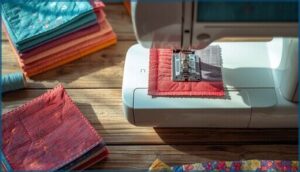
Picking the right serger for quilting isn’t one-size-fits-all — your style, budget, and skill level all play a role.
A few key factors can make the difference between a machine you love and one that collects dust. Here’s what to look at before you buy.
Matching Features to Quilting Styles
Your quilting style is the compass that points you to the right serger features. Chain piecing jelly rolls? You need a reliable feed system and high quilting speed.
Working with jerseys or mixed fabrics? Adjustable differential feed resolves fabric selection challenges beautifully. Stitch variety, edge finishing quality, and seam durability all shift based on what you’re making — so let your projects lead the way.
Budget Considerations for Quilters
Budget shapes every serger machine selection guide decision you’ll make. For most quilters, Serger Price Ranges fall between $200 and $500 — and that sweet spot covers solid budget-friendly options without unnecessary extras. Don’t forget Accessory Costs and Consumable Expenses like cones and blades. Used sergers can stretch your budget further, but inspect them carefully before buying.
Ease of Use for Beginners and Experts
Your sewing experience shapes everything about which serger feels right. A beginner serger lives or dies by its learning curve — and the best ones flatten it fast. Look for these userfriendly features:
- Control Layout with front-facing dials you can read at a glance
- Air Threading systems that cut setup time dramatically
- Workspace Visibility with bright LEDs and generous throat space
Speed Modes and guided settings let experts take full control while keeping beginners confident.
Brand Comparisons for Quilting Needs
Ever feel like picking a serger is a tug-of-war between features and price? Each brand brings its own flavor: Juki MO114D Overlock Sewing Machine is a powerhouse for stitch versatility and build quality, while Singer Heavy Duty Serger Overlock Machine shines for value. Janome 7933 balances price and reliability.
Here’s how your top contenders stack up:
| Brand | Air Threading | Stitch Versatility |
|---|---|---|
| Juki MO114D | No | High |
| Singer HD | No | Medium |
| Janome 7933 | No | Medium |
Maintenance and Long-Term Value
Think of your serger maintenance like a car — skip the upkeep, and you’ll pay for it later. Routine serger maintenance and care, like cleaning lint after every project and oiling every 8–10 hours, prevents costly repairs.
Long term costs average $80–$160 yearly for professional servicing. Strong resale strategies include keeping original accessories and service records. Serger durability improves substantially with consistent maintenance schedules.
Top 8 Serger Machines for Quilters
Finding the right serger can feel overwhelming with so many options on the market.
These eight machines were chosen with quilters specifically in mind — balancing stitch quality, ease of use, and real-world value. Here’s what made the cut.
1. Singer Heavy Duty Serger Machine
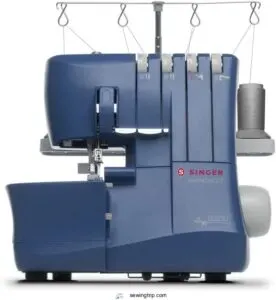
The Singer 14HD854 is a powerhouse built for quilters who mean business. Its heavy-duty metal frame keeps everything rock-solid at 1,300 stitches per minute — no wobbling, no skipping, even through thick quilt sandwiches. You get six built-in stitch types, including flatlock and rolled hem, plus a 60% larger cutting knife for clean, consistent seam allowances. The color-coded threading system makes setup fast, and the extra-high presser foot lift accommodates bulky batting layers without a fight.
| Best For | Home sewers and hobbyists who work with stretchy fabrics, sheers, or delicate materials and want clean, professional-looking seams fast. |
|---|---|
| Thread Count | 2/3/4 thread |
| Stitch Speed | 1,300 SPM |
| Frame Material | Metal |
| Differential Feed | Yes |
| Rolled Hem | Yes |
| Threading System | Color-coded |
| Additional Features |
|
- Handles 2-3-4 thread combinations, so you’ve got flexibility for all kinds of stitches and finishes
- Differential feed makes sewing stretchy or flimsy fabrics way less frustrating
- 1,300 stitches per minute means you can knock out projects quickly without sacrificing quality
- Threading can be tricky at first, even with the color-coded system
- No paper manual included — you’re stuck with a digital version, which isn’t everyone’s preference
- Some users have run into performance issues like pedal problems or timing hiccups right out of the box
2. Juki Overlock Sewing Machine
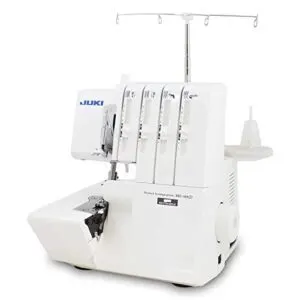
If the Singer 14HD854 is built like a tank, the Juki MO-114D is built like a race car. At 1,500 stitches per minute, it blazes through quilt edges and chain-pieced blocks without breaking a sweat. The metal frame keeps it steady, and the color-coded threading guides make setup surprisingly painless. Differential feed tackles everything from silky cotton to upholstery-weight fabric with ease. At $699, it’s a serious investment — but quilters who sew often will feel every penny’s worth.
| Best For | Quilters and home decor sewers who sew regularly and want a fast, reliable overlocker that can handle everything from delicate fabrics to heavy upholstery. |
|---|---|
| Thread Count | 2/3/4 thread |
| Stitch Speed | 1,500 SPM |
| Frame Material | Metal |
| Differential Feed | Yes |
| Rolled Hem | N/A |
| Threading System | Standard |
| Additional Features |
|
- Blazing fast at 1,500 stitches per minute — great for getting through big projects quickly
- Metal build keeps it sturdy and stable, even at high speeds
- Differential feed handles a wide range of fabric weights without fuss
- Some users have reported performance issues after a few months of use
- The pedal cord runs short, so you may need an extension cord depending on your setup
- No catch tray included, so cut fabric scraps end up wherever they land
3. Janome Horizon Serger Machine
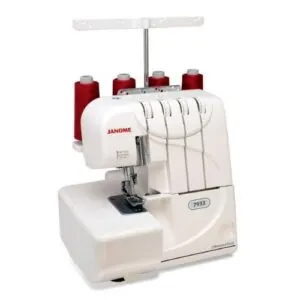
Speed is great, but sometimes you want a machine that’s a quiet workhorse. That’s the Janome 7933 Horizon. This two-needle 3/4-thread serger processes professional garments, intricate ruffles, and decorative threads like yarn without the noise of heavier machines.
The wide differential feed options give you real control over tricky fabrics. Beginners love how approachable it feels, and experienced quilters appreciate the precision. If clean finishes matter to you, the Janome 7933 earns its spot on this list.
| Best For | Beginners and experienced sewers who want a quiet, versatile serger for professional garments, ruffles, and decorative threading. |
|---|---|
| Thread Count | 3/4 thread |
| Stitch Speed | N/A |
| Frame Material | N/A |
| Differential Feed | Yes |
| Rolled Hem | N/A |
| Threading System | Standard |
| Additional Features |
|
- Runs quietly compared to most sergers, so you can sew without disturbing everyone around you
- Handles a wide range of projects — from clean garment finishes to decorative yarn threading
- Beginner-friendly design makes it easy to pick up without a steep learning curve
- Threading and tension can be frustrating, especially on refurbished models
- No removable sleeve or pant hem arm, which limits some finishing options
- Quality control isn’t always consistent — some units have arrived with defects right out of the box
4. Singer Metal Frame Serger Machine
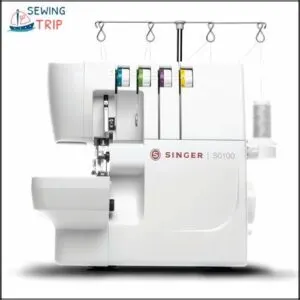
If the Janome wins on quiet precision, the Singer S0100 wins on muscle. This little powerhouse packs a full metal frame that stays put — no creeping across your table, even during long chain-piecing sessions.
You get 2, 3, or 4-thread options, 8 built-in stitch configurations, and a top speed of 1,300 stitches per minute. The color-coded threading system makes setup less intimidating.
For quilters who want durability and speed without a steep learning curve, this Singer delivers.
| Best For | Quilters and sewers who want a fast, durable serger that can handle everything from delicate fabrics to thick knits without slowing down. |
|---|---|
| Thread Count | 2/3/4 thread |
| Stitch Speed | 1,300 SPM |
| Frame Material | Metal/Plastic |
| Differential Feed | Yes |
| Rolled Hem | N/A |
| Threading System | Color-coded |
| Additional Features |
|
- Full metal frame keeps the machine stable even at top speeds — no sliding around mid-project
- 1,300 stitches per minute with 2, 3, or 4-thread options gives you serious versatility
- Color-coded threading system takes some of the guesswork out of setup
- Some buyers received machines that weren’t pre-threaded as advertised, and a few were missing the manual
- Threading can still be tricky for beginners without a video tutorial nearby
- Occasional reports of the pedal or machine cutting out unexpectedly
5. Juki Portable Serger Machine
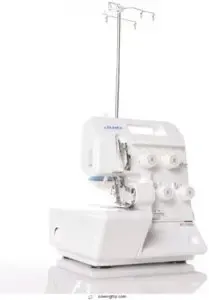
Portability meets performance in the Juki MO-644D. This compact machine processes 2, 3, and 4-thread stitches and runs up to 1,500 stitches per minute — fast enough to fly through a quilt top in one sitting. Color-coded threading takes the guesswork out of setup, and the adjustable differential feed (0.7 to 2.0) keeps cottons feeding flat. The built-in handle makes it easy to grab and go for retreats. A solid pick if you want professional results without being chained to one room.
| Best For | Sewers who want a reliable, easy-to-thread serger for light to medium weight fabrics and need something portable enough to take to classes or retreats. |
|---|---|
| Thread Count | 2/3/4 thread |
| Stitch Speed | N/A |
| Frame Material | N/A |
| Differential Feed | Yes |
| Rolled Hem | Yes |
| Threading System | Color-coded |
| Additional Features |
|
- Color-coded threading makes setup way less frustrating, even if you’re new to sergers
- Handles 2, 3, and 4-thread stitches plus automatic rolled hem — solid versatility for the price
- Compact and light enough to grab and go without a second thought
- No chain stitch or hem stitch, so it won’t cover every technique
- Needs oiling before first use, which is an extra step some people overlook
- Best suited for lighter fabrics, so it may struggle if you work with heavier materials often
6. Brother Heavy Duty Serger Machine
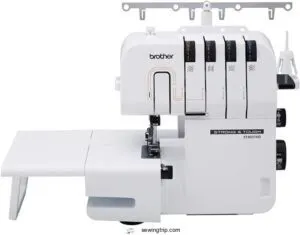
Built like a tank, the Brother ST4031HD is a serious machine for quilters who mean business. Its reinforced metal frame accommodates multiple layers of denim or canvas without flinching — and at 1,300 stitches per minute, you’ll blaze through long quilt edges fast.
The differential feed (0.7 to 2.0) keeps fabrics smooth and shift-free. Color-coded threading guides make rethreading painless mid-project. Plus, the large extension table gives bigger quilt pieces the support they need. Control and durability in one package.
| Best For | Sewing enthusiasts, professionals, and small businesses tackling heavy-duty projects like denim, thick fabrics, and home decor. |
|---|---|
| Thread Count | 2/3/4 thread |
| Stitch Speed | 1,300 SPM |
| Frame Material | Metal/Plastic |
| Differential Feed | Yes |
| Rolled Hem | N/A |
| Threading System | Standard |
| Additional Features |
|
- Metal frame handles tough, multi-layer fabrics without breaking a sweat
- Blazes through projects at 1,300 stitches per minute — seriously fast
- Color-coded thread guides make rethreading way less of a headache
- Threading can be tricky, so beginners might feel a bit overwhelmed
- Needs regular oiling to stay quiet and running smoothly
- That manufacturer oil smell can be pretty strong right out of the box
7. Juki Pearl Serger Sewing Machine
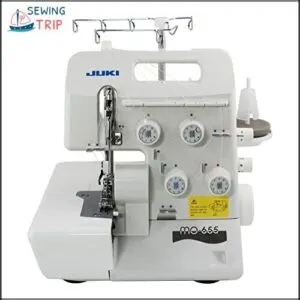
The Juki MO-655 is a genuine workhorse that quilters keep coming back to. It accommodates 2, 3, 4, and 5 thread options — including flatlock and rolled hem — so you’re covered from piecing quilt-as-you-go panels to finishing delicate runners. The differential feed ranges from 0.7 to 2.0, keeping layers stable without rippling. Color-coded threading guides make setup less frustrating, even mid-project. At 1,500 stitches per minute, you’ll move through long seams fast. It’s compact, capable, and built for serious quilting work.
| Best For | Home sewers and professionals who work with a variety of fabrics and want a reliable, multi-function serger for garment construction, hemming, and everyday sewing projects. |
|---|---|
| Thread Count | 2/3/4 thread |
| Stitch Speed | 1,300 SPM |
| Frame Material | Metal/Plastic |
| Differential Feed | Yes |
| Rolled Hem | N/A |
| Threading System | Color-coded |
| Additional Features |
|
- Handles 2/3/4/5 thread options with rolled hem, flatlock, overlock, and chain stitch — a lot of versatility in one machine
- Works on everything from lightweight cotton to heavy denim and canvas, so you’re not limited by fabric type
- Includes a cheat sheet and manual, which helps you get up and running without digging through endless tutorials
- Threading can be a real headache, especially if you’re new to sergers — expect a learning curve
- Some users have had issues with the chain stitch function, which is frustrating if that’s a feature you’re counting on
- No waste collection bin included, so trimmed fabric scraps go straight to your table or floor
8. Margar Serger Overlock Sewing Machine
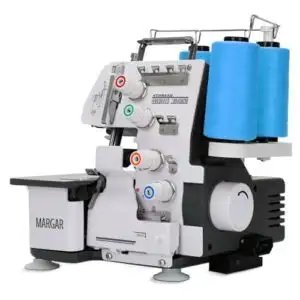
The Margar Serger Overlock Sewing Machine is a solid pick if you want industrial-grade durability without a commercial price tag. Its heavy-duty aluminum alloy frame processes 1,250 stitches per minute with barely any vibration — great news for keeping seams straight through thick quilt layers. You get 3- and 4-thread capability plus 12 built-in stitch patterns, including rolled edge options. Built-in LED lighting helps with dark fabrics and precise thread placement. At roughly 17 pounds, it’s portable enough to move yet steady enough to stay put.
| Best For | Quilters and home sewers who want near-industrial speed and stitch quality without spending commercial machine money. |
|---|---|
| Thread Count | 2/3/4/5 thread |
| Stitch Speed | N/A |
| Frame Material | N/A |
| Differential Feed | Yes |
| Rolled Hem | Yes |
| Threading System | Standard |
| Additional Features |
|
- Cranks out 1,250 stitches per minute with minimal vibration, so thick layers stay under control.
- Handles both 3- and 4-thread setups with 12 stitch patterns, including rolled edges — plenty of flexibility for different projects.
- Built-in LED lighting makes threading and working with dark fabrics a lot less frustrating.
- At 17 pounds, it’s manageable but not exactly grab-and-go for everyone.
- The range of stitch patterns, while decent, may feel limited if you’re used to more feature-rich machines.
- Higher stitch speeds can have a learning curve for newer sewers still getting comfortable with overlock machines.
Quilting Techniques Using a Serger
Once you have the right serger, the real fun begins. Learning a handful of key techniques will transform how you approach every quilting project, from raw edges to finished seams.
Here are five methods worth adding to your practice.
Serging Quilt Blocks for Speed and Precision
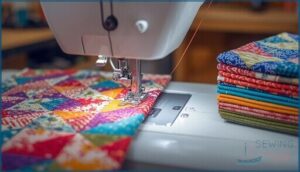
Serging quilt blocks is genuinely a breakthrough for speed optimization and seam accuracy. Your serger takes care of stitching and trimming in a single pass — that alone cuts quilting time dramatically.
- Differential feed keeps fabric control steady, even on bias edges
- Serger blades trim as you go, cleaning up quilt block assembly instantly
- Consistent ¼-inch seams improve precision techniques across every block
- Chain piecing dozens of units becomes straightforward in one continuous run
Finishing Quilt Edges to Prevent Fraying
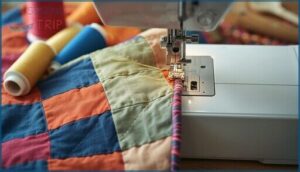
Fraying edges are a quilt’s quiet enemy — and your serger is the fix. A 3-thread overlock wraps raw edges clean, while polyester serger thread withstands repeated washing without breaking down.
Trim just 1 to 2 millimeters with the knife for a precise finish. These edge finishing tips and fabric stabilization techniques, paired with smart serger thread choices, make fray prevention methods practically painless.
Flatlock Stitch for Joining Batting and Backs
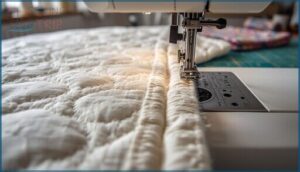
Now let’s talk about joining batting and backs — and this is where flatlock techniques really shine. Loosen your serger tension so the needle thread releases and the layers open flat. Batting joins land nearly ridge-free, and quilt backing seams stay low-profile enough for smooth machine quilting. Smart thread selection — think polyester — keeps those seams holding strong through dozens of washes.
Flatlock techniques join batting and backing nearly ridge-free, keeping seams smooth for machine quilting
Decorative Edges and Embellishments
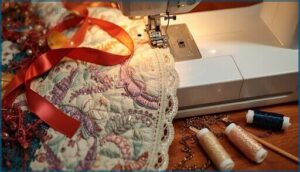
Your serger isn’t just a seam machine — it’s a creative powerhouse for decorative edges and embellishments. Rolled hems with metallic thread add shiny, polished outlines to art quilt edges.
Decorative trims, lace, and ribbons attach in one clean pass. Try these edge finishing ideas:
- Rolled hems with decorative threads for fancy edge finishes
- Lettuce edges for wavy, ruffled fabric embellishments
- Layered lace and sewing accents secured in a single serger pass
Creating Durable Seams for Heavy Use
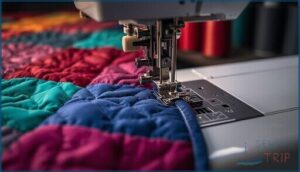
Once the decorative work is done, it’s time to think about seam reinforcement. Four-thread overlock is your go-to for quilts that see real daily punishment — kids dragging them, pets hogging them, hot wash cycles.
Pair that with polyester thread types for extra tensile strength. Dial in your differential feed, keep batting layers flat, and your overlock techniques will hold for hundreds of washes.
Serger Maintenance and Care for Quilters
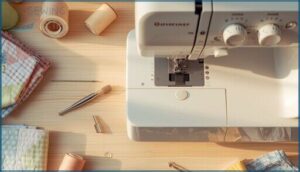
A serger that runs well is a serger that keeps you quilting.
Like any hardworking tool, it needs a little attention to stay in top shape.
Here’s what every quilter should know about keeping their machine running smoothly.
Routine Cleaning and Upkeep
Think of your serger like a high-performance tool — it runs best when you stay on top of the small stuff. Lint removal after every quilting session keeps your loopers and feed dogs clear.
Here’s a simple machine maintenance rhythm to follow:
- Brush out lint from loopers and knives after each project.
- Apply oil lubrication every 8–10 hours of stitching.
- Follow cleaning schedules — deep-clean under the needle plate every two weeks.
Serger storage matters too — keep it covered and unplugged between sessions.
Proper Thread and Needle Choices
Your thread and needle choices quietly make or break every seam. Polyester thread resists abrasion and stays colorfast through dozens of washes, while 50-weight cotton keeps seams flat and bulk-free.
Match your needle to your fabric — universal for woven quilting cottons, ballpoint for knits.
| Thread/Needle Choice | Best Use |
|---|---|
| 50-weight polyester | Durable, everyday quilts |
| 50-weight cotton | Natural fiber, flat seams |
| Universal 80/12 needle | Woven quilting cottons |
| Ballpoint needle | Knit or t-shirt quilts |
| Sharp/Microtex needle | Tight-weave high-thread-count cotton |
Troubleshooting Common Serger Issues
Five issues knock most quilters off course: Tension Issues, Thread Breakage, Needle Problems, Fabric Distortion, and Motor Malfunctions. Loops hanging off the edge? Your upper looper is too loose. Puckering along seam lines usually means needle tension is too tight.
Replace bent needles first — it fixes skipped stitches more often than you’d think. Motor stalling? Check for lint buildup before calling a technician.
Extending The Life of Your Serger
Longevity is earned, not given. Cover your machine when it’s not in use — dust is a quiet killer. Oil regularly, but just a drop at the manual’s marked points.
Swap blades before cuts get ragged, and change needles every 8 hours of sewing. Good user habits and consistent serger maintenance and care will keep your machine running strong for years.
Frequently Asked Questions (FAQs)
Can a serger replace a regular sewing machine?
Like a sous chef who preps but can’t plate the final dish, a serger manages edges and speed—but it can’t replace your domestic sewing machine’s piecing accuracy, quilting limitations aside, or full project scope.
How do I store a serger when not in use?
Cover it with a fitted hard case for dust protection, store it somewhere dry, and leave the presser foot down. Add silica gel packs for idle maintenance and a clean machine every session.
What accessories are essential for serger quilting?
Think you just need a serger? Wrong.
Serger Feet, Extension Tables, Thread Stands, Quilting Gloves, and Cutting Tools are the real MVPs — without them, your seam finishing and fray prevention game stays amateur.
How loud are serger machines during operation?
Most sergers run between 60 and 75 decibels — about as loud as a conversation.
Typical noise levels stay manageable, but loudness factors like plastic frames and dull knives can increase sound. Hearing comfort improves when you reduce serger vibration with a rubber mat.
Conclusion
The right serger machines for quilters work like a second set of expert hands—handling edges, seams, and finishes while you focus on the creative work.
Every machine on this list brings something real to the table, whether you’re binding your first lap quilt or churning out king-sized projects on a deadline. Match the features to how you actually sew, not just what looks impressive on paper.
Your best quilts are still ahead of you.
- https://www.sewingpartsonline.com/products/singer-s0100-serger
- https://rockymountainsewing.com/rolled-hems-time-to-get-out-the-serger/
- https://stitchinheaven.com/blogs/howdy/our-serger-machine-rundown
- https://sewcanshe.com/the-best-sergers-for-sewing/
- https://www.bernina.com/en-US/Machines-US/Overlocker/Overlock-Coverstitch-Combo/BERNINA-L-890-Quilters-Edition