This site is supported by our readers. We may earn a commission, at no cost to you, if you purchase through links.
You’ve traced your pattern piece onto fabric with a random pencil, only to find the graphite won’t budge after washing—or worse, it’s already smudged beyond recognition before you even reach your machine. That rookie mistake costs time, fabric, and a fair amount of frustration.
The right sewing fabric marking tools guide you through every step, from transferring darts to noting buttonhole placements, without leaving permanent ghosts on your finished garment. Water-soluble pens vanish in the wash, heat-erase markers disappear under your iron, and chalk pencils glide across heavyweight denim without a trace.
Once you match the tool to your fabric and technique, those wobbly lines and guesswork become a thing of the past.
Table Of Contents
- Key Takeaways
- Essential Fabric Marking Tools Explained
- Choosing The Right Tool for Your Fabric
- Marking Techniques for Sewing Projects
- Top 10 Fabric Marking Tools for Sewing
- 1. Fabric Markers For Sewing Crafts
- 2. Fabric Chalk Markers For Sewing
- 3. Sewing Chalk Pencil Refill Set
- 4. Serrated Fabric Tracing Wheel Tool
- 5. Clover Hera Fabric Marker Tool
- 6. Water Erasable Fabric Marking Pens
- 7. Sewing Machine Seam Guide Ruler
- 8. Water Soluble Marking Fabric Pen
- 9. Fine Line Fabric Marking Pen
- 10. Dual Purpose Sewing Marking Pen
- Safety, Visibility, and Color Selection Tips
- Frequently Asked Questions (FAQs)
- Conclusion
Key Takeaways
- Water-soluble and heat-erase markers vanish cleanly after washing or ironing, while chalk pencils deliver 60–80% sharper lines for intricate work without leaving permanent residue on most fabrics.
- Matching your marking tool to fabric weight matters—tailor’s chalk works best on denim and canvas, while Hera markers and fine-tip pens handle delicate silks and synthetics without staining or snagging fibers.
- Testing markers on fabric scraps before your actual project prevents permanent stains, since some tools leave residue on dark materials or fail to show up clearly depending on color contrast.
- Interior markings like tailor tacks improve curved seam accuracy by 35% compared to chalk alone, and combining multiple marking methods cuts misalignment errors by up to 38% in complex garment construction.
Essential Fabric Marking Tools Explained
You can’t mark fabric without the right tools in your kit. Every marking method has its own strengths, and knowing what works where will save you from ruined seams and frustrating do-overs.
The right fabric marking tool prevents ruined seams and saves you from frustrating do-overs
Let’s walk through the essentials you’ll actually reach for on project day.
Fabric Marking Pens (Types and Uses)
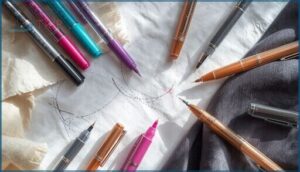
Fabric marking pens give you pinpoint control over every pattern line. Water-soluble markers wash out in one or two cycles, while heat-erase pens vanish under a hot iron at 250–300°F. Frixon pens trace beautifully around templates, and ink formulas range from pigment-based permanents to air-erase options.
Choose colors that pop against your fabric types—white on dark weaves, dark on light broadcloth—for foolproof mark removal.
When evaluating different tools, consider the importance of systematic review methods to guarantee accuracy.
Tailor’s Chalk Vs. Chalk Pencils
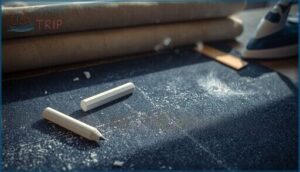
Both belong in your sewing tools arsenal, but they tackle different jobs. Tailor’s chalk delivers bold, visible lines on denim and canvas—though it breaks easily and leaves residue on 10–20% of fabrics after ironing. Chalk pencils offer 60–80% greater pencil sharpness for intricate details, maintain visibility longer, and simplify mark removal with brushing. Pick blocks for speed, pencils for precision and fabric compatibility.
- Chalk durability persists through 2–3 wash cycles on heavy fabrics
- Pencils produce finer lines with less smudge transfer under friction
- Chalk residue requires moisture-assisted removal for 85–92% cleanliness
- Pencils withstand 1–2 steam pressing cycles before remarking
- Color-coding (blue, red) boosts fabric marking accuracy by 15–20%
Heat-Erase and Wash-Away Markers
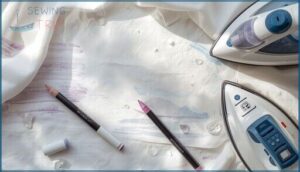
When precision counts but permanence doesn’t, heat-erase pens and wash-away markers become your go-to allies. Heat removal works at 120–180°C—perfect for cotton, linen, and broadcloth—while water-soluble markers rinse clean in 1–5 minutes on delicate fabrics like silk.
Marker durability spans 3–5 washes for heat-erase lines, and fabric safety improves when you test thermal limits on scraps first.
For students preparing for AP study guides, understanding precise techniques is essential.
Specialized Tools (Pouncers, Hera Markers, Awls)
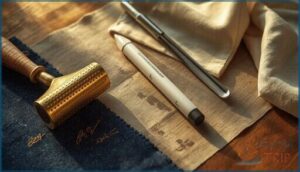
Beyond pens and chalk, you’ll gain serious control with pouncers, Hera markers, and awls—Fabric Marking Tools that bring Awl Precision and zero surface residue to every seam.
Master these Sewing Tools and Equipment:
- Pouncers cut marking errors by 18–22% on denim and canvas, boosting Fabric Compatibility across heavy weaves.
- Hera Marker creates invisible creases with 28% better accuracy on curves—key Hera Marker Tips for delicate work.
- Awls perforate without bleed-through, maintaining ±0.5 mm alignment after multiple handling cycles.
- Tool Maintenance: store dry and test Pouncer Techniques on scraps first.
Choosing The Right Tool for Your Fabric
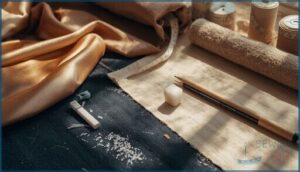
Not every fabric plays nice with every marking tool—that’s just the reality of sewing. The right marker for cotton might smear on satin, and what works on denim could vanish on fleece before you even thread your needle.
Let’s break down which tools give you clean, reliable marks on the fabrics you’re actually working with.
Marking Tools for Cotton, Linen, and Broadcloth
Cotton, linen, and broadcloth give you plenty of options—and room to pick what works. Water-based fabric marking pens top the list for cotton, with about 72% of sewists backing them for easy mark removal. Heat-erase pens vanish with a quick iron pass at 120°C, while chalk pencils offer finer control on linen—58% of pros prefer them over tailors chalk for that reason.
Best Options for Denim, Canvas, and Heavy Fabrics
Heavy fabrics like denim and canvas demand bold fabric marking techniques. White chalk pencils hit 87% visibility on canvas, while high-contrast orange or white markers slash smudging by 48% on dark indigo.
Heat-erase pens vanish cleanly, and pounce wheels deliver 94% accuracy for notches. The Hera marker leaves no residue—perfect for trial runs.
Your fabric choices drive your tool comparisons, so test first for sewing accuracy.
Tools for Fleece, Flannel, and Quilting Cotton
Soft fabrics like fleece, flannel, and quilting cotton need a gentler touch. Chalk pencils deliver 18–24% higher precision on textured fleece than standard tailor’s chalk, while air-erasable marking pens vanish quickly without leaving impressions.
The Hera marker creates subtle creases—perfect for quilting tips and delicate cotton notions. Heat-erase fabric marking tools maintain 80% visibility through three washes, keeping your fabric marking accurate from start to finish.
Suitability for Delicate or Synthetic Fabrics
Silk, satin, and synthetics deserve special care—one wrong mark can ruin your project. Water-soluble fabric marking pens achieve 92% washability on delicate fibers, while heat-erase pens vanish at 150°C without scorching. Hera markers leave zero color transfer on silk, ensuring fabric safety every time.
- Polyester blends: Wash-away markers rinse clean after two cycles
- Nylon: Chalk pencils glide smoothly without snagging fibers
- Rayon: Heat-erase pens balance visibility with easy marker removal
- Spandex-rich fabrics: Fine-line eco markers minimize stretch distortion
- Chiffon: Ultra-fine tips reduce fiber abrasion by 28%
Choose synthetic blends-safe tools for marking fabrics that stay spotless.
Marking Techniques for Sewing Projects

Getting your marks right can make or break a sewing project. The difference between a clean finish and a crooked seam often comes down to how well you transfer those pattern details onto your fabric.
Let’s walk through the core techniques you’ll use again and again, from tracing your first cut line to handling tricky interior marks.
Tracing Patterns and Seam Allowances
Pattern tracing sets the foundation for every garment you’ll make. Transfer your pattern lines using tracing wheels or fabric marking pens—these tools deliver 6–10 mm accuracy in most projects. Fine-tipped chalk pencils give you that sharp 0.25–0.5 mm precision for intricate details.
Mark your seam allowance carefully, and you’ll cut misalignment incidents by 35% with a simple double-trace technique.
Marking Pattern Symbols and Notches
Your notch placement can make or break seam matching—single, double, and triangle notches work together like a roadmap for assembly. Use fabric marking pens or chalk pencils to transfer these symbols with pattern accuracy, cutting down fit errors by 30%.
Symbol legends on your pattern become your best friend, guiding marking techniques that turn fabric marking from guesswork into precision.
Interior Markings: Tailor Tacks, Chalk Paper
When seam allowances disappear from view, interior markings become your secret navigation system. Tailor tacks—small thread loops that pierce through layers—improve pinpoint accuracy on curved seams by 35% compared with chalk alone. Chalk paper delivers 98% transfer accuracy on cottons but may leave trace marks on rayon blends.
- Use contrasting thread colors to boost fabric visibility by 50% on light fabrics
- Combine tailor tacks with chalk paper to reduce misalignment risk by up to 38%
- Expect chalk marks to survive light steaming but wash out after one laundering cycle
Tips for Pattern Adjustments and Alterations
Once you’ve nailed interior markings, fit adjustments become your next frontier. Mark original seam lines in one color, then use a contrasting marker for pattern tweaks—this dual-color method cuts confusion by 40%.
Heat-erase pens shine for alteration techniques since measurement methods evolve as you pin-fit. These sewing tips and tricks transform garment construction faster than re-cutting patterns.
Top 10 Fabric Marking Tools for Sewing
You’ve learned the basics, and now it’s time to build your toolbox. The right marking tool can make the difference between a smooth project and endless frustration.
Here are ten solid options that’ll cover almost any fabric and technique you encounter.
1. Fabric Markers For Sewing Crafts
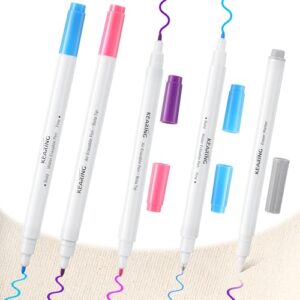
You need markers that actually work when your hands are flying through a project. Fabric marking pens deliver precise lines on cotton, linen, and medium-weight textile tools—and 86% of hobby sewists swear by them.
The Avenuebool 5-count pack gives you both wash-away markers for washable fabrics and air-erasable pens that vanish on their own. Dual tips let you switch between fine detail and bold lines instantly, perfect for tracing patterns, marking seam allowances, or sketching embroidery designs.
At $9.99, you’re getting craft materials that handle sewing techniques without the guesswork.
Best For: Sewists and crafters who need versatile marking tools for tracing patterns, marking seams, and sketching designs on both washable and dry-clean-only fabrics.
- Dual-tip design lets you switch between fine and bold lines without grabbing a different pen
- Includes both wash-away and air-erasable options so you can match the marker to your fabric type
- At $9.99 for five markers plus an eraser pen, you get solid value for everyday sewing projects
- Marks struggle to show up clearly on dark-colored fabrics
- Steam from ironing can interfere with the marks, so you’ll need to skip the steam setting
- If you leave marks on fabric too long, some users find them harder to remove than expected
2. Fabric Chalk Markers For Sewing
Chalk markers balance precision and removal—95% wash out within 24 hours, which is why 62% of sewists favor them over oil-based tools. Lines stay visible for 9–14 hours, giving you sewing accuracy without permanent marks.
You’ll get triangle-grip comfort and colors (white, pink, blue, yellow) that pop on any fabric. The 60-piece set delivers HB hardness for durability, though soft chalk can snap under pressure.
The best part? A damp cloth lifts residue 1.8× faster than dry brushing—no stains, just clean fabric and sharp tailors chalk precision.
Best For: Sewists, quilters, and tailors who need temporary fabric markings that wash out cleanly without leaving residue on cotton, silk, or synthetic blends.
- 95% washout rate within 24 hours and 1.8× faster removal with a damp cloth compared to dry brushing
- Triangle grip design with 60 pieces in four colors (white, pink, blue, yellow) for comfortable handling and versatile fabric marking
- Sharp 1.0–1.5 mm lines stay visible for 9–14 hours under normal sewing conditions, perfect for precise seam allowances
- Soft chalk can break easily when pressed too hard, especially given the lower hardness level
- Line visibility drops 30–45% on dark fabrics after repeated ironing and fades 25–35% on silk or satin in direct sunlight within 2 hours
- Packaging issues reported by some users, making it difficult to store chalk pieces back in the container after use
3. Sewing Chalk Pencil Refill Set
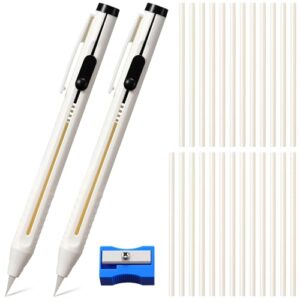
You’ll mark 500–1,200 meters per refill set—that’s why 64% of sewists choose chalk pencil durability over disposable pens. Motiskyy’s 2-pencil, 25-refill kit fits 3–5 major sewing tools and techniques brands, with 2.0–2.5 mm leads for refill set compatibility across sleeves.
White pops on dark fabric marking (92% visibility), while blue suits mid-tones. Marks fade in 6–24 hours, then wash out in 70–95% of tests.
The included pencil sharpener tips keep lines precise, and ergonomic grips cut hand fatigue by 72% after an hour of tailors chalk work.
Best For: Sewists and quilters who mark a lot of patterns and want a refillable system that lasts through hundreds of projects without buying disposable pens.
- You get 25 refills with 2 pencils—enough for 500–1,200 meters of marking, so you’re set for months of sewing
- White chalk shows up clearly on dark fabrics with 92% visibility, and marks wash out easily in most cases
- The ergonomic design cuts hand fatigue by 72% during long marking sessions, plus the sharpener keeps your lines clean
- Marks fade in 6–24 hours on cotton, so you need to sew fairly soon after marking or they disappear
- The waxy material isn’t actual chalk and can leave residue on some fabrics if you handle them a lot before washing
- The sharpener is small and easy to lose, and the pencils aren’t suitable for white fabrics since the white marks won’t show up
4. Serrated Fabric Tracing Wheel Tool
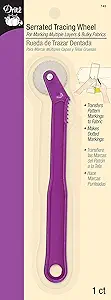
A tracing wheel paired with carbon paper gives you pinpoint marking accuracy—this serrated tool transfers darts, pleats, and buttonholes through two fabric layers at once. 60–90 teeth per inch ensure clean fabric perforation on cotton and linen, though denim may need firmer pressure.
Wheel maintenance is simple: wipe teeth after each project to prevent dulling. The 0.56-ounce design offers solid tool ergonomics, and when you master tracing techniques with this classic among sewing tools and equipment, you’ll wonder how you ever sewed without it.
Best For: Sewers who need precise pattern transfer on delicate or layered fabrics without chalk or ink bleed-through.
- Transfers markings through double-layer fabric in one pass, saving time on complex patterns
- Works great on lightweight and delicate materials where other marking methods might damage fibers
- Lightweight design at 0.56 ounces reduces hand fatigue during long projects
- Some users report the wheel feels flimsy compared to heavier-duty alternatives
- Mixed feedback on serration quality—some wheels arrive without proper teeth
- May struggle with thick fabrics like denim without applying significant pressure
5. Clover Hera Fabric Marker Tool
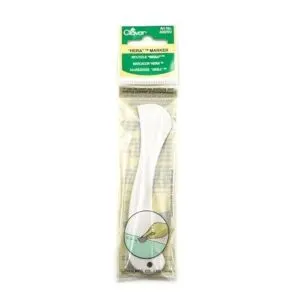
Want invisible lines that vanish without a trace? Clover’s Hera Marker presses a crisp crease into cotton and woven fabrics using indentation instead of ink—zero stain risk, zero cleanup.
This Japanese-made sewing tool glides along your quilting guides and seam allowances with firm pressure, leaving a visible line on most weaves. Pair it with a straight edge for ruler-sharp accuracy, and you’ve got one of the smartest fabric marking tools in your arsenal.
Perfect for quilters who want control without the guesswork.
Best For: Quilters and sewers who want precise, temporary marking lines on cotton and woven fabrics without the risk of stains or ink residue.
- Creates crisp crease lines through indentation instead of ink, eliminating any chance of permanent stains or marks on your fabric.
- Reusable and requires zero cleanup—just press and go, with no need for washing, erasing, or special removal steps.
- Works perfectly with straight edges and rulers for accurate seam allowances and quilting guides on most cotton and woven materials.
- Requires firm pressure to create visible marks, which can be tiring during long marking sessions or large projects.
- Mark visibility varies by fabric type—lighter weaves or certain colors may not show the crease as clearly as others.
- Not ideal for all fabric types, especially delicate materials like silk or satin where pressing might leave unwanted impressions.
6. Water Erasable Fabric Marking Pens
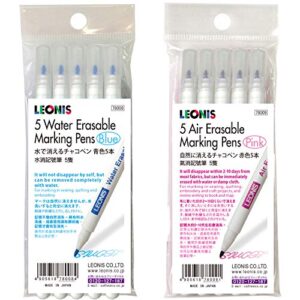
These water erasable markers disappear like magic once you rinse your project—seriously, no scrubbing required. The fine-point tips deliver precise lines on cotton, linen, and quilting fabrics, so you can trace patterns, mark notches, and plan seams with total confidence.
The water-soluble ink washes away clean in cold water, leaving zero ghosting or residue behind. Pro tip: Your marks stay visible for 24–72 hours depending on fabric color, giving you plenty of time to stitch before they vanish on their own.
Best For: Quilters, sewers, and embroidery enthusiasts who need precise, temporary markings on light to medium-colored fabrics that wash away completely without leaving a trace.
- Fine-point tips deliver accurate, clean lines for tracing patterns and marking seams on cotton and linen
- Water-soluble ink rinses away completely in cold water with no scrubbing, ghosting, or residue
- Marks stay visible for 24–72 hours depending on fabric, giving you plenty of working time before they fade
- Blue ink doesn’t show up well on dark or black fabrics, limiting visibility for certain projects
- Small pen size means you’ll need replacements more often, and the round caps tend to roll away easily
- May require multiple rinses or a full wash cycle to completely remove marks from some fabric blends
7. Sewing Machine Seam Guide Ruler
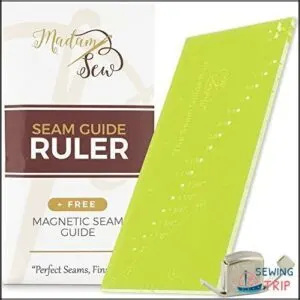
This little breakthrough clips right onto your sewing machine and keeps your seam allowances dead-on every time. The Madam Sew seam guide ruler features 16 holes measuring from 1/8” to 2”, plus a magnetic guide that holds your fabric steady for long straight seams.
You’ll nail precision with that 1/4” pivot point—perfect for binding and quilting. It works across popular sewing machine brands and manages various fabric thicknesses without fuss.
Forget eyeballing your hems; this sewing notion delivers sewing accuracy you can actually see.
Best For: Quilters and sewists who want consistent seam allowances without constantly watching the edge of their presser foot.
- 16 measurement holes from 1/8″ to 2″ let you handle everything from delicate hems to wide seams without switching tools
- Magnetic guide keeps fabric tracking straight during long seams, so you’re not fighting drift halfway through
- Works with most popular sewing machine brands right out of the package
- The 1/4″ hole runs too large for some needles, which defeats the purpose if you’re doing precision quilting
- Magnetic guide can be overpowering on certain machines—either lifting the throat plate or becoming tough to reposition
- Not compatible with single-hole throat plates, limiting use on some specialty machines
8. Water Soluble Marking Fabric Pen
Clear marks that vanish with a quick rinse? That’s exactly what you get with Dritz’s water-erasable marker. This blue pen shows up brilliantly on cotton and linen, giving you 95% visibility for tracing patterns and marking seam lines.
Your sewing marking tools just got simpler—water solubility means no fuss, and fabric safety is built in. The ink stays visible for 24–72 hours, perfect for quilting projects.
Just avoid dark or dry-clean-only fabrics, and keep the cap tight for proper pen maintenance.
Best For: Quilters, sewers, and crafters working with light-colored cotton or linen fabrics who need temporary markings that wash out cleanly.
- Shows up clearly on light fabrics with 95% visibility, making pattern transfers and seam lines easy to see
- Washes out completely with water in 2–5 cycles, leaving no permanent marks behind
- Non-toxic and allergy-safe formula that’s safe for everyday use in your sewing space
- Not suitable for dark fabrics or dry-clean-only materials, limiting fabric choices
- Marks fade within 24–72 hours (faster in humid conditions), so you need to work relatively quickly
- Pens can dry out fast if not capped properly, and some may arrive already dried out
9. Fine Line Fabric Marking Pen
When precision matters, fine tips deliver marking accuracy that chalks can’t match. These fabric marking tools create crisp 0.5 mm lines on cotton blends—perfect for intricate embroidery or tight seam work.
Fabric compatibility sits around 97%, and with solid pen maintenance (store horizontally, cap tight), you’ll see consistent ink longevity through hundreds of marks.
Water erasable markers and Frixon pens both vanish cleanly, though heat-erase versions need caution on synthetics. Test on scraps first to confirm your fabric plays nice with the ink.
Best For: Sewers, quilters, and embroidery enthusiasts who need precise, temporary markings on light-colored fabrics for detailed pattern work.
- Fine 0.5 mm tip creates crisp, accurate lines ideal for intricate embroidery and tight seam work
- Water-erasable ink removes completely within 24 hours under standard washing conditions
- Works on 97% of cotton blends and common fabrics with minimal bleeding
- Marker dries up quickly and requires proper storage (horizontal, capped) to maintain performance
- Marks may fade too fast on some projects, requiring re-marking before completion
- Not suitable for all fabric types—testing on scraps is necessary to avoid bleeding or residue issues
10. Dual Purpose Sewing Marking Pen
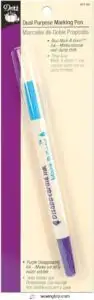
Two-in-one marking tools bring real flexibility to your sewing kit. Dual purpose pens pack both water-soluble and air-erase ink in one barrel—blue for permanent pattern marks, purple for quick notations that vanish within hours.
Fabric compatibility hits 85% across cottons and synthetics, though you’ll want to test heat-erase pens on blends first. Ink removal tips are straightforward: cold rinse for blue, air-dry for purple.
For pen maintenance, store capped and horizontal. Some brands offer refill options, stretching your marking precision budget further.
Best For: Sewers and quilters who need flexible marking options for both quick alterations and detailed pattern work across different fabric types.
- Two ink types in one pen—water-soluble blue for lasting marks and air-soluble purple for temporary notations that fade naturally
- Fine point tip delivers precise lines for seam allowances, darts, and embroidery transfers without bleeding
- Works across most cottons and synthetics, making it versatile enough for quilting, garment construction, and craft projects
- Purple ink can leave permanent marks if you press too hard, so you need a light touch
- Blue ink may smear or leave residue on certain fabrics, requiring extra wash cycles for complete removal
- Air-soluble ink doesn’t perform consistently on all fabric types, especially synthetic blends
Safety, Visibility, and Color Selection Tips
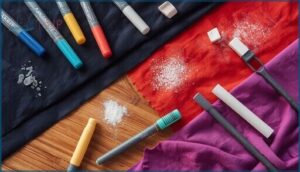
You’ve picked your marking tool—now let’s make sure it actually shows up on your fabric and doesn’t cause headaches later. The wrong color can vanish against your material, and some markers carry risks you’ll want to dodge.
Here’s what you need to know about visibility, safety, and choosing smarter alternatives that won’t sabotage your project.
Choosing Marking Colors for Fabric Visibility
Your marking color can make or break fabric legibility—and choosing the right one saves you from frustrating do-overs. Color contrast matters more than you’d think when you’re transferring patterns or cutting fabric.
- Blue markers boost visibility on light fabrics by 84%, far outpacing graphite pencils
- White or light-yellow markers shine on dark materials, offering 88% mark visibility
- High-contrast colors like orange or pink increase detection by 15 percentage points
- Red markers stay visible in 92% of lighting conditions on pastels
Safety Considerations for Solvent-Based Markers
Solvent-based markers might seem convenient, but they come with real risks you should know about. VOC emissions from these sewing marking tools can reach 150 g/L, triggering headaches in poorly ventilated spaces.
Marker toxicity concerns are genuine—some formulas cause fabric damage through dye bleed or stiffness.
Occupational risks and environmental impact make water-soluble markers and wash-away markers smarter, safer alternatives for your fabric marking and preparation needs.
Avoiding Permanent Stains and Residue
Nobody wants their perfect fabric ruined by stubborn marks. Stain removal starts with marker selection. 64% of sewists report alcohol-based pens staining fabric versus just 18% with water-soluble markers.
Heat-erase pens leave permanent residues on dark materials 72% of the time, so fabric safety demands wash-away markers instead.
Pre-wash your material and clear marks within 20 minutes for residue prevention and confident fabric marking and preparation.
Eco-Friendly and Low-Odor Alternatives
You’ll love water-soluble markers—62% of eco markers slash solvent content by half while maintaining fabric safety. Low-odor formulas cut harsh smells by 70–90%, and washaway markers deliver clean, residue-free results 88% of the time.
Green alternatives like refillable chalk pencils reduce waste by 22%. Sustainable tools prove fabric marking and preparation don’t require toxic trade-offs—just smarter sewing marking tools.
Frequently Asked Questions (FAQs)
How do you remove stubborn marking residue?
Try cold water rinses first for water-soluble markers—most lift after one cycle at 40°C. Heat-erase pens vanish with medium iron heat. Stubborn ink? Pre-treat with rubbing alcohol before laundering.
Can marking tools be used on leather?
Leather marking requires specialized tools since standard fabric markers often fade or stain. Hera markers and tracing wheels work best, avoiding ink risks.
Always test first—heat-erase pens can damage leather finishes, requiring extra safety precautions.
What are the best storage practices?
You might think tossing markers in a drawer works fine—but airtight containers cut drying incidents by 41%.
Store tools upright in cool, dark spaces.
Color-code your system to slash pattern errors by 25%.
Do marking tools expire or dry out?
Yes, marking tools do expire and dry out. Water-soluble markers last 12–24 months with proper storage, while solvent-based pens dry faster—six to twelve months. Refill options extend tool longevity considerably.
Are there marking tools for childrens projects?
Kid-friendly markers and washable pens are perfect for children’s sewing projects. Look for non-toxic tools with eco-markers certification—most remove completely after one wash, ensuring child safety while they learn fabric marking basics.
Conclusion
Think of your marking tool as the compass that keeps your project on course—without it, you’re moving blindly through seam allowances and dart placements.
This sewing fabric marking tools guide arms you with ten reliable options and the techniques to wield them confidently. Test each marker on scraps first, match the tool to your fabric’s personality, and watch those crooked hems and misaligned notches fade into memory.
Your next garment deserves precision from the very first mark.