This site is supported by our readers. We may earn a commission, at no cost to you, if you purchase through links.
Your machine jams on the fourth layer of canvas, the needle bends like a question mark, and you realize that delicate size 70 you grabbed isn’t cutting it. Heavy-duty projects demand sewing needles for heavy-duty projects—reinforced shafts, specialized points, and the right diameter to punch through multiple layers without breaking mid-seam.
The difference between a smooth run and constant frustration often comes down to matching your needle’s construction to your fabric’s density. Singer’s reinforced varieties slice through denim, leather needles handle hide with wedge-shaped precision, and Schmetz universals bridge the gap for mixed-material work.
Getting the sizing right—whether you’re reading European NM numbers or American equivalents—determines whether your stitches lock cleanly or skip across thick weaves.
Table Of Contents
Key Takeaways
- Match your needle’s shaft strength and point design to fabric density—reinforced steel for denim and canvas, wedge-shaped tips for leather, and sizes 90/14 to 110/18 for materials over 8 oz to prevent mid-project breakage.
- Replace needles every 4-6 hours of heavy-duty stitching and test on fabric scraps first, since worn tips cause skipped stitches, thread breakage, and fabric damage that derail your entire project.
- European NM sizes measure blade diameter in hundredths of millimeters while American sizes use a different scale—understanding both systems lets you grab the exact needle thickness your fabric weight demands.
- Pair needle selection with proper thread tension, presser foot pressure, and compatible accessories like Teflon feet for leather, because the right needle alone won’t deliver clean results without dialed-in machine settings.
Best Sewing Needles for Heavy Duty Projects
You need the right needle to conquer heavy-duty projects without breaking blades or damaging fabric. The sweet spot comes from matching needle construction and point type to your specific material—whether that’s leather, denim, or canvas.
Pair your needle selection with quality sewing accessory reviews to find clips, markers, and tools built to handle demanding fabrics.
Here are five heavy-duty needle options that deliver professional results on tough fabrics.
1. Singer Heavy Duty Sewing Machine Needles
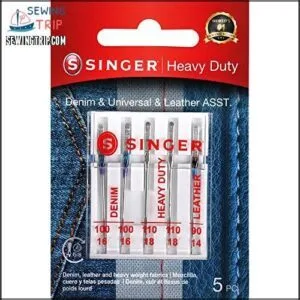
Singer’s Heavy Duty needles are built with reinforced shafts that won’t buckle under pressure, making them ideal for sewing through denim or canvas. The smooth driver shank ensures a wobble-free fit in most home and industrial Singer machines.
This set includes five color-coded needles in sizes 90/14, 100/16, and 110/18, allowing you to handle medium-weight leather to heavyweight cotton without needing to switch brands.
At $6.99, you get reliable needle alignment designed specifically for Singer machines, all stored in a slim case with sizes visible on the clear lid.
| Best For | Home sewers and crafters who regularly work with heavy fabrics like denim, canvas, leather, or upholstery materials and need reliable needles that won’t bend or break mid-project. |
|---|---|
| Brand | SINGER |
| Needle Count | 5 |
| Material | Steel |
| Machine Compatibility | Most quality machines |
| Price | $6.99 |
| Primary Use | Heavy fabrics |
| Additional Features |
|
- Color-coded sizing system makes it super easy to grab the right needle without squinting at tiny numbers
- Reinforced shafts handle thick layers of denim or canvas without bending, which saves you from constant needle replacements
- Works across multiple machine brands (Singer, Brother, Kenmore) so you’re not locked into one system
- Not designed for delicate fabrics like silk or chiffon, so you’ll need a separate set for lighter projects
- Only five needles in the pack means you might run through them quickly if you sew heavy materials often
- Older or budget sewing machines might have compatibility issues with the shaft design
2. Heavy Duty Leather Sewing Machine Needles
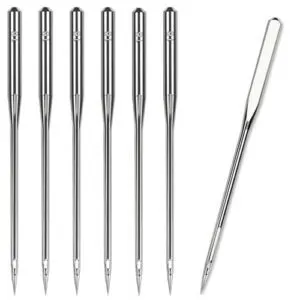
Leather needles feature a wedge-shaped tip that slices cleanly through hide instead of pushing fibers apart. This knife-edge design prevents tearing and creates precise perforations even in thick or layered materials.
You’ll find these in sizes 90/14 to 110/18, with some reaching 130/20 for seriously heavy hides. The high-carbon steel construction resists bending under pressure, while the enlarged eye accommodates bonded nylon and waxed threads common in leatherwork. They’re compatible with most machines that accept standard short-shank needles.
| Best For | Sewers working with thick materials like leather, denim, canvas, or upholstery who need durable needles that won’t bend or break during heavy-duty projects. |
|---|---|
| Brand | HLARTNET |
| Needle Count | 50 |
| Material | Iron alloy |
| Machine Compatibility | Most household machines |
| Price | Not specified |
| Primary Use | Thick fabrics |
| Additional Features |
|
- Large 50-piece pack offers excellent value and ensures you always have backups on hand
- Size 100/16 handles multiple thick fabric types from jeans to leather without switching needles
- Strong iron alloy construction stays sharp longer and resists bending under pressure
- Single size option (100/16) limits versatility for lighter fabrics or different project needs
- No warranty information provided, so durability claims can’t be verified
- Quality control may be inconsistent given the budget-friendly price point
3. Sewing Machine Needles Set
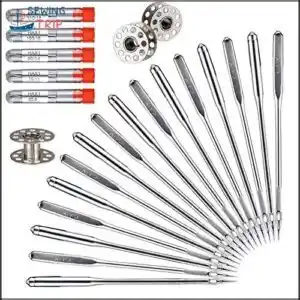
Multi-size needle sets give you tactical range without the clutter. A typical pack includes 50 needles spanning 65/9 through 110/18—enough to handle silk scarves and leather belts from one organized case.
If you’re tackling upholstery or canvas bags, check out this guide to sewing needles for thick fabric to match the right needle size to your project weight.
Look for the 130/705H or 15×1 fittings that lock into Singer, Brother, Janome, and most low-shank machines. The labeled slots keep each size accessible, while bonus bobbins and storage tubes sweeten the deal.
You’ll swap needles based on fabric weight instead of hunting through random drawers.
| Best For | Sewers who work with multiple fabric types and want an organized collection of needle sizes without buying them individually. |
|---|---|
| Brand | Generic |
| Needle Count | 50 |
| Material | High strength steel |
| Machine Compatibility | Most household machines |
| Price | Not specified |
| Primary Use | Various fabrics |
| Additional Features |
|
- Covers five needle sizes (65/9 to 110/18) so you can handle everything from delicate silk to heavy denim
- Comes with 50 needles plus storage tubes and bobbins—solid value if you sew regularly
- Fits most home machines from Singer, Brother, and Janome right out of the box
- Won’t work with industrial machines, so check your model before ordering
- Storage tubes require assembly, which adds a setup step
- Some users report the needles are too long for certain machines or cause thread fraying on thick fabrics
4. Schmetz Universal Sewing Machine Needles
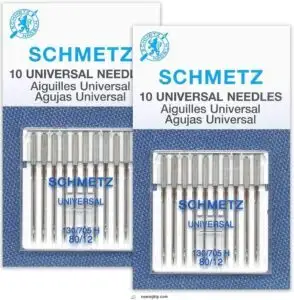
Schmetz Universal needles occupy the sweet spot between specialty tools and everyday workhorses. The slightly rounded point manages wovens and light-to-medium knits without fuss, while the 130/705 H system clicks into Brother, Janome, and most domestic machines.
You’ll find 60/8 through 110/18 sizes marked in both metric and US equivalents—enough range to match standard cotton, polyester blends, and everyday garment projects.
German-made precision keeps the blade diameter calibrated to prevent snags, and the corrosion-resistant plating outlasts cheap alternatives when you’re stitching home décor or basic clothing.
| Best For | Home sewers who need reliable, all-purpose needles for everyday projects like garments, quilts, and home décor across different fabric types. |
|---|---|
| Brand | SCHMETZ |
| Needle Count | 20 |
| Material | Steel |
| Machine Compatibility | Most household machines |
| Price | Not specified |
| Primary Use | General purpose |
| Additional Features |
|
- Works with both woven and knit fabrics, so you don’t need to swap needles constantly between projects
- Compatible with most household sewing machine brands like Brother, Janome, and Singer
- Comes with 20 needles (two packs of 10), giving you plenty of backups before needing to reorder
- Size 80/12 only—you’ll need to buy different packs if your project needs thinner or thicker needles
- Not built for heavy-duty materials like leather, denim, or canvas
- May wear out faster on industrial machines or high-volume sewing compared to specialty needles
5. Singer Sewing Machine Needles
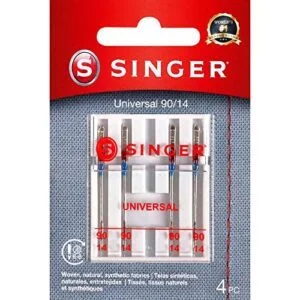
Singer’s standard needle lineup offers versatility without the premium price. The 90/14 universal set is compatible with Singer, Brother, Kenmore, and Bernina machines, utilizing the 130/705H shank.
Constructed from cold-forged steel, these needles resist flex when working with medium-weight wovens, synthetics, and natural fibers, making them ideal for quilting patches or everyday garment work. Color-coded tops and larger eyes enhance ease of threading, even under task lighting.
While some users report brittleness on thicker materials, these needles are best reserved for general-purpose projects rather than heavy-duty tasks like denim or canvas work.
| Best For | Home sewers working with medium-weight fabrics who need reliable, affordable needles for everyday projects like quilting and garment construction. |
|---|---|
| Brand | SINGER |
| Needle Count | 5 |
| Material | Cold-forged steel |
| Machine Compatibility | Domestic machines |
| Price | Not specified |
| Primary Use | Medium weight fabrics |
| Additional Features |
|
- Cold-forged steel construction minimizes needle flex and reduces skipped stitches on standard fabrics
- Compatible with multiple major sewing machine brands including Singer, Brother, Kenmore, and Bernina
- Color-coded tops and larger eyes make threading faster and easier in various lighting conditions
- Some users report brittleness and breakage, particularly on thicker materials
- Limited to size 90/14, which restricts versatility across different fabric weights
- Occasional quality control issues, including reports of damaged or empty packaging
Needle Size and Selection Guide
Getting the needle size right isn’t guesswork—it’s the difference between smooth stitching and broken needles halfway through your project. You’ll notice needles carry both European and American size markings, and understanding how these numbers correspond to actual diameter and fabric weight puts you in complete control.
Here’s what you need to match your needle to your material every single time.
European and American Needle Sizes
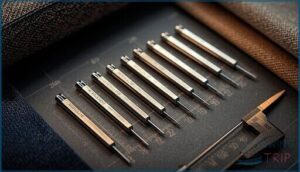
You’ll see two numbering systems when selecting Heavy Duty Sewing Machine Needles for thick fabric—and understanding both gives you complete control over your Sewing Needle Selection. The European NM Designations and American sizes may look confusing at first, but Size Conversions follow predictable patterns thanks to 1942 Standardization efforts.
Here’s how Metric vs American needle size systems compare:
- European NM system measures blade diameter in hundredths of millimeters—NM 90 equals 0.90 mm thickness
- American sizes use smaller numbers (8-22) that increase with needle diameter but aren’t direct millimeter measurements
- Dual labeling appears as 14/90 on most Heavy Duty Sewing Needles packaging, showing both American and European equivalents
- Size 14 American converts to NM 90 European—your sweet spot for most heavy denim and canvas projects
- Conversion charts on packaging help you match fabric weight to the right needle size across both systems
Measuring Needle Diameter
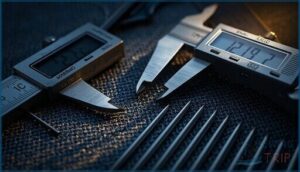
Diameter measurement is crucial for determining whether heavy-duty sewing needles will pierce canvas without deflection or snapping mid-seam. Calipers measure the shaft at multiple points, verifying needle calibration within manufacturer tolerances. Digital micrometers capture precise outer diameter readings, which are essential for needle selection when thread thickness and fabric interaction matter.
| Measurement Tool | Precision Level | Best Application |
|---|---|---|
| Calipers | ±0.01mm | Quick shaft verification |
| Digital Micrometers | ±0.001mm | Quality documentation |
| Laser Micrometry | ±0.0001mm | Manufacturing specs |
Thread passage smoothness depends on inner diameter consistency, while needle geometry affects hole size in the fabric.
Correlating Needle Size to Fabric Weight
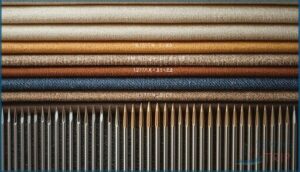
Your fabric weight dictates needle size—plain and simple. Heavy fabrics over 500 g per square meter demand 90/14 to 110/18 needles for reliable stitching without deflection.
Material density and thread thickness shift needle calibration requirements, affecting thread tension and sewing speed. Medium-heavy fabrics around 350-500 g perform best with 75/11 to 90/14 sizes, creating that sweet spot between penetration and fabric integrity.
Research shows that both fabric density and needle type influence fabric damage during sewing projects.
Fabric Weight and Needle Selection
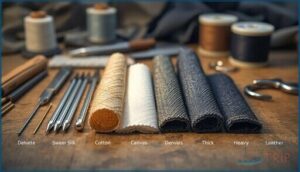
Match your needle to fabric density or risk poor thread tension and broken stitches. Material thickness determines whether you’ll breeze through seams or fight your machine at every pass.
- Lightweight fabrics (2-4 oz) need 60-75 metric needles to prevent visible holes
- Medium weights (4-8 oz) work with standard 80-90 sizes for balanced results
- Heavy fabric (8-14 oz) demands 90-110 heavyduty needles for reliable penetration
- Extra thick fabric above 12 oz requires 110-120 sizes paired with heavy thread
- Needle calibration affects sewing speed—wrong sizing creates skipped stitches and fabric puckering
To avoid problems like skipped stitches or fabric damage, refer to this guide to sewing needle types for recommended needle sizes and troubleshooting tips.
Test on scraps first. Needle selection controls your entire project outcome.
How to Choose The Right Heavy-Duty Needle
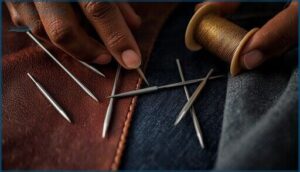
Picking the right heavy-duty needle isn’t guesswork—it’s about matching three key factors to your project. Your fabric type drives the needle point style, your thread determines the eye size you need, and your specific project requirements seal the deal.
Here’s how to nail each decision so your machine powers through without breaking needles or damaging fabric.
Fabric-Type Decision Guide
Your fabric selection drives needle materials and heavy-duty needle choices. Light fabrics under 4 oz use smaller gauges; medium fabrics 4-7 oz work with universal types. Heavy fabric sewing over 7 oz demands reinforced steel construction.
Fabric thickness and fabric density matter—wovens need sharp points, knits prefer ballpoint, while leather requires wedge-shaped tips. Match needle selection to your material’s weight for clean penetration.
Thread Compatibility and Project Requirements
Thread selection goes beyond needle materials—you’re balancing fabric density with thread tension to control stitch quality. Polyester threads need needle eyes sized 60 to 90 for smooth feeding through heavy fabric sewing. Cotton on denim requires slightly larger eyes to prevent heat buildup.
Project planning starts here: heavier fabrics demand higher tension settings and stitch lengths between 3.0 to 4.0 mm for strength without bulk.
Matching Needle to Project Needs
Your project planning hinges on matching Heavy Duty Sewing Needles to real-world demands. Fabric analysis reveals density, then needle calibration locks in the right size—16-18 for canvas, lighter for topstitching. Thread selection and stitch optimization follow naturally.
- Fast topstitching: larger sewing machine needles prevent skipped stitches on bulk.
- Multi-layer upholstery: reinforced shafts resist bending during extended cycles.
- Edge finishing: slightly finer needles maintain control at speed.
- Free-motion quilting: long-eye needles ease thread flow, reduce fraying.
Tips for Using Heavy Duty Sewing Needles
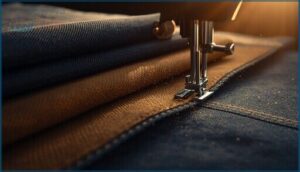
Getting the right needle is only half the battle. How you use it, maintain it, and pair it with the right accessories determines whether your heavy-duty project succeeds or fails.
Here’s what you need to master for perfect results every time.
Adjusting Machine Tension and Pressure
Before you thread that heavy duty needle, dial in your tension control and pressure settings. Start with a balanced lockstitch—where top and bottom threads meet cleanly at the fabric surface. If bobbin thread shows on top, crank up your thread tension slightly.
Reduce presser foot pressure for smooth fabric feed through multiple denim layers, then test stitch quality on scraps.
Proper Needle Maintenance and Replacement
Check every needle for burrs and nicks before you start—Needle Inspection catches problems that cause Fabric Damage and Thread Breakage. Swap Sewing Machine Needles after 4–6 hours of heavy-duty work to keep Thread Tension consistent. Fresh Needle Selection prevents skipped stitches.
Keep your Maintenance Schedules tight: replace needles immediately if fabric snags. Store them in a magnetic case—proper Needle Storage protects tips and extends Sewing Machine Maintenance intervals between Needle Replacement cycles.
Choosing Compatible Threads and Accessories
Stitch Quality rides on Thread Selection—pair spun polyester with chromium-plated Sewing Machine Needles for abrasion resistance on canvas and denim. Thread Tension adjustments prevent bird-nesting when you match thread weight to Needle Selection.
Teflon presser feet boost Accessory Compatibility on leather, while Fabric Marking tools like Chaco Liners guide your Sewing Techniques.
Proper Thread and Needle Selection with quality Needle Coating ensures consistent results every time.
Storing and Handling Heavy-Duty Needles
Lock your Singer Heavy Duty Needles in a dry cabinet—moisture and heat wreck needle durability before you even thread them. Label compartments by size and fabric type for quick needle selection, then cap points during transport to dodge puncture risks.
Toss bent needles into a puncture-resistant bin immediately—Safe Disposal Methods protect your workspace. Secure Storage Practices and smart Needle Organization Systems keep your needle replacement schedule on track.
Frequently Asked Questions (FAQs)
Can heavy duty needles work on lightweight fabrics?
Yes, but downsize to 80/12 or smaller for lightweight applications. Fabric compatibility depends on needle selection and proper sizing—larger sizes leave visible holes.
Test fabric density first; ballpoint styles suit knits while sharp points handle delicate wovens best.
How do you prevent needle breakage during projects?
Needle breakage stems from mismatched needle size, improper needle installation, and incorrect thread tension.
You’ll avoid thread breakage by calibrating your machine, prepping fabric layers, refining your sewing technique, and replacing sewing machine needles regularly.
What causes skipped stitches with heavy duty needles?
Skipped stitches happen when your hook misses the thread loop—usually from dull needle wear, incorrect machine timing, poor thread tension, or mismatched needle installation.
Fabric density also affects stitch formation with heavy duty needles.
Are universal needles suitable for thick leather projects?
Universal needles struggle with thick leather—they lack the knife-like point needed to slice cleanly through dense hides.
For professional results on heavy-duty materials, specialized leather needles sized 90/14 to 110/18 deliver exceptional penetration and durability.
Do needle brands affect compatibility with sewing machines?
Brand and shaft design directly impact machine compatibility. Most home machines accept standard systems from Schmetz, Organ, and Singer. Mismatched brands cause timing issues, bent needles, and skipped stitches that compromise your work.
Conclusion
Choosing sewing needles for heavy duty projects isn’t rocket science—it’s about matching shaft strength to fabric density. Whether you’re running denim through a Singer reinforced or punching leather with a wedge-point, the right needle eliminates jams before they start.
Swap worn tips every eight hours of stitching, keep tension dialed to your thread weight, and your machine will punch through canvas like parchment. Master the mechanics, and thick materials become just another Tuesday.
- https://www.klumhouse.com/slabtown
- https://www.hooptalent.com/blogs/news/singer-needles-chart-the-ultimate-guide-to-types-sizes-and-fabric-pairings
- https://www.amefird.com/technical-tools/thread-size/fabric-weight/
- https://www.schmetzneedles.com/pages/needle-guide
- https://www.maggieframes.com/blogs/embroidery-blogs/ultimate-guide-to-sewing-needle-types-how-to-choose-the-right-needle-for-every-fabric