This site is supported by our readers. We may earn a commission, at no cost to you, if you purchase through links.
Flat quilts are beautiful. But the moment you stitch a petal that casts its own shadow, something shifts—suddenly your fabric breathes. Three dimensional appliqué quilts do exactly that: they pull texture off the surface and into space, turning a traditional craft into something closer to sculpture.
The secret lies in what goes beneath each shape—foam, padding, or fusible interfacing—plus the stitching techniques that hold everything lifted and stable. Whether you’re drawn to dramatic floral layers or subtle trapunto effects, this guide walks you through the materials, methods, and machine settings to build real dimension into your quilts.
Table Of Contents
Key Takeaways
- What lifts your appliqué off the surface—foam, padding, or fusible interfacing tucked beneath each shape—is the real secret behind that shadow-casting, sculptural dimension.
- Raw-edge fusible, stuffed appliqué, trapunto, and folded fabric are four distinct techniques, each giving you a different kind of lift, so picking the right one shapes your whole design.
- Material choices do heavy lifting: cotton weight, batting loft, thread type, and even needle size all directly affect how dramatically your shapes rise and hold their form over time.
- Smart design thinking—mapping a single light source before you sew and pairing contrasting textures like matte cotton against velvet—turns a technically sound quilt into something that stops people in their tracks.
What Are Three Dimensional Appliqué Quilts?
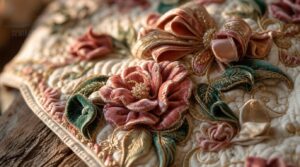
Three-dimensional appliqué quilts take fabric off the flat surface and give it real, touchable shape — think petals that lift, leaves that curl, and bows that actually pop up.
Mastering hand-stitched fabric manipulation techniques is what turns those lifted petals and curling leaves from happy accidents into repeatable, professional results.
This style transforms a quilt into something people can’t help but reach out and touch. Here’s a look at what makes this technique so compelling, starting with the basics.
Raised Appliqué Quilt Surfaces
Raised appliqué quilt surfaces are where fabric manipulation gets genuinely exciting. You’re building real elevation — using foam, padding, or stiff fusible interfacing tucked beneath shapes to push them off the background. That lift creates shadow and color depth naturally.
High relief stitching and edge reinforcement keep everything stable, while material weight determines how dramatically each shape rises. Structural support makes the whole surface feel intentional, not accidental.
Remember to leave a clear 1/8 inch space when stitching around each appliqué shape.
Texture Versus Flat Appliqué
So now that you understand lift, let’s talk about what separates texture from flat appliqué — because they’re genuinely different tools. Flat appliqué lies smooth against the background, relying on color blocking effects and silhouette. Dimensional appliqué uses fabric manipulation, trapunto stuffing, or stiff fusible interfacing to create surface texture with real depth and shadow play techniques.
- Visual vs tactile: flat appliqué pleases the eye; raised appliqué begs to be touched
- Edge stitching’s contrast defines shape boundaries without flattening raised areas
- Fabric weight’s impact determines how dramatically pieces lift or lie
- Shadow play techniques shift as light moves across stuffed or folded shapes
- Smooth cotton beside velvet amplifies perceived dimension instantly
Best Projects for Beginners
Starting with a geometric square motif or a simple animal silhouette appliqué keeps frustration low and confidence high. Try a nature flower block with just three fabric layers, or a seasonal starter quilt sized around 12 inches — perfect for quick wins.
Simple border framing ties everything together cleanly.
With good pattern templates and step-by-step color photos, DIY quilting finally feels doable.
Wall Quilts and Table Toppers
Once your confidence is up, think bigger — literally. 3D quilts shine as wall art or table toppers, where dimensional appliqué catches light and draws people in.
- Use mounting hardware like a rod pocket or dowel for sturdy wall display
- Plan lighting placement so raised shapes cast interesting shadows
- Match color harmony between backing and raised motifs
- Mind scale selection — motifs should suit the project’s size
- Follow cleaning care guidelines to protect fabric layering effects and visual depth in textiles
Tools and Materials You Need
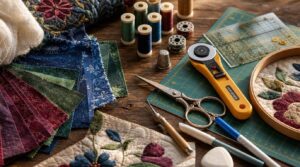
Before you cut a single piece of fabric, it helps to know what you’re working with. The right tools make a real difference — not just in how your quilt looks, but in how smoothly the whole process goes.
Here’s what you’ll want to have on hand.
Cotton Quilting Fabric
Your fabric choice makes or breaks 3D appliqué. Regular cotton fabric — 100% cotton quilting weight, around 3 to 4.5 ounces per square yard — is your best friend here. Its tight plain weave aids fabric appliqué and hand stitching beautifully. Look for good print colorfastness and a thread count of 60×60 to 70×70.
Pressing your cotton fabric before cutting gives you cleaner folds—just like the professional sewing and facing techniques that take garment construction from homemade to polished.
Always prewash. That simple step prevents shrinkage and keeps your dimensional appliqué crisp for years.
Fusible Web Options
Not all fusible webs are equal, and picking the right one shapes your whole project.
Heat n Bond ULTRAHOLD fusible web is a go-to for 3D appliqué — press it with a hot dry iron for up to eight seconds, and that iron-on adhesive locks fabric shaping with heat into a non-raveling, double-sided bond.
Thinner webs offer a repositionable bond for fussy placement. Always check fabric compatibility and choose residue-free formulations to keep edges crisp.
Batting and Stuffing Choices
What’s inside your quilt sandwich construction shapes how your raised elements breathe, hold, and last. Batting and polyester stuffing aren’t interchangeable — each plays a distinct role in the structure, texture, and longevity of your work.
- Loft selection: High-loft polyester stuffing lifts stuffed appliqué and trapunto shapes dramatically; low-loft cotton keeps things subtle
- Fiber blends: Blended battings balance drape with dimensional stability
- Thermal bonded batting: Resists fiber migration during stitching
- Eco-friendly batting: OEKO-TEX certified options skip harsh chemical treatments
- Care guidelines: Polyester washes easily; wool needs gentler handling
Needles, Thread, and Scissors
Your tools are doing half the work before you even touch fabric. For 3D appliqué, needle choice matters — use a standard quilting sharp for hand stitching appliqué and switch to a larger needle for metallic or layered machine stitching. Cotton thread blends naturally; polyester holds dense seams firmly.
| Tool | Best Use | Key Tip |
|---|---|---|
| Sharp needle | Hand tacking, hand stitching appliqué | Match weight to fabric thickness |
| Larger needle | Machine stitching, metallic thread | Prevents skipped stitches |
| Cotton thread | Natural sewing techniques for 3D | Shrinks with fabric |
| Embroidery scissors | Trimming thread tails | Keep blade dedicated to fabric |
| Fabric shears | Cutting fused layers | Sharpen regularly for clean edges |
Balanced thread tension keeps raised shapes smooth. Scissor maintenance — wiping blades dry after use — protects your sharpest tools.
Sewing Machine Settings
Your sewing machine is your silent partner — get its settings wrong and even beautiful fabric becomes a wrinkled mess.
For 3D appliqué, these four adjustments make the biggest difference:
- Upper thread tension at 4.0–5.0 keeps machine stitching balanced across layered shapes
- Stitch length setting of 1.5–2.0 mm works best for fine quilting details and sewing techniques for 3D edges
- Presser foot pressure slightly increased pressure manages batting bulk without skipped stitches
- Feed dog height tuned for thicker layers prevents slipping during hand tacking transitions and larger needle sewing
Core 3D Appliqué Techniques

Now we’re getting to the fun part — the actual techniques that bring your quilt to life.
There are several ways to build dimension into your work, and each one gives a slightly different look and feel. Here are the core methods worth knowing.
Raw-edge Fusible Appliqué
Raw edge appliqué is honestly one of the most forgiving entry points into dimensional work. You bond fabric shapes using a fusible web, leave the edges unturned, then secure everything with a zigzag stitch. That exposed edge? It’s the whole point — it lifts slightly, catching light and adding texture.
| Raw Edge Applique Element | What to Know |
|---|---|
| Fusible Web Testing | Always test on scraps first |
| Fabric Weight Pairing | Match similar weights for clean bonds |
| Teflon Press Sheet | Prevents scorching on layered pieces |
| Zigzag Stitch Length | Shorter = more secure edge stabilization |
| Dimensional Appliqué Result | Soft, painterly, tactile surface |
The raw edge applique method rewards careful material choices over perfect technique.
Stuffed Appliqué Shapes
Stuffed appliqué elevates dimension by padding fabric shapes with polyester fiberfill. Fiberfill density is critical: too much stiffens the design, while too little causes flattening. To compensate for compression, cut shapes slightly larger than your template. Finish edges with a slip stitch to contain fibers neatly.
Smart techniques ensure success:
- Test stiffness with light hand pressure before final attachment.
- Coordinate color values so lighter shapes visually recede.
- Layer thin fabrics atop thicker ones to manage bulk.
- Use a clean glass to press shapes, ensuring even height during stiffness testing.
Trapunto Quilting Effects
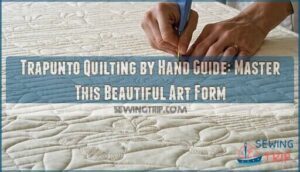
Trapunto takes stuffed appliqué a step further. Instead of padding individual shapes separately, this technique stitched outlines directly onto layered fabric, then stuffs batting underneath to push the motif up.
Mark your design with water-soluble marks first. Higher stitch density around the edges creates reinforcement that locks the puff in place.
Adjust foam padding thickness to control how dramatic the shadow play looks.
Folded Fabric Details
Folded fabric details differ from stuffed shapes—instead of padding from beneath, you’re sculpting right on the surface. Edge crisping ensures every fold remains sharp and clean, while strategic stitching locks dimension without flattening the structure.
Lightweight fabrics are essential for maintaining form; heavier materials like cotton tend to sag under their own weight.
Three pleating approaches worth exploring:
- Horizontal pleats suggest water or rolling hills
- Vertical pleats mimic tall grass or trees
- Subtle shading with thread color deepens fold stability under light
Hand-tacked Raised Edges
Where folded shapes sculpt the surface, hand-tacked raised edges give it voice. These small, evenly spaced stitches — about 2–3mm apart — lift fabric edges into soft, dimensional ridges that frame petals, leaves, and outlines beautifully.
| Technique Detail | What It Means for You |
|---|---|
| Stitch Spacing | 2–3mm apart keeps edges crisp |
| Thread Contrast | Match or bold-outline your motif |
| Fabric Compatibility | Cotton and linen hold shape best |
| Edge Durability | Secure knots survive machine washing |
| Maintenance Tips | Re-tack loose stitches after washing |
Hand-stitching appliqué this way keeps your 3D appliqué refined without overpowering the design.
Step-by-Step 3D Appliqué Tutorial
Ready to get your hands on some fabric? This section walks you through the whole process, from picking your first motif to stitching around those beautiful raised shapes.
Here’s exactly how to do it, step by step.
Choose a Simple Motif
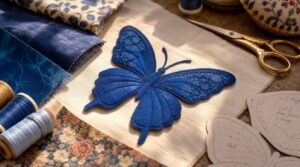
Your motif is the heartbeat of the whole design — so prioritize one that feels right, not just visually appealing. Symmetrical shapes like flower appliqué designs or butterfly appliqué patterns simplify placement, making them ideal choices.
Aim for motif contrast against your backing fabric to ensure visibility, and carefully consider scale legibility when adjusting size. These practical factors significantly impact the final aesthetic.
Smart fabric pairing and clean quilt design handle the rest, tying the composition together seamlessly.
Prepare Full-size Templates
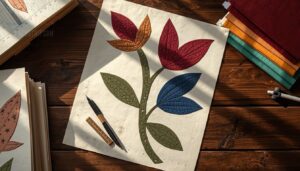
Before you cut a single thread, solid templates save you from costly mistakes. Print full-size patterns directly onto durable paper, then verify accurate grid scaling against a known measurement.
Label every piece clearly — fabric transfer methods work best when you know exactly where each shape belongs.
Store finished design templates flat in a labeled binder, and keep seam allowance consistency tight across all pieces.
Fuse and Cut Pieces
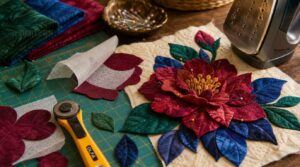
Now comes the satisfying part — turning your templates into actual fabric pieces ready to assemble. Web Weight Selection is critical: light fusible web suits delicate cotton, while heavier weights anchor bulkier layers. Equally important is Iron Temperature Control to prevent scorching — keep your iron dry and hot, pressing each section for about eight seconds.
For cutting, rotary blade maintenance ensures clean, fray-free edges. Always apply iron-on adhesive to the fabric’s wrong side first. Use an AccuQuilt cutter or sharp rotary blade for precision, and test your layout with temporary pin placement before finalizing.
- Apply iron-on adhesive to the fabric’s wrong side.
- Use an AccuQuilt cutter or sharp rotary blade for precision.
- Use temporary pin placement to test the layout before committing.
Layer and Stitch Shapes
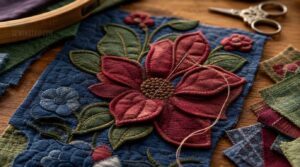
This is where your quilt starts to breathe. Begin by stacking pieces using Layer Thickness Gradients—thinner base layers first, with raised elements on top. Follow a Stitch Contour Path that mirrors each shape’s natural curve, and place your Anchor Point Strategy at key spots only.
Shadow Line Stitching adds depth fast, while Edge Fusion Control ensures everything remains lifted, not flattened. That’s real dimensional appliqué.
Quilt Around Raised Areas
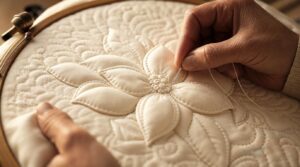
Stitching around raised shapes is where most beginners go wrong. Keep your stitch density management light near stuffed appliqué centers—dense quilting flattens what you just built up.
Use edge support strategies, like vertical stabilizing stitches just outside each shape, to hold volume without crushing it.
Backing alignment techniques matter here too; a slightly larger backing absorbs the extra bulk beautifully, keeping everything smooth and display-ready.
Design Tips for Dimensional Quilts
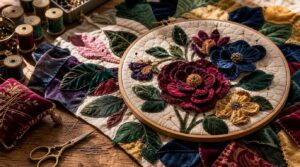
Good technique gets you started, but smart design choices are what make a dimensional quilt truly come alive. A few simple decisions — about light, texture, and layering — can take your work from flat to breathtaking.
Smart design choices about light, texture, and layering transform a dimensional quilt from flat to breathtaking
Here’s what to keep in mind as you plan your design.
Plan Shadows and Depth
Think of light as your secret design partner. Before you sew a single stitch, map your light source — pick one angle and stick with it. That’s Light Source Mapping in practice.
From there, let your Shadow Intensity Gradient do the work: darker Fabric Value Contrast underlays deepen perceived lift, while careful Seam Allowance Shadowing and Layer Stacking Order keep every dimensional appliqué shape reading crisp and intentional.
Mix Fabric Textures
Shadows define form — and so does texture. Once your light source is mapped, the fabrics you choose either enhance or flatten that depth. Smart Texture Layering Strategies make all the difference.
Try these Contrast Pairings for surface texture creation:
- Matte cotton against metallic lamé for Sheen vs Matte contrast
- Velvet beside burlap for tactile drama
- Lightweight chiffon layered over denim for Weight Balancing
- Crushed velvet with linen for Fiber Blend Harmony
- Ribbed jersey beneath satin for dimensional fabric pop
Material experimentation is where mixed media quilting gets exciting.
Build Floral Appliqué Layers
Fabric texture sets the stage — now let the flowers grow.
Petal Stacking starts with a heat-bound muslin base, then builds through Gradient Color Layers using one warm tone and one cool. Texture Pairing cotton against organza adds natural depth. Stabilizer Integration keeps everything flat during stitching.
Offset each layer slightly so petals look alive, not stacked like pancakes.
Add Safe Embellishments
Now that your flowers have dimension, a few finishing touches can make them truly sparkle. Choose rounded-edge sequins and nickel-free findings to avoid snagging threads or irritating skin. Water-based inks work beautifully for hand embroidery details.
Use fabric-safe adhesives sparingly — thin layers only. And always test embellishment placement on scrap fabric first. Smart choices here protect all that careful layering you’ve built.
Use Dimensional Quilt Patterns
Ready-made dimensional appliqué patterns take the guesswork out of block arrangement and visual rhythm. PDF patterns and pattern bundles often include size variations — some scaling from 20″ up to 55″ — so you’re never locked into one format.
Suggested fabric pairings are usually built-in.
Repeating motifs keep the design cohesive, and some bundles even include a FREE PATTERN to get you started on your first 3D appliqué block.
Frequently Asked Questions (FAQs)
How do you price 3D appliqué quilts for sale?
Start with your material cost analysis — fabric, fusible web, batting, and thread.
Add labor time valuation at your hourly rate.
Apply a wholesale markup strategy.
Don’t forget shipping cost inclusion.
How do you resize patterns for smaller finished quilts?
Multiply your finished block size by the scale factor, add back seam allowances, and do a test block first.
Recalculate yardage, adjust border reduction, and reprint full-size patterns before cutting.
Where can beginners find 3D appliqué workshops or classes?
Community Center Classes, Craft Store Workshops, and Studio Starter Sessions are your easiest entry points.
Online Video Courses and Certification Programs go deeper.
Quilting Arts Magazine and Instagram connect you to the quilt community, sharing real projects daily.
Conclusion
It’s no coincidence that quilters who try three dimensional appliqué quilts rarely go back to flat work—once your hands learn to build upward, they resist staying level.
That first raised petal, that shadow cast by a stuffed shape, rewires how you see fabric entirely. You’re not just covering a surface anymore. You’re sculpting it.
Trust the techniques, respect the layers, and let the texture do what flat fabric never could: make someone stop and reach out to touch it.
- https://tourmalinethymequilts.com/applismith-where-applique-gets-dimensional/
- https://pangobooks.com/titles/three-dimensional-applique/4f3bd2af-1d52-4b9a-982c-fba0d1ed859f-dCjBA4AHbiaUGBZoK6L0BYZgmVv1?srsltid=AfmBOooqafBnPlJrQ1121LDnOfzaou3RW_CTHyon9KT1pxsUKHWJkWsY
- https://quiltersconsignment.com/products/three-dimensional-applique
- https://www.getasquiltingstudio.com/2023/12/3d-accents-on-small-quilts.html
- https://blog.clover-usa.com/2021/12/18/sew-a-3d-applique-project/