This site is supported by our readers. We may earn a commission, at no cost to you, if you purchase through links.

Before the drop feed dog became standard, Singer’s earliest machines moved fabric with a spinning wheel—a single roughened rim rising through the bed to grip and pull cloth forward, stitch by stitch. That mechanism, introduced in U.S. Patent No. 8294 on August 12, 1851, defined how sewing machines fed material for the first decades of the industry.
A Singer sewing machine with a circular feed wheel isn’t just a collector’s curiosity—it’s the original solution to a problem every sewer still cares about: keeping stitches even and straight. Understanding how it works tells you something important about why modern machines are built the way they are.
Table Of Contents
- Key Takeaways
- What is a Singer Sewing Machine With Circular Feed Wheel?
- Origins of The Circular Feed Wheel in Singer’s 1851 Patent
- How The Needle, Shuttle, and Presser Foot Work Together
- Early Singer Models That Used The Circular Feed Wheel
- Collecting and Maintaining a Circular Feed Wheel Singer Machine
- Frequently Asked Questions (FAQs)
- Conclusion
Key Takeaways
- Singer’s 1851 circular feed wheel — patented as U.S. Patent No. 8294 — was the original solution for moving fabric evenly, gripping cloth with a roughened rim rather than the toothed drop feed dogs that became standard later.
- The circular feed wheel excels at straight seams because its single narrow contact path keeps fabric moving forward steadily, but that same design limits it to straight stitching and makes it incompatible with modern attachments.
- Early Singer models like the No. 1 and No. 2 Standard carried this feed system into commercial use, with industrial variants offering cylindrical beds and feed‑off‑the‑arm heads for trades like boot‑making and sleeve closing that flat beds couldn’t handle.
- Surviving circular feed wheel machines are genuinely rare, and their value jumps sharply based on original finish, provenance, and where you sell — specialty dealers consistently fetch far more than local listings for the same machine.
What is a Singer Sewing Machine With Circular Feed Wheel?

The Singer sewing machine with a circular feed wheel is one of the earliest commercial sewing machines ever built, dating back to Isaac Singer’s 1851 patent.
This design marked a turning point in home manufacturing — you can trace the full story of how the sewing machine was invented and evolved from those early Singer prototypes onward.
It works differently from most machines you’ve probably seen — and once you understand why, the design makes a lot of sense.
Here’s what you need to know about how it actually moves fabric, how it compares to later feed systems, and why it was built for straight sewing.
How The Circular Feed Wheel Moves Fabric
The circular feed wheel moves fabric through three synchronized actions:
- Frictional rim grip — the roughened wheel rim rises through the machine bed and pulls fabric forward by friction, not by lifting teeth.
- Synchronized feed timing — the wheel advances cloth only when the needle clears the material.
- Incremental rotation steps — each partial turn delivers one measured straight seam pull, keeping your stitches evenly spaced.
Difference Between Circular Feed Wheel and Drop Feed Dogs
That synchronized pull happens along a single narrow path — and that’s exactly where the feed systems split apart.
| Feature | Circular Feed Wheel | Drop Feed Dogs |
|---|---|---|
| Feed Path Geometry | Single round contact point | Wide rectangular tooth area |
| Contact Pressure | Concentrated at wheel rim | Spread across multiple teeth |
| Stitch Versatility | Straight stitch only | Zigzag and multipurpose |
| Attachment Compatibility | Limited; no simple swap | Provides darning plates, covers |
| Maintenance Wear | Wheel rim and bearing area | Tooth tops and feed bar |
Drop feed dogs also provide reversible feed and a showing lever for reversing direction of feed — standard on modern machines. Sewing machine operation and maintenance is simpler when machine setup procedure matches the feed system you’re working with.
Why This Design Suited Straight Sewing
The feed wheel earns its keep on straight seams. Its linear feed path keeps fabric moving forward at a steady pace — no detours, no pivots. That means consistent stitch spacing without constant correction.
For a deeper look at how this plays out in practice, the Janome JW8100 feed system review shows just how well consistent linear feeding holds up across long, uninterrupted straight seams.
Singer’s design is built on the earlier vertical straight‑needle motion that improved stitch consistency.
- Firm fabric grip prevents sideways drift on long runs
- Operator guidance stays simple: watch the edge, steer gently
- Presser foot and wheel work as one unit
- Workshop efficiency improves when seams repeat without repositioning
Origins of The Circular Feed Wheel in Singer’s 1851 Patent

Singer’s 1851 patent wasn’t just a piece of paperwork — it was the blueprint that changed how machines sew. To really understand where the circular feed wheel came from, you need to look at the key decisions Singer made that year.
Here’s what shaped that original design.
Isaac Singer’s 1851 Patent and Key Innovations
On August 12, 1851, Singer received U.S. Patent No. 8294 — a turning point in mass production history. This wasn’t a basic sewing patent; it was an improvement patent targeting specific mechanical changes.
Singer’s 1851 Patent No. 8294 wasn’t paperwork — it was the blueprint that changed how machines sew
| Innovation | Feature | Impact |
|---|---|---|
| Overhanging Arm | Open sewing space | Easier fabric control |
| Gear-Driven Transmission | Timed needle and shuttle | Consistent stitch formation |
| Circular Feed Wheel | Steady forward fabric pull | Reliable straight seams |
| Presser Foot | Holds material down | Even feeding without slipping |
| Commercialization Strategy | Affordable pricing plans | Accelerated Industrial Revolution adoption |
Patent Litigation shaped Singer’s early path, but interchangeable parts and smart material choices made commercialization stick.
How Singer Built on Howe’s Eye-Pointed Needle and Lockstitch
Singer didn’t start from scratch. Elias Howe had already cracked the core problem — needle geometry with the eye near the point, and a shuttle timing system that locked two threads inside the fabric.
Singer built on Howe’s foundation by refining the mechanics that control thread behavior — including the tension systems explained in this guide to sewing machine parts and their functions.
That lockstitch gave real stitch strength.
After losing the patent battles in 19th-century invention history, Singer paid patent royalty to Howe, then built smarter: better industrial adoption, tighter tolerances, interchangeable parts.
The Smithsonian Patent Model and Its Wooden Components
The Smithsonian holds Singer’s actual patent model for Patent No 8294 — and it’s a window into 1851 workshop craft.
The head, cams, and gear wheels are cast iron, but wooden frame construction reinforces the base.
That Iron‑Wood Jointing mix was practical: wood shaped faster and cut shipping weight.
Today, those mixed materials create real preservation challenges, since wood and iron age differently, demanding careful material conservation to keep this antique Singer sewing machine readable for exhibit interpretation.
How The Needle, Shuttle, and Presser Foot Work Together
Three parts do all the work in Singer’s 1851 machine: the needle, the shuttle, and the presser foot. Each one has a specific job, and they have to work in sync or the stitch falls apart.
Here’s how each piece fits into the picture.
Straight Needle and Lockstitch Mechanism Explained
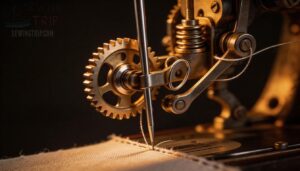
The needle bar timing is what makes everything click. Your needle travels straight up and down — no arc, no swing — driving the upper thread through the fabric in one clean line.
Upper thread control depends on tension discs, the check spring, and the take-up lever working in sync.
Nail your needle size matching, stitch length adjustment, and thread tension adjustment, and your lockstitch balance holds firm on both sides.
Role of The Shuttle in Forming Each Stitch
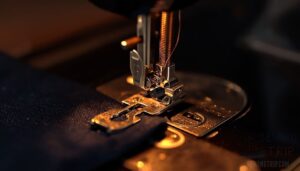
The shuttle does one job, but it has to do it perfectly. As the needle rises, the upper thread forms a brief loop below the fabric — and that’s when reciprocating motion drives the shuttle’s pointed nose through it.
This lock formation pulls bobbin thread into each stitch independently. Shuttle timing, thread tension, and bobbin capacity all control whether your stitches lock cleanly or collapse entirely.
How The Presser Foot Keeps Fabric Against The Feed Wheel
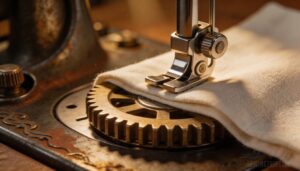
The presser foot acts like the top half of a clamp — the feed wheel grips from below, the foot holds firm from above.
Spring Pressure Adjustment controls how hard it presses down, letting you tune Material Grip Control for heavy or delicate cloth via the Pressure Screw Tuning dial.
Foot Sole Wear kills Foot Wheel Friction fast, so inspect it regularly.
Early Singer Models That Used The Circular Feed Wheel
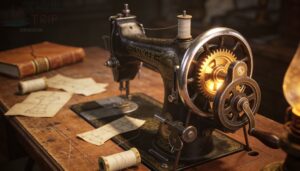
The circular feed wheel didn’t just appear in Singer’s 1851 patent model and disappear — it carried forward into several early commercial machines. Some of those models gave you a choice between wheel feed and drop feed depending on the job at hand.
Here’s a closer look at the specific Singer models that put this feed system to work.
Singer Number 1 Standard and Number 2 Standard Configurations
The No. 1 Standard and No. 2 Standard are Singer’s earliest commercial lockstitch configurations. Bed size comparison is the fastest way to tell them apart — the No. 2 gives you more room to the right of the needle.
Both share heavy cast iron construction, a large side balance wheel, and original japanned finish.
Serial number dating helps confirm which configuration you have.
Wheel Feed Vs. Drop Feed Options on Industrial Models
Once you move past bed size, feed type becomes the next big decision. Wheel feed delivers stronger material grip on leather and coated fabric, with better stitch accuracy along curved edges.
Drop feed suits flat apparel work, offering faster production speed. Surface marking and maintenance differences matter too — wheel mechanisms need more precise pressure adjustment.
Some industrial Singer machines included a showing lever for reversing direction of feed.
Feed-Off-the-Arm and Specialized Cylindrical-Bed Variants
Feed type tells only part of the story. The real key factor is bed shape.
Singer’s cylindrical-bed and feed-off-the-arm heads were built as task-specific heads for trades that flat beds simply couldn’t serve:
- Industrial Sleeve Closing — sleeves wrap around the narrow arm naturally
- Leather Edge Feeding — wheel feed precision keeps marked surfaces clean
- Cylindrical Bed Advantages — closed tubes like boot tops pass over freely
- Trouser and bag seams — guided without flattening the finished shape
Collecting and Maintaining a Circular Feed Wheel Singer Machine
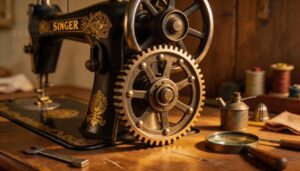
If you’ve got one of these early Singer machines, you’re holding onto a real piece of sewing history. Knowing how to spot it, what it’s worth, and how to keep it running makes all the difference.
Here’s what you need to know across three key areas.
Identifying Circular Feed Wheel Models by Features and Serial Numbers
circular feed wheel Singer starts with the casting itself — look for a round or curved throat plate opening instead of the long rectangular slot on drop feed models like the Model 66 or Model 99. Wheel casting clues, shuttle plate signs, and feed wheel wear marks all tell a story.
ISMACS records Cross-check serial number patterns against ISMACS records for reliable markings and dating confirmation.
Current Market Value and What Affects Collectibility
Once you’ve confirmed the model, value becomes your next puzzle.
Common antique Singers fetch $20–$200, but circular feed wheel machines carry a serious Rarity Premium — surviving 170-year-old examples are scarce.
Original Finish and Provenance Impact matter enormously. Condition Grading separates $300 machines from $1,500 ones. Auction Venue also shifts realized prices dramatically — specialty dealers consistently outperform local listings.
Lubrication, Belt Replacement, and Keeping The Mechanism Running
Keep it simple: one drop of light mineral oil at each Oil Application Points — upper shaft bearings, needle bar, presser foot bar, feed wheel shaft, and shuttle race. That’s your Bearing Oil Maintenance routine sorted.
- Shuttle Race Cleaning: scrape hardened varnish gently with wood, never steel
- Leather Belt Sizing: cut snug, join with a metal hook connector
- Running Checks Routine: always turn by hand before powering up
Frequently Asked Questions (FAQs)
What is the most sought after vintage Singer sewing machine?
Most collectors agree that Singer 221 Featherweight tops the vintage Singer wishlist.
It’s light, reliable, and genuinely fun to use — a rare combination that keeps demand strong across every corner of the collector market.
What are common problems with Singer machines?
Thread tension, needle breakage, bobbin shuttle jams, feed wheel wear, and belt slippage are the most common problems. Regular lubrication and machine lubrication guide practices keep most issues from starting.
What is the difference between a Singer 27 and 28?
Think of the Singer 27 and 28 as full-size versus three-quarter-size twins. The Singer 27 has a larger bed size and machine footprint; the Model 28 runs smaller, offering better portability differences.
What year was the Singer 66 made?
The Singer 66 first rolled out in 1902 and stayed in production until around
Your exact year depends on the serial number — that’s where Production Year Range and Factory Code Identification truly matter.
How much is a Singer 15 88 worth?
A working Singer 15-88 generally sells for €50–€109, depending on condition and whether it includes the original cabinet or treadle. Non-working examples often fetch €20 or less.
What is my old Singer sewing machine worth?
Your machine’s worth depends on model rarity, condition, and original accessories. Common Singer machines fetch $75–$300, while rare variants reach $800 or more.
serial numbers and compare recent auction results for accurate price benchmarking.
How do I find my Singer 27s serial number?
Check the bed plate, base plate engraving, or needle plate stamping first. Your serial number may also be hidden under the accessory drawer.
Use ISMACS for serial number lookup and dating methods.
What parts need regular replacement?
Replace the needle every 6–8 hours of sewing.
Swap the Treadle Belt when cracked, refresh the Winder Tire, check the Presser Foot, Shuttle Assembly, Bobbin, and Bobbin Case regularly.
Oil the Machine every session.
Whats the best way to clean my machine?
Unplug first — always. Wipe the surface, brush the bobbin area, and clear the feed wheel. Oil designated points only.
Log each session.
Thirty seconds of prevention beats an hour of troubleshooting.
Where can I find vintage sewing machine parts?
Online Parts Retailers like Etsy and New England Sewing stock belts, bobbins, and feet. Salvage Shops and Specialty Part Makers carry hard-to-find pieces.
Serial Number Guides and Repair Community Forums to confirm compatibility.
Conclusion
Just as the circular feed wheel moved fabric smoothly, understanding its mechanics moves you smoothly through sewing’s history. The Singer sewing machine with circular feed wheel showcases innovation’s impact on everyday tasks.
By grasping its design, you’ll appreciate modern machines’ evolution. This early model paved the way for today’s technology.
Familiarize yourself with the circular feed wheel’s role in sewing’s past, and you’ll better understand your own sewing machine’s capabilities with a Singer sewing machine with circular feed wheel.
- https://www.kleinanzeigen.de/s-freizeit-nachbarschaft/singer-15-88/k0c185
- https://help.singer.com/en-US/whats-my-sewing-machine-worth-407312
- https://www.quiltingboard.com/vintage-antique-machine-enthusiasts-f22/singer-15-88-15-89-a-t246745.html
- https://rubell.wordpress.com/2009/01/19/my-singer-model-15-88-sewing-machine/
- https://www.worthpoint.com/worthopedia/vintage-singer-sewing-machine-15-88-206435473