This site is supported by our readers. We may earn a commission, at no cost to you, if you purchase through links.
That gorgeous dress pattern you bought three months ago is still sitting in your drawer, intimidating you every time you open it. You’re not alone—most beginner sewers abandon their first pattern before making a single cut, overwhelmed by cryptic symbols, tissue-thin paper, and instructions that read like a foreign language.
But here’s the truth: learning to use a sewing pattern isn’t nearly as complicated as pattern companies make it seem. Once you understand the system—how to read the markings, prepare your pieces, and follow the logical sequence—you’ll wonder why it ever felt so mysterious. The key is breaking down each step, from selecting the right size to making your first confident cuts.
Table Of Contents
- Key Takeaways
- Selecting The Right Sewing Pattern
- Understanding Pattern Sizing
- Gathering Essential Sewing Supplies
- Preparing Sewing Pattern Pieces
- Interpreting Pattern Symbols and Markings
- Laying Out and Pinning Patterns on Fabric
- Cutting and Marking Fabric Accurately
- Following Pattern Instructions Step-by-Step
- Making Pattern Adjustments for Fit
- Troubleshooting Common Pattern Issues
- Frequently Asked Questions (FAQs)
- Conclusion
Key Takeaways
- Pattern sizing differs completely from ready-to-wear clothing sizes, so you’ll need to take precise body measurements and compare them to the pattern company’s size chart rather than relying on your usual size tag.
- The symbols and markings on pattern pieces—grain lines, notches, dots, darts, and cutting versus stitching lines—form a visual language that tells you exactly where to cut, fold, match, and sew without lengthy written instructions.
- Proper fabric preparation starts before cutting: align the grain line parallel to the selvage within an eighth inch, press pattern pieces flat to prevent shifting, and secure everything with pins or weights to maintain accuracy through every cut.
- Most patterns require adjustments for fit, which you’ll make by lengthening or shortening at designated lines, modifying width at bust/waist/hips, and reshaping darts or seams—always test changes on muslin before cutting your actual fabric.
Selecting The Right Sewing Pattern
Your first sewing pattern can make or break your enthusiasm for the craft, so it’s worth taking a few minutes to choose wisely. The right pattern matches your current abilities, gives you enough information to work confidently, and won’t overwhelm you with unnecessary complications.
Look for beginner-friendly sewing patterns that include clear instructions, minimal pattern pieces, and forgiving fabrics like cotton or linen.
Your first sewing pattern can make or break your enthusiasm for the craft, so choose one that matches your abilities and won’t overwhelm you
Here’s what to look for when you’re standing in front of that pattern rack or browsing online.
Matching Pattern to Skill Level
Pattern selection starts with honest skill assessment. Match your sewing proficiency to garment difficulty by checking pattern labels—look for “easy” or “beginner” tags that signal beginner guidance, not complex techniques.
- Simple patterns feature fewer pattern pieces and straight seams without darts
- Complex sleeve shapes, zippers, and linings indicate higher sewing pattern levels
- Multi-size grading adds pattern filtering challenges for learners
- Clear visual diagrams distinguish beginner-friendly sewing pattern usage from sophisticated projects
Reviewing Pattern Descriptions
Once you’ve matched your skill level, flip to the pattern envelope’s back panel for description analysis. This section reveals fabric guidance, size selection ranges, and view options with distinct hem lengths or sleeve styles.
Study yardage estimates, notion lists, and finished measurements carefully—they’re your pattern clues for success. Understanding sewing patterns starts here, where choosing a sewing pattern becomes strategic, not guesswork. For a deeper understanding, consult the detailed pattern description elements commonly found on commercial patterns.
| Pattern Element | What to Look For | Why It Matters |
|---|---|---|
| Views & Variations | Multiple silhouettes, hem options | Determines project versatility |
| Fabric Requirements | Type, weight, yardage by size | Prevents costly purchasing errors |
| Notions List | Zippers, interfacing, closures | Ensures complete supply gathering |
| Finished Measurements | Bust, waist, hip dimensions | Confirms fit before cutting |
Assessing Garment Complexity
Beyond pattern descriptions, you need to gauge fabric difficulty and seam complexity to avoid construction challenges. Count pattern pieces—more pieces mean more matching, grading, and alignment work.
Look for curved seams, princess lines, collars, and structured elements that demand precise sewing techniques. Complex garment construction with pleats, darts, or multiple closures extends your timeline and tests your skills during garment assembly.
Achieving a satisfactory finished product also relies on understanding the factors impacting good garment fit.
Understanding Pattern Sizing

Pattern sizing doesn’t match the numbers you see in ready-to-wear clothing, which catches most sewers off guard the first time they shop for patterns.
You’ll need to measure your body carefully and compare those numbers to the pattern company’s size chart, not the size tag in your closet. Getting the right fit starts with understanding how patterns are sized, how much ease you actually need, and why your usual size mightn’t be the one you should cut.
Taking Accurate Body Measurements
Your flexible tape is the bridge between body proportions and garment fitting—use it snug but not tight. Start at anatomical landmarks: bust at the fullest point, natural waist at the narrowest.
Record body measurements in consistent units, measuring three times for precision techniques that eliminate guesswork. These numbers determine your pattern size, so accuracy here saves hours of alterations later.
Using Size Charts Effectively
Commercial pattern size charts aren’t ready-to-wear sizing—they’re built on body measurements, not vanity labels. Compare your recorded numbers to the chart’s bust, waist, and hip columns with measurement precision that accounts for sizing variance.
Choose the size closest to your largest measurement, then cross-check finished garment measurements for fit guidance. If your fabric selection has significant stretch, you’ll often size down for the cleanest drape.
Allowing for Wearing Ease
Wearing ease basics separate body measurements from finished garment dimensions, giving you room to move without pulling at the seams. Your sewing pattern builds in this space through calculated seam allowances and pattern pieces that exceed your actual measurements.
Mastering proper fabric cutting techniques ensures those ease allowances stay accurate from pattern to final garment.
- Upper body ease adds 2 to 4 inches at the bust for comfortable arm movement
- Bodice fitting retains 1 to 2 inches at the waist for bending and twisting
- Hip ease allowance provides sitting comfort with 1 to 2 extra inches
- Fabric drape considerations reduce ease for knits, increase for wovens
Gathering Essential Sewing Supplies
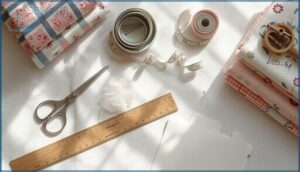
Before you can bring your sewing pattern to life, you’ll need to gather the right materials and tools.
The pattern envelope lists specific fabric requirements and notions, but understanding how to choose quality supplies makes all the difference in your finished garment.
Let’s break down what you need to have on hand before you make that first cut.
Choosing Suitable Fabrics
Your pattern envelope lists suggested fabrics for a reason—ignore it at your own risk. Start with fabric selection by checking fiber types and weave structures against the pattern’s recommendations.
Lightweight cottons and linens work beautifully for draped garments, while structured pieces need fabric properties like body and stability. Always consider drape analysis before fabric cutting, and remember that textile science isn’t just theory—it directly affects your finished garment’s fit and performance.
Selecting Notions and Trims
Your sewing pattern envelope lists required notions for a reason—zippers, buttons, snaps, and thread aren’t optional afterthoughts. Match notion types to your fabric weight and garment function.
Choose heavy-duty fasteners for outerwear, delicate trims for sheer fabrics, and fusible interfacing for collars and cuffs. Keep sewing supplies organized by type, and always buy extras of sewing accessories like elastic and hook closures to avoid project delays.
Preparing Cutting Tools
Sharp blades save fabric and sanity—dull scissors crush fibers instead of cutting cleanly. Before starting your sewing pattern, inspect your cutting tools and prepare them properly.
- Sharpen fabric shears at a 15 to 20 degree bevel using a sharpening stone for precision cuts
- Wear cut-resistant gloves during blade maintenance and edge inspection as safety precautions
- Clean rotary cutters with non-abrasive cleaner after each use to prevent fiber buildup
- Check coating options like titanium nitride for extended blade life during heavy cutting plans
- Store tracing wheel and tailor’s chalk separately from sharp tools to prevent accidental dulling
Preparing Sewing Pattern Pieces
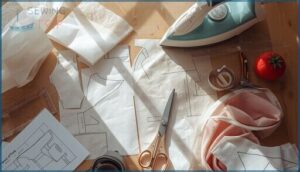
Before you can lay your pattern pieces on fabric, you need to get them ready for the pattern preparation. Whether you’re working with delicate tissue paper from a commercial pattern or assembling pages from a PDF download, proper preparation makes all the difference in achieving accurate cuts and a well-fitted garment.
Here’s how to handle each type of pattern and make certain your pieces are smooth, flat, and ready to use.
Cutting Out Tissue Patterns
Before your scissors touch that delicate sewing pattern, take a breath—precision here sets the stage for everything that follows. Use sharp fabric scissors or a rotary blade to cut tissue cutting along the size line you’ve traced, keeping the blade just outside the line to maintain pattern accuracy. This preserves seam allowance and ensures your pattern pieces align perfectly with fabric grain later.
Handle each piece gently to prevent tearing, especially around notches and darts. Lay pattern pieces flat while cutting—curled edges lead to distorted shapes that won’t transfer accurately to fabric. Cut single pieces first when patterns show left and right versions, then label them immediately to avoid confusion during fabric cutting techniques and layout steps.
| Tool | Best For | Technique |
|---|---|---|
| Fabric scissors | Curved edges, detailed cuts | Cut with long, smooth strokes |
| Rotary cutter | Straight lines, multiple layers | Use a ruler and cutting mat |
| Paper scissors | Initial rough cuts | Reserve for pattern prep only |
| Cutting mat | Protecting work surface | Self-healing surface preferred |
Assembling and Trimming PDF Patterns
When working with PDF patterns, trim the right and bottom edges of each page first, leaving the top and left intact for alignment.
Match printed page numbers and pattern marks before taping—this is where seam accuracy begins.
Use clear tape or a glue stick along joined edges, checking that notches align precisely across seams. Always verify the 1:1 scale box with a ruler before assembly.
Pressing Pattern Pieces for Accuracy
Once your pattern pieces are assembled, press them flat with a dry iron on low heat—wrinkled tissue shifts during layout, throwing off seam accuracy and pattern precision.
Set your iron temperature around 250°F to relax creases without scorching. Use a pressing cloth if the pattern is delicate.
This fabric preparation step locks in clean edges, ensuring your pattern pieces layout stays true to the sewing pattern instructions.
Interpreting Pattern Symbols and Markings
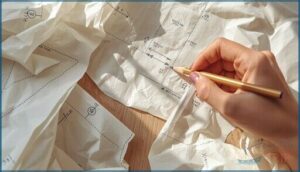
Once you’ve prepared your pattern pieces, the real work begins with understanding what all those lines, symbols, and little marks actually mean.
Think of pattern symbols as a visual language—they tell you exactly where to cut, fold, match, and stitch without spelling everything out in words. Let’s break down the most important markings you’ll encounter so you can translate your pattern pieces into a finished garment.
Identifying Grain Lines and Notches
Before you cut a single thread, locate the long arrow printed on your pattern pieces—that’s your grain line. Position it parallel to the fabric selvage to maintain proper fabric orientation and drape.
Next, find those small triangular notches along the edges. These marks guarantee pattern alignment when you’re joining seams, giving you the sewing accuracy professionals count on every time.
Decoding Dots, Circles, and Darts
Look for small dots on your pattern pieces—they mark matching points where seam guides align during assembly. Circles often indicate pocket placements, button spots, or gathering landmarks.
Darts create three-dimensional shape, transforming flat fabric into a contoured silhouette. The dart tip marks where the point ends, with legs running to the seam.
Transfer these pattern markings using a tracing wheel, ensuring dot alignment across pieces for professional results every time.
Recognizing Cutting and Stitching Lines
Most sewing patterns show two critical boundaries: the cutting line sits at the outer edge, while the stitching line reference runs inside it, separated by your seam allowance. That space between them—usually 5/8 inch—gives you room to sew and finish edges properly.
Dashed lines often mark where your needle should travel, while solid lines indicate cutting line accuracy. Always check notch alignment marks and fabric grain lines on your pattern pieces before you cut, since these pattern markings guarantee professional results when assembling garments.
Laying Out and Pinning Patterns on Fabric
Laying out your pattern pieces is where the planning pays off. Get this step right, and you’ll save fabric, prevent warping, and set yourself up for a smooth sewing experience.
Here’s how to position, align, and secure your pattern before you make a single cut.
Positioning Pattern Pieces Correctly
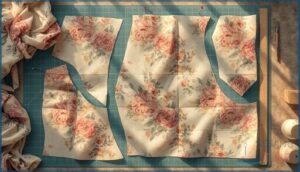
Think of pattern layout as a puzzle where each piece has a perfect home. Start by positioning the largest pattern pieces first, creating a stable foundation that prevents shifting.
For directional fabric layout, arrange all pieces so they face the same way—this maxim ensures visual harmony. Place multi-layer placement pieces on the fold for mirror symmetry, then fill gaps with smaller sections, always keeping notches accessible for matching.
Aligning With Fabric Grain
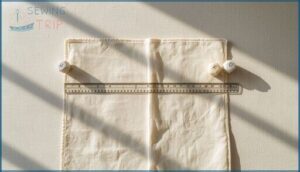
Before you cut a single thread, align the grain line on your pattern pieces parallel to the fabric selvage—this step determines fabric stability and drape. Measure from the grain line to the selvage at both ends, keeping distances equal within an eighth inch.
Proper grain direction prevents twisted seams and distorted hems, while deliberate bias cutting creates intentional drape for collars or bias-bound edges.
Securing Patterns With Pins or Weights
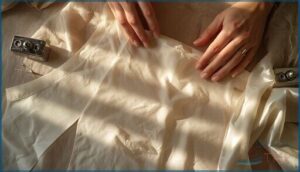
Pin placement directly affects cutting accuracy and sewing precision throughout your sewing project steps. Position pins perpendicular to the edge every 4 to 6 inches, securing pattern pieces for fabric stability without distorting grain lines.
Pattern weighting works better on slippery or thick fabrics—place weights at all four corners and close to edges for maximum hold during sewing pattern preparation.
Cutting and Marking Fabric Accurately

Once your pattern pieces are pinned in place, it’s time to cut and mark your fabric with precision—this step makes or breaks the accuracy of your final garment.
Sharp scissors, a steady hand, and the right marking tools will help you transfer every vital detail from pattern to fabric. Here’s how to cut cleanly and mark accurately so your pieces align perfectly during construction.
Cutting Along Designated Lines
Precision starts the instant your blade meets the pattern edge—drift even a millimeter, and seam allowances shift across every stitch. Position your scissors perpendicular to the cutting line, then advance in smooth strokes rather than choppy snips.
To ensure accuracy, follow these guidelines:
- Verify the solid line matches your chosen size before cutting any fabric.
- Keep blades angled slightly inward to honor the pattern edge exactly.
- Follow the straight of grain continuously to preserve structural integrity.
- Check cut edges immediately for snags that compromise seam allowance width.
Transferring Markings to Fabric
Once your blade finishes its work, you’ll need to capture every reference point before the pattern pieces come off. Chalk methods and tracing wheels offer speed, while tailors tacks deliver permanence on delicate weaves.
Water markers vanish with heat, and notch punching creates pinpoint guides along seam allowances. Test each technique on scrap fabric first—some chalk formulas smudge, and certain wheels leave visible grooves that show through sheer materials.
Marking Notches and Darts Precisely
With your markings transferred, focus on notch alignment and dart placement—these details control seam accuracy and final fit. Single notches mark front pattern pieces, while doubles indicate the back, ensuring you won’t reverse bodice panels mid-assembly.
For pattern precision during sewing pattern preparation:
- Snip small triangular wedges at each notch without cutting into the seam line
- Mark dart endpoints with tailor’s tacks or fine chalk dots
- Transfer all pattern piece interpretation symbols before unpinning tissue from fabric
Fabric marking now becomes your blueprint for impeccable sewing pattern markings explained in construction.
Following Pattern Instructions Step-by-Step

Now that your fabric is cut and marked, it’s time to put the pieces together.
Pattern instructions might look like a foreign language at first, with their numbered steps and cryptic diagrams, but they’re actually your roadmap to success.
Let’s break down how to read and follow these directions so you can sew with confidence instead of guesswork.
Understanding Sewing Order
The secret to garment construction lies in the sewing sequence laid out in your sewing pattern instructions. You’ll start with fabric preparation and work from the top down, tackling interfacings and center seams first.
Complete darts and style lines on flat pieces, then move to seam construction. This sewing order prevents shifting during garment assembly, ensuring each sewing technique builds on the last.
Interpreting Diagrams and Terminology
Once you’ve learned the sewing order, you’ll need to decode the visual language in your sewing pattern instructions. Diagram basics show you how pattern piece interpretation works—solid lines indicate cutting edges, while dashed lines mark stitching paths.
Symbol recognition helps you identify notches for alignment and dots for dart placement. Understanding sewing pattern instructions means matching sewing terminology like “grain line” to the fabric orientation arrows that guarantee proper drape.
Making Pattern Adjustments for Fit
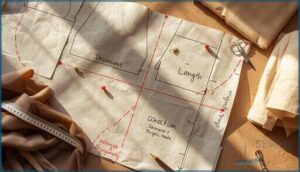
Patterns rarely fit perfectly straight from the envelope, so you’ll need to adjust them to match your body’s unique proportions. Most alterations fall into three main categories: changing the length of pattern pieces, modifying width at key points like the bust or hips, and reshaping darts or seams for better contour.
Here’s how to make each adjustment with precision and confidence.
Lengthening or Shortening Pieces
Need to adjust a sewing pattern’s length? Locate the lengthen and shorten lines printed on each pattern piece—these designated spots prevent distorting your garment’s silhouette.
For pattern alterations, cut horizontally along the line, then either overlap edges for shortening techniques or insert paper strips to add length. Always keep the grain line management aligned, redraw smooth curves at seams, and apply identical length adjustments to matching pieces for balanced sewing pattern modification.
Adjusting for Bust, Waist, and Hips
Perfect pattern fitting starts with matching your body proportions through targeted bust adjustments, waist modifications, and hip alterations. Measure from your high bust to the fullest point, then add or remove length at the bust line for accurate sewing pattern customization.
For waist modifications, shift horizontal lines to your natural waist position. Hip alterations add width evenly from the side seams outward, ensuring fitting garments achieve a custom fit without distorting your silhouette.
Modifying Darts and Seams
Dart transfer shifts fullness from one area to another while preserving fit—trace the highest point, then redraw seam allowances along new curved lines.
To perfect your sewing pattern through garment construction modifications, follow these sewing techniques:
- Use dart elimination by closing the original and smoothing contours into adjacent seams
- Combine multiple darts into one for simplified pattern making
- Apply dart redistribution to side seams for cleaner silhouette
- Test seam adjustment and seam realignment on muslin first
Troubleshooting Common Pattern Issues
Even with careful measuring and cutting, you’ll run into snags along the way—it’s part of the learning curve.
Fabric that won’t lie flat, pattern pieces that refuse to line up, and garments that don’t fit quite right are frustrations every sewist faces at some point.
Here’s how to identify what’s gone wrong and fix it before you reach for the seam ripper.
Fixing Fabric Distortion
Fabric distortion throws your whole garment off track, but you can fix it. Start with grain alignment—pin your pattern pieces parallel to the selvage before cutting to prevent diagonal pull.
Use fabric stabilizing techniques like light starch on bias edges and basting stitches on curves. Press seams open to control seam contraction, then use a tailor’s clapper for fabric relaxation and distortion control.
Resolving Misaligned Pieces
When pattern pieces won’t line up, check grain alignment first—fabric shifting during cutting throws off your pattern accuracy. Match notches exactly at seam junctions, then verify your seam allowance stays consistent throughout.
Pin each pattern piece at three-point intervals before stitching to prevent movement. If misalignment persists after pattern assembly, baste your seams first, test the fit, then adjust your sewing pattern formats accordingly.
Addressing Sizing or Fit Challenges
When your sewing pattern size doesn’t match your measurements, start with fit modification at key points—bust adjustments, waist, and hips.
Compare your high bust and full bust readings to determine if you need pattern grading between sizes. Calculate ease carefully, then test silhouette balance with a muslin mockup. Size grading and targeted modifications beat forcing an ill-fitting pattern every time.
Frequently Asked Questions (FAQs)
How to sew patterns together for beginners?
You’re diving into something that sounds simple until you realize patterns don’t exactly explain themselves. Start with fewer pieces, pin generously, press seams flat, and practice straight stitching first.
How do you follow a basic sewing pattern?
Start by selecting your pattern size using accurate measurements, then cut tissue pieces carefully.
Transfer all markings to fabric, align grain lines properly, and follow the sewing sequence in your instructions methodically.
How to use a sewing pattern without cutting it?
Like saving a file before editing, you can preserve your sewing pattern by using pattern tracing, overlay methods, carbon transfer, digital projection, or size adapting techniques—keeping the original intact for future projects.
How to use a pattern for multiple sizes?
You can trace your desired size onto separate paper to preserve the original, or blend between sizes at bust, waist, and hip using pattern grading rules for a custom fit with smooth transitions.
How do I store and organize my sewing patterns?
Most sewists drown in pattern chaos, yet the fix is simple: file paper patterns upright in labeled bins by garment type, store PDF patterns in cloud folders by designer, and maintain a master index for quick retrieval.
What are the best tools for tracing and modifying patterns?
Gather transparent tracing paper, French curves, and pattern rulers for precise modifications.
Use tracing wheels with carbon sheets for markings, water-soluble pens for fabric lines, and digital tools for adjustable adjustments before printing.
How do I match plaids and stripes when cutting fabric?
Match plaid alignment by cutting single-layer fabric with pattern pieces face up. Mark notches, align bold stripes at seams, and baste before final stitching to confirm stripe matching and seam accuracy across your garment.
What are some tips for sewing with slippery fabrics?
Stabilize slippery fabric with tissue paper underneath during cutting, use microtex needles and a walking foot, reduce stitch length to 0–5 mm, and secure pieces with pattern weights instead of pins.
How do I finish seams neatly on the inside of garments?
Your choice of seam finishing transforms a garment’s interior from raw to refined.
Try serger techniques for quick edge trimming, or use fabric binding on seam allowances for durable, professional interior neatening.
Can I reuse a sewing pattern multiple times?
Yes, you can reuse a pattern many times. Trace the original onto pattern tracing material or sturdy paper, preserving tissue pieces for future projects.
Store flat in folders to prevent distortion.
Conclusion
Like learning to read music symbols, mastering how to use a sewing pattern transforms mysterious symbols into clear instructions. You’ve now got the complete roadmap—from decoding markings to cutting with confidence.
That intimidating tissue paper sitting in your drawer? It’s just a blueprint waiting for your scissors and vision. Start with one pattern, follow each step deliberately, and you’ll discover what experienced sewers already know: sewing patterns aren’t obstacles, they’re your most reliable guides to garments that actually fit.