This site is supported by our readers. We may earn a commission, at no cost to you, if you purchase through links.
Pick up two spools of "40 wt" embroidery thread from different brands, and there’s a decent chance they won’t be the same thickness. That’s not a quality control failure—it’s a quirk baked into how thread is measured.
The weight system counts kilometers of thread per kilogram, so a higher number actually means finer thread, not heavier.
Most embroiderers learn this backward at first, and the confusion costs them puckered fabric and broken needles before it clicks.
Understanding thread thickness in embroidery means getting comfortable with three measurement systems, knowing your fabric’s demands, and matching every variable from needle size to tension before you stitch a single line.
Table Of Contents
Key Takeaways
- Thread weight numbers work backwards from what you’d expect — higher number means finer thread, because it measures how many kilometers fit in a kilogram.
- No single measurement system rules embroidery: weight (wt), denier, and Tex all describe thickness differently, so knowing how to convert between them saves you from costly mismatches.
- Your thread choice needs to match your fabric’s weight — fine 40–60 wt for lightweight fabrics, 40 wt for medium blends, and 30 wt or heavier for denim, canvas, and leather.
- Needle size, machine tension, and stitch density all need to shift when you change thread weight — getting just one of these wrong is usually what causes breaks, puckering, or skipped stitches.
What Thread Thickness Means
Thread thickness sounds simple, but there’s more going on beneath the surface than most beginners expect.
Getting a handle on the basics takes practice, and if you’re still finding your footing, this guide to choosing the right overlock machine for heavy fabric breaks down how thread weight interacts with different materials.
A few key ideas will change how you read labels, pick thread, and set up your machine. Here’s what you need to know first.
Thread Thickness Vs Thread Weight
Thread thickness and thread weight aren’t the same thing — though people use them interchangeably all the time.
Thickness is the physical diameter you can measure, shaped by fiber density impact, finish bulk, and ply structure.
Weight is a thread weight measurement system rooted in cotton-industry math.
Metric vs Imperial labeling adds another layer of confusion.
And yes, finish bulk and surface sheen can create a visual thickness illusion that fools even experienced stitchers.
Why Lower Weight Numbers Mean Thicker Thread
So now that you know weight isn’t the same as thickness, here’s the logic behind the numbers.
The thread weight measurement system comes from the cotton industry. It measures how many kilometers of thread fit in one kilogram. More thread per kilogram means thinner thread — so higher numbers equal finer.
In thread weight, higher numbers mean finer thread — more kilometers per kilogram, less bulk per stitch
That’s why 30 wt feels chunkier than 60 wt every time.
- Thread count system: higher number = more thread per kilo = thinner
- Fiber Density Influence: denser fibers pack more mass into less diameter
- Coating Layer Impact: wax or silicone finishes add measurable bulk
- Manufacturing Tolerance Variance: brands define weight ranges differently
- Cross-Brand Thickness Discrepancies: a 40 wt from one maker may differ noticeably from another’s
Common Embroidery Weights: 30 Wt, 40 Wt, 50 Wt, 60 Wt
Once you’ve got the logic down, the four main weights start making a lot more sense. 30wt is your bold workhorse — thick, strong, great for heavy designs. 40wt is the industry standard, used in about 65% of projects. 50wt sits comfortably in the middle. And 60wt? Super fine, perfect for detailed work.
Each fits into thread weight measurement systems that balance color vibrancy, machine speed settings, and supply chain availability.
Actual Thickness Vs Perceived Thickness
Here’s something that surprises most beginners: a thread’s actual diameter isn’t always what your eyes report. Color contrast, lighting angle, and fabric finish all play tricks.
A shiny thread catches light and looks fuller. Shadow play under dense stitch patterns adds visual bulk.
Even your stitch pattern changes perception. These are real factors influencing perceived thread thickness — separate from what a ruler would measure.
How Ply, Finish, and Fiber Affect Thickness
Beyond weight and diameter, three hidden variables shape how thick your thread actually looks and behaves — and they interact in surprising ways:
- Ply count impact: A second ply adds 10–20% diameter, but higher ply with a slick finish can push stitch height up 25% more than single-ply matte.
- Finish coating thickness: Wax or resin finishes stiffen thread and increase bulk, while smooth coatings compress during fills, reading visually thinner.
- Fiber composition variance: Polyester embroidery threads stay dimensionally stable; cotton embroidery threads vary naturally; rayon embroidery threads appear finer at equal weight; silk embroidery threads can thicken slightly from natural residues.
Ply finish interaction and tolerance variation compound everything — commercial threads allow ±3% diameter variance, which is small but meaningful across thousands of stitches.
Thread Measurement Systems Explained
Thread weight is just one piece of the puzzle — the real confusion starts when you realize there are actually several different systems used to measure it. Depending on where a thread is made or what software you’re using, you might see numbers in wt, denier, Tex, or ticket format.
Here’s what each system means and how they all connect.
Weight (wt) System Basics
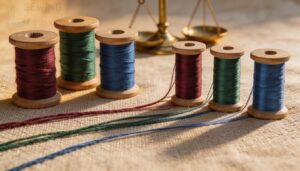
The weight (wt) system has cotton-industry historical origins, and its logic is refreshingly simple: the number tells you how many kilometers of thread fit in one kilogram. So 40wt thread runs longer and thinner than 30wt, which is heavier and bolder.
This industry standard directly shapes your stitch count impact, color consistency across brands, and cost implications when scaling up a project.
Denier and How It is Measured
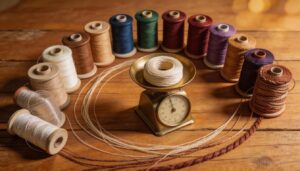
Here’s how the Denier system works: you take a standard test length of 9,000 meters of thread and weigh it in grams — that number is your denier. It’s a straightforward Mass Length Calculation. Higher numbers mean thicker thread.
The Denier Sampling Method uses Fiber Density Calibration under controlled conditions, and Denier Tolerance Levels maintain consistency across brands.
Simple, measurable, reliable.
Tex and Why Higher Tex Means Thicker
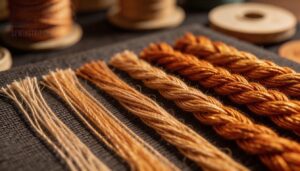
Tex works like Denier’s cousin — same idea, shorter ruler. Instead of 9,000 meters, the Tex system weighs 1,000 meters of thread in grams. Higher number, thicker thread. Simple.
Understanding this matters for your Thread thickness conversion chart and Stitch Coverage planning:
- 40 wt ≈ 20 Tex — your everyday workhorse
- Higher Tex increases Glossy Finish Bulk and Thread Sheen Effect
- High Tex raises Fabric Stiffness Impact — test before committing
Ticket Number Vs Needle Nm
Here’s where things get a little confusing — and you’re not alone if two systems have tripped you up.
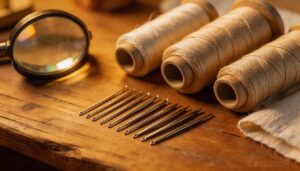
Ticket Number tracks thread compatibility, while Metric Size Nm measures the needle shaft itself. They’re related but not interchangeable.
Use Cross-Reference Tables and Brand Compatibility Guides for accurate Ticket-Nm Conversion, since Standardization Challenges mean one-to-one swaps aren’t always reliable.
Your Selection Workflow should always match Nm 75 or Nm 80 to your Thread thickness conversion chart.
Simple Thread Weight Conversion Examples
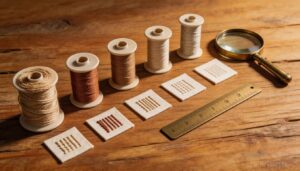
Converting between systems doesn’t have to feel like guesswork. A quick thread conversion chart shows that 30 wt equals roughly 250 denier or 28 Tex, while 40 wt lands around 180 denier or 20 Tex.
thread weight measurement systems — the denier system and Tex system — make fiber comparisons straightforward.
conversion tables for stitch calculations, and always test on scrap fabric first.
Choosing Thickness for Fabrics
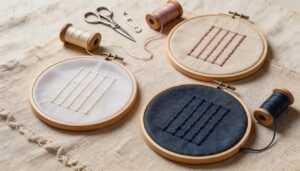
Picking the right thread weight for your fabric doesn’t have to feel like guesswork. The key is knowing how your fabric’s weight and structure interact with thread thickness. Here’s what you need to match them up correctly.
Fine Threads for Lightweight Fabrics
When you’re working on lightweight fabrics like silk, chiffon, or gauze, fine weights are your best friends. Threads between 40 and 60 wt keep stitches clean without weighing the fabric down.
Pair them with the right stabilizer choice, dial in your punch needle settings carefully, and you’ll sidestep fabric puckering prevention issues entirely.
Sheer fabric strategies matter too — tighter tension control keeps everything crisp.
Standard 40 Wt for Medium Fabrics
Step up to medium fabrics — twill, gabardine, cotton-poly blends — and 40wt becomes your go-to workhorse. It hits that sweet spot between coverage and breathability, making it ideal for logos and lettering without crowding the weave.
Here’s why 40wt shines on medium‑weight fabrics:
- Stabilizer Compatibility — bonds cleanly with cut-away and tear-away stabilizers, keeping stitches sharp
- Color Saturation Impact — delivers rich, consistent color without oversaturating the fabric
- Machine Speed Optimization — feeds smoothly at standard speeds, reducing thread breaks
- Cost Efficiency Analysis — widely available at lower price points than specialty weights
- Environmental Impact — less thread waste thanks to consistent tension and fewer re‑stitches
Following thread thickness guidelines for embroidery styles and matching thread thickness with needle size — usually a 75/11 — keeps everything running cleanly across all fabric considerations.
Heavy Threads for Denim, Canvas, and Leather
Denim, canvas, and leather are a different game.
fabrics punch back.
For Denim Topstitching Techniques, you’ll want 30 wt or heavier — it reduces multiple passes while keeping stitch visibility sharp.
Canvas Stabilizer Selection matters too, since thick threads need firm backing to prevent thread thickness and fabric puckering.
Industrial Leather Stitching demands waxed, abrasion-resistant threads with UV Protective Coatings and needle size compatibility up to 100/16.
Matching Fabric GSM to Thread Thickness
GSM‑Thread Correlation is your secret weapon here. Fabrics under 80 GSM pair best with 40–50 wt thread; go heavier, and you’ll overpower the weave.
Medium fabrics (80–150 GSM) handle 40–50 wt comfortably.
Open‑Weave Tolerance means looser fabrics actually welcome slightly thicker threads to close stitch gaps.
Always run a Swatch Testing Guide check first — Stitch Density Balance depends on it.
Preventing Puckering With The Right Thread Weight
Puckering usually means something’s out of balance — and thread weight is often the culprit. Matching your thread weight to your fabric keeps everything flat and smooth.
- Keep Bobbin Thread Balance equal to your top tension to prevent pulls
- Use a Stabilizer Choice that suits your fabric weight
- Plan your Design Layout Planning to avoid overly dense fills on light fabrics
Thread Types and Project Uses
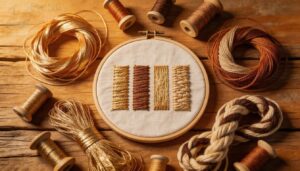
Not all threads are created equal, and the type you pick matters just as much as the weight. Each fiber behaves differently on fabric — affecting sheen, durability, and how your finished design actually looks.
Here’s how the most common thread types stack up and where each one truly shines.
Polyester Thread Thickness and Durability
Polyester threads are the workhorses of embroidery — and for good reason. Their UV resistance keeps colors from fading, while strong abrasion performance means designs survive heavy wear.
Colorfastness over washes stays reliable through cycle after cycle.
A higher ply count adds strength and reduces thread breakage.
Trilobal finish effects boost shine without changing actual thread thickness.
For most thread weight choices, 40 wt polyester hits the sweet spot for durability and longevity.
Rayon Thread for Sheen and Detail
Rayon thread is where thread thickness meets artistry. Its fine twist and smooth needle glide let it flow through fabric with minimal drag, delivering luminous fills that genuinely glow.
That sheen contrast — especially on dark colors — adds texture and dimension you can’t fake.
Color saturation stays rich, and the thread thickness effect on sheen and luster makes even simple motifs look polished.
Cotton Thread for Matte Embroidery
Cotton thread is the quiet workhorse of embroidery — no flashy sheen, just clean, confident coverage. Its natural matte finish techniques make it perfect when you want designs to whisper rather than shout.
Here’s why cotton thread earns its place in your kit:
- Matte Finish Techniques — Mercerization effects strengthen the fiber while keeping sheen and luster low and intentional.
- Thread Thickness Control — Available 30 wt to 60 wt, matching your thread weight to any fabric need.
- Colorfastness Strategies — Reactive dyes hold color through roughly 40 wash cycles.
- Wax Coating Benefits — Light wax resists snagging on textured surfaces without adding shine.
- Storage Conditions — Keep it cool and dry; moisture quietly warps both weave stability and color.
Follow basic thread thickness guidelines for embroidery styles, and cotton rewards you with results that age gracefully.
Silk and Metallic Thread Considerations
Silk and metallic threads are genuinely in a league of their own. Silk thread sheen creates rich luster interaction with light, deepening colors naturally.
For metallic thread handling, use a Teflon foot — the needle foot material reduces friction dramatically.
Stitch glow management matters too: shorter stitches control metallic sheen beautifully.
For colorfastness care, always cold-wash and air dry both thread types.
Thread Thickness for Lettering, Logos, and Fills
Thread thickness makes or breaks your lettering. For text under 10 mm, use 60 wt — it preserves legibility and keeps digitizing settings tight.
Corporate logos? 40 wt hits the sweet spot between color contrast and coverage density.
Heavy fills on denim demand 30 wt for full coverage per stitch.
Always match your stabilizer choice to thread weight, or your fabric pays the price.
Mixing Multiple Thread Weights in One Design
Once you’ve nailed single-weight choices, combining multiple thread weights in a project opens up real depth. A solid weight layering strategy pairs 30 wt outlines with 60 wt fills for contrast balancing that feels intentional, not busy.
Plan your design mockup workflow first, assign each segment its weight, then tune stitch density coordination and stabilizer selection per zone — your results will show it.
Needles, Tension, and Common Problems
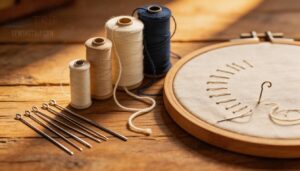
Getting your thread right is only half the battle — your needle and machine settings need to keep up. A mismatch here is usually what’s behind those frustrating breaks, loops, and skipped stitches.
Here’s what you need to know to get everything working together.
Matching Needle Size to Thread Thickness
Getting needle size right is like finding the perfect handshake — firm enough to connect, gentle enough not to crush. For 60 wt thread, a 65/9–75/11 needle manages stitch height optimization beautifully.
Step up to 90/14 for 30 wt.
Thread thickness and needle compatibility depend heavily on needle eye sizing and shank shoulder alignment.
Always monitor needle wear to catch problems early.
Sharp, Ballpoint, and Specialty Needle Choices
Now that you’ve matched size to weight, Needle Point Types matter just as much. Sharp point needles cut cleanly through denim and canvas, while ballpoint needles gently push knit fibers aside — no snags, no runs.
Specialty Coatings, like titanium, boost longevity considerably. Eye Size Variations accommodate metallic and thick rayon threads comfortably. Your needle selection guide starts with fabric type first.
Tension Adjustments for 30 Wt, 40 Wt, and 60 Wt
Once your needle’s right, embroidery machine tension becomes your next dial to respect. Top Tension Levels vary by weight — 30wt runs best around 6–8, 40wt sits comfortably at 4–6, and 60wt needs a lighter 2–4.
Bobbin Tension Balance keeps stitches even underneath.
Fabric Grip Influence matters too — denser fabrics need slight loosening.
Always adjust Speed Adjustments and Stitch Length Tuning together when switching thread weights.
Stitch Density Changes for Thick and Fine Threads
Thread thickness directly shapes how you set stitch density.
Thick threads like 30 wt need wider spacing — around 0.8 to 1.0 mm — to avoid puckering and fabric distortion management problems. Fine 60 wt threads tolerate tighter fills near 0.6 to 0.9 mm for smooth coverage and density.
Smart Underlay Strategies and Density Gradient Techniques, combined with Stitch Length Optimization, help every thread thickness effect on texture and dimension shine.
Fixing Thread Breaks, Skipped Stitches, and Looping
Even the best setup hits a snag sometimes — but most problems trace back to a handful of fixable culprits. Here’s what to check:
- Thread breakage — Inspect eye alignment for nicks or burrs
- Skipped stitches — Match needle size to thread thickness
- Looping — Rebalance bobbin tension underneath
- Thread path cleaning — Clear lint daily
- Stitch length — Adjust for heavy threads to reduce friction
Best Machine Setup for Smooth Embroidery Results
Getting your machine dialed in doesn’t have to feel overwhelming. A few smart adjustments make all the difference between frustrating thread breakage and buttery-smooth stitching.
| Setting | What to Do |
|---|---|
| Hoop Alignment | Center design, keep hoop parallel to needle |
| Stabilizer Selection | Match stabilizer weight to fabric |
| Bobbin Quality | Use smoothly wound bobbins for even tension |
| Electronic Tension Compensation | Enable auto-adjust for varying fabric thickness |
| Machine Calibration | Update firmware and calibrate sensors regularly |
Frequently Asked Questions (FAQs)
How often should embroidery needles be replaced?
Replace your needle every 8–12 hours of stitching. Watch for wear indicators like skipped stitches or fraying.
Project complexity and machine speed affect needle lifespan, so build a consistent replacement schedule into your routine.
Can thread weight affect embroidery wash durability?
Yes, thread weight directly affects wash durability. Heavier threads offer better abrasion resistance, while finer ones risk color fading faster.
Proper stabilizer effect, wash temperature impact, and material types all influence post-wash tension and longevity.
How do you store thread to maintain quality?
Store spools upright in Cool Dry Storage, away from sunlight for Light Exposure Control and Moisture Management. Upright Spool Arrangement prevents tangling.
Regular Inspection catches fraying early, protecting durability and longevity, thread luster, fade resistance, and break resistance.
clear storage containers help keep skeins visible and organized.
What stabilizers work best with thick threads?
Cutaway stabilizer selection matters most with thick threads. A 5–8 oz cutaway prevents fabric puckering and holds dense fills steady.
For slippery fabrics, sticky back options keep everything aligned before the first stitch.
Conclusion
Like a master chef adjusting seasoning, you’ve now got the recipe for perfect embroidery: understanding thread thickness is the secret ingredient.
You’ve learned to navigate weight systems, match threads to fabrics, and troubleshoot common issues.
With practice, you’ll confidently pair threads and fabrics, creating stunning designs. Remember, understanding thread thickness in embroidery is key to unlocking professional-looking results.
Your embroidery journey is now set for smooth stitching and beautiful finishes, every time, with precision and ease.