This site is supported by our readers. We may earn a commission, at no cost to you, if you purchase through links.

A crooked cut doesn’t announce itself until you’re pressing that final seam—and by then, you’ve wasted fabric, time, and patience. Most quilting mistakes trace back not to skill, but to the ruler. A ruler that slides a millimeter mid-cut, or one too short to span your border strips, quietly sabotages work that should be precise.
For home studio setups, especially where space is tight and every tool pulls double duty, the wrong ruler costs you more than money.
The right quilting rulers for home studio setups give you clean edges, repeatable accuracy, and cuts you can trust without second-guessing. The nine options ahead cover every core task—from squaring blocks to slicing bias strips—so you can build a compact, capable toolkit that works as hard as you do.
Table Of Contents
- Key Takeaways
- Top 9 Quilting Rulers for Home Studios
- 1. LINXIAO Acrylic Square Quilting Rulers
- 2. Creative Grids Stripology XL Quilting Ruler
- 3. Oqqlin Clear Acrylic 60 Degree Triangle Ruler
- 4. Fiskars Clear Sewing Ruler
- 5. Karpoulra Acrylic Slotted Quilting Ruler
- 6. Fiskars Clear Acrylic Sewing Ruler
- 7. Green Acrylic Quilting Ruler Set
- 8. Omnigrip Non Slip Quilting Ruler
- 9. Omnigrid 6 by 24 Quilting Ruler
- Must-Have Ruler Features
- Best Sizes for Home Studios
- Specialty Rulers by Quilt Task
- Setup, Care, and Buying Tips
- Choosing Rulers for Small Home Studio Layouts
- Pairing Rulers With Mats and Rotary Cutters
- Preventing Ruler Slip on Busy Work Surfaces
- Cleaning Acrylic Rulers Without Damaging Markings
- Storing Rulers Flat to Avoid Warping
- Avoiding Scratches, Yellowing, and Edge Wear
- What to Prioritize When Comparing Prices and Features
- Frequently Asked Questions (FAQs)
- Conclusion
Key Takeaways
- A ruler with non-slip backing isn’t a nice-to-have — it’s what stands between a clean cut and a ruined block, especially on busy home studio surfaces.
- Your starter kit only needs three rulers: a 6×24 inch for strips, a 6×6 inch square for corners, and a 4×12 inch for sashing and sectional trimming.
- Acrylic thickness matters more than price — rulers under 3mm flex under rotary pressure, which quietly kills your accuracy over time.
- Match the ruler to the task: slotted rulers for batch strips, square rulers for squaring blocks, and 60° triangle rulers for diamonds and hexagons.
Top 9 Quilting Rulers for Home Studios
Not every ruler belongs in every studio — the right pick depends on your projects, your cutting style, and how much table space you’re working with. These nine rulers cover everything from batch strip cutting to precise block trimming, so there’s a solid option no matter where you’re in your quilting journey.
If you want a deeper breakdown of what sets each option apart, this guide to sewing rulers for patchwork enthusiasts walks through the key features worth comparing before you buy.
Here’s what made the cut.
1. LINXIAO Acrylic Square Quilting Rulers
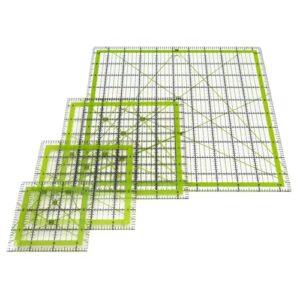
The LINXIAO set gives you four square rulers in one affordable pack — 3.5", 5", 6.5", and 10.5" — so you’re covered from tiny patchwork corners to full border blocks.
Each one is cut from 3 mm clear acrylic with green-tinted grid lines marked to 1/8-inch increments. The diagonal and 45° guides are easy to read on both light and dark fabrics.
At $8.98 for the set, it’s a practical starting point for any home studio.
| Best For | Quilters and fabric crafters of all skill levels who need accurate, versatile cutting guides for patchwork, sewing, and DIY projects. |
|---|---|
| Material | Clear acrylic |
| Measurement Units | Inches (1/8″ increments) |
| Angle Guides | 45°, 90° |
| Non-Slip Feature | Flat balanced design |
| Rotary Cutter Compatible | Yes |
| Intended Use | Quilting, patchwork, sewing |
| Additional Features |
|
- Four sizes in one pack covers a wide range of cutting needs, from small patchwork pieces to larger border blocks.
- Clear acrylic lets you see your fabric pattern underneath, so lining things up is quick and easy.
- At $8.98, it’s a solid value — hard to beat for a beginner or hobbyist on a budget.
- No storage pouch included, so keeping the rulers scratch-free takes a little extra effort.
- Only square shapes in the set — if you need circles or specialty cuts, you’ll have to shop elsewhere.
- Green markings can wash out under bright lighting or on shiny fabrics, which can slow you down mid-project.
2. Creative Grids Stripology XL Quilting Ruler
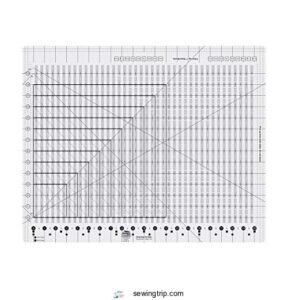
If you need to cut a lot of strips fast, the Creative Grids Stripology XL is hard to beat.
Designed by Gudrun Erla, this 17¾" × 22" ruler has cutting slots every ½ inch — so you can slice eight 2½-inch strips or fourteen 1½-inch strips in a single pass.
Black stars and squares mark the most common cuts at a glance.
The non-slip grip holds firm under pressure, and 45° and 60° angle guides handle diamonds and triangles without extra tools.
| Best For | Quilters and crafters who cut high volumes of fabric strips, squares, and geometric shapes and want to do it fast without sacrificing accuracy. |
|---|---|
| Material | Clear acrylic |
| Measurement Units | Inches (1/4″ increments) |
| Angle Guides | 45°, 60° |
| Non-Slip Feature | Non-slip grip surface |
| Rotary Cutter Compatible | Yes |
| Intended Use | Quilting, strip cutting |
| Additional Features |
|
- Cutting slots every ½ inch let you knock out dozens of strips in one pass — huge time saver on big projects.
- The non-slip grip actually stays put, so you’re not constantly readjusting mid-cut.
- 45° and 60° angle guides mean you can cut diamonds and triangles without hunting for extra tools.
- The instructions have typos in the ¼-inch cutting section, so double-check before you cut.
- Static can shift your fabric when you lift and reposition the ruler, which gets annoying fast.
- At nearly 18" × 22", it’s not exactly something you toss in a bag for a quilting retreat.
3. Oqqlin Clear Acrylic 60 Degree Triangle Ruler
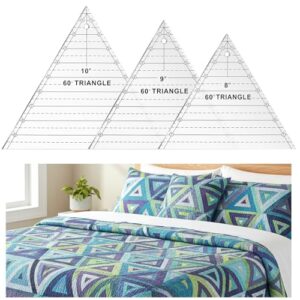
Where the Stripology XL manages volume, the Oqqlin 60° Triangle Ruler manages angles. This three-piece set — 8", 9", and 10" heights — gives you the range to cut accurate diamonds and hexagon blocks without swapping tools mid-project.
At 3 mm thick and fully transparent, you can see your fabric pattern right through it. Grid lines run at 1-inch and ½-inch intervals for clean, repeatable cuts.
Just note: it has no non-slip backing, so pair it with a grippy mat.
| Best For | Quilters and sewists who regularly cut diamonds, hexagons, or other angled shapes and want a versatile set of triangle rulers in one go. |
|---|---|
| Material | Clear acrylic |
| Measurement Units | Inches (1″ and 1/2″ increments) |
| Angle Guides | 60° |
| Non-Slip Feature | None included |
| Rotary Cutter Compatible | Yes |
| Intended Use | Quilting, patchwork |
| Additional Features |
|
- Three sizes (8", 9", 10") in one pack — no need to swap between rulers mid-project
- Fully transparent acrylic lets you see your fabric pattern underneath for better alignment
- 1-inch and ½-inch grid lines make measuring quick and cuts more consistent
- No non-slip backing, so the ruler can shift on smooth surfaces while cutting
- Angle accuracy can be off by up to ¼ inch — not ideal if you need precision templates
- Markings on one side only, and the diagonal numbers can be confusing at first
4. Fiskars Clear Sewing Ruler
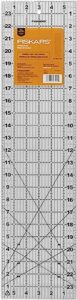
If angles are your focus, strips are next — and for strips, the Fiskars 6×24 Clear Sewing Ruler earns its place on the cutting table.
At 3 mm thick, it stays flat under rotary pressure without flexing.
The two-tone markings — black on light areas, white outline on dark — read clearly across any fabric.
Built-in 30°, 45°, and 60° bias lines handle your angled cuts cleanly.
At $21.49, it’s a reliable everyday ruler that won’t let you down mid-project.
| Best For | Quilters and sewists who regularly work with long fabric cuts and need reliable angle guides for bias and strip piecing. |
|---|---|
| Material | Clear acrylic |
| Measurement Units | Inches (grid lines) |
| Angle Guides | 30°, 45°, 60° |
| Non-Slip Feature | Non-slip surface (reported) |
| Rotary Cutter Compatible | Yes |
| Intended Use | Quilting, fabric cutting |
| Additional Features |
|
- Two-tone markings (black and white) stay readable on both light and dark fabrics — no more squinting or second-guessing your lines.
- Built-in 30°, 45°, and 60° bias guides make angled cuts quick and accurate without any extra tools.
- At $21.49, it’s an affordable, durable everyday ruler that holds up well under consistent rotary cutter use.
- Strictly for straight cuts — if you need curves or intricate shapes, you’ll need a different tool.
- The rotary blade isn’t included, so factor in that extra cost if you’re just getting started.
- Some units arrive with a slight warp, which means you might need to flatten it before your first use.
5. Karpoulra Acrylic Slotted Quilting Ruler
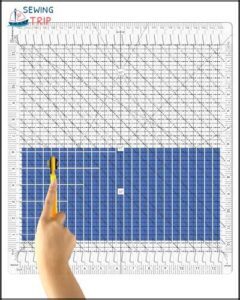
Strip cutting just got faster with the Karpoulra QR12X12.
This 12.5 × 12.5 in clear acrylic ruler comes with 26 evenly spaced ½-inch slots, so your rotary cutter rides through clean cuts without repositioning the ruler each time.
The built-in 45° and 60° guides handle binding strips, diamonds, and triangles in one tool.
Self-adhesive silicone grips on the back keep it planted on your mat.
At $25.71, it’s a practical addition for batch cutting days.
| Best For | Quilters and sewers who do a lot of batch cutting and want clean, repeatable strips and angled pieces without constantly repositioning their ruler. |
|---|---|
| Material | Clear acrylic |
| Measurement Units | Inches (1/2″ increments) |
| Angle Guides | 45°, 60° |
| Non-Slip Feature | Silicone grip strips |
| Rotary Cutter Compatible | Yes (slotted) |
| Intended Use | Quilting, sewing |
| Additional Features |
|
- 26 half-inch slots let you run a rotary cutter through multiple cuts in one go — huge time saver on bigger projects.
- Built-in 45° and 60° angle guides mean you don’t need a separate tool for binding strips, diamonds, or triangles.
- Clear acrylic with non-slip silicone grips keeps everything stable and visible, even on dark fabrics.
- Acrylic can crack if you drop it, so it needs careful handling.
- The slots are narrow — thicker rotary blades or craft knives may not fit.
- At 12.5 inches, it won’t cover larger quilt sections in one pass, so you’ll need to reposition for bigger cuts.
6. Fiskars Clear Acrylic Sewing Ruler
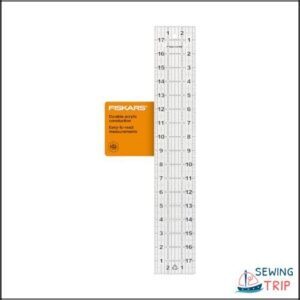
The Clear Acrylic Sewing Ruler keeps things simple — and that’s exactly the point.
At 18 inches long and 3 inches wide, it manages most straight cuts without overwhelming your cutting table. The 3 mm acrylic is thick enough to guide a rotary cutter cleanly, and the high-contrast grid stays readable on dark fabrics too.
Removable non-slip vinyl feet hold it steady when you need them. At $8.97, it’s an honest everyday tool backed by a full lifetime warranty.
| Best For | Quilters and sewists who need a reliable, no-fuss ruler for straight cuts and seam-allowance work without spending a lot. |
|---|---|
| Material | Clear acrylic |
| Measurement Units | Inches (grid lines) |
| Angle Guides | Not specified |
| Non-Slip Feature | Removable vinyl feet |
| Rotary Cutter Compatible | Yes |
| Intended Use | Quilting, sewing |
| Additional Features |
|
- High-contrast grid reads clearly on both light and dark fabrics
- Removable non-slip feet keep it steady during rotary cutting
- Full lifetime warranty for under $9 is genuinely hard to beat
- Acrylic can chip or scratch if dropped, so it needs a bit of careful handling
- Some units may arrive slightly bowed and need flattening before use
- Straight-edge only — no help if you need curved or very narrow cuts under 1.5 inches
7. Green Acrylic Quilting Ruler Set
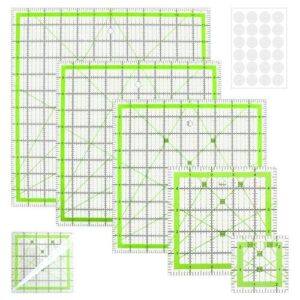
Five rulers in one box — that’s the pitch, and the Hariendny Green Acrylic Set ($19.69) delivers it well. Sizes run from 2.5" up to 12", so you’ve got square blocks covered across most beginner projects.
The green-tinted clear acrylic keeps your fabric pattern visible underneath, and 24 rubber gaskets plus built-in non-slip rings hold each ruler steady during cuts.
Markings include 1/8" subdivisions for fine trimming.
Just handle them carefully — some units arrive with light surface scratches out of the box.
| Best For | Beginner quilters who want a solid set of square rulers without spending a lot. |
|---|---|
| Material | Clear acrylic |
| Measurement Units | Inches (marked) |
| Angle Guides | Not specified |
| Non-Slip Feature | Non-slip rings + gaskets |
| Rotary Cutter Compatible | Yes |
| Intended Use | Quilting, patchwork |
| Additional Features |
|
- Five sizes in one box covers most basic quilting needs
- Clear acrylic lets you see your fabric pattern while you cut
- Non-slip rings and 24 rubber gaskets keep things steady
- Some sets arrive with surface scratches right out of the box
- Only square shapes — you’ll need extra tools for anything else
- Non-slip rings and edge markings may wear down over time
8. Omnigrip Non Slip Quilting Ruler
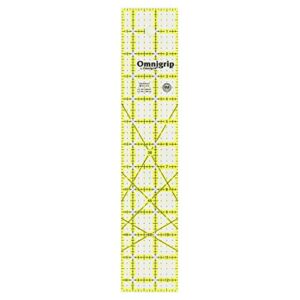
The Omnigrip 2.5" × 12.5" ruler is a compact workhorse that earns its place in any home studio.
At just 0.13" thick, it’s rigid enough to guide a rotary cutter cleanly without flexing mid-pass.
The patented non-slip backing grips your mat so the ruler stays put — no constant reseating between cuts.
Fine 1/8" markings and mirrored angle lines at 30°, 45°, and 60° work equally well for left- and right-handed quilters.
One note: check corners on arrival.
| Best For | Quilters of any skill level who need a reliable, compact ruler for precise cuts, bias angles, and patchwork work on smaller fabric pieces. |
|---|---|
| Material | Clear acrylic |
| Measurement Units | Inches (1/8″ increments) |
| Angle Guides | 30°, 45°, 60° |
| Non-Slip Feature | Non-slip bottom |
| Rotary Cutter Compatible | Yes |
| Intended Use | Quilting, small-scale cutting |
| Additional Features |
|
- Non-slip backing keeps the ruler firmly in place on your cutting mat, so you’re not constantly adjusting mid-cut.
- Fine 1/8" markings plus built-in 30°, 45°, and 60° angle lines make everything from straight cuts to bias diamonds easy to handle.
- Works for both left- and right-handed quilters, and the clear acrylic lets you see your fabric clearly underneath.
- At 12.5" long, it won’t cut it (pun intended) for larger quilt pieces that need a longer guide.
- Metric users are out of luck — markings are inches only, so keep a conversion chart handy.
- A few buyers have reported damaged corners on arrival, so give it a good look when it shows up.
9. Omnigrid 6 by 24 Quilting Ruler
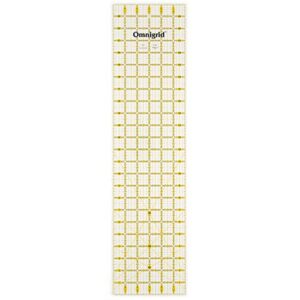
The Omnigrid 6" × 24" is the ruler most quilters reach for first — and with good reason.
At 11.56 oz, it’s substantial enough to stay flat without feeling like a workout.
Laser-cut edges glide cleanly under a rotary cutter, and the dual-color black-and-yellow grid stays readable on both light and dark fabrics.
Angle lines at 30°, 45°, and 60° handle bias cuts without guesswork.
One heads-up: it doesn’t include non-slip feet, so grab adhesive grip dots before your first cut.
| Best For | Quilters and sewists who need a reliable, everyday cutting ruler that works on any fabric color and handles both straight cuts and angles with ease. |
|---|---|
| Material | Rigid plastic |
| Measurement Units | Inches (1/8″ increments) |
| Angle Guides | Angle markings |
| Non-Slip Feature | Non-slip backing |
| Rotary Cutter Compatible | Yes |
| Intended Use | Quilting, patchwork |
| Additional Features |
|
- Dual-color black-and-yellow grid keeps lines visible on light and dark fabrics
- Angle markings at 30°, 45°, and 60° make bias cuts straightforward
- Laser-cut edges pair cleanly with rotary cutters for precise, consistent results
- Doesn’t come with non-slip feet, so the ruler can slide on fabric without added grip
- At 24 inches, it may fall short for larger cutting projects
- Can feel heavy during long cutting sessions
Must-Have Ruler Features
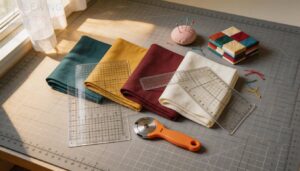
Not all rulers are built the same, and the difference shows up fast once you’re mid-cut. A few key features separate a ruler that holds steady from one that slides, fades, or chips after a season of use.
Here’s what to look for before you buy.
Non-slip Backing for Safer Rotary Cutting
A ruler that shifts mid-cut can ruin an entire block. That’s why nonslip backing isn’t optional — it’s your first line of defense.
Nonslip backing is not optional — it is your first line of defense against ruined cuts
Modern Grip Material Innovation uses rubberized or silicone-infused composites that grip your mat firmly through hundreds of cuts. Adhesive Longevity means the backing won’t peel even after repeated cleaning. Surface Compatibility Testing confirms it works on both fabric and mat surfaces.
What good nonslip backing does for you:
- Keeps your ruler locked during aggressive rotary cutter glides
- Resists moisture and thread-lint buildup common in home studios
- Stays grippy from cool basements to warm craft rooms — Temperature Resistance matters
- Facilitates Maintenance Best Practices: wipe clean with mild soap, air dry
- Protects your cuts so your nonslip surface stays effective long-term
Acrylic Thickness for Rigidity and Durability
Grip keeps your ruler in place — but thickness keeps it true.
A ¼-inch heavy-duty durable acrylic ruler resists flex and warping far better than thinner ⅛-inch sheets.
Material thickness and durability in rulers directly affect your cost durability tradeoff: thicker shatter-resistant acrylic lasts longer but weighs more, so consider weight handling over long cutting sessions.
Thickness tolerance within ±0.02 inch ensures consistent, accurate results every time.
Laser-cut Edges for Smooth, Accurate Cuts
Thickness keeps your ruler true — and laser-cut edges keep your cuts honest. A quality laser-finished edge holds straightness within ±0.2 mm over 12 inches, so you’re not accumulating offset across repeated blocks.
The burr-free sliding means no fabric snagging mid-stroke. That edge microstructure and tolerance precision also deliver real edge wear resistance, so laser-etched markings stay readable long after your mat shows wear.
High-contrast Grid Lines for Fabric Visibility
Sharp edges get you started — but if you can’t read your grid lines, accuracy falls apart fast. High-contrast markings are what actually keep your cuts honest across light and dark fabrics.
Look for these line quality indicators:
- Dual-color printed markings with 0.2–0.25 mm line thickness stay legible after repeated cleaning
- UV pigments in matte finish surfaces prevent fading under studio lights
- Edge tactile markers help confirm grid intersections when glare hits transparent acrylic
30°, 45°, and 60° Angle Markings
Once your grid lines are readable, angle cuts are next. The 30, 45, and 60 degree angle markings on a quality ruler do the math for you.
Laser etched angles stay sharp through years of cleaning — degree label visibility doesn’t fade.
Angle marking consistency across both ruler edges helps left- and right-handed cuts, giving your angle guide accuracy on every pass.
Clear Vs Tinted Acrylic for Alignment
Both ruler types work well — the right choice depends on your studio setup.
- Glare Management: Tinted acrylic reduces reflections under bright lighting, improving lighting adaptability for your eyes.
- Acrylic Clarity: High-clarity transparent acrylic shows your cutting mat’s grid through the ruler for precise fabric alignment.
- Mark Legibility: Clear acrylic needs high-contrast etching; color consistency matters more with tinted options.
- Scratch Visibility: Clear surfaces reveal wear faster, potentially affecting alignment accuracy over time.
- Fabric Visibility: Transparent acrylic keeps dark fabrics visible beneath the ruler edge.
Measurement Increments for Precision Trimming
Precise cuts start with knowing your increments. Most quality rulers offer 1/8" and 1/4" marks for borders and sashing, while 1/16" increments handle half-square triangles cleanly.
Bold Increment Visibility matters — dual-color printed markings stay readable on both light and dark fabric. Consistent Subdivisions across the full ruler length keep your tolerance within ±1/64".
| Increment | Best Use | Precision Level |
|---|---|---|
| 1/4" | Seam allowances, sashing | Standard |
| 1/8" | Borders, binding strips | Moderate |
| 1/16" | HSTs, small units | Fine |
Durable Marking Materials — especially laser-etched 18 grid increments — resist wear through 1,000+ cuts.
Best Sizes for Home Studios
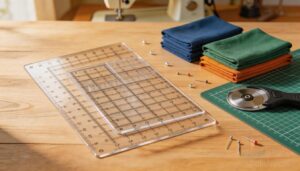
Ruler size matters more than most quilters expect, especially when your studio space is limited. right dimensions can mean the difference between clean, confident cuts and awkward repositioning mid-project.
Here’s a breakdown of the sizes worth having on hand.
Why 6 X 24 Rulers Suit Most Cutting Tables
A 6 x 24 ruler fits most home studio cutting tables without awkward overhang. It covers your cutting mat edge to edge, keeping a balanced workspace layout while supporting a consistent blade path across fabric strips.
Laser-cut edges guide your rotary cutter cleanly, and a nonslip grip holds firm. Corner squaring, borders, binding — this one size manages the everyday essentials.
When to Choose 12.5 Square Rulers
A 12.5 square ruler earns its place the moment you’re trimming fat quarter blocks or fitting patchwork sashing at inner edges. It fits standard 18×24 inch mats cleanly, with no overhang.
- Laser-cut edges glide without snagging on miniature quilt projects.
- Tidy 0.125-inch measurement increments help micro-adjust corners fast.
- Nonslip grip holds steady during hand-held cutting sessions.
- Grid visibility stays sharp even on a limited workspace.
Small Rulers for Block Trimming and Sub-cuts
Small rulers are where the real detail work happens. The article explains a small ruler scaling method for oversized blocks.
A compact option like the Creative Grids 6½ Inch x 6½ Inch Square Ruler manages edge alignment on tight blocks without crowding your mat. High-contrast markings keep incremental markings readable across light and dark fabrics.
For bias trim on half-square triangles, the slotted ruler guides your blade cleanly. Fabric visibility stays clear thanks to the acrylic construction.
Long Rulers for Borders, Sashing, and Binding
Long borders and sashing strips demand a ruler that goes the distance.
6 x 24 format, like the Creative Grids 6½ Inch x 24½ Inch Rectangle Ruler, facilitates border trimming, sashing, and binding cuts without constant repositioning.
Acrylic Transparency Benefits keep your fabric edge alignment accurate, while built-in seam allowance integration and edge notch precision mean clean, confident cuts every single time.
Matching Ruler Size to Quilt Project Type
Project Scale Matching starts with knowing your block.
A 6 x 6 inch ruler manages Block Size Alignment on 4-patch blocks cleanly.
The Creative Grids 6½ Inch x 24½ Inch Rectangle Ruler covers Border Length Planning across long sashing runs.
For Strip Width Coordination, a 6 x 24 inch ruler reduces repositioning.
Pattern Complexity Fit and Specialty Stripology Shape Cut work demand the 12.5 Square Ruler.
Building a Compact Starter Ruler Set
Once you’ve matched your ruler to your project type, the next step is pulling together a set that actually fits your space and budget.
Start with these three:
- A 6 by 24 inch ruler — your primary workhorse for strip cutting
- A 6 by 6 inch square for corner checks and small blocks
- A 4 by 12 inch acrylic ruler for sashing and sectional trimming
- A Compact Storage Box or Portable Carry Case keeps all three flat and warp‑free
- Nonslip grip features in quilting rulers matter more than price — don’t skip them
This is the essential quilting tools foundation for choosing the best quilting ruler for beginners without overbuying.
Specialty Rulers by Quilt Task
Not every quilt project calls for the same ruler.
The shape you’re cutting — strips, triangles, bias edges, or perfect squares — determines which tool actually gets the job done. Here’s what to reach for based on the task at hand.
Slotted Rulers for Batch Strip Cutting
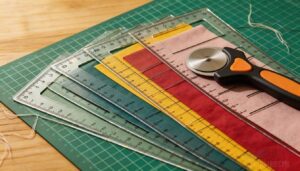
When you’re cutting dozens of strips for a Jelly Roll quilt, slotted rulers for efficient strip cutting are a game changer. Slot spacing optimization — usually at ½‑inch increments — locks your blade in place, so blade alignment consistency is nearly automatic.
That means layered fabric handling across multiple passes stays tight and accurate.
Acrylic slot durability holds up session after session, keeping your batch cut efficiency high from the first strip to the last.
Square Rulers for Squaring Quilt Blocks
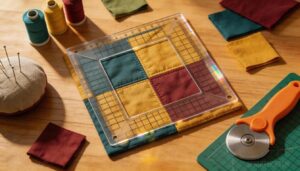
Once your strips are cut, squaring blocks is where accuracy really shows. A 12.5 square ruler covers blocks up to 12 inches finished — that’s your go-to for quilt block squaring.
Here’s what to look for:
- Optical Grade Clarity for clean fabric visibility
- Laser-cut edges for Edge Burr Prevention
- Precise measurement increments including 1/8-inch marks
- Seam Allowance Accuracy built into grid lines
- Eco-friendly Acrylic with Ruler Weight Balance for fatigue-free trimming
Triangle Rulers for Diamonds and Hexagons
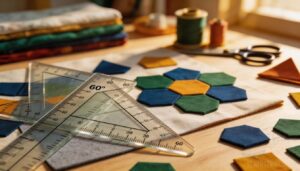
For diamonds and hexagons, triangle rulers are the tool that makes complex geometry manageable. A 60° angle cuts clean diamond units; pair two and you get a perfect hexagon every time.
| Feature | Diamond Cutting | Hexagon Cutting |
|---|---|---|
| Angle Guides | 60° Triangular Bias Marks | 60°/120° intersections |
| Grip | Edge Grip Textures | Non-slip backing |
| Visibility | Tinted Acrylic Visibility | High-contrast markings |
Hexagon Seam Guides and Diamond Layout Templates keep your counts accurate without guesswork.
Angle Rulers for Bias and Diagonal Cuts
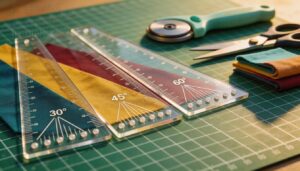
Bias and diagonal cuts demand a ruler you can trust not to drift. Angle rulers built with Locking Angle Mechanisms and Silicone Base Grips hold firm through every stroke.
- 30 45 and 60 angle lines cover most quilting needs
- Laser Etched Scales stay readable after years of use
- Compound Angle Guides simplify mitered corners and diamond joins
- 45 angle guides align bias strips flush to the grain
- 60 angle guides support consistent diagonal lines for squareness verification
Specialty Rulers for Half-square Triangles
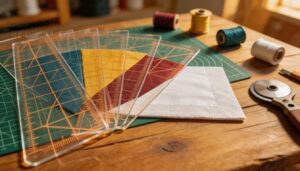
Half square triangles trip up even experienced quilters—but the right ruler fixes that quickly. Specialty HST rulers with Integrated Lock Channels grip your seam line so the ruler won’t rock mid-trim.
Dual-Use HST/QST designs let you cut quarter square triangles from the same tool.
Portable Nested Sets cover 2.5 and 4.5 inch finished sizes.
Shadowed Center Guides and Laser-etched markings keep alignment honest, while Nonslip grip and Quick-Flip Orientation reduce wasted steps.
Rulers Vs Quilting Templates for Home Use
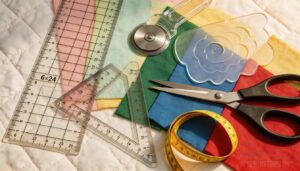
Rulers and templates aren’t rivals — they solve different problems. Rulers handle straight cuts and repeatable measurements, making them a more handy tool in your quilt making accessories kit. Templates shine for curved or complex block shapes.
cost comparison, rulers win: a basic 6×24 set runs under $30. Templates can reach $50 per piece. space efficiency, rulers stack flat easily.
Can Quilting Rulers Work for Free-motion Quilting?
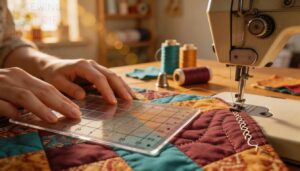
Yes, quilting rulers can support free motion quilting — but with a different role than cutting.
Place a non-slip ruler lightly on your quilt surface for low-pressure guidance and tactile feedback along guided stitch paths. This controls fabric tension and reduces ruler edge drag.
It’s a practical free motion quilting technique, and most sewing machines support basic ruler compatibility without specialty feet.
Setup, Care, and Buying Tips
Getting the most out of your rulers comes down to how you set up, use, and look after them. A few simple habits can extend the life of your tools and keep your cuts accurate for years.
Here’s what to know before you buy — and how to take care of what you already have.
Choosing Rulers for Small Home Studio Layouts
A cramped cutting table doesn’t have to cramp your accuracy. In a small home studio, space efficiency starts with choosing the right quilting ruler — usually a 6×24 inch for strips and a 12.5 inch square for blocks.
Compact storage solutions like wall-mounted organizers keep rulers accessible without cluttering surfaces.
Prioritize ergonomic grip and smart angle guide placement so silhouette visibility stays clear, even with limited elbow room.
Pairing Rulers With Mats and Rotary Cutters
Once your layout is sorted, the next step is making sure your tools work together.
Your rotary cutter mat should offer solid grip and a clean grid for blade alignment. Clear acrylic rulers let you see mat markings for precise fabric alignment. Slotted fabric cutters need uniform mat surfaces to track accurately. Choose a nonslip mat with good color contrast for edge protection and reliable angle guide integration.
Preventing Ruler Slip on Busy Work Surfaces
A slipping ruler wastes fabric fast. Good nonslip backing technology grips your mat surface so each cut stays true. Here’s how to lock yours in place:
- Apply grip tape application along the ruler’s back edge for extended sessions.
- Use micro-suction adhesive models that cling without residue.
- Add weighted ruler ends to reduce lateral drift on long cuts.
- Try corner clamp usage at fixed contact points for stability.
- Prep your mat surface preparation with a lint-free wipe first.
Silicone grips and nonslip rings add localized friction at corners. A nonslip grip coating covers the full back on premium models. These nonslip features aren’t optional — they’re what separates a clean cut from a crooked one.
Cleaning Acrylic Rulers Without Damaging Markings
Keep your rulers readable with a simple routine. For Mild Soap Cleaning, mix a drop of dish soap in warm water, then use the Microfiber Wipe Technique — light strokes along the edge, minimal pressure.
For sticky spots, Isopropyl Alcohol Use at 70% lifts residue without harming clear acrylic or laser-etched markings. Dry immediately for Residue-Free Cleaning that keeps high-clarity transparent acrylic sharp.
Storing Rulers Flat to Avoid Warping
Once your rulers are clean, where you store them matters just as much. Lay them flat — no leaning against walls.
Use the Flat Stacking Technique: stack rulers of similar material thickness with even Weight Distribution. Protective Sleeves prevent surface impressions.
Keep the area between 60–75°F with humidity control around 40–60% for acrylic ruler durability and laser‑etched markings durability.
Avoiding Scratches, Yellowing, and Edge Wear
Three threats shorten a ruler’s life: scratches, yellowing, and edge wear. A UV-resistant coating slows sun damage, while an anti-scratch surface resists blade contact.
Wipe heavy-duty durable acrylic with mild soap — skip alcohol sprays. Laser-etched markings‘ durability depends on gentle cleaning routines.
Beveled edge treatment prevents chipping, and high-clarity transparent acrylic stays readable longer when you avoid abrasive pads entirely.
What to Prioritize When Comparing Prices and Features
Before you buy, line up three things: total cost at checkout (base price plus shipping), seller reputation, and return policy. Bundle discounts can cut your effective cost per ruler substantially.
material thickness of at least 3mm, laser-cut edges, and reliable nonslip features — these directly affect measurement precision.
solid warranty length tells you the manufacturer actually stands behind what they’re selling.
Frequently Asked Questions (FAQs)
Do you need a speciality quilting ruler?
Not every quilter needs specialty tools right away. Project Complexity and Space Constraints often matter more than hype.
A basic straight-edge covers most beginner cuts — specialty quilting rulers for strip cutting come later.
Why do I need a quilting ruler?
Precise cuts make or break a quilt.
A quilting ruler gives you consistent block size, reduces fabric waste, and speeds up your cutting workflow — so every piece lands exactly where it should.
What is the difference between a ruler and a quilting template?
A ruler guides your rotary cutter along a straight edge. A quilting template defines a fixed shape for tracing or cutting.
Use rulers for measuring; use templates for repeating pattern pieces.
Can I use a ruler for free motion quilting?
Yes, you can. Attach a ruler foot for needle clearance and fabric glide.
Practice drills on scrap first. Stitch consistency improves fast with the right foot attachment and free motion quilting rulers.
What is the best quilting ruler to use?
For most quilters, a 6×24 inch non-slip acrylic ruler covers nearly every cut. Strong brand reputation, verified customer reviews, and warranty support matter as much as laser-cut edges and material thickness.
How do quilting rulers differ from drafting rulers?
Quilting rulers are built from thin clear acrylic with nonslip backing, laser-cut edges, and inch-based scale units. Drafting rulers use heavier materials and metric scales — entirely different application context.
Are quilting rulers safe for children to use?
With parental supervision, age-appropriate rulers featuring blunt edge designs and grip-enhanced surfaces are safe for kids. Prioritize shatter-resistant acrylic and nonslip grip features.
Keep rotary cutters away — those stay in adult hands only.
Can rulers double as straight edges for marking?
Acrylic rulers double as straight edges.
Laser-cut edges guide pencil glide easily and cleanly, while transparent acrylic keeps your fabric line visible.
Use chalk for marking tool compatibility and clean grid lines every time.
Do quilting rulers work on stretchy or knit fabric?
Yes, but knit fabric stabilization is key. Use a ruler with silicone grips, pin or weight the fabric flat, and cut slowly.
Non-slip features and laser-cut edges make a real difference on stretchy material.
Conclusion
Imagine quilting a queen-sized bedspread with precision-cut strips, every seam aligning perfectly. With the right tools, like top-rated quilting rulers for home studio setups, you can achieve professional results.
These rulers provide clean edges, accuracy, and cuts you can trust. By investing in a few essential rulers, you’ll save time, fabric, and frustration.
Your quilts will improve, and so will your confidence. Make every cut count with the best tools for your home studio.