This site is supported by our readers. We may earn a commission, at no cost to you, if you purchase through links.
Pick up two spools labeled "40 wt" from different brands, and you might be holding threads that are noticeably different in thickness. That’s not a printing error—it’s the result of competing measurement systems that never agreed on a universal standard.
Cotton count, Tex, Denier, Nm: each system made perfect sense to the industry that invented it, and now you’re stuck translating between all of them. A thread weight conversion chart cuts through that confusion fast, giving you the exact numbers to match thread across brands, needles, and project types without second-guessing every spool you grab.
Table Of Contents
Key Takeaways
- Thread weight numbers run backwards — a 30 wt is thicker than an 80 wt — and once that clicks, every conversion chart starts making sense.
- Tex and Denier are just two ways to measure the same thing: Tex weighs 1,000 meters of thread, Denier weighs 9,000, and you can convert between them by multiplying or dividing by 9.
- Your thread weight should match your project — 40–50 wt for garments and denim, 50–60 wt for piecing, and 60–80 wt for fine appliqué work where bulk is the enemy.
- Most sewing problems like breakage, puckering, and skipped stitches trace back to a mismatch between thread weight, needle size, and tension — fix the match, and the problems usually disappear.
Thread Weight Systems Explained
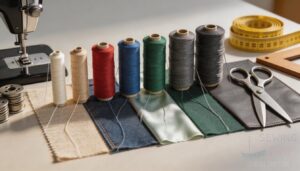
Thread weight systems can feel like a foreign language at first — different numbers, different scales, different rules depending on the brand. But once you understand how each system works, picking the right thread becomes second nature.
Once it clicks, you’ll find choosing the right thread weight for every project far less intimidating than that jumble of numbers first suggested.
Here’s a breakdown of the six main concepts you need to know.
What Thread Weight Numbers Actually Mean
Thread weight numbers have historical origins in old textile mills, where spinners counted yarn lengths to grade thickness. Today, that legacy creates consumer labeling confusion — one brand says "40 wt," another lists Tex or Denier.
These aren’t competing guesses; they’re different thread weight measurement systems measuring the same thing. Fiber influence matters too, since cotton, polyester, and silk behave differently at identical thread density perception values.
Why Lower Wt Means Thicker Thread
Once you grasp the thread weight inverse relationship, everything clicks. Lower wt numbers mean thicker thread — a 30 wt is noticeably chunkier than an 80 wt.
That thickness comes from Core Geometry, Ply Construction, Filament Bundling, and Coating Thickness working together.
A higher Core‑Sheath Ratio adds bulk too. Understanding thread weight measurement this way makes reading any thread weight conversion chart far less confusing.
How Tex Measures Grams Per 1,000 Meters
Once you know why wt numbers flip the scale, Tex starts to feel refreshingly logical. It’s a Universal Weight Unit built on a simple idea: weigh 1,000 meters of thread.
That Mass per Kilometer reading becomes your Tex value. A Tex number of 25 means 1,000 meters weighs exactly 25 grams — no guesswork.
Higher Tex Definition, heavier thread. It’s a reliable Thread Density Indicator, every thread weight conversion chart depends on.
How Denier Measures Grams Per 9,000 Meters
Denier works the same way as Tex — just stretched across a longer baseline. Denier Measurement Process weighs a 9,000-Meter Sample instead of 1,000 meters.
Mass Per Length reading becomes your denier number. So 270 denier means 9,000 meters weighs 270 grams.
Standard Denier Tolerance stays tight, thanks to the Calibration Scale Method, making it reliable for any thread weight conversion chart.
Where Nm and Dtex Fit In
Two more units round out your thread size conversion chart: Nm and Dtex. Nm tracks twist influence on filament yarns, while Dtex measures grams per 10,000 meters — think of Dtex 250 as roughly equivalent to 40 Nm in everyday weaving.
Here’s where each unit earns its place:
- Filament vs Staple — Nm suits continuous filaments; Dtex fits staple fibers and synthetics
- Dtex Strength Impact — higher Dtex means heavier, more abrasion-resistant yarn
- Nm Twist Influence — higher Nm signals finer, smoother filament
- Drape and Handfeel — both units directly shape how fabric moves
- Cross-Brand Equivalents — your thread weight conversion chart needs both for accurate Tex measurement comparisons
Why Brands Use Different Sizing Systems
Regional market preferences and historical labeling legacy explain most of the confusion. US brands lean on cotton count for consumer familiarity factors, while European brands favor Tex or Denier for precision. That’s why your thread weight conversion chart guide becomes essential for cross‑border conversion challenges.
| System | Primary Use |
|---|---|
| Wt (Cotton Count) | North American quilting |
| Tex | International/industrial |
| Denier | Embroidery & synthetics |
Thread Weight Conversion Chart
Once you know how the systems work, the next step is seeing them side by side.
The chart below maps each common weight to its Tex, Denier, and Nm equivalents so you can match threads across brands without guessing. Here’s how the numbers line up, from the heaviest weights down to the finest.
12 Wt to Tex, Denier, and Nm
Think of 12 wt as the heavyweight champion of decorative stitching.
It sits around Tex 80–105 and 720–950 denier — numbers that matter when running digital pattern calculations or checking brand conversion tables.
Fiber type influences these values slightly across manufacturers, but the range stays consistent with historical thread standards built for industrial heavy-duty use.
| Measurement | 12 Wt Value |
|---|---|
| Tex | 80–105 |
| Denier | 720–950 |
30 Wt to Tex, Denier, and Nm
30 wt sits right in the middle of the pack — adaptable enough for topstitching, bold enough to show on quilts.
| Measurement | 30 Wt Value |
|---|---|
| Tex | 45–50 |
| Denier | 400–450 |
| Metric Count (Nm) | 20–22 |
Conversion accuracy matters here because brand variations are real. Fabric compatibility and needle matching both depend on knowing your exact Tex and Denier before making tension adjustments.
40 Wt to Tex, Denier, and Nm
40 wt is the sweet spot — strong enough to hold, fine enough to stay out of the way. Bulk vs visibility balances perfectly here, and the fiber blend influence on stitch density correlation is real.
| Measurement | 40 Wt Value |
|---|---|
| Tex | 25–30 |
| Denier | 225–270 |
| Nm | 33–40 |
Color shading effect and thread elasticity factor both shine at this weight.
50 Wt to Tex, Denier, and Nm
50 wt is the workhorse of the sewing world — a Historical Standard Evolution that’s earned its place in nearly every project bag. Fiber Density Impact keeps it fine yet durable. Use Digital Conversion Apps and Material Compatibility Checks to confirm Thread Performance Metrics across brands.
| Measurement | 50 Wt Value |
|---|---|
| Tex | 20–27 |
| Denier | 180–243 |
| Nm | 37–50 |
Run your thread weight conversion before switching brands.
60 Wt to Tex, Denier, and Nm
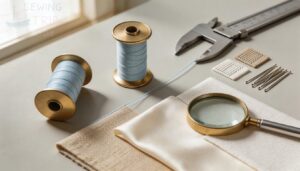
Step down from 50 wt, and 60 wt gets noticeably finer. Fiber Influence and Finish Effects both shift your Conversion Accuracy, so always run Practical Testing before committing.
Regional Standards also cause small variances across brands.
| Measurement | 60 Wt Value |
|---|---|
| Tex | 20–22 |
| Denier | 58–62 |
| Nm | 20–25 |
Use this thread weight conversion chart as your starting point.
80 Wt and 100 Wt Equivalents
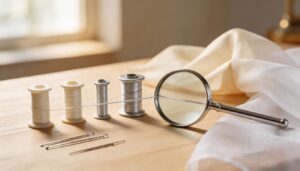
Go finer than 60 wt, and you’re working with threads built for precision.
80 wt sits around Tex 12–15 and 108–135 Denier — ideal for delicate fabric suitability needs. 100 wt drops even finer, reaching Tex 10–12 and 90–110 Denier. Brand variability means stitch strength and sewing speed can shift slightly between manufacturers.
| Thread Weight | Tex / Denier |
|---|---|
| 80 Wt | Tex 12–15 |
| 80 Wt | 108–135 Denier |
| 100 Wt | Tex 10–12 |
| 100 Wt | 90–110 Denier |
| Both | Use 60/8–70/10 needle |
Converting Weight, Tex, and Denier

Once you know what Tex, denier, and Nm actually measure, converting between them is straightforward math. Each system has its own formula, and they all connect back to the same core idea — thread mass over a set length.
Here’s how the conversions work.
Tex to Denier Conversion Formula
Once you know a thread’s Tex measurement, converting to denier takes one step: multiply Tex by 9. That’s the linear conversion principle at work. A Tex 30 thread? That’s 270 denier. Simple as that.
- Tex 25 = 225 denier — your standard 40 wt all-purpose thread
- Tex 10 = 90 denier — ultra-fine, perfect for bobbin work
- Tex 45 = 405 denier — bold decorative quilting territory
- Tex 80 = 720 denier — heavy-duty canvas and leather applications
Denier to Tex Conversion Formula
Going the other direction is just as clean. Divide denier by 9 to get Tex — that’s your thread weight conversion formula. Denier 270 becomes Tex 30.
For ply summation, add each strand’s denier first, then divide. Twist effect and brand variability can shift results 2–5%, so rounding rules matter. Denier 225 might land at Tex 24.9 — round to 25 for comparing tex denier and dtex units practically.
Tex to Nm Conversion Formula
Nm flips the script on Tex — divide 1,000 by your Tex value and you’re done. That’s the full formula derivation, no extras needed. Unit consistency matters here since both systems use grams per 1,000 meters as their base.
- Calculation Example: Tex 25 → Nm = 1,000 ÷ 25 = Nm 40
- Precision Factors: Round to nearest whole number
- Practical Implementation: Match Nm to your spool spec sheet
- Tex to Thread Weight: Higher Nm = finer thread
Nm to Tex Conversion Formula
Just flip the Tex to Nm formula around: Tex = 1,000 ÷ Nm. That’s your core conversion formula.
For a practical example calculation, Nm 40 gives you Tex 25 — a standard 40 wt thread.
Keep in mind fiber type impact and density adjustment factor can shift results by 5–15%, so standard constant variations exist across brands.
Always cross-check against your thread weight chart.
How to Estimate Equivalents Across Brands
No two brands speak exactly the same language. When you convert thread weights across brands, start with a swatch comparison technique — sew identical seams and compare feel.
Watch for fiber blend impact and twist level differences, since those shift real-world performance even at matching Tex or Denier values.
Ply construction variations matter too.
Keep a brand chart mapping your results alongside your thread weight conversion chart for quick sewing thread conversion chart reference.
When Conversion Numbers Vary Slightly
Small gaps in your thread weight conversion chart aren’t mistakes — they’re tolerance bands built into the system. Manufacturers allow roughly ±5% variance between Tex and Thread Weight values, and data rounding practices explain most mismatches.
Here’s what to watch:
- Conversion footnotes on reputable charts disclose acceptable statistical variance ranges.
- Fiber type shifts results — cotton versus polyester behave differently under precision instruments.
- Differences between Weight Tex and Denier systems mean understanding thread weight measurement requires cross‑checking, not blind trust.
Choosing Thread by Project Type
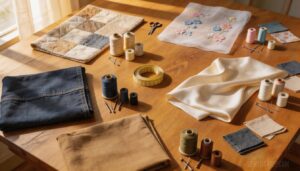
The thread you reach for should match what you’re actually making. A weight that works beautifully on a quilt backing can completely wreck a delicate appliqué seam.
The right thread weight for a quilt backing can completely destroy a delicate appliqué seam
Here’s how to match your thread to your project.
Best Thread Weights for Piecing
Piecing is where seam bulk control makes or breaks your quilt.
For most quilting cotton, 50–60 wt thread hits the sweet spot — fine enough to disappear into light fabric visibility seams, strong enough to hold.
Your thread weight conversion chart helps match Tex and Denier to fabric compatibility across brands.
| Thread Weight | Best Use in Piecing |
|---|---|
| 60 wt (Tex 15) | Delicate, light fabrics |
| 50 wt (Tex 27–30) | Standard quilting cotton |
Best Thread Weights for Quilting
Quilting pulls every layer together — and your thread choice determines whether that bond lasts.
For quilt layering on a domestic machine, 40–60 wt threads manage stitch bulk well without fighting the batting.
Use this quick guide with your thread weight chart:
- 40 wt — dense quilting, strong thread longevity on heavy seasonal fabric choice
- 50 wt — everyday quilting, balanced coverage
- 60 wt — fine texture, subtle thread finish types
- 30 wt — bold decorative lines
Best Thread Weights for Embroidery
Embroidery is where thread weight really shows its personality. For most machine embroidery, 40 wt (Tex 25–30, ~270 Denier) hits the sweet spot — strong Thread Longevity, solid Color Vibrancy, and enough Thread Sheen to pop without bulk.
Need finer detail? Drop to 60 wt.
| Weight | Tex / Denier | Best Use |
|---|---|---|
| 40 wt | Tex 25–30 / 270 Den | Fill stitching, monograms |
| 60 wt | Tex 15 / 135 Den | Fine lines, portraits |
| 12 wt | Tex 80+ / 720+ Den | Bold outlines |
Fabric Compatibility matters here — lighter fabrics need finer weights to prevent puckering. Higher Stitch Density calls for mid-range threads per your thread weight chart guide.
Best Thread Weights for Garment Sewing
Garments call for a different kind of precision. For most seams and tops, 40–50 wt (Tex 25–30, ~225–270 denier) gives you the right balance of Seam Durability and Bulk Management without showing through. If you want the full picture on how weight, denier, and Tex all connect, this thread thickness guide for embroidery and garment sewing breaks down the conversions and fabric pairings in plain terms.
Lightweight linings? Go 60 wt.
Your thread weight conversion chart is your shortcut here — Fabric Compatibility, clean Stitch Appearance, and the right Thread Finish all start with matching sewing thread weight to fabric.
Best Thread Weights for Denim and Canvas
Denim and canvas don’t play nice with lightweight threads. You need 40–50 wt (Tex 25–30, around 225–270 denier) for real Abrasion Resistance. Core Spun Strength keeps seams tight through thick layers.
Match your Needle Eye Size to the thread — usually a 90/14 or 100/16. Check Colorfastness Options for workwear. Always do a Tension Adjustment on scrap first.
Fine Threads for Appliqué and Detail Work
Fine detail work calls for a lighter touch than denim ever will. For appliqué, stick to 60–80 wt (around Tex 10–15, 90–135 denier). Your thread weight conversion chart makes finding these equivalents fast.
- Fiber Finish Choices shape visibility — matte cotton hides, silk glows
- Micro Needle Tips protect delicate weaves during thread thickness measurement
- Stitch Length Optimization prevents puckering on silk and lawn
Stabilizer Selection with Colorfastness Testing before committing.
Matching Thread, Needle, and Tension
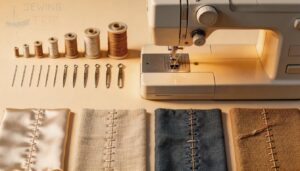
Getting thread weight right is only half the battle — your needle and tension settings have to keep up. The wrong combination leads to skipped stitches, puckering, or thread that snaps mid-seam.
Here’s what you need to know to match all three correctly.
Needle Sizes for Fine Thread Weights
Think of your needle as a delivery system — the wrong size ruins everything. For fine threads (80–100 wt, Tex 10–12), stick to size 60/8 through 70/10.
Your thread weight chart confirms this range. Eye Size Optimization matters here: a proportionally larger eye reduces shredding.
Microtex sharps offer Sharpness and Friction control, making them your best pick for delicate weaves per any reliable Fabric Compatibility Guide.
Needle Sizes for Medium Thread Weights
Medium thread weights — 40 to 60 wt (Tex 25–30, around 225–270 Denier) — work best with size 80/12 to 90/14 needles. Your thread weight chart confirms this range.
Eye Diameter Range sits between 1.25 and 1.65 mm, which facilitates smooth feeding on quilting cotton and similar fabrics.
Point Style Selection matters too: universal works for most wovens, while Microtex manages tighter weaves without tearing.
Needle Sizes for Heavy Thread Weights
Heavy thread (12–30 wt, Tex 40–105) needs a 100/16 or 110/18 needle — that extra needle eye diameter lets heavyweight thread feed without shredding. Your thread weight chart backs this up.
For denim and canvas, a Denim Needle is the right call. On knits, switch to a Ballpoint Choice instead.
Titanium Coating helps reduce heat buildup, so slow your Stitch Speed down on dense layers.
How Thread Weight Affects Tension
Thread weight and needle size work together like a key and lock — get one wrong, and tension falls apart fast.
- Tension Adjustment Strategies start with matching thread weight to needle size before touching any dial
- Needle Eye Clearance prevents constriction; a tight eye spikes tension unpredictably
- Thread Elongation Impact means high-stretch threads need slightly looser settings
- Fabric Friction Influence shifts ideal tension depending on finish and weave density
- Spool Winding Consistency keeps thread feeding evenly, stabilizing your sewing machine tension throughout the seam
Bobbin Thread Choices by Weight
Your bobbin thread choice matters more than most sewers realize. Match it to your top thread using your thread weight chart for best results.
| Fabric Type | Bobbin Thread Weight |
|---|---|
| Delicate silk | 100 wt (Tex 10) |
| Quilting cotton | 50–60 wt (Tex 15–27) |
| Woven garments | 40 wt (Tex 25) |
| Denim/canvas | 30 wt (Tex 35–40) |
| Upholstery | 12 wt (Tex 80+) |
Heavier Denier bobbins affect Stitch Density Impact and Fabric Bulk Reduction noticeably. Always check Bobbin Case Compatibility — thick thread needs proper Needle Eye Sizing and slower Speed Adjustments to prevent bird-nesting. Use Tex measurement and thread weight conversion formulas to confirm your match before sewing.
Why Test Stitches on Scrap Fabric
A scrap seam is your best Problem Prevention Strategy before you touch the real fabric. It gives you a Tension Balance Check, Needle Fit Verification, and Stitch Appearance Preview all at once.
You’ll spot puckering caused by wrong thread weight, catch fabric compatibility issues, and confirm seam durability fast.
Use your thread weight chart, make your thread tension adjustment, and watch Fabric Behavior Observation do the work.
Refer to the guide on matching thread weight to fabric for detailed recommendations.
Fixing Thread Weight Problems
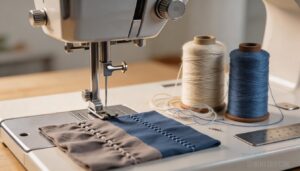
Even the best thread setup runs into trouble sometimes. Most problems come down to a mismatch between your thread weight, needle size, and tension settings.
Here are the most common issues and how to fix them.
Thread Breakage From Size Mismatch
When the needle eye fit is off, thread snapping isn’t far behind. Forcing thick thread through a tight eye creates rubbing damage with every stitch — and tension overload does the rest.
Watch for these thread breakage warning signs:
- Shredding near the needle eye
- Frequent breaks at the same spot
- Skipped stitches before a full snap
Matching thread weight with needle size and tension solves this fast.
Puckering Caused by Heavy Thread
Heavy thread pushes fabric fibers upward — that’s thread bulk distribution at work, and lightweight fabrics feel it most.
| Fix | Why It Helps |
|---|---|
| Longer stitch length | Reduces seam density impact |
| Lower top tension | Eases machine tension adjustment |
| Lighter thread weight | Improves fabric bulk sensitivity |
| Larger needle size | Smoother thread bulk distribution |
| Test on scraps | Catches seam puckering early |
Skipped Stitches With Incorrect Needles
Puckering sorted? Good. Now let’s talk about skipped stitches — because they’re almost always a needle problem, not a thread problem.
Needle Alignment, Needle Type Mismatch, and Needle Sharpness all play into this. A dull or bent needle won’t pierce cleanly, and Fabric Feed Interaction suffers instantly. Thread Path Obstructions from debris or a damaged clamp make it worse.
- needle size to thread weight — an 80/12 accommodates 40 wt; a 90/14 suits 30 wt
- replace your needle every 8–10 sewing hours, no exceptions
- Use sharp needles on wovens, ballpoint on knits — Needle Type Mismatch is a silent stitching killer
- Check Needle Alignment by reseating the needle fully before testing
- Always run a test stitch after any needle change to confirm machine tension holds steady
Bobbin Loops and Tension Imbalance
Skipped stitches fixed — now check under your fabric. Bobbin loops hiding there usually point to loose top tension settings or a presser foot threading mistake. Always raise your foot before threading; closed discs mean zero tension. Run a Pull Test Procedure to confirm grip. Use your thread weight conversion chart to spot Tex measurement and Denier mismatches between top and bobbin thread.
| Problem | Fix |
|---|---|
| Loops on underside | Increase top tension by one step |
| Top thread showing | Loosen Bobbin Case Screw a quarter turn |
Adjust bobbin thread tension gradually — never all at once.
Shredding From Dull Needle Eyes
Even a slightly dull needle destroys thread fast. Tiny burrs form on the eye after hitting pins or thick fabric, and Eye Edge Friction causes micro‑tears every stitch.
Fine threads under 50wt suffer most.
Run Burr Detection by dragging your fingernail across the eye — snags mean replace it.
Apply Needle Lubrication each bobbin fill, and practice Speed Management under 600 spm on dense seams.
Signs You Need a Different Thread Weight
Your fabric is talking — you just have to listen. Thread fraying, stitch looping, and uneven stitch length are all red flags.
Fabric pulling near seams or needle heat building up fast usually means your weight is off. Switch lighter when stitches pucker; go heavier when seams look weak.
Trust what the fabric tells you.
Frequently Asked Questions (FAQs)
Can I mix thread weights in one project?
Yes, you can. Mixing weights adds accent stitching and layered texture to a project.
Just test on scrap fabric first, label each section, and confirm your fabric can support the heavier thread.
How does thread weight affect seam visibility?
Heavier thread adds seam bulk and increases topstitch visibility, especially on smooth fabrics.
Stitch density, fabric contrast, light reflection, and color matching all shape how much a seam shows — sometimes more than thread thickness itself.
Does fiber type change how weight performs?
Absolutely. Fiber type shapes how weight performs in real stitching.
Cotton thread grips tightly. Polyester thread resists stretching. Silk thread shifts with elastic fiber behavior.
Your seam reacts differently depending on what’s underneath the number.
How do I read thread labels at the store?
Know what you’re buying before you buy it.
At a sewing supply store, check the spool for fiber type, color dye codes, Tex or Denier, spool length indicators, and brand naming conventions — they tell you everything.
Which thread weight works best for hand sewing?
For most hand sewing projects, 40 to 50 wt hits the sweet spot — strong enough for fabric compatibility without adding bulk, with just enough stitch visibility to keep your work looking clean and controlled.
Conclusion
Did you know that 80% of sewing issues stem from thread weight mismatches? A thread weight conversion chart becomes your best friend, ensuring smooth transitions between Tex, Denier, and Nm systems.
With this guide, you’ll confidently match threads across brands, needles, and projects. Say goodbye to breakage, puckering, and skipped stitches.
Your sewing projects will thank you. Master the conversion and improve your craft with precision and ease, every time.